

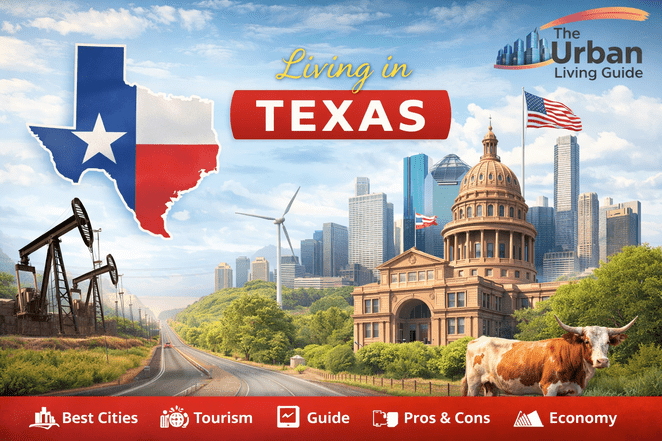
Living in Texas: Navigating Energy Corridors, Tech Booms, and Lone Star Heritage in 2026
Stepping into Texas in 2026 means immersing yourself in a massive economic powerhouse spanning over 268,596 square miles across the Southern United States. As a long-term local resident will tell you, the Lone Star State is far more than just the postcard clichés of oil fields, sprawling cattle ranches, and cowboy boots. From the humid breeze rolling off the Gulf of Mexico in Galveston to the rolling hills of the Texas Hill Country and the high-tech velocity of Austin, day-to-day life here is defined by immense geographic diversity, a population surging past 30 million residents, and a dynamic multicultural identity rooted deeply in Spanish-Mexican heritage and independent frontier history. For official administrative guidelines and civic updates, residents frequently consult the Official State of Texas Website.
| Quick Facts Snapshot: Texas (2026) | |
|---|---|
| Time Zones | Central Time Zone (CT) and Mountain Time Zone (MT) |
| State Population | Approx. 30.5 Million (Second-largest in the U.S.) |
| State Income Tax | 0% (No personal or corporate state income tax) |
| Median Home Price | $320,000 – $450,000 (Varies heavily by metro core vs. rural acreage) |
| Average Rent Range | $1,300 – $2,300+ per month (Dependent on neighborhood proximity) |
| Sales Tax Baseline | 6.25% state base, with local municipal/county additions pushing totals up to 8.25% |
What It Is Really Like to Live Here (The Macro Reality & Historical Identity)
Living across the Lone Star State requires adapting to a distinct cultural ethos where personal independence, business expansion, and traditional hospitality form the foundation of everyday community life. Locals quickly learn that surviving and thriving here involves managing extreme summer heatwaves, navigating massive urban sprawl across major interstate arteries like I-35, and embracing a lifestyle driven by rapid economic growth and expansive regional pride.
- Cultural Vibe: A powerful fusion of Southern tradition, Mexican-influenced Tex-Mex cuisine, ranching heritage, and modern cosmopolitan innovation found in major metros.
- Pace of Life: Varies sharply from the fast-paced, high-tech corporate culture of Austin and Dallas to the slower, traditional rhythm of rural towns and agricultural counties.
- The Resident Trade-Off: Long-term locals accept high property tax assessments and scorching summer humidity in exchange for zero state income tax, robust job mobility, and relatively affordable housing compared to coastal states.
Regional Diversity, Geography & Economic Zones
As the second-largest state in the nation by area, Texas encompasses starkly contrasting geographic zones that shape completely different daily living experiences.
Coastal Corridors, Metro Hubs & Urban Centers
- Greater Houston Area: A massive metropolitan expanse driven by international energy markets, petrochemical trade, and the world’s largest medical complex, centered around the Houston Ship Channel.
- The Dallas-Fort Worth Metroplex (DFW): A powerful dual-city engine anchored by corporate headquarters, financial institutions, logistics networks, and massive suburban developments like Plano and Frisco.
- Austin & The Texas Hill Country: A picturesque region defined by limestone hills, clear rivers like the Colorado River, and a dominant technology and startup ecosystem.
Mountain, Plains, Agricultural & Border Belts
- West Texas & Permian Basin: Arid desert terrain, rugged mountain ranges around Big Bend National Park, and the heavy oil-and-gas extraction fields driving the state’s energy output.
- The Panhandle & North Plains: Flat, expansive agricultural terrain dedicated to massive cattle ranches, wind energy production, and extensive grain farming.
Infrastructure, Power Grids, Water Systems & Transport Networks
Sustaining over 30 million residents requires an independent power grid, vast water resource management, and extensive highway corridors.
Water Resources, Rivers, Dams & Reservoirs
- Major River Basins: The Rio Grande forms the international border, while rivers like the Trinity River, Brazos River, and Colorado River supply municipal reservoirs and agricultural irrigation.
- Water Management: Managed closely through regional authorities and reservoirs like Lake Livingston and Lake Travis to balance urban consumption with drought-prone agricultural needs. Explore water policy details at the Texas Water Development Board.
Power Generation & The ERCOT Grid
- Independent Grid System: Unlike most U.S. states, Texas operates its own synchronized power grid managed by the Electric Reliability Council of Texas (ERCOT), independent of national interconnections.
- Energy Mix: Powered by a unique combination of natural gas, coal, nuclear facilities like the South Texas Project, and a booming capacity of wind and utility-scale solar generation across West Texas.
Statewide Transit, Rail, Air & Port Connectivity
- Global Aviation Hubs: International travel is anchored by world-class mega-airports including Dallas/Fort Worth International Airport (DFW) and Houston George Bush Intercontinental Airport (IAH).
- Interstate Backbone: Massive freight and commuter traffic flows along major interstate arteries like the I-10, I-35, and I-45.
- Maritime Commerce: Deep-water shipping operations at the Port of Houston serve as vital links for international trade and petrochemical logistics.
Statewide Economy, Job Markets & Major Industries
Texas boasts one of the most resilient and diversified economies in the global marketplace, consistently ranking near the top for corporate relocations and job creation.
- GDP Powerhouse: Generating nearly 9% of the total United States GDP, positioning Texas as an economic titan on par with major sovereign nations.
- Dominant Sectors: Traditional energy (oil, natural gas), renewable power (wind, solar), high-technology manufacturing, aerospace, healthcare, and international trade.
- Corporate Footprint: Headquarters for multi-national giants such as ExxonMobil, Tesla, Dell Technologies, Oracle, AT&T, and American Airlines. Track state business incentives via the Texas Economic Development Corporation.
Salary Realities Across Economic Corridors
- High Earning Potential: Specialized roles in tech hubs like Austin or energy sectors in Houston command salaries well above national medians, often exceeding $100,000 for experienced engineers and managers.
- Take-Home Pay Advantage: Because the state enforces zero personal income tax, workers retain a larger percentage of their gross earnings compared to counterparts in states like California or New York.
Cost of Living Realities & Housing Market Variance
While Texas generally offers a more affordable lifestyle than coastal states, rapid population growth has introduced significant regional pricing pressures.
- Housing Market Index: While mid-sized cities and rural towns offer highly accessible homes, high-growth metros like Austin and suburban Dallas have experienced substantial appreciation in median home values.
- Utility & Energy Demands: Extreme summer temperatures lead to heavy air conditioning usage, driving up seasonal electricity bills despite deregulated power provider options.
- Tax Balance: The absence of income tax is balanced by higher-than-average local property tax rates, which fund municipal services and school districts.
| Expense Category | Cost Range / Index Reality |
|---|---|
| Housing (Metro vs. Rural) | $350,000 – $600,000 median home prices in urban centers; under $250,000 in smaller towns |
| Utilities & Electricity | Close to national averages annually, with significant spikes during peak summer air-conditioning months |
| Transportation & Fuel | Moderate fuel prices compared to coastal states, though heavy reliance on personal vehicles drives total monthly transit costs |
| Groceries & Goods | Slightly below national benchmarks, supported by widespread regional supermarket chains like H-E-B |
State Tax Climate, Business Environment & Government Policies
Texas operates under a famously low-regulation, pro-business governance framework designed to encourage corporate investment and personal financial growth.
- Zero State Income Tax: The Texas Constitution explicitly prohibits personal state income tax, making it a primary destination for relocating professionals. Review tax guidelines at the Texas Comptroller of Public Accounts.
- Property Tax Realities: Lacking income tax, local entities rely heavily on property assessments, resulting in effective property tax rates that rank among the highest in the country.
- Business Climate: Minimal corporate bureaucracy, tort reform, and right-to-work labor laws attract thousands of out-of-state businesses annually.
Legal & Lifestyle Governance Quirks
- Tort Reform Standards: Strict legal caps on civil litigation damages designed to protect medical providers and corporate employers from excessive liability claims.
- Open Records & Transparency: Robust state public information laws ensuring high governmental transparency across municipal and county bodies.
- Property Rights: Strong legal protections favoring landowner rights, eminent domain limitations, and homestead exemptions.
Climate, Weather Extremes & Natural Geography
The vast expanse of Texas creates multiple distinct climate zones, demanding preparation for seasonal weather volatility.
- Seasonal Variations: Summers are intensely hot across the entire state, with temperatures frequently surpassing 35°C (95°F) for weeks on end. Winters remain mild overall, though periodic Arctic cold fronts can cause severe freezes.
- Environmental Realities: Residents must maintain active emergency preparedness for Gulf Coast hurricanes, severe spring thunderstorms, tornadoes in North Texas, and historic drought cycles.
- Natural Landmarks: From the Chihuahuan Desert at Big Bend National Park to the pine forests of East Texas, outdoor recreation is deeply varied.
Insurance Cost Realities (Storm & Environmental Risks)
- Windstorm & Hail Premiums: Homeowners insurance policies in coastal counties and storm-prone corridors require specialized windstorm coverage, driving up annual premiums.
- Flood Insurance Needs: Because heavy tropical downpours can cause localized flash flooding, standard home policies typically exclude flood damage, requiring separate federal or private flood policies.
- Property Valuation Adjustments: Rapid real estate appreciation has driven up assessed property valuations, directly increasing annual property tax and insurance escrow burdens.
Education Systems & Major Healthcare Networks
Access to world-class research universities and advanced medical complexes anchors the infrastructure of major Texas metropolitan areas.
- Higher Education Framework: Home to powerhouse academic institutions including the University of Texas at Austin and Texas A&M University, driving cutting-edge research.
- Advanced Healthcare: Anchored globally by the Texas Medical Center in Houston, the largest medical complex in the world, providing unmatched clinical care and biotechnology research. Review public health standards via the Texas Department of State Health Services.
- Public Education: School district quality varies significantly by local property tax bases, with suburban districts in counties like Collin County earning high ratings.
Culture, Outdoor Recreation & Lifestyle Shifts
Daily life in Texas blends rich historical traditions with modern urban amenities, offering endless opportunities for weekend recreation.
- Outdoor Living: Tubing down the Guadalupe River, hiking the trails of Big Bend, and boating across large reservoirs form regular weekend routines for residents.
- Culinary Heritage: Famed worldwide for authentic Central Texas barbecue pits, roadside taco trucks, and dynamic Tex-Mex dining traditions.
- Sports & Entertainment: Deeply passionate culture surrounding college football, professional leagues (NFL, NBA, MLB, MLS), and massive seasonal rodeos. Explore statewide tourism through Travel Texas.
Relocation & State Residency Essentials
Establishing official legal residency in Texas involves straightforward administrative steps that secure your state-level privileges and tax status.
- Driver’s License & Vehicle Registration: New residents are legally required to transfer their out-of-state driver’s licenses and register their motor vehicles with the state within 30 days of establishing residency.
- Voter Registration: Eligible citizens can register to vote through county voter registrars, ensuring participation in local and statewide elections.
- Tax Status Benefits: Establishing primary domicile in Texas instantly exempts individuals from personal state income tax obligations on subsequent earnings.
Major Counties and Rural Living Realities in Texas
Beyond the gleaming downtown skylines, Texas is defined by its powerful county administrative units and peaceful rural landscapes.
- Harris County: The most populous county in the state, anchored by Houston, driving international trade, energy, and medical innovation.
- Travis County: Centered around Austin, representing the state’s primary technology, music, and creative arts corridor.
- Dallas County: A historic and commercial nucleus powering corporate finance, real estate, and professional services.
- Rural and Agricultural Living: Expansive rural counties across East Texas, the Hill Country, and South Texas offer affordable housing, open spaces, and tight-knit agricultural communities centered on cattle and crops.
Major Regional Hubs and Cities to Explore
Texas urban architecture is defined by distinct regional cities, each offering a unique economic engine and daily lifestyle profile.
| City / Hub | Primary Economic Driver | Vibe & Lifestyle Profile |
|---|---|---|
| Houston | Energy, Healthcare, Aerospace | Global diversity, sprawling neighborhoods, robust industrial economy |
| Austin | Technology, Startups, Live Music | Creative, fast-growing, active outdoor culture, young professional hub |
| Dallas | Corporate Headquarters, Finance | Sophisticated business center, upscale suburban master-planned communities |
| San Antonio | Military Defense, Tourism, History | Rich cultural heritage, slower pace of life, highly accessible living costs |
| Fort Worth | Western Heritage, Logistics | Relaxed alternative to Dallas, growing manufacturing and cultural arts base |
Houston — The Energy and Healthcare Capital
Sprawling across a massive multi-county grid, Houston serves as the industrial and medical titan of the state. Life here revolves around global energy markets, world-class medical innovation at the Texas Medical Center, and an unmatched culinary scene shaped by global immigration.
Austin — The Live Music and Tech Capital
Nestled along the banks of the Colorado River, Austin pairs high-tech venture capital with a bohemian music and outdoor recreation culture. It offers a vibrant, youthful urban core surrounded by rapidly expanding hill country suburbs.
Dallas — The Corporate and Financial Powerhouse
Anchored by gleaming skyscrapers and extensive commercial networks, Dallas represents polished urban sophistication. Residents enjoy elite dining, high-end retail districts, and master-planned suburban enclaves with exceptional family infrastructure.
San Antonio — The Historic Cultural Crossroads
Steeped in Spanish-colonial history anchored by the Alamo and the River Walk, San Antonio offers a relaxed, family-oriented pace of life. It combines a massive military presence with affordable housing and deep cultural traditions.
Fort Worth — Where the West Begins
Retaining its proud cattle-driving heritage in the historic Stockyards district, Fort Worth offers a more grounded, traditional Texas lifestyle while boasting a booming economy and world-class museums in its cultural district.
Pros and Cons of Making Texas Your Home
| Advantages (Pros) | Systemic Drawbacks (Cons) |
|---|---|
| Zero personal state income tax maximizing take-home pay | High property tax assessments across most municipal districts |
| Strong, diversified job market spanning energy, tech, and healthcare | Intense, prolonged summer heatwaves lasting multiple months |
| Generally affordable housing options compared to coastal states | Heavy urban traffic congestion and reliance on car transportation |
| World-class higher education institutions and medical facilities | Vulnerability to severe weather events like hurricanes and winter storms |
Frequently Asked Questions About Living in Texas
Is Texas a good state to live in?
Yes, especially for career growth, job opportunities, and overall cost advantages, provided you are prepared for hot summer climates and local property tax structures.
What is the actual cost of living in Texas?
It sits comfortably below the national average, driven primarily by accessible housing options outside major metro cores, though utility costs rise during peak summer months.
Which region or city is best to settle down in?
It depends entirely on your industry and lifestyle: Austin or Dallas for technology and corporate careers, Houston for energy and medicine, and San Antonio or Fort Worth for traditional value and relaxed pacing.
Does Texas enforce state income tax?
No, Texas maintains a constitutionally mandated ban on personal and corporate state income taxes.
How safe is everyday life across the state?
Safety varies by neighborhood and municipality; suburban master-planned communities and smaller towns offer exceptionally high security, while urban cores require standard metropolitan awareness.
What industries dominate the Texas job market?
Energy production, information technology, aerospace engineering, healthcare, logistics, and large-scale agriculture drive continuous employment growth.
What is the weather like across the state?
Summers are exceptionally hot and humid statewide, while winters remain mild with occasional freezing cold snaps varying sharply between coastal and northern plains regions.
How do residency rules apply when moving to Texas?
New residents must transfer driver’s licenses and register vehicles within 30 days, instantly unlocking tax exemptions on personal state income.
What should I know about Texas property taxes?
Because there is no state income tax, local governments rely heavily on property assessments, resulting in higher-than-average property tax rates depending on the county.
Explore Detailed City Guides Across Texas
We have compiled comprehensive resources and detailed guides to help you understand what daily living feels like across different urban hubs and regional centers throughout the state.
At The Urban Living Guide (TULG), our mission is to deliver research-backed, data-driven insights, lifestyle breakdowns, and practical guidance to help you navigate modern urban living decisions with complete clarity.