

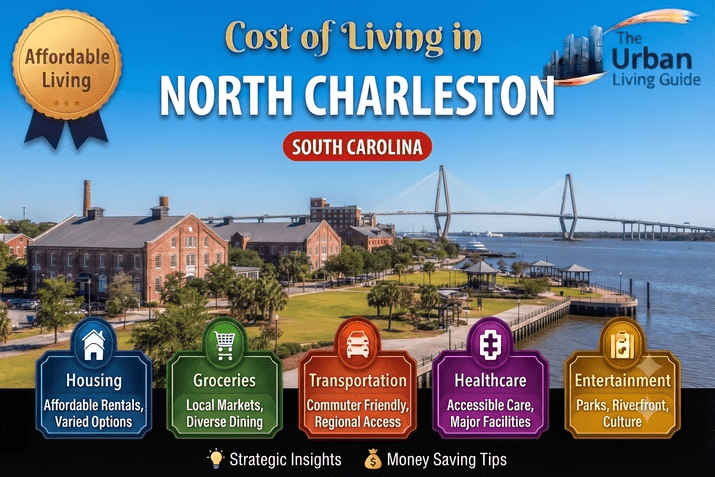
Cost of Living in North Charleston 2026: Industrial Growth, Park Circle Real Estate & Lowcountry Financials
Stretching across the dynamic industrial and residential corridors of the Charleston metropolitan area, life in North Charleston combines booming aerospace and manufacturing employment with rich local culture. While the region is celebrated for its thriving arts scene in Park Circle, proximity to the Charleston International Airport, and major industrial anchors like Boeing and Mercedes-Benz, managing monthly household expenditures in 2026 requires balancing climbing real estate valuations against favorable South Carolina tax structures. Whether you are relocating for defense careers at Joint Base Charleston or healthcare roles across the region, understanding the true cost of living in North Charleston delivers essential financial clarity.
For incoming professionals, growing families, and retirees moving across Charleston County and Dorchester County, evaluating the local cost of living demands a detailed look at regional price points. When breaking down household expenses for North Charleston during 2026, residents must account for intense summer air conditioning demands, heavy commuter traffic along Interstate 26 and Interstate 526, and consumer outlays shaped by coastal supply chains.
Average Monthly Expense Breakdown – North Charleston
Monthly expenses in North Charleston vary significantly depending on household size, lifestyle choices, and whether you choose to live within revitalized urban districts like Park Circle or master-planned suburban neighborhoods. Below is a structured monthly financial breakdown displayed in a professional comparative table reflecting current economic conditions in 2026:
| Expense Category | Single Adult | Couple | Family of 4 |
|---|---|---|---|
| Housing / Rent | $1,300 – $1,750 | $1,700 – $2,400 | $2,500 – $3,500 |
| Groceries & Food | $320 – $440 | $580 – $810 | $880 – $1,200 |
| Transportation & Commute | $190 – $320 | $330 – $540 | $460 – $720 |
| Utilities & Internet | $160 – $250 | $220 – $360 | $290 – $450 |
| Healthcare & Insurance | $240 – $430 | $480 – $850 | $750 – $1,300 |
| Childcare & Education | $0 | $0 | $950 – $1,800 |
| Entertainment & Leisure | $150 – $320 | $300 – $560 | $460 – $820 |
Local residents frequently note that while everyday necessities and housing track notably below historic downtown Charleston pricing, managing utility shifts and vehicle property taxes requires careful budgeting.
Watch this video to get a closer look at housing and neighborhood pricing in North Charleston, South Carolina.
Housing Costs, Real Estate & Neighborhood Dynamics
Housing forms a major financial pillar when evaluating the cost of living in North Charleston, where real estate valuations average roughly $375,000—significantly lower than Charleston proper, which exceeds $640,000. The metropolitan housing market spans historic bungalow districts in Park Circle to modern suburban subdivisions across Dorchester County. Municipal zoning and residential guidelines are coordinated via the North Charleston Planning and Zoning Department.
- Park Circle & Urban 1-BHK Apartments: Multi-family rentals near revitalized commercial hubs range from $1,250 to $1,750/month.
- Suburban 1-Bhk Apartments: Outlying residential corridors offer spacious leasing options starting between $1,050 and $1,450/month.
- Family 3-BHK Rentals: Single-family rental houses across established school districts command $1,800 to $2,700/month.
- Real Estate Purchase Market: The median home purchase price sits near $375,000, providing exceptional square footage value for buyers relocating for employment at major manufacturing and aerospace centers.
Utilities & Bills Costs in North Charleston
Managing utility overhead in North Charleston is manageable, with electricity, natural gas, and municipal services coordinated by established regional providers.
- Electric & Gas Services: Dominion Energy and Berkeley Electric Cooperative supply electricity across the metropolitan area, while Dominion handles natural gas. Monthly utility bills average $160 to $250/month, with intense summer cooling loads pushing electric bills higher during peak humidity.
- Water & Wastewater Services: Municipal water services managed by Charleston Water System average $50 to $85/month for standard residential consumption.
- Curbside Waste & Recycling: City-managed or private waste removal runs $90 to $115 per quarter.
- High-Speed Fiber Internet: Gigabit broadband connectivity via providers like Spectrum and AT&T Fiber costs $55 to $85/month.
Grocery and Food Costs
Food expenditures in North Charleston track close to national averages, supported by efficient regional supply distribution networks and active local markets.
- Supermarket Options: Residents choose from value-driven stores like Walmart and Food Lion, popular regional staples like Publix and Harris Teeter, as well as specialty ethnic markets.
- Local Farmers Markets: Shopping weekly at local venues like the Park Circle Farmers Market allows residents to purchase fresh seasonal produce while supporting regional growers.
- Essential Price Benchmarks: A gallon of milk averages $2.40 to $2.90, a dozen eggs runs $3.25 to $5.50, and casual dining meals cost $16 to $27 per person.
Transportation and Commute Costs in North Charleston
Navigating the broader Lowcountry relies heavily on personal vehicles, though public transit is supported by regional networks.
- Public Transit & Passes: CARTA (Charleston Area Regional Transportation Authority) operates public transit bus routes across the city, with monthly commuter passes costing roughly $50 to $65.
- Fuel & Auto Operation: Regular unleaded gasoline averages $2.45 to $2.85 per gallon, keeping monthly fuel costs around $190 to $320 for standard commuters in North Charleston.
- Rideshare & Parking: Uber and Lyft operate extensively throughout commercial and residential zones, while monthly parking passes run $70 to $120/month. Full-coverage auto insurance averages $1,350 to $1,900 annually.
Healthcare Costs
Healthcare outlays in North Charleston remain competitive, reflecting expanding medical infrastructure across the Charleston metropolitan region.
- Major Health Systems: Care is anchored by Trident Health, MUSC Health facilities, and Roper St. Francis Healthcare networks.
- Out-of-Pocket & Insurance: Standard general practitioner co-pays run $25 to $45, specialist visits range from $45 to $75, and individual marketplace health insurance premiums average $320 to $580/month depending on age and coverage tiers.
Entertainment & Lifestyle Costs
Recreational opportunities across North Charleston combine active community parks with a flourishing arts and dining scene:
- Outdoor Recreation: Exploring Riverfront Park along the Cooper River, walking the trails at Oak Terrace Preserve, or visiting local community greenspaces incurs minimal monetary cost.
- Arts & Culture: Attending major concerts and events at the North Charleston Coliseum & Performing Arts Center or dining at trendy local bistros in Park Circle provides vibrant weekend leisure.
- Fitness & Wellness: Commercial gym memberships and community fitness centers average $35 to $75/month.
Pet-Related Living Costs in North Charleston
Caring for dogs and cats across local residential neighborhoods involves predictable monthly outlays:
- Veterinary Care: Routine wellness exams, vaccinations, and preventative parasite care run $45 to $90/month.
- Pet Supplies & Grooming: Premium pet food and professional grooming services add $50 to $115/month.
City-Specific Living Costs in North Charleston
Living in an industrial hub introduces specific environmental and administrative factors that influence household budgeting in North Charleston:
- Commuter Traffic Corridors: Navigating heavy rush-hour traffic along Interstate 26 requires strategic commute planning for aerospace and manufacturing workers.
- Annual Vehicle Property Taxes: South Carolina assesses a recurring local property tax on motor vehicles every year, requiring distinct annual budget planning apart from standard state DMV registration fees.
- Flood Zone Awareness: Certain low-lying pockets near tidal creeks require reviewing flood maps and securing appropriate property insurance coverage.
Taxes in North Charleston
Tax structures in North Charleston and South Carolina during 2026 impact overall household financial planning:
- State Personal Income Tax: South Carolina implements a progressive income tax structure with a top marginal rate reaching 6.2%.
- Property & Vehicle Taxes: Owner-occupied primary residences benefit from a favorable 4% assessment ratio, whereas secondary homes and registered motor vehicles are assessed at 6%.
Annual & Yearly Expenses
Comprehensive financial planning in North Charleston requires accounting for recurring annual and yearly non-housing obligations:
- Auto Insurance & Fees: Annual car insurance totals $1,350 to $1,900, alongside recurring local vehicle property taxes and state DMV registration fees.
- Homeowners Insurance: Annual property and hazard insurance policies range from $950 to $1,700 for single-family homes.
- Subscriptions & Club Dues: Digital streaming and recreational club memberships average $180 to $420 yearly.
- Professional Services: Annual tax preparation and local filing fees add $150 to $350 yearly.
- Total Estimated Annual Non-Housing Outlays: $2,800 to $5,600 per household.
Downtown vs. Suburbs Cost of Living Comparison – North Charleston
Comparing the revitalized urban core against surrounding suburban enclaves highlights key lifestyle and financial choices in North Charleston:
| Cost Parameter | Park Circle (Urban Core) | Wescott Plantation (Suburban) | Coosaw Creek (Suburban) | Dorchester Corridor |
|---|---|---|---|---|
| Housing (1-3 BHK Rent) | $1,350 – $1,900 | $1,400 – $2,100 | $1,600 – $2,400 | $1,250 – $1,850 |
| Parking & Garage Fees | Street permit / Free | Free / Included | Free / Included | Free / Included |
| Transportation & Commute | Walkable, CARTA buses | I-26 & Dorchester driving | Air Force base proximity | Interstate 526 access |
| Schools & Family Spaces | Historic bungalow charm | Golf community living | Gated family neighborhoods | Established public schools |
| Dining & Entertainment | Park Circle breweries & eateries | Suburban clubhouses | Country club dining | Local retail centers |
| Home Maint. & Taxes | Historic upkeep | Suburban HOA dues | Master association dues | Standard maintenance |
| Car Ownership vs. Transit | Optional for core district | Mandatory | Mandatory | Mandatory |
Strategic Insight: Young professionals and creative couples frequently gravitate toward the walkable brewery and arts scene in Park Circle, while growing families lean toward golf course communities in Wescott Plantation or Coosaw Creek.
Local Resident Realities: What Long-Timers Say About Living Costs
“Moving to Park Circle gave us the incredible community feel of Charleston without the exorbitant downtown price tag. Home values here offer remarkable equity potential for anyone working in manufacturing or aerospace.”
“Living near Wescott Plantation lets our family enjoy great suburban amenities and strong schools while keeping commuting distance to Boeing and the airport under twenty minutes.”
Is North Charleston Expensive or Affordable?
North Charleston stands out as one of the most economically strategic and accessible cities in the entire Charleston metropolitan area, offering an overall cost of living sitting close to or slightly below national medians while remaining dramatically more affordable than peninsula real estate.
Key factors driving local affordability include:
- Median home purchase valuations averaging near $375,000, saving buyers hundreds of thousands compared to historic downtown Charleston.
- Robust employment opportunities across major aerospace, defense, and manufacturing sectors supporting steady household incomes.
- Zero state sales tax on basic at-home grocery items, easing weekly household budgets.
- Abundant suburban expansion providing diverse multi-family leasing options.
Who May Find North Charleston Expensive? — And Who Can Afford It Comfortably?
While aerospace engineers, defense contractors, and healthcare professionals enjoy strong purchasing power across the city, service workers and entry-level earners may encounter specific financial friction in North Charleston.
Groups that may experience economic challenges include:
- Entry-level service and retail workers earning under $35,000 annually who face tightening rental inventory in premier school districts.
- Newcomers unaware of annual vehicle property taxes who fail to factor recurring car taxes into their yearly cash flow.
- Home buyers seeking large estate properties without substantial down payments against rising metropolitan demand.
Segment-wise income mapping outlines clear comfort thresholds in North Charleston in 2026:
| Income Bracket | Affordability Status | What to Expect |
|---|---|---|
| Under $42K/year | High Financial Strain | Requires roommate arrangements, disciplined budgeting, and selection of outer rental corridors. |
| $45K – $75K/year | Moderate Comfort | Comfortably supports multi-family suburban rentals, reliable vehicle ownership, and steady savings. |
| $80K+/year | Affluent Living | Unlocks independent homeownership in premier suburban school districts and flexible leisure spending. |
Practical Money-Saving Tips
Maximizing household purchasing power in North Charleston requires leveraging local market knowledge and proactive efficiency practices:
- Optimize summer energy management: Program thermostats effectively and utilize ceiling fans to manage cooling overhead from Dominion Energy during peak humid months.
- Shop regional value grocers: Source weekly provisions at budget-friendly supermarkets like Food Lion, Walmart, or local farmers markets to cut food expenses.
- Explore growing suburban corridors: Consider leasing or purchasing in expanding neighboring areas like Dorchester County to secure lower monthly housing costs.
- Utilize free community recreation: Enjoy zero-cost weekend activities by walking the trails at Riverfront Park or exploring public greenspaces around Park Circle.
Frequently Asked Questions About Living Costs
How does North Charleston compare cost-wise to historic downtown Charleston?
North Charleston offers an overall cost of living that is substantially lower than downtown Charleston, highlighted by median home prices averaging near $375,000 compared to over $640,000 on the peninsula.
What monthly income is required to live comfortably as a single professional in North Charleston?
Single working professionals typically need an annual income between $48,000 and $62,000 to independently cover rent, utilities, vehicle financing, and lifestyle expenses without financial stress.
What are the primary utility providers serving residential homes in North Charleston?
Electricity is primarily supplied by Dominion Energy and Berkeley Electric Cooperative, while municipal water services are provided by Charleston Water System.
Are groceries taxed heavily in the state of South Carolina?
State law exempts basic at-home grocery items from state sales tax, though local county sales taxes apply to prepared hot foods, restaurant meals, and non-grocery retail purchases.
What is the average home purchase price in the North Charleston real estate market?
The median home purchase price across North Charleston sits near $375,000, offering exceptional square footage value for buyers relocating for major industrial employment.
Do I need a personal vehicle to navigate daily life in North Charleston?
While CARTA buses serve urban routes, North Charleston remains largely car-dependent, making personal vehicle ownership essential for most professional commutes and suburban errands.
What unique vehicle-related taxes should newcomers anticipate?
New residents must account for South Carolina’s recurring annual personal property tax assessed on registered motor vehicles, which is billed separately from standard state DMV registration fees.
Know more about North Charleston
At The Urban Living Guide, we provide meticulous data and insider perspectives to help you navigate your upcoming relocation with total confidence. Explore our curated resource hubs below to discover everything you need for a seamless transition into the region:
- Living in North Charleston, South Carolina
- Pros and Cons of Living in North Charleston
- Best Neighborhoods in North Charleston
Ready to take the next step in your moving journey? Read our comprehensive master guide here: Moving to North Charleston, South Carolina. Stay connected and follow all our latest city updates across The Urban Living Guide.