

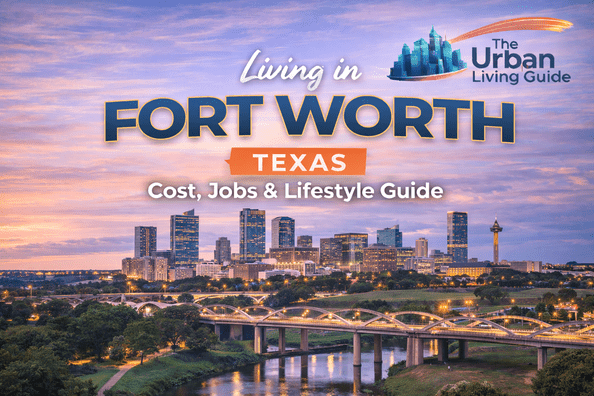
Living in Fort Worth, Texas: What Life Is Like in Cowtown
Living in Fort Worth, Texas offers a compelling mix of celebrated Western heritage, booming corporate opportunity, and accessible housing costs compared to larger coastal metropolitan centers. As the 12th-largest city in the United States and the second-largest anchor of the Dallas–Fort Worth Metroplex, Fort Worth spans over 350 square miles across Tarrant County, extending into portions of Denton County, Parker County, and Wise County. Long affectionately nicknamed “Cowtown” and “Panther City,” Fort Worth maintains a distinctly relaxed, community-oriented identity that stands in contrast to the fast-paced, high-rise corporate backdrop of neighboring Dallas.
However, relocating to Fort Worth requires practical preparation regarding expansive geographical sprawl, heavy car dependency, and local tax structures. While Texas levies no state personal income tax, local property tax rates and toll road fees along major thoroughfares can impact overall monthly household budgets. Whether you are transferring to the defense facilities at Lockheed Martin, joining the sprawling healthcare sector near Near Southside, or searching for family-friendly housing along Chisholm Trail Parkway, this comprehensive guide covers housing trends, top neighborhoods, employment sectors, and daily living realities in Fort Worth.
If you are exploring the North Texas region for the first time, review the interactive map below to understand how Fort Worth connects to the broader DFW Metroplex.
All real estate statistics, utility benchmarks, and local economic insights in this guide are derived from municipal databases, regional commerce reports, and long-term local resident expertise updated for 2026.
What Makes Fort Worth So Unique & Popular
Fort Worth occupies a distinct cultural niche in Texas, honoring its historic cattle-driving past while fostering world-class art institutions and advanced industrial manufacturing. Unlike many sprawling suburban hubs, Fort Worth maintains a distinct downtown core centered around historic Sundance Square, an award-winning 35-block pedestrian-friendly entertainment district filled with red-brick streets, restored nineteenth-century architecture, and vibrant outdoor plazas.
Another major factor driving historic growth to Fort Worth is its celebrated Cultural District, home to internationally recognized architectural and artistic landmarks like the Kimbell Art Museum and the Modern Art Museum of Fort Worth. The city successfully blends western tradition with modern urban development, creating a distinct lifestyle that appeals to corporate executives, aerospace engineers, growing young families, and active retirees alike.
Key drivers attracting newcomers to Fort Worth:
- Lower housing purchase prices and rental rates compared to Dallas and Austin
- Zero personal state income tax across all income brackets in Texas
- High-paying employment clusters in aerospace, defense, healthcare, and logistics
- World-class museums and historic destinations like the Fort Worth Stockyards
- Top-performing suburban public school districts across Tarrant County
- Seamless international travel access via nearby Dallas/Fort Worth International Airport
Fort Worth at a Glance: Key Relocation Metrics
Reviewing baseline economic and demographic data offers important financial perspective prior to relocating to Greater Fort Worth for 2026.
| Relocation Metric | Fort Worth Local Benchmark | National / Regional Comparison |
|---|---|---|
| Total Population | 975,000+ (City) / 8.0+ Million (DFW Metro) | 12th largest city in U.S.; 5th fastest growing major metro |
| Median Home Purchase Price | $335,000–$360,000 | Approximately 10% lower than national average |
| Average Monthly Rent (1-Bed) | $1,200–$1,600 | More affordable than Dallas urban core |
| State Income Tax Rate | 0.00% | No individual state income tax in Texas |
| Average Property Tax Rate | 2.2%–2.7% (Varies by county/ISD) | Higher than U.S. national average |
| Average Daily Commute Time | 27.5 Minutes | Slightly faster than national major metro average |
| Primary Economic Sectors | Aerospace, Defense, Healthcare, Logistics | Major global defense manufacturing center |
While base real estate prices remain accessible, prospective homeowners should calculate local property tax rates and homeowner association (HOA) fees into their long-term housing budget.
Famous Personalities, Sports Teams & Major Brands in Fort Worth
Fort Worth possesses a rich tapestry of famous personalities, iconic corporate headquarters, and athletic traditions. Famous figures associated with the city include acclaimed television writer and producer Taylor Sheridan (creator of Yellowstone), Grammy Award-winning singer Kelly Clarkson, golf legend Ben Hogan, and historic western figure Butch Cassidy.
Sports culture is deeply embedded throughout Tarrant County. Collegiate sports revolve around the TCU Horned Frogs of Texas Christian University, whose football and baseball programs draw thousands of fans to Amon G. Carter Stadium and Lupton Stadium. Golf fans gather annually at Colonial Country Club for the historic Charles Schwab Challenge on the PGA Tour. Additionally, rodeo tradition lives on through the Fort Worth Stock Show & Rodeo held annually at the state-of-the-art Dickies Arena.
Major international brands born or headquartered in Fort Worth include global rail giant BNSF Railway, iconic workwear brand Dickies, historic bootmaker Justin Boots, specialized eye care leader Alcon, aviation pioneer Bell Flight, and major electronic retailer legacy RadioShack.
Job Market & Business Opportunities with Major Employers
The economy in Fort Worth is robust, highly diversified, and resilient. Unlike cities heavily dependent on tech venture capital, Fort Worth is built on advanced defense manufacturing, heavy rail logistics, healthcare services, civil engineering, and commercial aviation.
The city’s industrial engine is led by aerospace manufacturing, specifically Lockheed Martin Aeronautics located at Air Force Plant 4 near Lake Worth. Employing over 18,000 professionals, this massive facility serves as the primary assembly location for the F-35 Lightning II stealth fighter jet, providing thousands of high-wage engineering and technical positions.
Primary corporate employers and institutional anchors:
- Lockheed Martin Aeronautics: Premier defense manufacturing plant assembling military aircraft in West Fort Worth.
- American Airlines: Global airline corporate headquarters operating at Trinity Lakes adjacent to DFW International Airport.
- BNSF Railway: One of North America’s largest freight railroad networks headquartered in North Fort Worth.
- Texas Health Resources: One of the largest non-profit health systems in North Texas, operating major medical campuses like Texas Health Harris Methodist Hospital Fort Worth.
- Cook Children’s Medical Center: Nationally recognized pediatric healthcare network located in the Medical District.
- Bell Flight: Major helicopter and vertical-lift aircraft manufacturer headquartered in nearby Hurst.
- Alcon: Global medical device company specializing in eye care products headquartered in South Fort Worth.
Salaries across industrial management, healthcare engineering, and supply chain logistics remain strong, yielding high purchasing power due to favorable state tax laws.
Housing & Real Estate Overview in Fort Worth
Real estate accessibility remains one of the main drivers for families relocating to Living in Fort Worth, Texas. Home buyers can find diverse housing architecture, ranging from historic 1920s Craftsman bungalows in Fairmount to modern suburban master-planned developments in AllianceTown Center or Walsh Ranch.
The rental market features modern mid-rise residential complexes in West 7th alongside family-oriented rental houses across northern Tarrant County suburbs.
Estimated monthly rent ranges for 2026:
- Studio Apartments: $950–$1,200 per month
- 1-Bedroom Apartments: $1,100–$1,600 per month
- 2-Bedroom Apartments: $1,500–$2,200 per month
- 3-Bedroom Single-Family Rental Homes: $2,100–$3,000 per month
When purchasing single-family homes in Fort Worth, buyers should review municipal utility district (MUD) taxes, property tax assessments, and inspect home foundations carefully, as expansive North Texas clay soils require proper lawn irrigation and maintenance.
Best Neighborhoods in Fort Worth: Finding Your Ideal Community
Selecting the right neighborhood in Fort Worth depends on workplace commute routes, public school ratings, and personal lifestyle choices. The metro area is geographically structured by central loops including Loop 820, Interstate 35W, and Interstate 30.
- Central / University Core
- College faculty, alumni, established families
- Urban Core (West of Downtown)
- Young professionals, commuters, nightlife seekers
- North Suburb (Tarrant County)
- Families seeking top public schools and larger lots
- Historic West Central
- First-time buyers, historic home preservationists
- Northeast Suburb
- Suburban families, middle-market buyers
- Historic South Central
- Healthcare workers, artists, historic bungalow lovers
| Neighborhood / Suburb | Location Profile | Median Home Price | Target Resident Demographic |
|---|---|---|---|
| TCU / University Area | $480,000–$780,000 | ||
| West 7th / Cultural District | $350,000–$550,000 | ||
| Keller | $490,000–$750,000 | ||
| Arlington Heights | $380,000–$620,000 | ||
| North Richland Hills | $340,000–$510,000 | ||
| Fairmount / Near Southside | $360,000–$580,000 |
In-Depth Breakdown of Popular Neighborhood Profiles:
TCU / University Area: Situated surrounding Texas Christian University, this neighborhood features tree-canopied streets, historic homes, charming local retail along Berry Street, and strong community engagement.
West 7th District: Connecting Downtown Fort Worth to the Cultural District, West 7th offers dense apartment living, walkable dining, craft cocktail lounges, and active entertainment options.
Keller & Alliance: Located north along US-377 and I-35W, these rapidly growing suburban communities feature master-planned subdivisions, extensive retail at Alliance Town Center, and top-rated public schools in Keller ISD.
Fairmount National Historic District: One of the largest intact historic neighborhoods in the Southwest, featuring early twentieth-century bungalows, brick streetscapes, and walking access to coffee houses along Magnolia Avenue.
What It’s Really Like Living in Fort Worth (Daily Life & Vibe)
Daily life in Fort Worth is relaxed, welcoming, and community-centered. Residents take immense pride in maintaining a “small-town feel” within a major American city, emphasizing weekend family outings, community youth athletics, outdoor recreation, and local dining.
To watch authentic footage capturing daily community routines, commute dynamics, and neighborhood tours when Living in Fort Worth, Texas, view the local vlog footage below.
The culinary landscape in Fort Worth celebrates historic Texas barbecue, Tex-Mex institutions, and modern farm-to-table concepts. Local weekend rituals include watching the daily cattle drive at the Fort Worth Stockyards, grabbing Tex-Mex and margaritas under the patio trees at Joe T. Garcia’s, enjoying craft Texas barbecue at Heim Barbecue or Michelin-recognized Goldee’s Barbecue, and strolling around Sundance Square.
Cost of Living in Fort Worth: Monthly Expenses & Salary Needs
Although living costs in Fort Worth are reasonable compared to coastal U.S. cities, overall expenses depend on household commute lengths, summer electric utility bills, and toll highway usage.
Estimated monthly cost breakdown for a single adult in 2026:
- Housing (1-Bedroom Lease): $1,200–$1,600
- Utilities (Electricity, Water, Trash): $150–$250 (Peaks in July–August due to air conditioning)
- Groceries & Food Supplies: $300–$500
- Transportation (Gasoline, Tolls, Auto Insurance): $150–$300
- Healthcare & Personal Expenses: Moderate costs backed by regional health networks
To live comfortably, save for long-term investments, and enjoy regional recreation while Living in Fort Worth, Texas, a single worker generally needs an annual salary of $70,000–$95,000. Families purchasing single-family homes in top suburban school districts typically require household incomes starting at $110,000–$140,000.
Transportation, Highway Bottlenecks & Airport Connectivity
Fort Worth is an expansive, car-dependent city. While public transportation is managed by Trinity Metro (operating regional bus routes and passenger rail), personal vehicles are essential for daily commuting and errands.
Major regional highway thoroughfares include:
- Interstate 35W: Primary north-south commuter artery connecting downtown to Alliance and Denton. The “Mixmaster” interchange near downtown experiences rush-hour bottlenecks.
- Interstate 30 (Tom Landry Freeway): East-west highway connecting Fort Worth directly to Arlington and Dallas.
- Loop 820 (Jim Wright Freeway): Concentric highway loop encircling inner Fort Worth suburbs.
- Chisholm Trail Parkway (SH 121): Premier toll road connecting downtown directly to southwestern communities like Burleson and Cleburne.
For regional rail and air connectivity, residents utilize TEXRail, a 27-mile commuter rail line linking Downtown Fort Worth directly to Dallas/Fort Worth International Airport (DFW), one of the world’s most connected aviation hubs. The city also operates Fort Worth Meacham International Airport for private and corporate aviation.
Weather Patterns, Seasonal Realities & Climate Factors
Fort Worth features a humid subtropical climate with long, hot summers, mild winters, and variable spring weather conditions.
Seasonal breakdown and weather factors:
- Summers (June–September): Hot and sunny. Daytime high temperatures consistently exceed 95°F–100°F during July and August, requiring high-capacity central air conditioning.
- Winters (December–February): Mild and mild. High temperatures typically range between 55°F–65°F, though brief arctic cold fronts can cause temporary freezing conditions.
- Spring severe weather: March through May brings severe spring thunderstorm risks, including heavy rain, high winds, and hail storms across North Texas.
Education, Schools & Major Universities
Higher education institutions play an influential role in Fort Worth’s research, cultural events, and healthcare training.
Major universities located in the city include:
- Texas Christian University (TCU): Prominent private Tier-One research university known for business, communications, nursing, and athletic programs.
- Texas Wesleyan University: Historic private university located in East Fort Worth, renowned for education and business degrees.
- UNT Health Science Center (UNTHSC): Premier graduate academic medical center housing the Texas College of Osteopathic Medicine in the Cultural District.
- Texas A&M University School of Law: Top-ranked law school located in Downtown Fort Worth.
K-12 public education is served primarily by Fort Worth ISD in the urban core, while surrounding suburban neighborhoods attend top-rated independent school districts including Keller ISD, Carroll ISD (Southlake), Eagle Mountain-Saginaw ISD, and Mansfield ISD.
Medical Facilities, Hospitals & Healthcare Systems
Healthcare access in Fort Worth is exceptional, anchored by a concentrated Medical District located just south of downtown in the Near Southside neighborhood.
Key healthcare systems operating in the area include:
- Cook Children’s Medical Center: World-class pediatric medical complex specializing in pediatric surgery, cardiology, and oncology.
- Texas Health Harris Methodist Hospital Fort Worth: Premier Level 1 Trauma Center and regional healthcare anchor.
- Baylor Scott & White All Saints Medical Center: Major medical hospital renowned for women’s health, transplantation, and oncology services.
- JPS Health Network (John Peter Smith Hospital): Essential public county hospital system operating major emergency and psychiatric facilities across Tarrant County.
Popular Hotels, Cafes, Dining & Culinary Scene
The hospitality and culinary culture in Fort Worth combines western luxury with modern urban sophistication. Visitors stay at premier boutique destinations such as Hotel Drover at the Fort Worth Stockyards, The Kimpton Harper Hotel in Downtown Fort Worth, and The Sinclair Hotel near Sundance Square.
Coffee lovers gather at independent roasters across central neighborhoods, including Avoca Coffee Roasters on Magnolia Avenue, Craftwork Coffee Co. in Arlington Heights, and Booray’s Coffee.
The dining scene spans historic cowboy traditions and acclaimed high-end concepts. Legendary spots include Reata Restaurant for western cuisine, Joe T. Garcia’s for famous patio Tex-Mex, Clay Pigeon for seasonal scratch cooking, and Waters Restaurant for fine seafood in Sundance Square.
Sightseeing, Cultural Spots & Tourist Attractions
Fort Worth provides an abundance of cultural, historical, and family attractions throughout the city.
Top tourist spots and local landmarks include:
- Fort Worth Stockyards National Historic District: Historic district featuring twice-daily live cattle drives, wooden corrals, western wear shops, and live music at Billy Bob’s Texas (the world’s largest honky-tonk).
- Sundance Square: Walkable 35-block downtown plaza featuring giant umbrellas, outdoor dining, galleries, and live theater at Bass Performance Hall.
- Kimbell Art Museum & Modern Art Museum of Fort Worth: World-renowned art institutions housing masterpieces in architecturally significant buildings designed by Louis Kahn and Tadao Ando.
- Fort Worth Botanic Garden & Japanese Garden: The oldest botanical garden in Texas, spanning 110 acres of lush habitats.
- Fort Worth Zoo: Consistently ranked among the top zoos in the nation, housing over 7,000 native and exotic animals.
Honest Trade-offs: Pros and Cons of Living in Fort Worth
Reviewing balanced trade-offs helps ensure Fort Worth aligns with your lifestyle expectations before moving.
Pros of Living in Fort Worth:
- Accessible Housing Real Estate: Home prices and rentals remain significantly lower than in Dallas or Austin.
- Zero State Income Tax: Favorable state tax environment increases take-home earnings.
- Strong Corporate Job Market: High-wage industrial roles across aerospace, defense, logistics, and healthcare.
- Distinct Local Identity & Culture: Unique mix of authentic western heritage, community warmth, and world-class fine arts.
- Family-Friendly Suburbs: Outstanding public school districts and safe residential communities across Tarrant County.
Cons of Living in Fort Worth:
- Extreme Summer Temperatures: Extended heatwaves with temperatures frequently exceeding 95°F–100°F during summer.
- Heavy Automobile Dependency: Public transit options are limited, mandating personal vehicle ownership.
- Higher Property Taxes: Local property tax rates offset some state tax benefits for homeowners.
- Commuter Highway Traffic: Peak rush-hour traffic delays along I-35W and I-30.
- Slower Urban Nightlife: Nightlife options are quieter and less dense than in urban Dallas.
Who Is Fort Worth Ideal For (and Who Should Avoid It?)
Fort Worth is ideal for:
- Aerospace engineers, defense specialists, supply chain managers, and healthcare professionals seeking steady career growth.
- Growing families looking for spacious single-family homes in master-planned communities with top public schools.
- Relocating buyers who want the economic strength of the DFW Metroplex while enjoying a relaxed, community-focused environment.
Fort Worth may not be ideal for:
- Individuals seeking a high-density, car-free urban lifestyle reliant on extensive public subway or rail networks.
- People with low tolerance for hot, humid summer weather.
- Tech professionals seeking a high-density startup ecosystem focused primarily on early-stage software companies.
Real Experiences: Perspectives from Long-Term Residents (5 to 10+ Years)
David M. (7-Year Resident in Keller): “Moving our family from California to Keller was the best financial decision we ever made. Our children attend top public schools, we bought a beautiful home with a backyard pool, and my commute to Lockheed Martin in West Fort Worth is manageable. Cowtown has a genuine warmth that makes you feel at home right away.”
Sarah L. (11-Year Resident in Fairmount): “Living near Southside in Fairmount gives you a totally different side of Fort Worth. We can walk to Magnolia Avenue for local coffee at Avoca, dine at scratch kitchens, and ride bikes to the Cultural District. It gives you all the perks of city living while keeping that classic Fort Worth community charm.”
Frequently Asked Questions About Living in Fort Worth, Texas
Is Fort Worth cheaper to live in than Dallas?
Yes, Fort Worth generally offers more affordable housing purchase prices and rental rates than Dallas, making it a popular option for homebuyers in the DFW Metroplex.
What salary do you need to live comfortably in Fort Worth?
A single adult typically needs an annual salary between $70,000–$95,000 for comfortable living, while families purchasing single-family homes in top school districts generally require household earnings starting at $110,000–$140,000.
Is Fort Worth safe for families?
Yes, Fort Worth features numerous safe, family-oriented neighborhoods and suburbs. Areas like Keller, TCU / University Area, Arlington Heights, and North Richland Hills are widely praised for family safety.
Can you live in Fort Worth without owning a car?
Living without a vehicle is difficult in Fort Worth. While central districts like Sundance Square or West 7th offer walkable pockets, the city’s overall sprawl requires personal driving for daily commutes.
What are the main military and defense employers in Fort Worth?
Defense manufacturing is led by Lockheed Martin Aeronautics at Air Force Plant 4, alongside naval air infrastructure at Naval Air Station Joint Reserve Base Fort Worth.
How far is Fort Worth from Dallas?
Fort Worth is located approximately 32 miles west of Downtown Dallas along Interstate 30, with travel times ranging between 35 to 55 minutes depending on traffic conditions.
🔗 Explore More Cities in Texas
If you’re exploring more options beyond Fort Worth, The Urban Living Guide has covered several other popular cities in Texas. You can also check:
- Living in Houston, Texas
- Living in Dallas, Texas
- Living in Austin, Texas
- Living in San Antonio, Texas
These guides give you a complete picture of what it’s like living across different cities, covering everything from cost of living, housing, and job opportunities to neighborhoods, commute, weather, education, popular places, and major employers.
The Urban Living Guide brings together these local insights in one place, helping you compare cities easily and make a confident, well-informed decision based on your lifestyle and goals.
Thinking about Fort Worth? Here are a few must-read guides:
- Cost of Living in Fort Worth, Texas
- Pros and Cons of Living in Fort Worth, Texas
- Best Neighborhoods in Fort Worth, Texas
And if you’re planning your move, don’t miss our complete guide: Moving to Fort Worth, Texas