

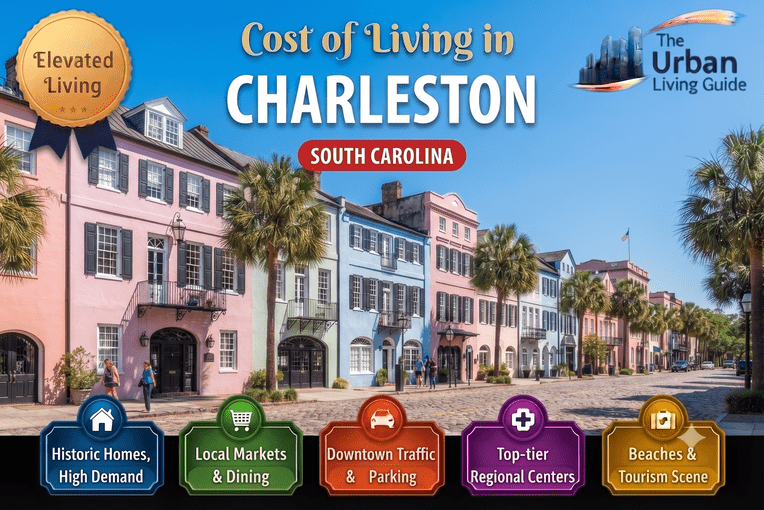
Cost of Living in Charleston, South Carolina 2026: Lowcountry Economics, Peninsula Real Estate & Coastal Financials
Nestled where the Ashley River and the Cooper River meet to empty into the Atlantic, life in the City of Charleston offers an intoxicating blend of antebellum history, cobblestone streets, and a booming coastal economy. While the local landscape is world-famous for its lowcountry sunsets, harbor breezes, and historic pastel townhomes, managing monthly household expenditures in 2026 requires balancing the city’s soaring real estate valuations against zero state income tax advantages. Whether you are relocating for tech and logistics, defense contracting at the Joint Base Charleston, or healthcare positions at the Medical University of South Carolina (MUSC), establishing a household across the historic Charleston Peninsula or surrounding suburbs requires precise financial planning.
For incoming professionals, remote workers, and growing families planting roots across Charleston County and Berkeley County, understanding the true cost of living demands a clear-eyed look at market realities. When breaking down expenses for Charleston during 2026, residents must account for intense summer air conditioning demands, heavy reliance on personal vehicle transit across Interstate 26 and US Route 17, and everyday consumer costs shaped by regional coastal supply chains.
Average Monthly Expense Breakdown – Charleston
Monthly expenses in Charleston vary significantly depending on household size, lifestyle choices, and whether you choose to live within the historic urban core or family-oriented suburbs like Mount Pleasant or West Ashley. Below is a structured monthly financial breakdown displayed in a professional comparative table reflecting economic conditions in 2026:
| Expense Category | Single Adult | Couple | Family of 4 |
|---|---|---|---|
| Housing / Rent | $1,800 – $2,500 | $2,400 – $3,200 | $3,500 – $4,800 |
| Groceries & Food | $350 – $450 | $650 – $850 | $900 – $1,200 |
| Transportation & Commute | $220 – $380 | $380 – $600 | $500 – $750 |
| Utilities & Internet | $240 – $350 | $320 – $450 | $400 – $580 |
| Healthcare & Insurance | $375 – $650 | $650 – $1,100 | $900 – $1,500 |
| Childcare & Education | $0 | $0 | $1,200 – $2,200 |
| Entertainment & Leisure | $200 – $400 | $400 – $700 | $600 – $1,000 |
Local residents frequently note that while dining out and coastal recreation offer unmatched quality of life, balancing housing inflation and summer utility spikes requires meticulous household budgeting.
Watch this video to get a closer look at housing and neighborhood pricing in Charleston.
Housing Costs, Real Estate & Neighborhood Dynamics in Charleston
Housing represents the single most significant financial hurdle for newcomers moving to Charleston, where historic preservation limits core inventory and high demand from out-of-state buyers keeps valuations elevated. The metropolitan real estate landscape is sharply divided between the peninsula and sprawling suburban enclaves. Municipal zoning and growth policies are managed in part through the City of Charleston Planning Department.
- Downtown 1-BHK Apartments: Compact rentals on the historic peninsula range from $2,100 to $2,800/month for standard, non-luxury units.
- Suburban 1-BHK Apartments: Outlying areas like Mount Pleasant, West Ashley, and North Charleston offer more space for $1,600 to $2,200/month.
- Family 3-BHK Rentals: Multi-bedroom houses downtown command $3,500 to $5,000/month, while suburban equivalents run $2,400 to $3,500/month.
- Real Estate Purchase Market: The median home price across Charleston proper sits near $625,000, with historic downtown properties exceeding $800,000 to well over $1,000,000. Suburbs like Summerville and West Ashley provide entry points between $400,000 and $550,000.
Utilities & Bills Costs in Charleston
Managing utility overhead in the Lowcountry requires preparing for extreme summer heat and humidity, with electricity and gas services primarily handled by providers like Dominion Energy.
- Basic Monthly Utilities: Electricity, water, sewer, and waste services average $180 to $250/month during moderate spring and autumn months.
- Summer Air Conditioning Surges: When July and August temperatures hit 95 degrees with 90 percent humidity, running air conditioning full blast pushes electric bills to $200 to $300/month, with heavy residential units occasionally reaching $350.
- Internet & Connectivity: High-speed fiber broadband costs $60 to $100/month.
- Pest Control Services: Due to regional humidity and local wildlife, routine pest management runs $40 to $60/month to keep palmetto bugs at bay.
Grocery and Food Costs in Charleston
Grocery expenditures in the area track roughly 8 to 10 percent higher than the national average due to coastal logistics and tourist-driven supply chains. Weekly provisions are commonly sourced from regional mainstays like Harris Teeter, Publix, or discount grocers like Aldi.
- Everyday Consumer Staples: A gallon of milk averages $4.50, a dozen eggs runs $4.75, and a pound of chicken breast approaches $5.50.
- Farmers Markets: Shopping at local venues like the Charleston Farmers Market in Marion Square helps budget-conscious residents secure fresher local produce while cutting costs.
- Casual & Fine Dining: Casual mid-range meals cost $18 to $25 per person, upscale downtown dining ranges from $35 to $60 per person, and an elaborate dinner for two with drinks easily reaches $250 to $300.
Transportation and Commute Costs in Charleston
Navigating the metropolitan area relies heavily on private motor vehicles, though public transit is supported by the Charleston Area Regional Transportation Authority (CARTA).
- Fuel & Vehicle Operation: Regular unleaded gasoline hovers around $2.40 to $2.80 per gallon. Monthly fuel expenditures average $220 to $380 depending on commute distances from suburbs like Mount Pleasant or Summerville.
- Car Insurance: Full-coverage auto insurance in South Carolina ranges from $1,400 to $1,900 annually.
- Downtown Parking: Securing a monthly parking garage pass downtown costs $80 to $150/month, as street parking is heavily restricted and competitive.
Healthcare Costs in Charleston
Healthcare outlays remain competitive, anchored by world-class institutions like MUSC Health and Trident Health.
- Doctor Consultations: Standard general practitioner co-pays run $25 to $50, while specialist visits range from $50 to $75.
- Health Insurance Premiums: Individual marketplace health insurance plans average $350 to $600/month depending on age and coverage tiers.
Entertainment & Lifestyle Costs in Charleston
Recreational opportunities span historic tours, coastal beach days at Folly Beach and Sullivan’s Island, and cultural festivals:
- Fitness & Recreation: Commercial gym memberships and fitness centers average $45 to $90/month.
- Outdoor Leisure: Enjoying public parks, walking the Charleston Waterfront Park, or spending weekends on local beaches incurs minimal monetary cost beyond parking or fuel.
Pet-Related Living Costs in Charleston
Caring for dogs and cats across coastal neighborhoods involves steady monthly outlays:
- Veterinary Care: Routine wellness exams and preventative flea and tick medications run $50 to $100/month.
- Pet Supplies & Grooming: Premium pet food and grooming services add $60 to $130/month.
City-Specific Living Costs in Charleston
Living in the Lowcountry presents distinct environmental factors that influence household budgeting:
- Flood Insurance & Elevation Maintenance: Properties located in low-lying coastal zones or near tidal creeks require specialized flood insurance policies, which can add significant annual costs.
- Hurricane Preparation & Mitigation: Seasonal tropical storm preparedness requires investing in storm shutters, emergency supplies, and landscape maintenance for heavy live oak debris.
- Salt Air Vehicle Maintenance: Proximity to the ocean accelerates coastal corrosion, making periodic undercarriage car washes and protective waxing essential vehicle expenses.
Taxes in Charleston
Tax structures in Charleston and South Carolina during 2026 impact overall financial planning:
- State Income Tax: South Carolina utilizes a progressive personal income tax structure with a top marginal rate reaching 6.2%.
- Property Taxes: Charleston County maintains an effective property tax rate of roughly 0.55%, though owner-occupied primary residences benefit from substantial assessment ratio reductions compared to secondary homes or commercial properties.
Annual & Yearly Expenses in Charleston
Comprehensive budgeting requires accounting for recurring annual and yearly non-housing expenses across the metropolitan area:
- Insurance & Licensing: Automotive insurance totals $1,400 to $1,900 yearly, alongside state vehicle registration fees of $40 to $80.
- Property Protection: Homeowners insurance policies range from $1,200 to $2,500 annually, influenced heavily by wind-hail and coastal storm deductibles.
- Memberships & Subscriptions: Digital subscriptions and annual club dues average $200 to $500 yearly.
- Professional Services: Annual tax preparation and local business license filings add $150 to $400 yearly.
- Total Estimated Annual Non-Housing Outlays: $3,500 to $6,800 per household.
Downtown vs. Suburbs Cost of Living Comparison – Charleston
Comparing the historic urban core against surrounding suburban enclaves highlights major lifestyle and financial choices:
| Cost Parameter | Downtown Peninsula | Mount Pleasant | West Ashley | North Charleston |
|---|---|---|---|---|
| Housing (1-2 BHK Rent) | $2,100 – $3,200 | $1,850 – $2,600 | $1,550 – $2,200 | $1,400 – $1,950 |
| Parking & Garage Fees | $80 – $150/mo | Free / Included | Free / Included | Free / Included |
| Transportation & Commute | Walkable, CARTA buses | US-17 commuter driving | Route 7 & I-26 access | I-26 and I-526 hubs |
| Childcare & Schools | Private & boutique options | Top-tier public school zones | Established neighborhood schools | Diverse public programs |
| Dining & Entertainment | World-class King Street dining | Towne Centre shopping | Local neighborhood bistros | Park Circle eateries |
| Home Maint. / Insurance | Historic property upkeep | Standard suburban HOA | Moderate maintenance | Affordable entry points |
| Car Ownership vs. Transit | Optional for core city | Mandatory | Mandatory | Mandatory |
Strategic Insight: Professionals and couples seeking coastal charm and walkability lean toward the historic Charleston Peninsula or Mount Pleasant, while growing families often target West Ashley or Summerville for balanced residential space.
Local Resident Realities: What Long-Timers Say About Living Costs
“Moving to Charleston is a dream come true for the food and beach lifestyle, but housing costs have skyrocketed over the past few years. You have to budget smartly for summer electricity bills when the humidity spikes.”
“Living on the peninsula is incredible if you want to walk to King Street restaurants, but parking passes and older home maintenance add up quickly. It is an amazing lifestyle if your career supports the cost of living.”
Is Charleston Expensive or Affordable?
Charleston occupies a premium tier within South Carolina, offering world-class coastal living paired with financial outlays that run roughly 15% to 22% above the national average.
Key factors driving local affordability dynamics include:
- High real estate demand fueled by continuous inward migration from northern and coastal tech markets.
- Zero personal income tax at the state level that offsets baseline expenses for higher-earning professionals.
- Elevated summer utility and property insurance overhead due to regional climate conditions.
- Thriving hospitality and culinary infrastructure that influences discretionary spending.
Who May Find Charleston Expensive? — And Who Can Afford It Comfortably?
While technology, healthcare, and corporate professionals enjoy solid purchasing power across the metropolitan area, service workers and entry-level earners frequently face tight financial pressures.
Groups that may experience economic friction include:
- Service and hospitality workers earning under $40,000 annually who encounter strict rental competition.
- Newcomers unfamiliar with coastal insurance rates who fail to factor wind-hail and flood protection into their housing budgets.
- Home buyers seeking single-family properties without substantial down payments against median prices averaging $625,000.
Segment-wise income mapping outlines clear comfort thresholds across Charleston in 2026:
| Income Bracket | Affordability Status | What to Expect |
|---|---|---|
| Under $55K/year | High Financial Strain | Requires roomate arrangements, strict budgeting, and housing outside core suburban hubs. |
| $55K – $95K/year | Moderate Comfort | Supports standard multi-family rentals, reliable vehicle transit, and steady savings. |
| $100K+/year | Affluent Living | Unlocks independent homeownership in premier suburbs and flexible dining outlays. |
Practical Money-Saving Tips for Charleston Residents
Optimizing monthly outlays across the Lowcountry involves leveraging local market knowledge and seasonal efficiency strategies:
- Program peak summer thermostats: Manage energy consumption efficiently to mitigate steep electricity bills from Dominion Energy during peak humidity months.
- Shop regional discount grocers: Source weekly staples at local value supermarkets like Aldi or utilize weekend farmers markets to reduce food costs.
- Explore suburban housing corridors: Consider leasing or purchasing in surrounding areas like West Ashley or Summerville to secure lower rental rates than downtown peninsula towers.
- Utilize free coastal recreation: Enjoy zero-cost outdoor activities by walking the Charleston Waterfront Park or relaxing on public beaches during off-peak hours.
Frequently Asked Questions About Living Costs in Charleston
How does Charleston compare cost-wise to major metropolitan areas across the United States?
Charleston sits roughly 15% to 22% above the national average for cost of living, primarily driven by high housing demand, tourism-influenced dining, and coastal property valuation pressures.
What monthly income is required to live comfortably as a single professional in Charleston?
Single working professionals typically need an annual income between $60,000 and $75,000 to independently cover rent, utilities, vehicle financing, and lifestyle expenses without financial stress.
How severe are summer utility bills in the Lowcountry?
Extreme summer heat and 90 percent humidity force air conditioning units to run continuously, causing monthly electric bills to spike by $100 to $150 compared to mild spring and autumn months.
What is the median home purchase price in the Charleston real estate market?
The median home price across Charleston proper sits near $625,000, with historic downtown properties exceeding $800,000 to well over $1,000,000 depending on exact proximity to the harbor.
Are property taxes considered high for homeowners in Charleston County?
Charleston County maintains an effective property tax rate of roughly 0.55%, which is relatively moderate, though high home valuations mean annual property tax bills remain substantial.
Do I need a personal vehicle to navigate daily life in Charleston?
While public transit options like CARTA buses serve specific routes, Charleston remains largely car-dependent for efficient commuting between suburban residential zones and the downtown employment core.
What are the primary financial benefits of moving to South Carolina?
The primary financial advantages include moderate property tax assessment ratios for primary residences and a progressive state income tax structure that remains favorable compared to high-tax coastal states.
Internal Linking & Resource Hub
At The Urban Living Guide, we provide meticulous data to help you navigate your relocation. Explore our related resources for the region:
- Living in Charleston, South Carolina
- Pros and Cons of Living in Charleston
- Best Neighborhoods in Charleston
Ready to finalize your relocation plan? Read our comprehensive master breakdown here: Moving to Charleston, South Carolina.