

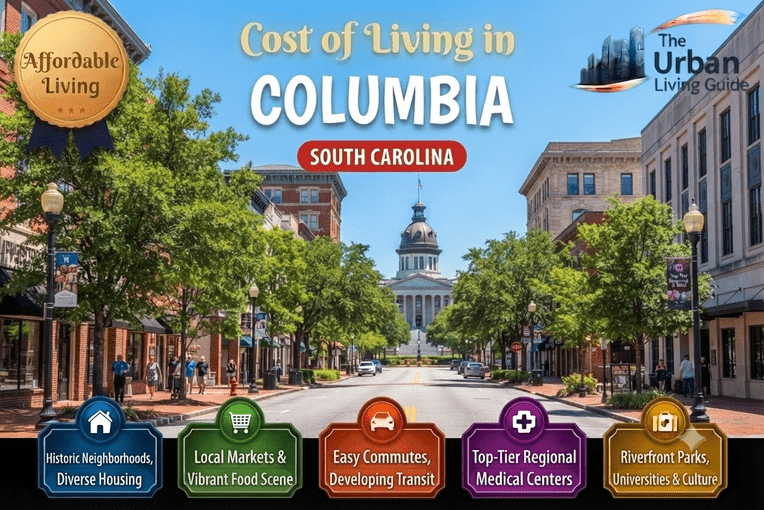
Cost of Living in Columbia, South Carolina 2026: Midlands Economics, Congaree Real Estate & Capital City Financials
Stretching across the banks of the Congaree River and anchored by the vibrant academic presence of the University of South Carolina, life in the City of Columbia combines rich southern history with a rapidly expanding economic and cultural hub. While the region is celebrated for its historic neighborhoods, live oak canopies, and proximity to Lake Murray, managing monthly household expenditures in 2026 requires evaluating real estate valuations that remain significantly below national averages against shifting seasonal utility demands. Whether you are relocating for defense contracting at Fort Jackson, healthcare careers within major regional hospital systems, or remote work looking for southern hospitality, establishing a household across the capital city or surrounding suburbs like Lexington, Irmo, or Blythewood offers compelling economic advantages.
For incoming professionals, growing families, and retirees moving across Richland County and Lexington County, understanding the true cost of living demands a detailed look at regional price points. When breaking down expenses for Columbia, South Carolina during 2026, residents must account for intense summer air conditioning spikes during humid months, heavy reliance on personal vehicle commutes across Interstate 20, Interstate 26, and Interstate 77, and everyday consumer costs shaped by strong regional distribution networks.
Average Monthly Expense Breakdown – Columbia, South Carolina
Monthly expenses in Columbia vary depending on household size, lifestyle choices, and whether you choose to live within the urban core or popular suburban enclaves like Lexington or Irmo. Below is a structured monthly financial breakdown displayed in a professional comparative table reflecting current economic conditions in 2026:
| Expense Category | Single Adult | Couple | Family of 4 |
|---|---|---|---|
| Housing / Rent | $1,100 – $1,550 | $1,500 – $2,100 | $2,200 – $3,200 |
| Groceries & Food | $300 – $420 | $550 – $780 | $850 – $1,150 |
| Transportation & Commute | $180 – $300 | $320 – $520 | $450 – $680 |
| Utilities & Internet | $150 – $240 | $210 – $330 | $280 – $420 |
| Healthcare & Insurance | $220 – $400 | $450 – $800 | $700 – $1,200 |
| Childcare & Education | $0 | $0 | $900 – $1,650 |
| Entertainment & Leisure | $150 – $320 | $300 – $550 | $450 – $800 |
Local residents frequently note that while everyday necessities and housing track roughly 12% to 15% below the U.S. national average, balancing utility shifts and property taxes requires careful annual planning.
Watch this video to get a closer look at housing and neighborhood pricing in Columbia, South Carolina.
Housing Costs, Real Estate & Neighborhood Dynamics in Columbia, South Carolina
Housing represents the most significant financial advantage for newcomers moving to Columbia, South Carolina, where overall real estate costs sit roughly 26% below the national average. The metropolitan real estate market spans urban historic districts like Five Points and Shandon to expansive suburban communities across Lexington County and Richland County. Municipal zoning and residential guidelines are coordinated via the City of Columbia Planning and Development Services.
- Downtown 1-BHK Apartments: Modern multi-family units near the university and downtown cultural districts range from $1,100 to $1,550/month.
- Suburban 1-BHK Apartments: Outlying residential corridors like Irmo, Blythewood, and Elgen offer accessible leasing options starting around $950 to $1,300/month.
- Family 3-BHK Rentals: Single-family rental houses across suburban neighborhoods command $1,600 to $2,400/month.
- Real Estate Purchase Market: The overall median home price across the Columbia metro area sits near $270,000 to $318,000, allowing buyers to secure construction and established single-family homes well below national norms, while luxury estates around Lake Murray reach $800,000 to $1,000,000+.
Utilities & Bills Costs in Columbia, South Carolina
Managing utility overhead in the Midlands requires preparing for high summer cooling loads and mild winter heating requirements, with primary electricity and natural gas services managed by Dominion Energy.
- Electric & Gas Services: Dominion Energy supplies electricity and natural gas, with standard household bills averaging $150 to $240/month annually for mid-sized homes. Peak summer cooling months push electricity higher when running AC units continuously against 95-degree afternoon heat.
- Water & Sewer Services: Municipal water and wastewater management provided by local agencies (such as City of Columbia Utilities and Joint Municipal) average $90 to $150/month, which includes standard tiered consumption fees and flat metering charges.
- Curbside Trash & Recycling: Private or county-managed curbside waste pickup in unincorporated areas averages $95 to $110 per quarter.
- High-Speed Fiber Internet: Reliable broadband connectivity via regional telecom providers runs $55 to $85/month.
Grocery and Food Costs in Columbia, South Carolina
Food expenditures in the capital region track slightly below national averages, benefiting from strong local supply chain logistics. Everyday consumer provisions are widely available across major national and regional supermarkets.
- Supermarket Tiers: Residents choose from value-driven stores like Walmart, Food Lion, and Aldi, mainstream favorites like Publix, upscale specialty markets like Lowe’s Foods (featuring unique community beer dens and butcher counters), and specialty grocers like Trader Joe’s.
- Local Farmers Markets: Shopping weekly at the vibrant Soda City Market downtown or local farm stands helps residents secure fresh seasonal produce while supporting regional growers.
- Essential Price Benchmarks: A gallon of whole milk runs $2.30 to $2.80, a dozen eggs averages $3.20 to $5.50 depending on cage-free sourcing, and casual dining meals cost $15 to $25 per person.
Transportation and Commute Costs in Columbia, South Carolina
Navigating the capital region relies heavily on personal vehicles, though public transit is supported by The COMET bus network connecting urban and suburban corridors.
- Public Transit & Passes: The COMET bus network provides fixed-route services across Richland and Lexington counties, with monthly transit passes costing roughly $50 to $65.
- Fuel & Auto Operation: South Carolina consistently ranks among states with lower-than-average fuel costs. Regular unleaded gasoline averages $2.45 to $2.85 per gallon, keeping monthly fuel outlays manageable at $180 to $300 for standard commuters.
- Rideshare & Parking: Uber and Lyft rides are readily available across downtown, while monthly downtown parking garage passes run $75 to $130/month. Full-coverage auto insurance averages $1,350 to $1,900 annually.
Healthcare Costs in Columbia, South Carolina
Healthcare outlays remain competitive, anchored by world-class medical networks providing comprehensive specialty and emergency services throughout the Midlands.
- Major Health Systems: Care is anchored by Prisma Health (operating the region’s largest trauma center downtown), Lexington Medical Center in West Columbia, MUSC Health Midlands, and the Dorn VA Medical Center.
- Out-of-Pocket & Insurance: Standard general practitioner co-pays run $25 to $45, specialist visits range from $45 to $75, and individual marketplace health insurance premiums average $320 to $580/month depending on age and deductible tiers.
Entertainment & Lifestyle Costs in Columbia, South Carolina
Recreational opportunities across the capital city combine natural wonders with family-friendly cultural attractions:
- Outdoor & Nature Recreation: Exploring Congaree National Park, walking the Riverfront Park trail system, and boating or fishing on Lake Murray offer low-cost or free weekend leisure.
- Family Attractions & Culture: Visiting the world-renowned Riverbanks Zoo and Garden or attending downtown festivals adds vibrant community engagement with modest admission fees.
- Fitness & Wellness: Commercial gym memberships and community fitness centers average $35 to $75/month.
Pet-Related Living Costs in Columbia, South Carolina
Caring for dogs and cats across suburban neighborhoods involves reliable recurring monthly expenses:
- Veterinary Care: Routine wellness exams, vaccinations, and preventative flea/tick treatments run $45 to $90/month.
- Supplies & Grooming: Premium pet food and professional grooming services add $50 to $110/month.
City-Specific Living Costs in Columbia, South Carolina
Living in the Midlands introduces distinct environmental and regional factors that influence household budgeting:
- Heavy Spring Pollen Seasons: High pine pollen counts in March and April require frequent vehicle car washes, replacement HVAC air filters, and occasional allergy management outlays.
- Severe Summer Humidity & AC Load: Extended summer heatwaves demand rigorous air conditioning upkeep and weatherization to maintain energy efficiency.
- Annual Vehicle Property Taxes: South Carolina assesses a recurring local property tax on motor vehicles every year, requiring careful annual budget tracking distinct from standard state registration fees.
Taxes in Columbia, South Carolina
Tax structures in Columbia and South Carolina during 2026 shape household disposable income:
- State Personal Income Tax: South Carolina utilizes a progressive income tax structure with a top marginal rate reaching 6.2% for earnings exceeding upper tax brackets.
- Property & Vehicle Taxes: Owner-occupied primary residences benefit from favorable assessment ratios, whereas secondary properties and registered motor vehicles are assessed separate recurring annual taxes based on current valuations.
Annual & Yearly Expenses in Columbia, South Carolina
Comprehensive financial planning requires accounting for recurring annual and yearly non-housing obligations:
- Auto Insurance & Registration: Annual car insurance totals $1,350 to $1,900, alongside recurring local vehicle property taxes and state DMV registration fees.
- Homeowners Insurance: Annual property and hazard insurance policies range from $900 to $1,600 for single-family homes.
- Subscriptions & Club Dues: Digital streaming and recreational club memberships average $180 to $450 yearly.
- Professional Services: Annual tax preparation and local filing fees add $150 to $350 yearly.
- Total Estimated Annual Non-Housing Outlays: $2,800 to $5,500 per household.
Downtown vs. Suburbs Cost of Living Comparison – Columbia, South Carolina
Comparing the urban core against surrounding suburban enclaves highlights key lifestyle and financial choices:
| Cost Parameter | Downtown Core | Lexington (Suburban) | Irmo (Suburban) | Blythewood (Suburban) |
|---|---|---|---|---|
| Housing (1-3 BHK Rent) | $1,150 – $1,800 | $1,400 – $2,200 | $1,250 – $1,900 | $1,350 – $2,100 |
| Parking & Garage Fees | $75 – $130/mo | Free / Included | Free / Included | Free / Included |
| Transportation & Commute | COMET buses, walkable | I-20 commuter driving | I-26 corridor access | I-77 commuter driving |
| Schools & Family Spaces | Urban campus proximity | Top-rated district zones | Established family areas | Spacious semi-rural lots |
| Dining & Entertainment | Vista & Main Street dining | Lake Murray recreation | Local retail plazas | Quiet community parks |
| Home Maint. & Taxes | Urban assessments | Suburban HOA dues | Moderate upkeep | Acreage maintenance |
| Car Ownership vs. Transit | Optional for core city | Mandatory | Mandatory | Mandatory |
Strategic Insight: Young professionals and university staff often choose downtown lofts for walkability to the Vista and Main Street, whereas families frequently prioritize top-tier public school zones and spacious new construction in Lexington or Blythewood.
Local Resident Realities: What Long-Timers Say About Living Costs
“Moving from the Northeast, our housing dollar stretches so much further here in Lexington. We bought a brand-new home with a large yard for what a tiny condo cost us up north, though you definitely need to budget for vehicle property taxes every year.”
“Living near downtown Columbia gives you incredible access to Soda City Market on Saturdays and great local dining in the Vista. Summer electric bills can climb when running the AC full blast, but the overall cost of living is remarkably stable.”
Is Columbia, South Carolina Expensive or Affordable?
Columbia stands out as one of the most economically accessible capital cities in the Southeast, offering an overall cost of living that sits roughly 11% to 14% below the national average.
Key factors driving local affordability include:
- Real estate and housing valuations tracking roughly 26% lower than the U.S. median.
- Favorable fuel prices and manageable vehicle commute distances across Richland and Lexington counties.
- Zero sales tax on basic at-home grocery items, easing weekly household outlays.
- Abundant new construction inventory that provides competitive leasing and purchase options.
Who May Find Columbia, South Carolina Expensive? — And Who Can Afford It Comfortably?
While technology, healthcare, and university professionals enjoy robust purchasing power across the Midlands, entry-level service earners and households with limited savings may face specific financial constraints.
Groups that may experience economic friction include:
- Entry-level service and hospitality workers earning under $35,000 annually who face tightening rental options in prime suburban school districts.
- Newcomers unaccustomed to annual vehicle property taxes who fail to anticipate recurring local tax bills assessed on registered cars.
- Home buyers seeking luxury waterfront estates around Lake Murray without substantial capital down payments.
Segment-wise income mapping outlines clear comfort thresholds across Columbia, South Carolina in 2026:
| Income Bracket | Affordability Status | What to Expect |
|---|---|---|
| Under $45K/year | High Financial Strain | Requires roommate arrangements, disciplined budgeting, and selection of outer rental corridors. |
| $45K – $80K/year | Moderate Comfort | Comfortably supports multi-family suburban rentals, reliable vehicle ownership, and moderate savings. |
| $85K+/year | Affluent Living | Unlocks independent homeownership in top suburban school zones and flexible leisure spending. |
Practical Money-Saving Tips for Columbia, South Carolina Residents
Maximizing household purchasing power across the Midlands requires leveraging local market knowledge and proactive utility management:
- Optimize summer energy efficiency: Program thermostats effectively and utilize ceiling fans to manage peak cooling bills from Dominion Energy during humid months.
- Shop regional value grocers: Purchase weekly provisions at budget-friendly supermarkets like Food Lion, Aldi, or local farm markets to cut food overhead.
- Explore growing suburban corridors: Consider leasing or purchasing in expanding neighboring areas like Irmo or Elgin to secure lower monthly housing costs.
- Utilize free public recreation: Enjoy zero-cost weekend activities by walking the Riverfront Park trails or exploring public spaces around Congaree National Park.
Frequently Asked Questions About Living Costs in Columbia, South Carolina
How does Columbia, South Carolina compare cost-wise to the U.S. national average?
Columbia offers an overall cost of living that runs roughly 11% to 14% below the national average, primarily driven by highly accessible housing costs and moderate everyday consumer expenses.
What monthly income is required to live comfortably as a single professional in Columbia?
Single working professionals typically need an annual income between $48,000 and $62,000 to independently cover rent, utilities, vehicle financing, and lifestyle expenses without financial stress.
What are the main utility providers serving residential homes in Columbia?
Electricity and natural gas services are primarily supplied by Dominion Energy, while water and wastewater management are handled by municipal utilities like City of Columbia Utilities.
Are groceries taxed heavily in the state of South Carolina?
State law exempts basic at-home grocery items from state sales tax, though local county sales taxes apply to prepared hot foods, restaurant meals, and non-grocery retail purchases.
What is the median home purchase price in the Columbia real estate market?
The overall median home price across the Columbia metropolitan area sits between $270,000 and $318,000, offering exceptional value compared to coastal markets and national price medians.
Do I need a personal vehicle to navigate daily life in Columbia?
While The COMET bus network serves key urban corridors, Columbia remains largely car-dependent, making personal vehicle ownership essential for most professional commutes and suburban errands.
What unique vehicle-related taxes should newcomers anticipate?
New residents must account for South Carolina’s recurring annual personal property tax assessed on registered motor vehicles, which is billed separately from standard state DMV registration fees.
Internal Linking & Resource Hub
At The Urban Living Guide (TULG), we provide meticulous data to help you navigate your relocation. Explore our related resources for the region:
- Living in Columbia, South Carolina
- Pros and Cons of Living in Columbia
- Best Neighborhoods in Columbia
Ready to finalize your relocation plan? Read our comprehensive master breakdown here: Moving to Columbia, South Carolina.