

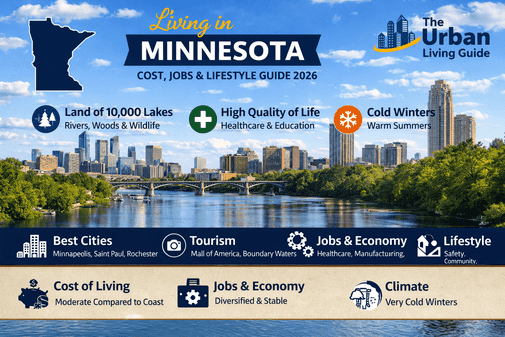
Living in Minnesota: Twin Cities Innovation, Great Lakes Wilderness & Midwestern Stability in 2026
Settling into Minnesota in 2026 means establishing roots in a region defined by its rugged, water-centric geography, a sophisticated knowledge-based economy, and a cultural commitment to high-quality public services. Spanning over 86,936 square miles, the “Land of 10,000 Lakes” is bordered by the vast Lake Superior to the northeast, the agricultural plains of the Red River Valley to the west, and the deep, forested basins of the North Woods. As a long-term local resident will tell you, the state offers a distinct living proposition: the high-velocity, corporate-driven environment of the Minneapolis-Saint Paul (Twin Cities) metropolitan area contrasted with the quiet, four-season wilderness that characterizes the majority of the state.
From the global life-science campuses in Rochester and the tech corridors of Minneapolis to the iron-ore heritage of the Iron Range, everyday life here is characterized by a strong work ethic, deep Scandinavian cultural influences, and a stable economy anchored by healthcare, retail giants, and manufacturing. For official administrative guidelines, state tax filings, and civic resources, residents frequently consult the Official State of Minnesota Portal.
| Quick Facts Snapshot: Minnesota (2026) | |
|---|---|
| Time Zone | Central Time Zone (CT / UTC-6, Daylight Saving UTC-5) |
| State Population | Approx. 5.7 Million (Strong concentration in the Twin Cities metro core) |
| State Income Tax | Progressive tax brackets ranging from 5.35% up to 9.85% for high-earners |
| Median Home Price | $300,000 – $450,000+ (High variance between urban/suburban hubs and rural lakefront properties) |
| Average Rent Range | $1,300 – $2,200+ per month (Dependent heavily on urban density vs. outer suburbs) |
| Sales Tax Baseline | 6.875% state base, with local municipal and special district additions |
What It Is Really Like to Live Here in Minnesota
Living in Minnesota requires mastering a lifestyle where community-focused “Minnesota Nice” meets the realities of a rigorous, four-season northern climate. Locals quickly understand that life is structured around the transition from long, snow-filled winters—where hockey, ice fishing, and indoor social clubs dominate—to glorious, vibrant summers centered on cabin culture and boating on the thousands of inland lakes.
The state’s identity is defined by a deep-seated commitment to public education, outdoor recreation, and a robust, diversified economy that avoids the volatility of boom-and-bust cycles. Whether you are living in a high-rise in Downtown Minneapolis or a quiet lakeside property in the Brainerd Lakes area, the state’s high standard of living is evident in its infrastructure and community-oriented public policy. Gain deeper insights into regional heritage at the Explore Minnesota Tourism board.
- Cultural Vibe: A powerful, community-driven atmosphere powered by Scandinavian roots, a world-class theater and arts scene (second only to NYC in theaters per capita), and a genuine respect for nature.
- Pace of Life: Varies significantly—ranging from the efficient, professional, and transit-connected rhythm of the Twin Cities to the slow-paced, recreational-focused life of northern lake communities.
- The Resident Trade-Off: Long-term locals accept demanding income tax brackets and the endurance required for harsh winter months in exchange for unmatched safety, world-class healthcare networks, and a deep, multi-generational sense of community stability.
Regional Diversity, Geography & Economic Zones in Minnesota
Minnesota’s geography creates two distinct worlds: the bustling, urbanized south and the wild, forested north.
Coastal Corridors, Metro Hubs & Suburban Enclaves
- The Twin Cities Metro (Minneapolis/St. Paul): Serving as the absolute economic nerve center, hosting Fortune 500 corporate HQs, massive healthcare clusters, and a deep talent pool in engineering and tech.
- The Rochester Medical Corridor: A globally unique economic zone focused almost entirely on healthcare innovation, anchored by the presence of the Mayo Clinic.
- The St. Cloud & Central Suburban Belt: Fast-growing residential and manufacturing communities providing a critical link between the rural agricultural lands and the urban Twin Cities.
Mountain, Inland, Agricultural & Resource Belts
- The North Shore & Iron Range: Defined by the wild Lake Superior coastline and historical mining industries, this region now centers on eco-tourism and outdoor adventure.
- The Southern Agricultural Heartland: A vast, productive zone featuring flat plains and dairy farming that serves as the foundation for the state’s massive food-processing industry.
Infrastructure, Power Grids, Water Systems & Transport Networks in Minnesota
Maintaining high living standards in a harsh northern climate requires massive investments in public utilities, water treatment, and resilient transit infrastructure.
Water Resources & Watersheds
- Great Lakes Protection: As a primary steward of the Great Lakes basin, the state maintains strict water-quality monitoring for its 10,000+ lakes. Learn more via the Minnesota Pollution Control Agency.
Power Generation & Clean Energy Frameworks
- Grid Resiliency: Supplied primarily by Xcel Energy and Minnesota Power, the grid focuses on winterizing transmission lines to survive sub-zero temperature cycles and increasing wind energy capacity on the western plains.
Statewide Transit, Rail, Air & Port Connectivity
- Global Aviation: The state is anchored by Minneapolis–Saint Paul International Airport (MSP), a premier international hub.
- Mass-Transit Grid: Metro Transit operates extensive light rail, bus rapid transit, and local bus networks across the Twin Cities, while Amtrak provides critical north-south and east-west rail connectivity.
Statewide Economy, Job Markets & Major Industries in Minnesota
Minnesota has developed a highly sophisticated, knowledge-based economy that avoids over-reliance on any single sector.
- Economic Powerhouse: Generating massive economic output driven by world-class healthcare, retail, and manufacturing innovation.
- Dominant Sectors: Medical devices/life sciences, corporate retail, financial services, food production, and technology research.
- Corporate Footprint: Headquarters for global giants like Target, 3M, Best Buy, General Mills, and UnitedHealth Group. Track state economic initiatives via Minnesota DEED.
Salary Realities Across Economic Corridors
- Metropolitan Potential: Roles in medical research, corporate strategy, and technology management in the Twin Cities command salaries frequently exceeding $100,000 to $150,000+.
- Regional Wage Variance: Manufacturing and service wages in rural western/northern counties align closer to national medians, offering an excellent quality-of-life-to-wage ratio due to significantly lower housing costs.
Cost of Living Realities & Housing Market Variance in Minnesota
Living in Minnesota is increasingly about choosing your location: the urban core of Minneapolis offers premium real estate value, while suburban and regional cities like Rochester and Duluth offer substantial purchasing power.
| Expense Category | Cost Range / Index Reality |
|---|---|
| Housing (Twin Cities vs. Regional) | $1,600 – $2,800+ rent in MSP; $900 – $1,500 in regional hub cities |
| Utilities & Heating | High annual heating costs; energy-efficient windows/insulation are critical requirements |
| Transportation | Dependent on location: Metro transit passes vs. car-centric rural commuting |
| Groceries & Goods | Closely mirrors national averages, reflecting a healthy, competitive market |
State Tax Climate, Business Environment & Government Policies
Minnesota maintains a robust fiscal policy aimed at funding high-quality public infrastructure, education, and social services. Review tax compliance guidelines via the Minnesota Department of Revenue.
- Income Tax Structure: Progressive individual income tax brackets that support high levels of municipal services and state-wide public investment.
- Property Tax Pressures: Regional school district funding is derived from local property assessments, which should be researched thoroughly before any home purchase.
Legal & Lifestyle Governance Quirks
- Driver Licensing: New residents are required to secure a Minnesota driver’s license through the Driver and Vehicle Services (DVS) division within a standard compliance period.
- Voter Registration: Minnesota offers same-day voter registration, reflecting the state’s long-standing tradition of high civic participation.
Climate, Weather Extremes & Natural Geography
Minnesota experiences a true humid continental climate, featuring vivid seasonal transitions and significant temperature variations.
- Seasonal Variations: Long, cold, and snowy winters are a defining experience, matched by vibrant, sunny, and temperate summers.
- Environmental Realities: Residents utilize comprehensive snow-removal infrastructure and winter-ready housing, ensuring that daily life continues efficiently regardless of weather.
- Natural Landmarks: From the massive freshwater expanses of Lake Superior to the sprawling wetlands and forests of Voyageurs National Park.
Insurance Cost Realities (Disaster & Weather Risks)
- Winter Damage: Property insurance and maintenance planning focus on roof snow-load management, ice-dam remediation, and pipe-freeze mitigation.
- Wind/Hail Coverage: Inland regions may encounter severe thunderstorm events during summer, warranting appropriate wind and hail coverage on standard homeowner policies.
Education Systems & Major Healthcare Networks
Minnesota is globally recognized for the excellence of its education and clinical research facilities, particularly those surrounding the Twin Cities and Rochester.
- Higher Education Framework: Home to academic leaders including the University of Minnesota, Macalester College, and the University of St. Thomas.
- Advanced Healthcare: Elite medical networks including the world-famous Mayo Clinic in Rochester and the M Health Fairview system provide groundbreaking clinical care. Review public health standards via the Minnesota Department of Health.
Culture, Outdoor Recreation & Lifestyle Shifts in Minnesota
Daily life in Minnesota centers on a deep appreciation for the outdoors and a robust community-centered social life.
- Outdoor Living: Ice fishing, cross-country skiing, boating on thousands of inland lakes, and exploring the Superior Hiking Trail are essential recreational routines.
- Arts & Entertainment: The state boasts one of the nation’s most respected theater scenes, diverse culinary offerings, and legendary local music culture. Explore statewide tourism via Minnesota DNR.
Relocation & State Residency Essentials
- DVS Compliance: New residents must secure a Minnesota driver’s license and transfer vehicle registrations at a DVS office.
- Voter Registration: Easily managed online via the Secretary of State portal to participate in local and statewide elections.
Major Counties and Rural Living Realities in Minnesota
- Hennepin County: The urban core and economic heart of the Twin Cities metro.
- Ramsey County: The seat of the state capital, St. Paul, offering a dense, historic urban environment.
- Olmsted County: Anchored by Rochester, serving as a global center for medical innovation.
Major Regional Hubs and Cities to Explore
Major Urban Hubs at a Glance
| City / Hub | Primary Economic Driver | Vibe & Lifestyle Profile |
|---|---|---|
| Minneapolis | Finance, Tech, Retail | Modern, ambitious, vibrant |
| Saint Paul | Government, Education | Historic, traditional, community-focused |
| Rochester | Healthcare, Research | Medical hub, suburban-professional |
| Duluth | Tourism, Maritime | Scenic, outdoor-focused, coastal |
| Bloomington | Retail, Commercial | Convenient, suburban, commercial |
Detailed Breakdown of Key Regional Hubs
Minneapolis — The Global Economic Anchor
As the state’s largest urban center, Minneapolis serves as a powerhouse for the retail, tech, and financial industries. It offers a dense, walkable urban experience with access to world-class arts and culture.
Saint Paul — The Historic State Capital
St. Paul provides a traditional, historic charm with government stability, serving as the cultural anchor of the state’s capital region.
Rochester — The World-Class Medical Gateway
Rochester is defined by its role as the home of the Mayo Clinic, creating a unique, stable, and highly educated professional community.
Duluth — The Superior North Shore Jewel
Duluth offers a unique maritime urban experience on the shore of Lake Superior, appealing to those seeking immediate access to mountain hiking and lake-based recreation.
Bloomington — The Suburban Commercial Powerhouse
Located in the heart of the metro, Bloomington is a primary commercial and transit hub, offering family-oriented housing and unmatched proximity to the international airport.
Pros and Cons of Making Minnesota Your Home
| Advantages (Pros) | Systemic Drawbacks (Cons) |
|---|---|
| Exceptional public education and healthcare systems | Intense, long, and snowy winter months |
| Diverse, stable, and high-paying job market | Higher state income tax burden |
| Unmatched freshwater and outdoor recreation access | Cold weather increases annual utility costs |
| High safety rankings and community stability | Rising real estate costs in core urban zones |
| Strong social services and civic infrastructure | Car dependency in rural and regional areas |
Frequently Asked Questions About Living in Minnesota
Is Minnesota a good state to live in?
Yes, it is highly regarded for its stable economy, top-tier school systems, and high quality of life, making it an excellent long-term home for families and career-focused professionals.
What is the actual cost of living in Minnesota?
The cost is moderate; it is higher than many Midwest neighbors due to premium service quality and infrastructure, but remains more affordable than major coastal urban hubs.
Which region or city is best to settle down in?
It depends on your career and lifestyle needs: Minneapolis for urban professionals, Rochester for medical-field stability, and Duluth for outdoor enthusiasts who prefer lake-centric living.
Does Minnesota have high taxes?
The state income tax is progressive, which supports strong public services, and property taxes vary by county to fund well-regarded local school districts.
How safe is everyday life across the state?
Minnesota consistently ranks as one of the safest states; while urban centers have typical metropolitan trends, the vast majority of suburban and rural counties are very safe.
What industries dominate Minnesota’s job market?
The economy is anchored by massive retail HQs, medical device manufacturing, healthcare research, finance, and food manufacturing.
What is the weather like?
Expect cold, snowy winters—a central feature of the Minnesota lifestyle—balanced by pleasant, sunny springs, warm summers, and beautiful autumn color transitions.
Explore Detailed City Guides Across Minnesota
At The Urban Living Guide, our core mission is to provide deeply researched regional insights and city-level navigation tools to help you evaluate your relocation options with total confidence. To discover what daily life, housing patterns, and local economies look like across our featured municipal centers throughout the North Star State, explore our comprehensive resident hub guides below:
- Living in Minneapolis, Minnesota
- Living in Saint Paul, Minnesota
- Living in Rochester, Minnesota
- Living in Duluth, Minnesota
- Living in Bloomington, Minnesota
Whether you are comparing career prospects in the global corporate retail sector or evaluating lifestyle shifts near the Great Lakes, our editorial team remains dedicated to delivering research-backed, data-driven frameworks to support your relocation and residency decisions with complete clarity.