

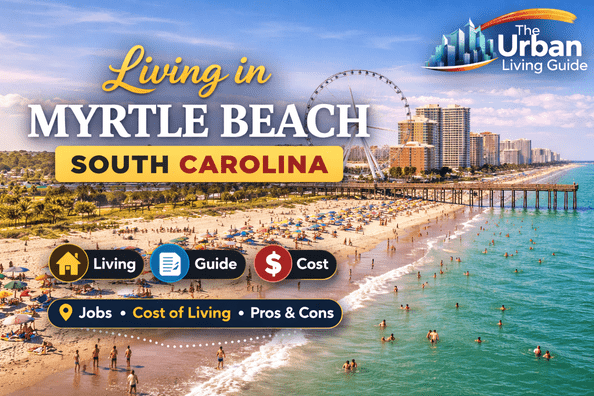
Living in Myrtle Beach, South Carolina in 2026: Exploring Grand Strand Resort Culture, Atlantic Beaches, and Coastal Affordability
Stretching across the sweeping 60-mile stretch of the famous Grand Strand along the Atlantic coastline of South Carolina, living in Myrtle Beach, South Carolina offers an unbeatable combination of wide sandy beaches, world-class golf courses, vibrant boardwalk entertainment, and accessible resort-town living. As the tourism capital of the Palmetto State with a year-round city proper population of approximately 40,000 residents (anchoring a rapidly expanding metropolitan region exceeding 400,000 people), Myrtle Beach delivers permanent coastal living at a fraction of the cost found in traditional southern or Florida beach markets.
Universally celebrated across the nation as a premier vacation destination, Myrtle Beach commands a far deeper permanent resident identity centered on master-planned communities like Market Common, family-oriented suburban corridors like Carolina Forest, and relaxed coastal enclaves in North Myrtle Beach. Whether you are strolling along the iconic Myrtle Beach Boardwalk, playing a round on one of over 80 championship golf courses, or dining on fresh local seafood at a waterfront restaurant, life here delivers a sun-drenched, unhurried, and budget-friendly standard of living. Local municipal governance, public safety programs, and community services are centrally administered through the official City of Myrtle Beach Operations Portal under the direction of city leadership.
Watch a recent video by a popular vlogger to experience daily life and authentic vibes in Myrtle Beach:
Why Myrtle Beach Has Evolved Into the Grand Strand’s Favorite Permanent Home
Over recent decades, Myrtle Beach has captured national acclaim as a premier haven for retirees, remote executives, golf enthusiasts, and families seeking oceanfront living without exorbitant price tags. Key factors driving its sustained popularity include:
- Unrivaled Coastal Affordability: Real estate valuations and rental rates sitting significantly below Charleston or coastal Florida markets. Explore regional tourism and economic initiatives via the official Visit Myrtle Beach Tourism Portal.
- Endless Golf and Recreation: Home to over 80 championship golf courses, sprawling entertainment complexes like Broadway at the Beach, and miles of public beaches.
- Favorable Tax Structure: Low primary property tax assessment ratios for South Carolina owner-occupied residences, keeping long-term holding costs manageable.
- Active Social and Retirement Culture: Welcoming community networks, social clubs, and master-planned villages tailored for active adults.
Myrtle Beach At a Glance: Key Living Metrics
Famous Personalities, Local Icons & Major Brands in Myrtle Beach
Myrtle Beach boasts a vibrant entertainment culture that has launched television legends, minor league sports teams, and global hospitality corporations:
- Vanna White: The iconic co-op host of Wheel of Fortune, who spent her formative youth growing up and attending school right in North Myrtle Beach (Wheel of Fortune Official Portal).
- Myrtle Beach Pelicans (MiLB): The Class-A Minor League Baseball affiliate of the Chicago Cubs, bringing energetic summer evening sports entertainment to Pelicans Ballpark (Myrtle Beach Pelicans Portal).
- Hilton & Marriott Resorts: Global hospitality leaders maintaining sprawling oceanfront properties and conference centers along the Grand Strand (Hilton Official Portal).
- Wyndham Vacation Resorts: Major resort management operations anchoring regional employment and hospitality development.
Career Landscape & Major Employers Along the Grand Strand
The employment landscape in Myrtle Beach offers specialized professional opportunities focused on hospitality management, healthcare systems, and retail trade:
- Hospitality and Resort Management: Anchored by major hotel groups, golf complexes, and entertainment venues, providing thousands of operational and executive careers. Track regional workforce data via the South Carolina Department of Labor.
- Healthcare and Medical Services: Supported by Grand Strand Medical Center and regional hospital systems, delivering comprehensive nursing and emergency medical careers.
- Higher Education and Public Service: Coastal Carolina University and Horry County public services driving professional administration employment.
- Real Estate and Construction: A booming building sector driven by continuous residential expansion across suburban master-planned corridors.
Housing Market Dynamics & Real Estate Overview in Myrtle Beach
Navigating the real estate market in Myrtle Beach requires understanding its resort condo inventory, master-planned suburban growth, and flood insurance requirements:
- Diverse Architectural Stock: Features resort-style oceanfront condominiums, neo-traditional village homes in Market Common, and master-planned single-family properties in Carolina Forest. Track property assessments via the Horry County Assessor Portal.
- Market Valuations: Offering some of the most budget-friendly beachfront real estate on the East Coast, providing excellent square footage and rental investment potential.
- Rental Market Inventory: Average monthly rent spans $1,000 to $1,300 for studio units, $1,200 to $1,600 for one-bedroom apartments, $1,600 to $2,200 for two-bedroom properties, and $2,300 to $4,000+ for single-family rental homes and luxury coastal estates.
- Primary Property Tax Rates: Owner-occupied primary residences benefit from favorable South Carolina tax assessment ratios, lowering annual tax burdens.
Best Neighborhoods in Myrtle Beach: Finding Your Ideal Community
Check the interactive map below to understand the coastal orientation and position of Myrtle Beach:
What Daily Life Really Looks Like in Myrtle Beach (Rhythm & Vibe)
Daily life in Myrtle Beach is characterized by an active, coastal, and outdoor-oriented rhythm that celebrates sunshine and beachside leisure:
- Morning Beach Strolls: Residents often start mornings walking along the sandy shoreline or grabbing coffee at oceanview cafes before crowds arrive. Check municipal recreation schedules via the official City of Myrtle Beach Parks and Recreation Portal.
- Afternoon Golf and Shopping: Spending warm afternoons playing golf on championship courses, shopping at Broadway at the Beach, or relaxing by community pools.
- Seafood and Waterfront Evenings: Enjoying fresh local seafood at waterfront restaurants along the marshwalk or attending evening community concerts.
- Social Atmosphere: Warm, welcoming, resort-oriented, casual, and highly popular among retirees and beach lovers.
Cost of Living Breakdown: Monthly Expenses & Salary Expectations
Commute Realities, Highway Corridors & Transit Options
Myrtle Beach provides coastal transportation infrastructure designed for beach access while managing seasonal tourism volume:
- U.S. Route 17 & U.S. Route 501: Primary arterial lifelines connecting Myrtle Beach north toward North Myrtle Beach and west toward interior South Carolina (South Carolina Department of Transportation Portal).
- Commute Times: Average daily local commutes remain convenient at approximately 15 to 25 minutes during off-peak seasons.
- Coast RTA Bus Network: Municipal public bus routes providing transit coverage across municipal routes (Coast RTA Public Transit Portal).
- Aviation Convenience: Proximity to Myrtle Beach International Airport (MYR) positioned centrally just minutes from downtown.
Coastal Climate Realities, Seasons & Environmental Factors
The environmental rhythm of Myrtle Beach follows a classic humid subtropical climate featuring warm summers and mild winters:
- Warm, Humid Summers: Summer daytime highs routinely average 85°F to 90°F moderated by Atlantic sea breezes and high regional humidity. Track active forecasts via the National Weather Service Wilmington / Myrtle Beach Portal.
- Mild, Pleasant Winters: Winter seasons bring mild temperatures with daytime highs averaging 55°F to 63°F and rare freezing nights.
Higher Education, Schools & Academic Excellence
Educational infrastructure stands as a premier anchor for families and continuing academic development:
- Coastal Carolina University (CCU): Comprehensive public university located nearby in Conway, offering extensive undergraduate and graduate programs (Coastal Carolina University Official Portal).
- Horry-Georgetown Technical College (HGTC): Providing technical career certifications and workforce training.
- Horry County Schools: Operating one of the largest and most progressive public school districts in South Carolina.
Healthcare Infrastructure & Regional Medical Networks
Healthcare infrastructure in Myrtle Beach is advanced, highly specialized, and anchored by premier regional medical networks:
- Grand Strand Medical Center: Designated trauma center operated by Grand Strand Health, featuring advanced surgical units, cardiac care, and emergency services (Grand Strand Health Official Portal).
- McLeod Health: Major regional healthcare network operating acute care facilities and emergency departments across suburban corridors like Carolina Forest.
Hospitality, Oceanfront Resorts & Local Culinary Scene
The hospitality and culinary identity of Myrtle Beach reflects sprawling oceanfront resort comfort, seafood dining, and beachside hospitality:
- Hilton Myrtle Beach Resort & Marriott Grande Dunes: Sophisticated oceanfront resort properties offering fine dining, spa retreats, and luxury guest amenities (Hilton Myrtle Beach Resort Portal).
- Beach Hippie Coffee & Boardwalk Coffee House: Independent local cafes anchoring casual beachside mornings.
- Sea Captain’s House & Hook & Barrel: Legendary local dining establishments serving elite Lowcountry seafood.
Entertainment Venues, Boardwalks & Iconic Sightseeing
Landmark entertainment complexes and coastal attractions significantly enhance the daily quality of life for local residents:
- Myrtle Beach Boardwalk: Scenic 1.2-mile oceanfront walkway featuring arcades, open-air cafes, and panoramic Atlantic views (Visit Myrtle Beach Boardwalk Portal).
- Broadway at the Beach: Massive entertainment, shopping, and dining complex built around a 23-acre lake.
- SkyWheel Myrtle Beach: One of the tallest observation wheels in the United States, offering soaring coastal views.
Regional Trade-offs: Pros and Cons of Living in Myrtle Beach
Who Is Myrtle Beach Ideal For — And Who Should Avoid It?
Who Myrtle Beach Ideal For
- Retirees Seeking Beach Life: Active adults looking for affordable oceanfront housing, golf courses, and warm winters.
- Golf and Water Sports Enthusiasts: People who prioritize access to over 80 golf courses, fishing piers, and sandy beaches.
- Remote Workers Wanting Sunshine: Professionals wanting mild winter weather, coastal scenery, and a relaxed pace of life.
- Families Seeking Value: Residents looking for budget-friendly coastal suburban neighborhoods like Carolina Forest.
Who Should Avoid Myrtle Beach
- Corporate Diversity Job Seekers: Workers requiring massive corporate headquarters and diverse manufacturing or high-tech finance sectors.
- Tourist Crowd Avoiders: Individuals who dislike heavy summer visitor congestion and bustling resort traffic.
- Storm-Anxious Individuals: People who experience severe anxiety during Atlantic hurricane seasons and coastal flood alerts.
- Subway and Rapid Transit Purists: Residents requiring extensive urban rail transit systems without driving.
Real Experiences: Perspectives from Long-Term Residents (5 to 10+ Years)
“Retiring to the Market Common neighborhood eight years ago from the Northeast was the best lifestyle decision we’ve ever made. Walking to boutique shops, playing golf on amazing courses, and enjoying the quiet winter months when the tourists leave is absolute paradise. Summers get busy, but you learn the local shortcuts, and the beach lifestyle is unbeatable.”
[Source: r/myrtlebeach Community Discussions — u/MarketCommonRetiree, resident of 9 years]
“The big reality check for newcomers is learning to navigate Route 17 during peak summer tourist season and keeping hurricane evacuation plans ready every autumn. However, once you embrace the Grand Strand rhythm, the affordability of coastal housing, the friendly neighbors, and the year-round golf make it an incredible place to live.”
[Source: Local Resident Panels & Community Forums — Brenda K., Carolina Forest homeowner of 10 years]
Frequently Asked Questions About Living in Myrtle Beach, South Carolina
Is living in Myrtle Beach, South Carolina expensive compared to other beach towns?
No. Myrtle Beach is widely recognized as one of the most affordable coastal resort cities in the United States, offering lower median home prices than Charleston or Florida beach towns.
What level of annual salary do individuals need to live comfortably in Myrtle Beach?
Most single professionals and working families require an annual household income between $55,000 and $110,000 to comfortably cover housing, utilities, transportation, and discretionary spending.
Can residents successfully navigate daily life in Myrtle Beach without owning a personal vehicle?
While certain resort pockets are walkable, the broader Grand Strand metropolitan area is spread out across miles of coastline, making a personal vehicle essential for daily commuting and errands.
What are the standout residential neighborhoods recommended for new residents?
Top residential districts include Market Common for urban neo-traditional walkability, Carolina Forest for master-planned suburban family schools, and North Myrtle Beach for relaxed coastal living.
How do daily commute dynamics function for working professionals across the city?
Commuters primarily utilize U.S. Routes 17 and 501, enjoying convenient average daily commute times of around 15 to 25 minutes during off-peak seasons.
What core natural and cultural highlights define the local Myrtle Beach experience?
Residents enjoy walking along the Myrtle Beach Boardwalk, shopping at Broadway at the Beach, playing golf on championship courses, and relaxing on sandy beaches.
🔗 Explore More Cities in South Carolina
If you’re exploring more options beyond Myrtle Beach, The Urban Living Guide has journeyed across several other vibrant destinations throughout South Carolina. You might also want to check out:
- Living in Charleston, South Carolina
- Living in Columbia, South Carolina
- Living in Greenville, South Carolina
- Living in North Charleston, South Carolina
Interested in uncovering more details about Myrtle Beach? Dive into these specialized resources:
- Cost of Living in Myrtle Beach, South Carolina
- Pros and Cons of Living in Myrtle Beach, South Carolina
- Best Neighborhoods in Myrtle Beach, South Carolina
For a complete transition breakdown from initial research to settling in, explore our extensive relocation manual: Moving to Myrtle Beach, South Carolina
Our curated municipal profiles cut through the noise to examine what really matters on a day-to-day basis—from localized real estate inventory and school district ratings to regional job markets, seasonal micro-climates, and authentic neighborhood personalities.
By keeping all these hyper-local benchmarks in one place, The Urban Living Guide empowers you to weigh regional trade-offs effortlessly, evaluate employment corridors side by side, and secure a residential setting tailored precisely to your long-term personal and professional ambitions.