

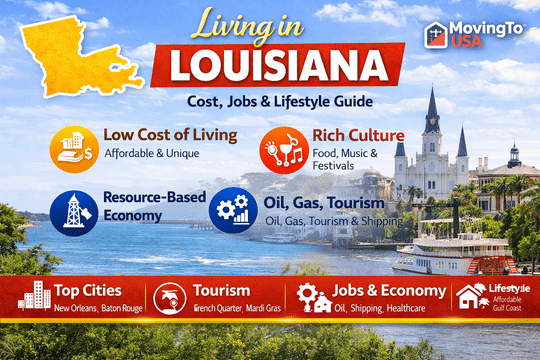
Living in Louisiana: Bayou Culture, Energy Hubs & Gulf Coast Realities in 2026
Stepping into Louisiana in 2026 is an immersion into a landscape where the rhythm of life is dictated by the pulse of the Mississippi River and the shifting tides of the Gulf of Mexico. Spanning 52,375 square miles, the state is a complex, water-bound region that stands apart from the rest of the American South. As a long-term local resident will tell you, the reality of life in the Bayou State is less about fitting into a generic national mold and more about embracing a distinct cultural fusion—where Creole and Cajun heritages define everything from the dialect spoken in Lafayette to the culinary foundations of New Orleans.
From the industrial energy complexes along the Mississippi River to the fast-growing government and administrative corridors of Baton Rouge, everyday life here is characterized by deep, centuries-old historical roots, a population of approximately 4.6 million residents, and an economy anchored by oil and gas, massive maritime logistics, and global tourism. For official administrative guidelines, state tax filings, and civic resources, residents frequently consult the Official State of Louisiana Portal.
| Quick Facts Snapshot: Louisiana (2026) | |
|---|---|
| Time Zone | Central Time (CT / UTC-6, Daylight Saving UTC-5) |
| State Population | Approx. 4.6 Million (Concentrated in the I-10/I-12 corridor) |
| State Income Tax | Progressive tax brackets ranging from 1.85% to 4.25% |
| Median Home Price | $200,000 – $350,000+ (High variance between NOLA/Baton Rouge and rural interior) |
| Average Rent Range | $1,000 – $1,900+ per month (Dependent on neighborhood and flood-zone proximity) |
| Sales Tax Baseline | 4.45% state base, with local parish additions typically pushing totals between 8% and 10% |
What It Is Really Like to Live Here (The Macro Reality & Cultural Identity)
Living in Louisiana requires mastering a lifestyle governed by the environment—specifically the water, the humidity, and the unique cultural pace of the Deep South. Locals quickly understand that day-to-day existence is framed by resilience, given the state’s frequent exposure to tropical weather and the ongoing engineering efforts to manage its complex levee systems.
Unlike states with singular, homogeneous cultural identities, Louisiana thrives on the tension between its colonial past and its modern role as a global energy and shipping titan. Long-term residents realize that while the state offers a cost-of-living profile that is arguably the most competitive in the Gulf region, the “trade-off” involves navigating the complexities of flood insurance and maintaining properties against high-heat, high-humidity weather cycles. Explore regional heritage and tourism planning at the Louisiana Office of Tourism.
- Cultural Vibe: A powerful melting pot driven by Creole and Cajun culinary traditions, a global reputation for jazz and blues, and a community-oriented festival calendar that is unrivaled in the U.S.
- Pace of Life: Distinctly polarized—ranging from the high-energy, tourist-dense nightlife of New Orleans’ French Quarter to the relaxed, community-focused life of the Acadiana region (Lafayette/Lake Charles).
- The Resident Trade-Off: Locals accept the challenges of navigating a water-dominated landscape in exchange for a lifestyle that prioritizes food, music, family connection, and a lower-than-average financial barrier to entry for homeownership.
Regional Diversity, Geography & Economic Zones
Because Louisiana sits at the mouth of the Mississippi River, its geography dictates everything from how houses are elevated to how the state’s logistics-heavy economy functions.
The Urban & Industrial Crescent
- The New Orleans Metro: The primary economic anchor for tourism, finance, and higher education, serving as the cultural beacon of the Gulf Coast.
- Baton Rouge (The Capital): Serving as the industrial heart, anchored by a massive concentration of petrochemical plants and the administrative functions of the state government.
- Acadiana (Lafayette Region): The true heartland of Cajun culture, balancing oil-field services, local food manufacturing, and a distinct, localized economic ecosystem.
The Inland, Bayou & Pine Belts
- The Bayou & Wetland Regions: A sprawling network of cypress swamps and brackish marshes that define the landscape of south-central Louisiana, supporting fishing and eco-tourism.
- North Louisiana: Characterized by pine forests and rolling hills, cities like Shreveport and Monroe provide a different pace of life with strong roots in forestry, gaming, and regional manufacturing.
Infrastructure, Power Grids, Water Systems & Transport Networks
Sustaining 4.6 million residents in a delta environment demands sophisticated engineering, massive levee maintenance, and reliable energy generation.
Water Engineering & Levees
- The Mississippi River Basin: The river is the state’s lifeblood, requiring constant maintenance by the U.S. Army Corps of Engineers to manage flow and mitigate seasonal flood risks. Learn more via the Louisiana Department of Environmental Quality.
Power Generation & Energy Frameworks
- Grid Resiliency: Supplied by major utilities like Entergy Louisiana, the power grid is constantly being upgraded to handle heavy summer cooling loads and potential disruptions from tropical weather events.
Statewide Transit, Rail, Air & Port Connectivity
- Global Logistics Gateways: International travel is anchored by Louis Armstrong New Orleans International (MSY), while the Port of South Louisiana is one of the largest bulk-cargo port systems in the Western Hemisphere.
- Transport Grid: I-10 serves as the primary East-West artery for freight moving across the Gulf Coast, while I-49 connects the northern and southern regions.
Statewide Economy, Job Markets & Major Industries
Louisiana has maintained a steady macroeconomic footprint, serving as a critical global player in energy and the international shipping supply chain.
- Economic Footprint: Leveraging its unique position at the mouth of the Mississippi, the state remains a central node for the transit of goods moving between the U.S. interior and international markets.
- Dominant Sectors: Petroleum and natural gas extraction/refining, international maritime logistics, healthcare administration, food/beverage manufacturing, and hospitality/tourism.
- Corporate Presence: Operational HQs for major entities like Entergy, CenturyLink, and extensive operations for oil/gas majors. Track economic initiatives via Louisiana Economic Development.
Salary Realities Across Economic Corridors
- Professional Potential: Technical roles in petrochemical engineering, specialized maritime logistics, and medical administration command competitive professional salaries that frequently exceed $80,000 to $130,000+ annually.
- Regional Wage Variance: Service, hospitality, and agricultural wages in the bayou and rural north align with regional cost benchmarks, offering excellent value relative to the cost of living.
Cost of Living Realities & Housing Market Variance
Living in Louisiana is one of the most financially efficient choices in the U.S. While popular neighborhoods in New Orleans see price spikes, the broader state market provides immense purchasing power for first-time buyers.
| Expense Category | Cost Range / Index Reality |
|---|---|
| Housing (Urban vs. Rural) | $1,300–$2,200 monthly rent in New Orleans/Baton Rouge; $800–$1,300 in regional hubs |
| Utilities & Heating | Moderate; high A/C demand in summer, mild winters limit heating costs |
| Transportation | High dependence on car ownership; fuel prices are typically among the lowest in the U.S. |
| Groceries & Goods | Below national medians due to agricultural proximity |
State Tax Climate, Business Environment & Government Policies
The state maintains a balanced, business-oriented fiscal policy designed to keep costs low for local families and corporations alike. Review official compliance via the Louisiana Department of Revenue.
- Tax Structure: Operates on a progressive income tax bracket system, while municipal sales tax rates vary across parishes.
- Property Taxes: Louisiana features some of the lowest property tax rates in the nation, which is a major driver for long-term homeownership.
Legal & Lifestyle Governance Quirks
- Driver Licensing: New residents must transfer out-of-state driver’s licenses and register personal motor vehicles with the Office of Motor Vehicles (OMV) within a strict compliance window.
- Legal Civil Code: Unlike other U.S. states based on English Common Law, Louisiana’s legal system is partially derived from the Napoleonic Code, which occasionally impacts real estate and estate planning.
Climate, Weather Extremes & Natural Geography
Louisiana features a humid subtropical climate, renowned for its long, hot summers and mild, wet winters.
- Seasonal Variations: Summers involve high humidity and frequent afternoon rain, while winters are very mild. The growing season is nearly year-round.
- Hurricane Readiness: Property insurance and disaster-response planning are essential parts of life in coastal Louisiana.
Insurance Cost Realities (Disaster & Weather Risks)
- Wind & Flood Riders: Properties in the coastal “parishes” require specialized flood and windstorm endorsements that must be factored into any monthly housing budget.
Education Systems & Major Healthcare Networks
Institutional prestige in Louisiana is anchored by top-tier academic centers and regional health leaders. Explore state metrics via the Louisiana Department of Health.
- Higher Education: Home to institutions like Tulane University, Louisiana State University (LSU), and University of Louisiana at Lafayette.
- Advanced Healthcare: Elite networks like the Ochsner Health System provide world-class clinical care, with expanding medical research facilities throughout the urban centers.
Culture, Outdoor Recreation & Lifestyle Shifts
Daily life is defined by festivals and unique culinary traditions. Explore state recreation via Louisiana State Parks.
- Outdoor Living: Fishing in the Atchafalaya Basin, exploring the Kisatchie National Forest, and attending iconic events like Mardi Gras and Jazz Fest.
- Culinary Heritage: Famed for authentic Creole and Cajun cooking, including gumbo, jambalaya, and fresh Gulf seafood.
Relocation & State Residency Essentials
- DMV Licensing: Secure a Louisiana driver’s license at an OMV office within the standard relocation timeline.
- Voter Registration: Online enrollment is managed by the Secretary of State.
Major Parishes and Rural Living Realities in Louisiana
- Orleans Parish: The economic and cultural heart of New Orleans.
- East Baton Rouge Parish: The capital district and industrial hub.
- Lafayette Parish: The center of the Acadiana and Cajun cultural/economic lifestyle.
Major Regional Hubs and Cities to Explore
Major Urban Hubs at a Glance
| City / Hub | Primary Driver | Vibe & Lifestyle Profile |
|---|---|---|
| New Orleans | Tourism, Maritime | Electric, historic, globally-connected |
| Baton Rouge | Gov, Industry | Administrative, resilient, stable |
| Lafayette | Energy, Culture | Authentic, Cajun-centered, growing |
| Shreveport | Gaming, Logistics | Classic, regional-hub, industrial |
| Lake Charles | Energy, Shipping | Industrial, coastal, expanding |
Detailed Breakdown of Key Regional Hubs
New Orleans — The Global Cultural Epicenter
As the cultural engine of the state, New Orleans offers unparalleled historic depth and tourism-driven energy. It is ideal for those who value architecture, music, and an environment that is uniquely American.
Baton Rouge — The Administrative and Industrial Anchor
Baton Rouge pairs a deep administrative government role with a bustling industrial port and refining sector, providing consistent economic stability and city-wide utility.
Lafayette — The Cajun Heart
Lafayette is the epicenter of the Acadiana lifestyle. It is known for its intense dedication to Cajun culture, amazing local food, and a vibrant community of small-business owners.
Shreveport — The Northern Gateway
Shreveport offers a pragmatic, regional business hub for northern Louisiana, providing affordability and essential services to the upper parishes.
Lake Charles — The Gulf Energy Frontier
Lake Charles acts as a major hub for the energy and chemical-manufacturing sector, offering stable, high-wage industrial roles and unique coastal access.
Pros and Cons of Making Louisiana Your Home
| Advantages (Pros) | Systemic Drawbacks (Cons) |
|---|---|
| Extremely affordable housing markets | High humidity and tropical storm/hurricane risks |
| Rich cultural, music, and culinary traditions | Economic reliance on specific industrial cycles |
| Low property tax rates | Transportation infrastructure challenges |
| Unique, resilient social community | Healthcare service gaps in deep-rural zones |
| Accessible outdoor/water recreation | Vulnerability to flooding events |
Frequently Asked Questions About Living in Louisiana
Is Louisiana a good state to live in?
Yes, especially if you prioritize affordability, a unique and world-famous cultural environment, and long-term economic opportunity in logistics, healthcare, and energy sectors.
What is the actual cost of living in Louisiana?
It is among the lowest in the nation, particularly for housing. Residents find their monthly salaries go much further here than in coastal or major metropolitan hubs like Chicago or Atlanta.
Which region or city is best to settle down in?
It depends on your career focus: New Orleans for cultural/tourism sectors, Baton Rouge for government/administrative roles, and Lafayette for those embedded in the energy sector.
Does Louisiana have high taxes?
The state income tax is progressive but generally moderate. Property taxes are among the lowest in the U.S., which helps offset higher insurance and maintenance costs.
How safe is everyday life across the state?
Safety varies significantly; major metropolitan urban cores experience typical city crime, while most suburban parishes and rural areas remain quiet, family-focused, and highly secure.
What industries dominate Louisiana’s job market?
Energy production (petroleum/natural gas), international port logistics, medical services, tourism, and food manufacturing define the employment landscape.
What is the weather like?
Expect a subtropical climate with very hot, humid summers and short, mild winters. Hurricane season management is a routine aspect of life for coastal residents.
Explore Detailed City Guides Across Louisiana
At The Urban Living Guide (TULG), our core mission is to provide deeply researched regional insights and city-level navigation tools to help you evaluate your relocation options with total confidence. To discover what daily life, housing patterns, and local economies look like across our featured municipal centers throughout the Bayou State, explore our comprehensive resident hub guides below:
- Living in New Orleans, Louisiana
- Living in Baton Rouge, Louisiana
- Living in Lafayette, Louisiana
- Living in Shreveport, Louisiana
- Living in Lake Charles, Louisiana
Whether you are comparing career prospects in the energy corridor or evaluating lifestyle shifts in the heart of the Creole coast, our editorial team remains dedicated to delivering research-backed, data-driven frameworks to support your relocation and residency decisions with complete clarity.