

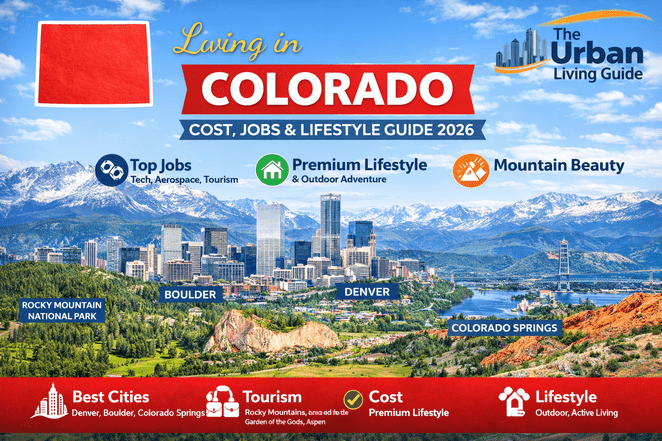
Living in Colorado: Rocky Mountain Lifestyle, Tech Jobs & High-Altitude Living in 2026
Making your home in Colorado in 2026 means settling into a breathtaking western landscape spanning over 104,185 square miles, defined by the towering Rocky Mountains, high-altitude basins, and the sprawling Front Range urban corridor. As a long-term local resident will tell you, the Centennial State offers a distinctive balance between the high-velocity, tech-driven professional hubs of the Denver Metro and the quiet, adventure-focused pace of historic mountain towns like Telluride or Breckenridge.
From the aerospace and startup campuses of Boulder and Denver to the military and defense corridors of Colorado Springs, everyday life here is characterized by a health-conscious culture, a population of approximately 5.9 million residents, and a dynamic economy anchored by energy, tourism, and innovation. For official administrative guidelines, state tax filings, and civic resources, residents frequently consult the Official State of Colorado Portal.
| Quick Facts Snapshot: Colorado (2026) | |
|---|---|
| Time Zone | Mountain Standard Time (MST / UTC-7, Daylight Saving UTC-6) |
| State Population | Approx. 5.9 Million (Consistent growth along the Front Range urban corridor) |
| State Income Tax | Flat individual income tax rate of 4.40% |
| Median Home Price | $500,000 – $750,000+ (Extreme divergence between Denver metro hubs and Western Slope rural counties) |
| Average Rent Range | $1,500 – $2,800+ per month (Dependent heavily on Denver/Boulder proximity) |
| Sales Tax Baseline | 2.9% state base, with local municipal and county additions pushing combined totals between 6.5% and 9.0% |
What It Is Really Like to Live Here (The Macro Reality & Cultural Identity)
Living across the Centennial State requires mastering a lifestyle defined by its immense topographical variation—from the flat, semi-arid plains of the eastern border to the jagged Continental Divide peaks. Locals quickly understand that day-to-day existence depends entirely on your relationship with the altitude and the seasonal transit patterns across the Rocky Mountains. The state thrives on a unique tension between preservation of its wild, natural beauty and the rapid, innovative development of its tech and aerospace sectors. Long-term residents recognize that while the state offers unmatched outdoor access and a vibrant “work-hard, play-hard” culture, navigating the high-cost housing market and managing life at 5,280 feet (and much higher) requires consistent preparation. Learn more about state lifestyle and recreation at Colorado Tourism Office.
- Geographic Reach: Spanning from the high plains of the Great Plains to the interior Rocky Mountains and the deep canyon lands of the Western Slope.
- Economic Identity: A stable, innovation-driven economy heavily anchored by the federal government (defense/aerospace), renewable energy development, massive outdoor tourism, and a burgeoning tech-startup ecosystem.
- Cultural Heritage: A sophisticated blend of western frontier legacy, deep Native American history, a dominant fitness and wellness-oriented social culture, and a globally recognized craft brewery scene.
Regional Diversity, Geography & Economic Zones
Colorado is geographically bifurcated between the Front Range urban corridor and the wild, mountain-dominated western territory. Understanding these zones is critical because your zip code dictates not only your weather and altitude but your primary job market and utility dependencies.
Coastal Corridors, Metro Hubs & Suburban Enclaves
- The Front Range (Denver/Boulder): The economic engine, housing the majority of the state’s corporate HQs, aerospace clusters, university networks, and healthcare systems.
- Colorado Springs (The Pikes Peak Region): A distinct cultural and economic entity with a heavy military-industrial and aerospace presence, framed by the iconic Pikes Peak.
- The Northern Corridor (Fort Collins): A fast-growing tech and academic zone, balancing corporate innovation with proximity to Rocky Mountain National Park.
Mountain, Inland, Agricultural & Resource Belts
- The Mountain Resorts (Aspen/Vail/Breckenridge): These areas operate on a separate climate and tourism-driven cycle, catering to luxury real estate markets and high-end recreation.
- The Western Slope: Including Grand Junction, known for its distinct semi-arid basin climate, agriculture, viticulture, and proximity to the Colorado National Monument.
- Resource Management: Energy production (natural gas and minerals) anchors many smaller inland towns, providing a distinct economic backbone compared to the urban Front Range.
Infrastructure, Power Grids, Water Systems & Transport Networks
Sustaining over 5 million residents in a high-altitude, semi-arid environment demands world-class civil engineering, critical water rights management, and reliable electrical infrastructure capable of handling extreme terrain.
Water Resources, Aqueducts & Watersheds
- Colorado River Basin: As the headwaters for several major river systems, Colorado’s water usage is governed by the Colorado River Compact; water security is a primary focus of state policy. Learn more via the Colorado Department of Natural Resources.
- Mountain Snowpack: The state’s water supply is seasonally dependent on the mountain snowpack; municipal utilities invest heavily in massive storage reservoirs and sophisticated delivery networks.
Power Generation & Clean Energy Frameworks
- Energy Mix: Electricity is supplied primarily through Xcel Energy, with an aggressive state-mandated shift toward renewable energy sources including utility-scale wind and solar installations located across the eastern plains.
Statewide Transit, Rail, Air & Port Connectivity
- Global Aviation: International travel is anchored by Denver International Airport (DEN), one of the world’s busiest hubs, complemented by regional air connectivity in Colorado Springs and Grand Junction.
- Mountain Logistics: Freight and commuter movement across the mountains relies heavily on Interstate 70 (I-70), which is subject to unique alpine weather and traffic management requirements.
Statewide Economy, Job Markets & Major Industries
The Colorado economy has successfully transitioned from an extractive resource industry to a high-tech and high-altitude powerhouse for aerospace, software, and bio-science.
- GDP Powerhouse: Generating massive economic output driven by defense contracting, federal research laboratories, and a rapidly expanding tech-startup corridor.
- Dominant Sectors: Aerospace engineering, telecommunications, financial technology, outdoor lifestyle retail, and renewable energy development.
- Corporate Footprint: Major operational bases for giants like Lockheed Martin, Ball Aerospace, Arrow Electronics, and DaVita. Monitor statewide economic initiatives via the Colorado Office of Economic Development and International Trade.
Salary Realities Across Economic Corridors
- Front Range Potential: Specialized roles in aerospace, software development, and executive management command average professional salaries well above national medians, frequently exceeding $100,000 to $160,000+.
- Regional Wage Variance: Traditional service and hospitality wages in mountain towns align closer to national medians, though housing costs often outpace wage growth in these specific tourism-heavy zones.
Cost of Living Realities & Housing Market Variance
Living in Colorado requires careful budget planning. While the state was once considered affordable, explosive population growth has significantly pushed up home values along the Front Range.
| Expense Category | Cost Range / Index Reality |
|---|---|
| Housing (Metro vs. Mountain) | $1,800 – $3,000+ monthly in Denver/Boulder; $1,200 – $2,000 in inland/Western Slope |
| Utilities & Heating | Moderate, but fluctuates with peak winter heating demands in high-altitude towns |
| Transportation | High reliance on well-maintained personal vehicles; fuel/maintenance for mountain driving is essential |
| Groceries & Goods | Closely mirrors national averages, with slight premiums in isolated mountain communities |
State Tax Climate, Business Environment & Government Policies
Colorado operates under a unique governance model governed by the TABOR (Taxpayer’s Bill of Rights) amendment, which limits state revenue and spending growth, creating a predictable fiscal environment. Review tax compliance guidelines via the Colorado Department of Revenue.
- Income Tax Structure: Imposes a flat individual income tax rate, providing fiscal transparency for households and businesses alike.
- Regulatory Posture: A pro-business environment that encourages tech innovation, renewable energy infrastructure, and small business startup development.
Legal & Lifestyle Governance Quirks
- Vehicle Titling: Legal mandates require new residents to transfer out-of-state driver’s licenses and register personal motor vehicles through the Division of Motor Vehicles (DMV) within 30 days of establishing residency.
- Open Records & Transparency: Colorado has robust open-records statutes ensuring public access to municipal and state agency documentation.
Climate, Weather Extremes & Natural Geography
Colorado is world-renowned for its semi-arid alpine climate, boasting over 300 days of sunshine annually while experiencing profound seasonal extremes.
- Seasonal Variations: Low-altitude plains experience warm summers and moderate winters, while high-elevation mountain peaks face sub-freezing temperatures and heavy seasonal snowfall.
- Environmental Realities: Residents maintain preparedness for rapid shifts in temperature, alpine solar radiation, and wildfire risks during the drier summer months.
- Natural Landmarks: From the massive peaks of Rocky Mountain National Park to the unique geological formations in Garden of the Gods.
Insurance Cost Realities (Wildfire & Weather Risks)
- Wildfire Exposure: Properties situated in “wildland-urban interfaces” throughout the mountain regions require specialized hazard insurance and proactive wildfire mitigation measures.
- Hail & Wind: Frequent seasonal hail events across the eastern plains often drive specific deductible adjustments for home and auto insurance policies.
Education Systems & Major Healthcare Networks
Access to tier-one research universities and advanced medical complexes anchors Colorado’s institutional prestige.
- Higher Education: Home to research giants including the University of Colorado Boulder (CU), Colorado State University, and the Colorado School of Mines.
- Advanced Healthcare: Elite networks like UCHealth and the Anschutz Medical Campus provide world-class clinical care and bio-science research. Review public health standards via the Colorado Department of Public Health & Environment.
Culture, Outdoor Recreation & Lifestyle Shifts
Daily life in Colorado balances high-energy metropolitan cultural amenities with world-class mountain recreation.
- Outdoor Living: Hiking 14,000-foot peaks, world-class skiing at resorts like Aspen and Vail, and mountain biking across the Front Range trail systems.
- Culinary Heritage: A growing reputation for craft breweries, farm-to-table cuisine, and diverse international food scenes in Denver’s urban neighborhoods. Explore recreation via Colorado Parks and Wildlife.
Relocation & State Residency Essentials
- DMV/MVD Licensing: New residents are required to transfer their out-of-state driver’s license and register personal vehicles at a state office within 30 days of establishing residency.
- Voter Registration: Easily managed online via the Colorado Secretary of State office for participation in state and federal elections.
Major Counties and Rural Living Realities in Colorado
- Denver County: The urban core and central economic heart of the state.
- Boulder County: A technology, research, and high-quality-of-life enclave.
- El Paso County: Anchored by Colorado Springs, balancing defense industry jobs with mountain access.
Major Regional Hubs and Cities to Explore
Major Urban Hubs and Economic Centers at a Glance
| City / Hub | Economic Driver | Vibe Profile |
|---|---|---|
| Denver | Corporate HQs, Tech | Urban, cultural, transit-connected |
| Boulder | Startups, University | Academic, active, nature-focused |
| Colorado Springs | Defense, Aerospace | Family-friendly, mountain-adjacent |
Detailed Breakdown of Key Regional Hubs
Denver — The Mile-High Economic Anchor
As the state’s sprawling economic hub, Denver provides immense career opportunity, professional sports, and a high-energy urban lifestyle balanced by proximity to the mountains.
Boulder — The Innovation and Academic Core
Boulder serves as the premier destination for tech entrepreneurs and researchers, offering an exceptionally high quality of life with world-class trails and intellectual culture.
Colorado Springs — The Aerospace and Military Gateway
Framed by the iconic Pikes Peak, Colorado Springs offers a pragmatic, high-value alternative for defense and aerospace professionals seeking community-focused living.
Pros and Cons of Making Colorado Your Home
| Advantages (Pros) | Systemic Drawbacks (Cons) |
|---|---|
| World-class outdoor lifestyle and year-round recreation | Rapidly rising cost of housing in the Front Range |
| Stable, diverse economy in tech and aerospace | Intense weekend traffic congestion on mountain highways |
Frequently Asked Questions About Living in Colorado
Is Colorado a good state to live in?
Yes, especially if you prioritize economic opportunity, access to nature, and an active lifestyle, though it requires adapting to a high-cost environment.
What is the actual cost of living in Colorado?
It is above the national average, primarily driven by rising demand for housing in Denver, Boulder, and surrounding suburban corridors.
Which city is best for families?
Colorado Springs and suburban Denver offer excellent public schools and community-focused neighborhood infrastructure.
How safe is Colorado?
Safety is high in suburban mountain areas and master-planned communities, while larger urban cores follow standard national metropolitan trends.
What industries dominate Colorado’s job market?
Aerospace engineering, software development, renewable energy, and outdoor tourism serve as the pillars of the modern Colorado workforce.
Does Colorado have high taxes?
The state utilizes a flat income tax, which provides relative fiscal predictability, though property tax assessments depend heavily on the specific county and municipality.
Explore Detailed City Guides Across Colorado
At The Urban Living Guide (TULG), our core mission is to provide deeply researched regional insights and city-level navigation tools to help you evaluate your relocation options with total confidence. To discover what daily life, housing patterns, and local economies look like across our featured municipal centers throughout the state, explore our comprehensive resident hub guides below:
- Living in Denver, Colorado
- Living in Boulder, Colorado
- Living in Colorado Springs, Colorado
- Living in Fort Collins, Colorado
- Living in Aurora, Colorado
Whether you are comparing career prospects in the aerospace corridor or evaluating lifestyle shifts near the Rockies, our editorial team remains dedicated to delivering research-backed, data-driven frameworks to support your relocation and residency decisions with complete clarity.