

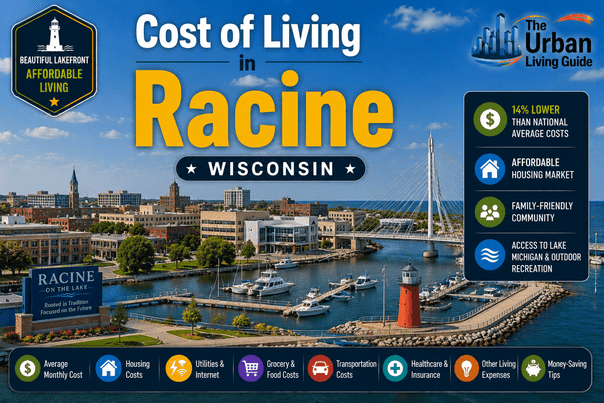
Cost of Living in Racine, WI: Wisconsin’s Oldest Manufacturing City, Lake Michigan Living & Ultra-Affordable Housing
Racine punches above its weight as an affordable Wisconsin gem. Just 25 miles south of downtown Milwaukee, Racine is a small Wisconsin city sitting on the shores of Lake Michigan and the Root River, with a population of 77,000 spread across 15 square miles. Today, the area’s largest employers include SC Johnson and the tractor manufacturer New Holland. If you’re relocating for SC Johnson work, seeking genuine manufacturing job opportunities, or simply wanting one of the most affordable cities in Wisconsin to buy a home, Racine offers real affordability without sacrifice.
This guide breaks down real 2026 costs with actual data. Many people overlook Racine entirely, but the city combines historic manufacturing strength, Lake Michigan access, and housing costs that are shockingly low even by Wisconsin standards.
Average Monthly Cost in Racine
Here’s what monthly living typically looks like:
-
- Single person: Around $2,100–$2,800
- Couple: Typically $3,400–$4,400
- Family of four: Approximately $4,800–$6,200
Racine’s 2026 cost of living is $2,528 per month for singles and $5,567 per month for families of four. Your actual spending depends on neighborhood and lifestyle choices.
Housing Costs in Racine
Rent here stands among America’s most affordable:
-
- Studio: $877 per month
- 1-bedroom apartment: $1,156 per month
- 2-bedroom units: $1,231 per month
- 3-bedroom homes: $1,482 per month
The median home value is $183,049 and if you’re a renter, you can expect the median rent here to be $841. Imagine owning a home for a median value of just $147,000 – less than half the national average. Downtown and lakefront neighborhoods command slightly higher rents. Suburban areas offer even better value. If you’re coming from Milwaukee, Chicago, or anywhere else, housing here is shockingly affordable—In January 2017, it was rated “the most affordable place to live in the world” by the Demographia International Housing Affordability survey.
The rental market serves SC Johnson employees, families, and young professionals seeking real affordability. The city became a central port and manufacturing center and eventually was the home of big-name products like Windex and Pledge.
Utilities & Internet
Monthly costs breakdown:
-
- Utilities (electricity, gas, water, trash): Approximately $140–$190 for standard apartments
- Internet: $50–$75 for reliable speeds
- Seasonal variations: Winter heating adds to bills; lake moderates summer temps
Housing costs in Racine are more affordable than average in the United States.
Grocery & Food Costs
Expect to spend on groceries:
-
- Groceries: Approximately $300–$450 per person monthly
- Dining out: Runs $11–$22 per meal at local spots and chains
- Stores: Pick ‘n Save, Aldi, Costco, Festival Foods
- No sales tax on groceries: Wisconsin exempts groceries from sales tax
Shopping at Aldi or Costco keeps costs very low. Food expenses run 2.7% above average at $411 monthly for an individual and $1,335 for a family, still quite reasonable.
Transportation Costs
Transportation depends on work location:
-
- Car owners: Gas, insurance, parking average $170–$300 monthly
- Public transit: Limited Racine Transit; $60 monthly pass
- Milwaukee commute: Drive via I-94, approximately 30 minutes
- Chicago commute: Drive via I-94, approximately 90 minutes
Most Racine residents drive. Public transit covers local routes but isn’t comprehensive. Many work at local SC Johnson, Modine, or manufacturing firms, keeping commutes short. Energy, transportation and healthcare costs are 22.1% lower at about $682 per month for one person and $1,506 for a household.
Healthcare & Insurance
Health insurance and medical expenses:
-
- Employer health insurance: Typically $160–$380 per month for individuals
- Local clinics and regional hospitals serve Racine
- Specialist visits and prescriptions: Budget $45–$130 monthly for regular care
- Health care costs in Racine are more affordable than the US average
Other Living Expenses
Entertainment, gym memberships, phone plans, and personal care add $140–$300 monthly:
-
- Racine County has nearly 120 miles of designated bicycle routes and recreation trails, and the Racine Art Museum holds the largest and most significant contemporary craft collection in North America
- Lake Michigan waterfront access provides free recreation
- Milwaukee and Chicago cultural attractions are nearby
- Family activities cost less than major city options
Monthly Expense Snapshot
| Expense Category | Single Person | Couple | Family of Four |
| Rent (1-BR/2-BR/3-BR) | $1,156–$1,400 | $1,230–$1,700 | $1,480–$2,000 |
| Utilities | $140–$190 | $160–$230 | $190–$270 |
| Groceries | $300–$450 | $500–$700 | $900–$1,300 |
| Transportation | $170–$300 | $240–$400 | $350–$550 |
| Healthcare (basic) | $45–$130 | $90–$260 | $135–$390 |
| Entertainment/Personal | $140–$300 | $200–$450 | $250–$550 |
| TOTAL (avg monthly) | $1,751–$2,370 | $2,420–$3,740 | $3,305–$5,060 |
Annual & Yearly Expenses
Beyond monthly costs, budget for these regular annual expenses:
Vehicle-Related:
-
- Car insurance: $800–$1,300 yearly in Wisconsin
- Vehicle registration/renewal: $150–$250 yearly
- Maintenance & inspections: Budget $400–$800 yearly
- Winter tires (optional if not driving): $200–$400 seasonal
Insurance & Protection:
-
- Renters insurance: $100–$200 yearly if renting
- Life insurance: $200–$600 yearly if applicable
- Homeowners insurance: $700–$1,200 yearly if purchasing
Subscriptions & Memberships:
-
- Streaming services: $150–$350 yearly
- Gym membership: $300–$600 yearly
- Bicycle maintenance (strong biking culture): $100–$300 yearly
Professional/Administrative:
-
- Annual vehicle inspection: $30–$50 yearly
- Healthcare checkups: $100–$250 if not covered
- Tax preparation: $100–$300 if using professionals
Typical Yearly Non-Housing Expenses: $2,500–$4,500 depending on vehicle and lifestyle
Is Racine Expensive or Affordable?
Racine falls into the very affordable category. Racine is 11% less expensive than the national average and 2% less expensive to live in than the average city in Wisconsin. More impressively, Its median home price of $103,625 makes it one of the most affordable cities in Wisconsin to buy a home.
Real talk: Racine is the most affordable option in this Wisconsin series. Housing is shockingly low, utilities are cheaper, and job opportunities exist locally. There are more than 300 established manufacturing firms across Racine County, employing 25,000 people.
👤 Who Can Afford to Live Comfortably
The median household income of $52,766 is below the national average, but the incredibly low cost of housing significantly enhances the quality of life. SC Johnson employees, Modine Manufacturing workers, local manufacturing professionals, and anyone seeking ultra-affordable living handle costs easily. Even modest incomes work well here.
⚠️ Who May Find Racine Challenging
Single earners making under $32,000 can actually live reasonably in Racine—it’s that affordable. The median household income in Racine is $57,501, compared with the national median household income of $83,181. The bigger challenge: The job market in Racine is worse than the national average. Unemployment in Racine is higher than the national average. Job availability is limited; you may need to commute to Milwaukee or Chicago for career growth
Money-Saving Tips
-
- Rent virtually anywhere in Racine—all neighborhoods are affordable
- Shop at Aldi, Costco, or Festival Foods for lowest grocery costs
- Drive locally or use Racine Transit for short trips
- Take advantage of free Lake Michigan waterfront access and bike trails
- Cook at home; dining out is cheap but cooking saves more
- Buy instead of rent if staying long-term—home prices are incredible
- Bundle insurance policies for discounts
- Maintain vehicle regularly to avoid expensive repairs
- Commute to Milwaukee for higher-paying jobs; live affordably here
FAQs
Is Racine cheaper than other Wisconsin cities?
Yes, Racine is the most affordable city in this Wisconsin series. Housing costs less than Green Bay, Kenosha, Milwaukee, and Madison. It may be the cheapest mid-sized city in Wisconsin.
What salary do I need to live comfortably in Racine?
Median household income of $52,766 is the benchmark. Single individuals can manage on $32,000–$40,000, which is rare for American cities. Racine is genuinely affordable even on modest wages.
Are groceries expensive in Racine?
No, groceries run around $300–$450 per person monthly. Shopping at Aldi or Costco keeps costs very low, and no grocery sales tax helps.
Is the job market strong in Racine?
Job market is moderate. SC Johnson, Modine Manufacturing, and manufacturing firms provide employment, but career growth may require commuting to Milwaukee or Chicago for better opportunities.
How does Racine compare to Milwaukee or Chicago?
Racine costs 30–40% less than Chicago, 20–25% less than Milwaukee proper. Housing is the biggest advantage—you can buy a home here for what an apartment costs in Chicago.
Explore more with The Urban Living Guide
Before moving to Racine, make sure you check: