

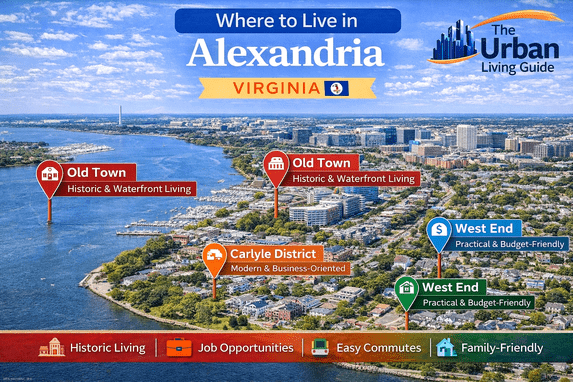
Best Neighborhoods in Alexandria, Virginia: Historic Old Town Cobblestones, Del Ray Avenues & Potomac River Living in 2026
Covering approximately 15.0 square miles of land area along the western banks of the Potomac River immediately south of Washington, D.C., the independent municipality of Alexandria operates under the council-manager governance of the City of Alexandria. Housing an incorporated municipal core population exceeding 159,000 residents and anchoring the historic, maritime, and federal technology core of the Greater Washington metropolitan region (surpassing 6.3 million people), “George Washington’s Hometown” stands as an international powerhouse for federal regulatory policy, national defense contracting, patent and intellectual property law, and four-season Potomac riverfront living.
Relocating across Northern Virginia requires evaluating distinct historic preservation districts, tidal river flood zones, and regional commuter transit corridors operated by the Washington Metropolitan Area Transit Authority (WMATA Metrorail & Metrobus) and the local DASH Bus system.
Inbound movers consistently balance direct daily access to primary regional employers—including the global corporate headquarters of the United States Patent and Trademark Office (USPTO), the National Science Foundation (NSF), the United States Department of Defense at the Mark Center, The Pentagon, and healthcare systems anchored by Inova Alexandria Hospital—against daily transit commutes across Interstate 495 (Capital Beltway / Woodrow Wilson Bridge), Interstate 395 (Shirley Highway), US Route 1 (Richmond Highway), George Washington Memorial Parkway, King Street (Route 7), and Duke Street (Route 236), with air connectivity via Ronald Reagan Washington National Airport (DCA).
Join local real estate expert Paul Kim for an authentic walkthrough exploring the historic cobblestone waterfront, Del Ray avenues, and daily lifestyle across Alexandria, Virginia:
Key Residential Districts in Alexandria, Virginia at a Glance in 2026
| Neighborhood | Location | Distance to Old Town Waterfront | Development Status | Transit Connectivity | Cost Level | Best Fit For |
|---|---|---|---|---|---|---|
| Old Town Alexandria | East Potomac Riverfront | 0 mi (Core) | Preserved 18th-Century Cobblestone Port | Exceptional (King St Metro, Free Trolley, Water Taxi) | High-to-Premium | Patent Attorneys, Federal Executives & Foodies |
| Del Ray | North Central Basin | ~1.8 mi northwest | Historic 1920s Main Street & Bungalows | Exceptional (Braddock Rd / Potomac Yard Metro, US-1) | High-to-Premium | Young Families, Creatives & Dog Owners |
| Potomac Yard | Northeast Rail Corridor | ~2.5 mi north | Modern Master-Planned Tech & Transit Hub | Exceptional (Potomac Yard Metro, Route 1, GW Pkwy) | High-to-Premium | Amazon HQ2 Staff, Tech Engineers & Commuters |
| Rosemont | West Old Town Ridge | ~1.2 mi west | Historic 1908 Streetcar Suburb | Exceptional (King St & Braddock Rd Metros, King St) | Ultra-Premium | Physicians, Law Partners & Historic Lovers |
| Alexandria West & Seminary Hill | West End Ridge | ~5.5 mi west | Established Mid-Century Suburbia | High (I-395 (Exit 4), Seminary Rd, Route 7) | Accessible / Mid-Range | Defense Staff, First-Time Buyers & Hospital Employees |
Comprehensive Breakdown of Living Options Across Alexandria
Old Town Alexandria — 18th-Century Historic Architecture, King Street Mile & Riverfront Marina
Covering the historic grid along the Potomac River shoreline centered along King Street, Fairfax Street, and Union Street, Old Town Alexandria serves as the historic, civic, culinary, and maritime heart of the city. Founded in 1749 and operating under strict municipal historic preservation overlay guidelines championed by the City of Alexandria Office of Historic Alexandria, the district is world-renowned for its preserved Federal and Georgian brick townhouses, gaslamp-lit cobblestone streets along Captain’s Row (Prince Street), and vibrant waterfront parks.
The urban core delivers an authentic car-optional lifestyle with the free King Street Trolley connecting the riverfront marina directly to the King Street-Old Town Metrorail station in under 10 minutes.
- Housing: Real estate is dominated by preserved 18th- and 19th-century Federal brick townhomes with historic cast-iron gas lanterns and private courtyard gardens, converted historic brick warehouse condominiums, and modern luxury riverfront condominium towers (such as Robinson Landing and The Waterfront). Townhome and single-family purchase prices typically range from $650,000 to $3,500,000+, while residential rental flats average $1,950 to $4,200 per month.
- Safety & Crime Rate: Patrolled by the Alexandria Police Department (APD) Sector 1. Old Town maintains a safe, clean, and well-illuminated streetscape supported by active foot and bicycle police patrols and steady pedestrian traffic day and night.
- School District & Education Quality: Governed by Alexandria City Public Schools (ACPS), containing neighborhood public campuses such as Lyles-Crouch Traditional Academy (consistently rated among the highest-performing public elementary schools in Virginia), George Washington Middle School, and Alexandria City High School (historic campus formerly known as T.C. Williams), alongside elite private academies like St. Stephen’s and St. Agnes School.
- Walkability & Daily Conveniences: Outstanding pedestrian walkability (Walk Score of 93-97/100). Residents walk to over 200 independent boutiques, chef-driven seafood restaurants, historic taverns (Gadsby’s Tavern), artisan espresso bars, and grocers including Trader Joe’s on North St. Asaph, Harris Teeter on Pitt St, and the year-round Saturday morning Old Town Farmers’ Market at Market Square (held continuously since 1753).
- Parks & Green Spaces / Pet-Friendliness: Municipal greenspaces include Waterfront Park (featuring open turf lawns and public art installations), Founders Park (scenic riverside dog walking greenway), Windmill Hill Park, and walking access to the historic Torpedo Factory Art Center and the 18-mile paved Mount Vernon Trail. Exceptionally pet-friendly.
- Parking & Traffic Congestion: Managed through municipal underground structured parking garages and residential zone street permits; private brick carports or detached rear garages command high value. Surface traffic along King Street and Washington Street (Route 1) moves steadily with weekend visitor slowdowns.
- Nearby: 8-minute drive to Ronald Reagan Washington National Airport (DCA), 12 minutes to Downtown Washington, D.C., and 6 minutes to Amazon HQ2 in National Landing.
- Noise Levels & Vibe: Historic, cultured, and maritime, filled with riverboat horns, outdoor cafe diners along King Street, art museum patrons, and quiet residential evenings along cobblestone alleys.
- Medical Facilities & Hospitals: Direct 8-minute drive west via Duke Street to Inova Alexandria Hospital on Seminary Road.
- Transit Connectivity: Unmatched multimodal transit centered at the King Street-Old Town Metrorail Station (Blue & Yellow Lines), passenger rail at the Alexandria Union Amtrak / VRE Station, the Potomac Riverboat Water Taxi connecting to The Wharf D.C. and National Harbor, and rapid vehicular access to George Washington Parkway and I-495.
- Affordability: High-to-premium urban price profile; elevated property equity reflects irreplaceable 18th-century architectural heritage, Potomac riverfront access, and rapid subway transit to D.C.
- Who It’s Best For: Patent and intellectual property attorneys at USPTO, corporate lobbyists, defense consultants, history lovers, and urbanites seeking walkable waterfront luxury.
- Drawbacks: High housing acquisition costs per square foot, high-tide street flooding along the lower Strand/King Street foot during severe storm surges, and tourist crowd density on holiday weekends.
Del Ray — “Where Business Is A Pleasure”, 1920s Craftsman Cottages & Mount Vernon Avenue
Covering the established residential basin north of Old Town along Mount Vernon Avenue between Braddock Road and West Glebe Road, Del Ray is celebrated as one of Northern Virginia’s most charming, dog-friendly, and vibrant “Main Street” communities. Originally developed in 1894 as a planned streetcar suburb around the historic St. Asaph Racetrack, the community operates under City of Alexandria municipal administration and is championed by the Del Ray Business Association.
The neighborhood is defined by tree-shaded avenues lined with classic Craftsman bungalows, front porches with American flags, independent coffee roasters, art galleries, and the beloved “First Thursday” community street festivals.
- Housing: Real estate stock features classic 1920s–1940s wood-frame Craftsman bungalows with deep front porches, brick Colonials, Victorian cottages, and custom modern infill single-family homes. Single-family home purchase prices typically range from $680,000 to $1,450,000+, while residential rental properties average $1,850 to $3,400 per month.
- Safety & Crime Rate: Patrolled by the APD Sector 2. Del Ray consistently records low violent and property crime rates, supported by high owner-occupancy and exceptionally active neighborhood block watch networks.
- School District & Education Quality: Governed by ACPS, containing neighborhood public campuses such as Mount Vernon Community School (Dual-Language Immersion Program), Cora Kelly School for Math, Science & Technology, George Washington Middle School, and Alexandria City High School.
- Walkability & Daily Conveniences: Outstanding main-street pedestrian walkability (Walk Score of 88-92/100). Residents stroll along Mount Vernon Avenue to iconic spots like Evening Star Cafe, St. Elmo’s Coffee Pub, The Dairy Godmother (Wisconsin Custard), neighborhood pharmacies, and grocers including ALDI on Monroe and Giant Food.
- Parks & Green Spaces / Pet-Friendliness: Municipal recreation is anchored by Del Ray Dog Park, Eugene Simpson Stadium Park (featuring lighted baseball diamonds and dog parks), The Avenue Green, and walking access to the Four Mile Run Trail. Exceptionally pet-friendly.
- Parking & Traffic Congestion: Plentiful private residential driveways and open on-street parking keep neighborhood lanes clear. Commuter traffic on Mount Vernon Avenue and US Route 1 (Richmond Highway) moves smoothly.
- Nearby: 5-minute drive to Potomac Yard Metrorail Station, 6 minutes to Amazon HQ2 in Pentagon City, and 7 minutes to Reagan National Airport (DCA).
- Noise Levels & Vibe: Warm, artistic, and family-centered, characterized by neighbors chatting on front porches, dogs on outdoor cafe patios, and peaceful residential evenings.
- Medical Facilities & Hospitals: Direct 6-minute drive to Inova Alexandria Hospital on Seminary Road.
- Transit Connectivity: Walkable access to both the Braddock Road Metrorail Station (south end) and the new Potomac Yard Metrorail Station (Blue & Yellow Lines) (north end), supported by DASH Bus Routes (Lines 30 and 36) and rapid road access to US-1 and I-395.
- Affordability: High-tier suburban price profile; provides detached single-family bungalow living with private yards and strong equity stability fueled by Amazon HQ2 and Virginia Tech Innovation Campus growth.
- Who It’s Best For: Young families, dog owners, tech workers commuting to Amazon HQ2 or D.C., remote creatives, and buyers seeking classic 1920s architecture with a small-town community feel.
- Drawbacks: Older home electrical and plumbing modernization requirements, smaller original bungalow square footages, and street parking competition along Mount Vernon Avenue during festival nights.
Potomac Yard — Master-Planned Urban Innovation, Virginia Tech Tech Campus & Infill Rail
Covering approximately 300 acres along the eastern rail corridor between Del Ray and the Potomac River along Route 1 (Richmond Highway) and Potomac Avenue, Potomac Yard represents Northern Virginia’s newest and most innovative master-planned urban transit community. Built on the historic grounds of what was once one of the largest rail classification yards in the eastern United States, the development operates under City of Alexandria municipal administration and is guided by the Potomac Yard Community Association.
The neighborhood is centered around the newly opened infill Potomac Yard-VT Metrorail Station, modern four-story brownstone-style townhomes, lush linear parks, open-air retail, and the multi-million-dollar Virginia Tech Innovation Campus.
- Housing: Real estate stock features modern 2010s–2020s four-story brick executive townhomes with private rooftop terraces and two-car garages, luxury condominium residences, and contemporary podium apartment mid-rises (such as The Dylan and The Sur). Townhome and condominium purchase prices typically range from $450,000 to $1,350,000+, while modern rental apartments average $1,950 to $3,200 per month.
- Safety & Crime Rate: Patrolled by the APD Sector 2. Potomac Yard maintains very low crime rates, supported by modern master-planned environmental lighting and active community security.
- School District & Education Quality: Governed by ACPS, containing neighborhood public institutions such as Jefferson-Houston PreK-8 IB School and Alexandria City High School, alongside graduate innovation programs at the Virginia Tech Innovation Campus.
- Walkability & Daily Conveniences: Outstanding master-planned walkability (Walk Score of 86-90/100). Residents walk to open-air shopping power centers at Potomac Yard Center, hosting Target, Barnes & Noble, Giant Food, casual family dining, and quick pedestrian bridge access into Del Ray.
- Parks & Green Spaces / Pet-Friendliness: Municipal recreation is anchored by the 24-acre linear Potomac Yard Park (featuring interactive spraygrounds, lighted basketball and tennis courts, playgrounds, and picnic pavilions), Four Mile Run Park, and direct connectivity to the Mount Vernon Trail. Exceptionally pet-friendly.
- Parking & Traffic Congestion: Plentiful private attached two-car garages in townhome tracts and structured parking decks in apartment buildings keep streets clear. Commuter traffic on Route 1 (Richmond Highway) moves smoothly following recent transitway expansions.
- Nearby: 4-minute Metrorail ride to Amazon HQ2 / National Landing, 5 minutes to Reagan National Airport (DCA), and 12 minutes to Downtown Washington, D.C.
- Noise Levels & Vibe: Modern, energetic, and professional, filled with tech engineers, graduate researchers, cyclists along the parkway, and calm evenings.
- Medical Facilities & Hospitals: Direct 8-minute drive to Inova Alexandria Hospital and 10 minutes to Virginia Hospital Center.
- Transit Connectivity: Direct subway access at the Potomac Yard-VT Metrorail Station (Blue & Yellow Lines), dedicated bus transit on the Metroway BRT, and rapid road access to George Washington Parkway and US-1.
- Affordability: High-tier urban price tier; provides brand-new energy-efficient construction, multi-story townhome living, and instant subway access with high long-term appreciation potential.
- Who It’s Best For: Amazon HQ2 software engineers, Virginia Tech faculty and graduate researchers, federal commuters, and buyers wanting modern townhomes with low maintenance.
- Drawbacks: Monthly community HOA assessments, ongoing redevelopment of retail center parcels into high-density mixed-use blocks, and aircraft approach sounds from nearby DCA Airport runways.
Rosemont — 1908 Historic Streetcar Suburb, Grand Shade Trees & Dual Metro Stations
Covering the rolling elevated ridges immediately west of Old Town nestled between King Street, Braddock Road, and Russell Road, Rosemont is widely recognized as one of Alexandria’s most architecturally distinguished and tranquil historic enclaves. Developed starting in 1908 as a planned streetcar suburb connected directly to Washington, D.C., the neighborhood operates under City of Alexandria municipal governance and is listed on the National Register of Historic Places, supported by the Rosemont Citizens Association.
The neighborhood is defined by soaring oak and maple canopies, grand early 20th-century estates, expansive private yards, quiet sidewalks, and direct walking access to two separate Metrorail stations.
- Housing: Real estate stock features classic 1910s–1930s brick Georgian Revivals, Craftsman stone bungalows, Dutch Colonials, and custom estate renovations on generous lots. Single-family home purchase prices typically range from $850,000 to $2,450,000+ (with an overall average of $1.4 million), while residential rentals average $2,850 to $5,500 per month.
- Safety & Crime Rate: Patrolled by the APD Sector 1. Rosemont consistently records some of the lowest violent and property crime rates in Northern Virginia, supported by high owner-occupancy and active community vigilance.
- School District & Education Quality: Governed by ACPS, containing neighborhood public campuses such as Naomi L. Brooks Elementary School (formerly Matthew Maury) (renowned for strong parental involvement and academic achievement), George Washington Middle School, and Alexandria City High School.
- Walkability & Daily Conveniences: Outstanding village walkability (Walk Score of 84-88/100). Residents stroll along shaded sidewalks to local bakeries, The Uptowner Cafe, corner markets, and walk directly into the boutique dining and shopping hubs of Old Town and Del Ray.
- Parks & Green Spaces / Pet-Friendliness: Municipal recreation is anchored by Hooffs Run Park and Greenway (featuring shaded creek walking trails and nature paths), Beach Park, Maury Park, and walking access to the historic grounds of the George Washington Masonic National Memorial. Exceptionally pet-friendly.
- Parking & Traffic Congestion: Plentiful private residential driveways, detached garages, and open on-street parking keep neighborhood lanes clear. Commuter traffic on Russell Road and King Street moves steadily.
- Nearby: 4-minute walk to King Street Metrorail Station, 6 minutes to Old Town Waterfront, and 10 minutes to Reagan National Airport (DCA).
- Noise Levels & Vibe: Serene, refined, and historic, characterized by birdsong under mature oak canopies, neighbors walking dogs along greenways, and quiet residential evenings.
- Medical Facilities & Hospitals: Direct 5-minute drive west to Inova Alexandria Hospital on Seminary Road.
- Transit Connectivity: Unrivaled dual-station transit access centered within walking distance of both the King Street-Old Town Metrorail Station and Braddock Road Metrorail Station (Blue & Yellow Lines), passenger rail via Alexandria Union Amtrak/VRE Station, and rapid roadway access to US-1 and I-495.
- Affordability: Ultra-premium price profile for Alexandria; higher real estate acquisition values are balanced by Brooks Elementary zoning, large wooded parcels, and dual-Metro walking access.
- Who It’s Best For: Medical practice directors, corporate law partners, senior federal executives, and families seeking single-family homes with large yards and rapid subway transit.
- Drawbacks: Substantial home purchase entry barrier, high annual property taxes, and older home mechanical and radiator heating maintenance overhead.
Alexandria West & Seminary Hill — Established Mid-Century Living, Inova Hospital & Interstate 395 Access
Covering the rolling elevated ridges of western Alexandria along Seminary Road, Beauregard Street, and King Street (Route 7), Alexandria West & Seminary Hill represents one of the city’s most practical, established, and budget-accessible residential communities. Developed primarily between 1950 and 1980, the district operates under City of Alexandria municipal administration and is championed by active civic neighborhood associations.
The neighborhood combines quiet residential cul-de-sacs with mid-century single-family brick homes, extensive city parks, direct walking access to Inova Alexandria Hospital, and direct 5-minute highway access to the Mark Center Department of Defense Complex.
- Housing: Real estate stock features classic 1950s–1970s brick single-family ramblers, split-levels on quarter-to-half-acre landscaped lots in subdivisions (such as Seminary Valley and Parkside), contemporary townhomes in Cameron Station, and garden-style apartment communities. Single-family purchase prices typically range from $480,000 to $850,000+, townhomes range from $420,000 to $750,000, and rental apartments average $1,550 to $2,450 per month.
- Safety & Crime Rate: Patrolled by the APD Sector 3. Alexandria West maintains a very stable, family-oriented residential environment supported by active neighborhood block watches and high owner-occupancy.
- School District & Education Quality: Governed by ACPS, containing neighborhood public campuses such as James K. Polk Elementary School, William Ramsay Elementary, Francis C. Hammond Middle School, and Alexandria City High School, alongside prestigious private institutions like Episcopal High School (100% boarding preparatory school).
- Walkability & Daily Conveniences: Suburban residential streets are automobile-dependent, but commercial shopping plazas along King Street and Little River Turnpike host diverse international dining, bakeries, pharmacies, and grocers including Harris Teeter at Foxchase, Trader Joe’s at Bailey’s Crossroads, and Safeway.
- Parks & Green Spaces / Pet-Friendliness: Municipal recreation is anchored by the 52-acre Ben Brenman Park (featuring lighted athletic fields, dog parks, and walking paths around a central lake), Holmes Run Stream Valley Park (featuring paved nature trails connecting to Lake Barcroft), and Dora Kelley Nature Park. Exceptionally pet-friendly.
- Parking & Traffic Congestion: Plentiful private attached garages, carports, and wide residential driveways keep neighborhood lanes clear. Commuter traffic moves smoothly with fast on-ramps to Interstate 395 (Exit 4) and King Street (Route 7).
- Nearby: 4-minute drive to The Mark Center DoD Complex, 8 minutes to The Pentagon, and 12 minutes to Downtown Washington, D.C.
- Noise Levels & Vibe: Grounded, traditional, and family-centered, characterized by mature trees, children playing in neighborhood parks, and quiet residential evenings.
- Medical Facilities & Hospitals: Direct walking and driving access: located immediately adjacent to the main campus of Inova Alexandria Hospital on Seminary Road.
- Transit Connectivity: Major highway positioning along Interstate 395 (Shirley Highway) and King Street (Route 7), supported by DASH Bus Routes (Lines 35 and 102) and the Mark Center Transit Center (providing express buses to the Pentagon Metrorail Station).
- Affordability: Alexandria’s most accessible single-family homeownership price tier, offering larger lot sizes, single-story ranch living, and lower purchase price-per-square-foot metrics.
- Who It’s Best For: Defense personnel at the Mark Center or Pentagon, healthcare practitioners and nurses at Inova Hospital, first-time homebuyers, and corporate commuters.
- Drawbacks: Older home mechanical and cosmetic modernization requirements, distance from the Old Town waterfront (5.5 miles), and rush-hour congestion along the I-395 corridor.
Neighborhood Trade-offs: Living Advantages & Drawbacks Across Alexandria, Virginia
| Neighborhood | Core Advantages (Pros) | Core Limitations (Cons) |
|---|---|---|
| Old Town Alexandria | Historic 18th-century cobblestone streets; walkable dining on King St; King St Metro & Water Taxi; Lyles-Crouch Academy. | Higher purchase prices per square foot; high-tide street flooding on lower King St foot; tourist weekend crowds. |
| Del Ray | 1920s Craftsman bungalows; walkable “Main Street” on Mount Vernon Ave; First Thursday festivals; 6 minutes to Amazon HQ2. | Older home plumbing/electrical updates; smaller original bungalow square footage; street parking competition during festivals. |
| Potomac Yard | Direct Potomac Yard-VT Metro access; modern brownstone townhomes; Virginia Tech Innovation Campus; 24-acre park. | Monthly community HOA dues; ongoing high-density construction; aircraft approach noise from nearby DCA runways. |
| Rosemont | Historic 1908 streetcar suburb; top-rated Brooks Elementary; walking distance to dual Metros (King St & Braddock Rd); large lots. | Ultra-premium purchase pricing ($850k-$2.45M+); high property taxes; older home heating and plumbing maintenance. |
| Alexandria West | Alexandria’s most affordable single-family homes; walking distance to Inova Hospital; 4 minutes to Mark Center DoD; I-395 access. | Distance from Old Town waterfront (5.5 miles); complete automobile dependence; rush-hour traffic along I-395. |
Voices of the Community: What Residents Say About Living in Alexandria, Virginia
“Moving into Del Ray gave us the dream neighborhood for our family and dogs. We can walk down Mount Vernon Avenue for custard at Dairy Godmother and coffee at St. Elmo’s, our kids attend Mount Vernon Community School, and my commute to Amazon HQ2 takes barely six minutes on my electric bike.”
— David Miller, Cloud Infrastructure Architect (Verified Local Contributor, Reddit r/alexandria Relocation Forum)
“Living in Old Town Alexandria along the Potomac River offers an authentic historic lifestyle that is hard to match anywhere on the East Coast. I walk to dinner on King Street, hop on the Water Taxi to D.C., and love having Saturday morning farmers markets at Market Square right outside our door.”
— Catherine Hayes, Intellectual Property Partner (Verified Resident Review, Niche Community Insights)
Finding Your Ideal Residential Fit in Alexandria
Selecting your ideal neighborhood in Alexandria requires balancing your household budget with daily workplace destinations, family schooling priorities, and regional transit logistics. Because the City of Alexandria is situated along the Potomac River and connected by the Metrorail Blue and Yellow Lines, your chosen location dictates whether your daily commute relies on subway transit into Downtown Washington, D.C., cycling along the Mount Vernon Trail (Old Town, Potomac Yard), or driving across regional expressways like Interstate 495 (Capital Beltway), Interstate 395, and US Route 1.
Patent attorneys at the USPTO, software engineers at Amazon HQ2 or Virginia Tech Innovation Campus, defense specialists at the Mark Center or The Pentagon, and healthcare staff at Inova Alexandria Hospital should evaluate transit corridors to optimize daily convenience.
Beyond transportation corridors, evaluate essential municipal utility and building infrastructure realities. Northern Virginia experiences four distinct seasons with cold winter temperatures alongside warm, humid summers, making home heating and cooling efficiency through Dominion Energy Virginia and Washington Gas an essential consideration.
In addition, prospective homebuyers evaluating historic Federal townhomes in Old Town or 1920s Craftsman bungalows in Del Ray should inspect masonry pointing, roof flashings, boiler heating systems, and clay sewer laterals, while buyers in master-planned communities like Potomac Yard should verify homeowners association (HOA) reserve funds. Before executing a residential lease or property purchase agreement, verify high-speed fiber broadband availability (such as Verizon Fios or Comcast Xfinity Gigabit) and confirm Alexandria City Public Schools assignment boundaries.
Essential Local Insights & FAQs for Alexandria, Virginia
Which neighborhood in Alexandria is considered best for families with school-age children?
Del Ray, Rosemont, and Old Town are widely regarded as premier family communities in Alexandria. Del Ray and Rosemont provide access to top-ranked public elementary schools (such as Naomi L. Brooks and Mount Vernon Community School) alongside safe, tree-lined streets, neighborhood dog parks, and active community civic leagues.
What is the most walkable neighborhood in Alexandria where you can live without relying on a car?
Old Town Alexandria, Del Ray, and Potomac Yard offer the highest walkability in the city, boasting Walk Scores above 88. Old Town features a Walk Score of 95, allowing residents to walk to over 200 restaurants, grocery stores like Trader Joe’s and Harris Teeter, the Potomac riverfront, and connect directly to the King Street-Old Town Metrorail Station.
What are the safest residential neighborhoods to live in within Alexandria proper?
Rosemont, Old Town, and Del Ray consistently report some of the lowest violent and property crime rates in Northern Virginia. These neighborhoods benefit from high owner-occupancy, dedicated APD foot and bike patrols, and active community watch associations.
What are the most affordable neighborhoods for homebuyers and renters in Alexandria?
Alexandria West (Seminary Valley), Landmark, and Lincolnia provide budget-friendly housing opportunities in the city. In Alexandria West, buyers and renters can secure mid-century single-family brick homes and garden-style townhomes at price points significantly lower than historic Old Town and Potomac Yard enclaves.
How bad is traffic congestion when commuting from Alexandria into Washington, D.C.?
Traffic congestion across the 14th Street Bridge, George Washington Parkway, and Interstate 395 is heavy during morning (7:00 AM to 9:30 AM) and evening (4:00 PM to 6:30 PM) rush hours. Utilizing the WMATA Metrorail system (Blue & Yellow Lines) provides a dependable alternative to bypass highway and bridge gridlock.
Which Alexandria neighborhood is best for tech professionals working at Amazon HQ2?
Potomac Yard, Del Ray, and Old Town North provide the fastest commutes to Amazon HQ2 in National Landing (under 4 to 8 minutes). Potomac Yard offers a direct 4-minute Metrorail ride on the Yellow Line to the Crystal City and Pentagon City stations.
Is Alexandria an affordable place to live compared to Washington, D.C.?
While Alexandria is one of Northern Virginia’s most affluent independent cities, it offers lower overall personal income tax rates, superior public services, and historic single-family homes with yards and river access that provide exceptional long-term investment value compared to the District of Columbia.
Alexandria, Virginia Relocation Resources & Living Guides
The Urban Living Guide creates deeply researched, practical, and informative city relocation resources designed to help individuals, working professionals, and families navigate complex urban landscapes. By analyzing municipal infrastructure, hyper-local zoning patterns, commuter realities, and housing markets, our guides provide actionable insights so you can make confident, data-backed decisions when moving to major metropolitan areas.
Explore our regional guides across Alexandria and Northern Virginia:
- Living in Alexandria, Virginia
- Cost of Living in Alexandria, Virginia
- Pros and Cons of Living in Alexandria, Virginia
Made your decision to move to George Washington’s Hometown? Read our comprehensive relocation roadmap: Moving to Alexandria, Virginia.
Follow The Urban Living Guide for ongoing regional insights, neighborhood developments, and expert local coverage across Greater Alexandria and the Commonwealth of Virginia.