

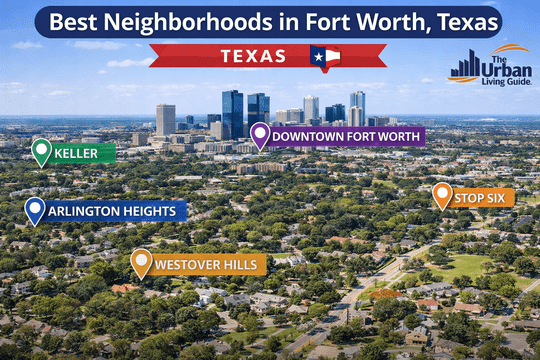
Best Neighborhoods in Fort Worth, Texas: Cowtown Charm, Historic Pockets & Booming Suburbs in 2026
Spanning an expansive 355 square miles of land area across North Central Texas, the City of Fort Worth operates under the municipal governance of the City of Fort Worth, serving as the cultural and economic anchor of Tarrant County with municipal territory stretching into Denton, Parker, and Wise Counties. Housing a municipal core population exceeding 960,000 residents and anchoring the western half of the Dallas-Fort Worth (DFW) Metroplex, Cowtown has evolved from its 19th-century livestock trading heritage into a thriving center for aviation, defense logistics, transportation, healthcare, and higher education.
Moving to Fort Worth requires evaluating distinct geographic corridors shaped by the forks of the Trinity River, regional prairie terrain, expansive clay soil conditions, and high-capacity freeway networks managed by the Texas Department of Transportation.
Residential living across Greater Fort Worth offers diverse lifestyle environments, ranging from walkable brick-paved historic plazas and cultural arts districts to exclusive gated golf enclaves and rapidly expanding master-planned northern suburbs. Inbound residents routinely balance convenient daily access to major regional employers—such as Lockheed Martin Aeronautics, American Airlines Global Headquarters, BNSF Railway, Bell Textron, and the Fort Worth Medical District—against peak-hour highway commute times.
Selecting the right neighborhood defines your daily route across key transportation arteries, including Interstate 30 (Tom Landry Freeway), Interstate 35W, Interstate 820 (Jim Wright Freeway), State Highway 121 (Airport Freeway/Chisholm Trail Parkway), and US Route 287, while establishing your local access to municipal services, community parklands, and top-tier public school districts.
Watch this video to explore different neighborhoods, suburban corridors, and residential communities across Fort Worth:
Best Areas to Live in Fort Worth at a Glance in 2026
| Neighborhood Name | Location | Distance from Core (Downtown) | Development Status | Transit Connectivity | Cost Level | Best Fit For |
|---|---|---|---|---|---|---|
| Keller | North Tarrant County (Incorporated) | Approximately 18 miles north | Established Master-Planned Suburban | Moderate (Automobile-centric, US-377, I-35W) | Mid-to-High Range | Growing Families & Corporate Professionals |
| Downtown Fort Worth (Sundance Square) | Central Core | 0 miles (Urban Center) | High-Density Historic Urban | Exceptional (Fort Worth Central Station, TEXRail, TRE) | Mid-to-High Range | Urban Professionals, Commuters & Creatives |
| Westover Hills | West Core (Independent Town) | Approximately 5 miles west | Historic Ultra-Luxury Enclave | Moderate (Automobile-centric, I-30, Camp Bowie) | Ultra-Premium | High-Net-Worth Executives & Established Families |
| Arlington Heights | West Central / Cultural District Edge | Approximately 3.5 miles west | Historic Walkable Infill | High (Trinity Metro Bus Lines, I-30) | Mid-Range | Young Families, Medical Staff & Creatives |
| Stop Six (Historic Cavile Corridor) | Southeast Basin | Approximately 5 miles southeast | Developing Infill / Revitalization Zone | High (Trinity Metro Routes, US-287, I-820) | Accessible / Budget-Friendly | First-Time Homebuyers & Value Renters |
Best Neighborhoods in Fort Worth Discussed in Detail
Keller — Master-Planned Suburban Prestige & Exemplary Educational Corridor
Situated in the rolling prairie terrain of northern Tarrant County, the incorporated city of Keller is widely celebrated as one of North Texas’s premier family-oriented suburban communities. Operating under its own municipal administration via the City of Keller Official Portal, the city features mature tree-lined subdivisions, modern custom home developments, and a preserved historic retail core in Old Town Keller along US Highway 377. Combining strict residential zoning, low crime rates, and proximity to major corporate employment hubs in the AllianceTexas Corridor, Keller delivers a secure and upscale suburban living environment.
- Housing: Real estate inventory consists of spacious single-family brick and stone residences on expansive lots, master-planned gated subdivisions (such as Hidden Lakes and Manor Gate), and modern suburban townhomes. Single-family purchase prices typically range around $460,000 to $1,250,000+, while rental homes average $2,200 to $3,450 per month.
- Safety & Crime Rate: Protected by the dedicated Keller Police Department, the city consistently reports some of the lowest violent and property crime rates in the DFW Metroplex, supported by regional public safety dispatch and active neighborhood watch programs.
- School District & Education Quality: Governed primarily by the top-rated Keller Independent School District (KISD), featuring high-performing public schools such as Keller High School and Keller Central High School, recognized for academic excellence, state-level fine arts, and championship athletic programs.
- Walkability & Daily Conveniences: The historic village center of Old Town Keller along Main Street (US-377) offers walkable dining, artisan bakeries, and boutique shops, while commercial corridors along Keller Parkway (FM 1709) host retail power centers including Kroger Marketplace, Tom Thumb, and Sprouts Farmers Market.
- Parks & Green Spaces / Pet-Friendliness: Exceptional municipal parks managed by the city, including the 130-acre Bear Creek Park (featuring 26 miles of connected hike-and-bike trails, fishing pavilions, and sports fields) and The Keller Pointe community recreation and aquatic center, complemented by pet-friendly parks like K-9 Pointe Dog Park.
- Parking & Traffic Congestion: Wide two-to-three car garages and spacious suburban driveways provide effortless residential parking. Morning commuter slowdowns occur along US-377, FM 1709, and the on-ramps to Interstate 35W heading toward Downtown Fort Worth.
- Noise Levels & Vibe: Serene, quiet, and family-oriented, characterized by peaceful residential cul-de-sacs with low ambient background noise.
- Medical Facilities & Hospitals: Direct medical infrastructure supported within city boundaries by Texas Health Harris Methodist Hospital Alliance located just north on I-35W and Medical City Alliance.
- Transit Connectivity: Automobile-centric regional travel via US-377, FM 1709, and I-35W; commuter rail access is accessible 10 minutes south via the Trinity Metro TEXRail Smithfield Station in North Richland Hills, providing non-stop passenger rail to DFW Airport and Downtown Fort Worth.
- Affordability: Mid-to-high suburban pricing; provides larger lot sizes, custom construction finishes, and extensive municipal amenities at accessible rates compared to northern Dallas suburbs like Southlake or Westlake.
- Who It’s Best For: Growing families prioritizing exemplary public schools, corporate professionals working in the Alliance corridor or DFW Airport, and buyers seeking peaceful suburban living.
- Drawbacks: Substantial 18-to-25-mile daily highway commute into Downtown Fort Worth during peak rush hours and car dependence for standard daily errands.
Downtown Fort Worth — Historic Brick Urban Core, Sundance Square & Transit Hub
Surrounded by the natural bend of the Trinity River to the north and east, Downtown Fort Worth is the central business, legal, governmental, and cultural core of Tarrant County. Spanning a 35-block pedestrian-friendly street grid centered on the famous red-brick plaza of Sundance Square, downtown features restored 19th-century commercial buildings alongside modern glass residential towers and corporate office high-rises. Operating under guided civic management supported by the City of Fort Worth and Downtown Fort Worth, Inc. (DFWI), the urban core provides walkable, transit-oriented living.
- Housing: Dominated by luxury high-rise condominium towers (such as The Tower and Omni Residences), converted historic brick lofts, and contemporary mid-rise apartment communities along Commerce Street and Houston Street. Condominium purchase valuations typically range around $310,000 to $1,150,000, while modern 1-bedroom rental apartments average $1,550 to $2,650 per month.
- Safety & Crime Rate: Patrolled by the Fort Worth Police Department (FWPD) Central Division and supported by dedicated private Sundance Square security bicycle patrols, giving Downtown Fort Worth a reputation as one of the cleanest and safest urban centers in the country.
- School District & Education Quality: Governed by the Fort Worth Independent School District (FWISD), with higher education footprints anchored by the expanding Texas A&M University Fort Worth Law & Innovation Campus and Tarrant County College Trinity River Campus.
- Walkability & Daily Conveniences: Outstanding walkability (Walk Score of 86-90/100). Residents comfortably stroll to grocery markets like Neighbor’s House Grocery, historic performing arts at Bass Performance Hall, movie theaters, and dozens of chef-driven steakhouses and cafes.
- Parks & Green Spaces / Pet-Friendliness: Exceptional urban public spaces including the world-renowned Fort Worth Water Gardens on Commerce Street, General Worth Square, Heritage Park Overlook, and direct stair access down into the paved Trinity Trails Network. Highly pet-friendly with indoor residential pet facilities.
- Parking & Traffic Congestion: Assigned garage parking spaces typically add $100 to $200 per month for apartment residents. Street parking is strictly metered, with traffic building along Belknap Street and Weatherford Street during peak business hours.
- Noise Levels & Vibe: Vibrant, historic, and polished, featuring brick-paved sidewalk chatter, fountain water features, and energetic weekend entertainment crowds.
- Medical Facilities & Hospitals: Direct 5-minute access to the massive healthcare complex in the Fort Worth Medical District, anchored by Texas Health Harris Methodist Hospital Fort Worth, Cook Children’s Medical Center, and Baylor Scott & White All Saints Medical Center.
- Transit Connectivity: Unmatched regional rail connectivity centered at Fort Worth Central Station, offering direct passenger rail via Trinity Metro TEXRail (direct to DFW Airport Terminal B), the Trinity Railway Express (TRE) to Downtown Dallas, and Amtrak (Texas Eagle and Heartland Flyer), with vehicle access to I-35W and I-30. Regional aviation is accessible via Dallas Fort Worth International Airport (DFW) located 22 miles northeast.
- Affordability: Mid-to-high urban pricing; condominium price-per-square-foot ratios remain accessible compared to Downtown Dallas or Austin, though monthly building HOA dues apply.
- Who It’s Best For: Corporate professionals, attorneys, aviation staff commuting via TEXRail, medical fellows, and urbanites seeking a walkable, car-optional lifestyle.
- Drawbacks: Higher residential parking fees, weekend nightlife crowds around Sundance Square, and limited big-box grocery options within the immediate grid.
Westover Hills — Historic Estate Grandeur, Private Seclusion & Ultra-Luxury Living
Occupying an elevated wooded plateau overlooking the Clear Fork of the Trinity River just west of central Fort Worth, the independent incorporated town of Westover Hills represents one of the wealthiest and most prestigious residential municipalities in the United States. Founded in the 1920s around the private grounds of the Shady Oaks Country Club and River Crest Country Club, the enclave is characterized by grand winding estate parkways, mature native post oaks, historic architectural pedigree, and strict municipal building codes. Local governance and emergency services are managed through the Town of Westover Hills Official Portal.
- Housing: Real estate stock is composed of custom historic multi-million dollar estates, grand Spanish Colonial Revivals, French Châteaux, mid-century architectural masterpieces, and modern stone mansions along Roaring Springs Road and Valley Ridge Road on multi-acre lots. Detached home valuations typically range around $1,850,000 to $12,000,000+, with virtually zero multi-family rental properties within town boundaries.
- Safety & Crime Rate: Protected by the dedicated Westover Hills Police Department (WHPD), which maintains continuous 24/7 mobile patrols across all residential streets and delivers emergency response times averaging under 2 minutes.
- School District & Education Quality: Governed by FWISD, but world-renowned for its proximity to top independent private college preparatory institutions in Fort Worth, including Fort Worth Country Day, All Saints’ Episcopal School, and Trinity Valley School.
- Walkability & Daily Conveniences: The private residential lanes are tranquil, secluded, and automobile-dependent without sidewalks, though premier shopping is immediately adjacent along the historic red-brick Camp Bowie Boulevard Corridor, featuring specialty grocers like Central Market Fort Worth, upscale boutiques, and fine dining.
- Parks & Green Spaces / Pet-Friendliness: Surrounded by private golf fairways at Shady Oaks Country Club and River Crest Country Club, with immediate access to public green spaces along the Trinity River Greenbelt and Z. Boaz Community Park.
- Parking & Traffic Congestion: Expansive private multi-car motor courts and gated residential garages keep all neighborhood streets clear. Surrounding traffic flows steadily onto Interstate 30 and State Highway 183.
- Noise Levels & Vibe: Exceptionally quiet, secluded, and serene, characterized by massive shaded oak canopies, birdsong, and private gated residences with virtually zero ambient traffic noise.
- Medical Facilities & Hospitals: Direct 8-minute vehicular access to comprehensive emergency trauma and specialty care at Texas Health Harris Methodist Hospital Fort Worth and Baylor Scott & White All Saints.
- Transit Connectivity: Road-centric travel via Camp Bowie Boulevard, Interstate 30, and I-820, allowing a 7-minute drive into Downtown Fort Worth and a 10-minute commute to the Cultural District.
- Affordability: Ultra-premium price structure across property acquisitions, local ad valorem property taxes, and private country club memberships.
- Who It’s Best For: High-net-worth families, corporate CEOs, established civic leaders, medical executives, and buyers seeking architectural prestige, complete privacy, and unmatched municipal security.
- Drawbacks: High capital entry barrier for homeownership, strict municipal zoning restrictions prohibiting commercial development, and reliance on private vehicles for all errands.
Arlington Heights — Historic Craftsman Charm, Tree-Canopied Streets & Cultural Proximity
Situated in west-central Fort Worth between Interstate 30 and Camp Bowie Boulevard, Arlington Heights is one of the city’s most beloved and established historic residential neighborhoods. Developed primarily in the 1920s through the 1940s, the community is characterized by picturesque tree-canopied streets, classic Craftsman bungalows, Tudor cottages, and renovated mid-century homes. Positioned immediately adjacent to the world-renowned Fort Worth Cultural District, Arlington Heights blends historic neighborhood warmth with pedestrian access to dining and museums.
- Housing: Real estate features restored historic 1920s Craftsman bungalows, charming brick Tudor cottages, California ranch-style homes, and modern infill townhome developments. Single-family purchase prices typically range around $320,000 to $720,000, while rental duplexes and apartments average $1,450 to $2,350 per month.
- Safety & Crime Rate: Patrolled by the FWPD West Division. The area maintains an active, engaged residential community with low rates of violent crime, though opportunistic property incidents like vehicle break-ins occur along busier perimeter streets.
- School District & Education Quality: Governed by FWISD, featuring neighborhood campuses such as South Hi Mount Elementary, Stripling Middle School, and Arlington Heights High School, alongside proximity to private options.
- Walkability & Daily Conveniences: Outstanding pedestrian activity along the historic red-brick spine of Camp Bowie Boulevard, home to beloved local grocers like Central Market, vintage record shops, neighborhood bakeries, and casual bistros.
- Parks & Green Spaces / Pet-Friendliness: Immediate access to open municipal parklands at Lake Como Park (featuring lakeside walking paths and recreation centers), Trinity Park, and the paved trails of the Trinity Trails Network. The neighborhood is exceptionally pet-friendly with walkable sidewalk grids.
- Parking & Traffic Congestion: Generous on-street parking and private residential driveways. Commuter traffic builds along Hulen Street, Montgomery Street, and on-ramps to Interstate 30 during peak morning drive times.
- Noise Levels & Vibe: Relaxed, friendly, and established, with quiet residential evenings transitioning to lively daytime sidewalk foot traffic near Camp Bowie.
- Medical Facilities & Hospitals: Direct 5-to-7 minute access to the Fort Worth Medical District, including Texas Health Harris Methodist and Cook Children’s Medical Center.
- Transit Connectivity: High-frequency bus lines operated by Trinity Metro (Routes 2 and 7) running along Camp Bowie directly to Downtown, with rapid vehicle on-ramps to Interstate 30 and Chisholm Trail Parkway.
- Affordability: Balanced mid-range pricing; offers character-rich historic single-family homes at accessible entry valuations compared to Westover Hills or Rivercrest.
- Who It’s Best For: Young professionals, healthcare workers at the Medical District, university faculty at nearby Texas Christian University (TCU), young families, and museum lovers.
- Drawbacks: Older home plumbing and electrical systems requiring periodic renovation, smaller historic garage dimensions, and peak-hour traffic along Hulen Street.
Stop Six (Historic Cavile Corridor) — Cultural Heritage, Urban Revitalization & Affordable Infill
Located in the southeastern quadrant of Fort Worth along Rosedale Street and Berry Street, Stop Six is a culturally rich, historic African American community with roots tracing back to the early 1900s as the sixth stop on the historic Northern Texas Traction Company interurban electric streetcar line between Fort Worth and Cleburne. Today, the district is undergoing historic community revitalization through the comprehensive Stop Six Choice Neighborhood Initiative led by the Fort Worth Housing Solutions (FWHS) and the City of Fort Worth, delivering newly constructed modern mixed-income housing, community health centers, and commercial hubs.
- Housing: Real estate stock is composed of classic 1940s–1960s single-story wood frame and brick starter homes on generous lot sizes, newly constructed modern energy-efficient mixed-income townhomes (such as Cowan Place and Hughes House), and affordable rental properties. Single-family purchase prices typically range around $170,000 to $310,000, while rental apartments and homes average $950 to $1,550 per month.
- Safety & Crime Rate: Patrolled by the FWPD East Division. While the community has historically navigated elevated property and violent crime rates, ongoing city infrastructure investments, community policing initiatives, and residential redevelopment continue to improve neighborhood safety.
- School District & Education Quality: Governed by FWISD, featuring neighborhood campuses such as Paul Laurence Dunbar High School (renowned for its historical legacy and STEM programs), Sunrise-McMillan Elementary, and William James Middle School.
- Walkability & Daily Conveniences: Moderate pedestrian walkability along the developing East Rosedale Street commercial corridor, home to local community markets, traditional soul food cafes, community churches, and newly constructed retail centers.
- Parks & Green Spaces / Pet-Friendliness: Municipal recreation is anchored by the expansive Gateway Park on the Trinity River (featuring mountain biking trails, baseball complexes, and the Fort Woof Dog Park), alongside neighborhood parks like Rosedale Park and Tandy Hills Natural Area (a 160-acre indigenous prairie preserve offering hiking trails and skyline views).
- Parking & Traffic Congestion: Plentiful private residential driveway parking and open street parking. Rapid highway access onto US Route 287 (Martin Luther King Jr. Freeway) and Interstate 820 provides stress-free commuting without northern suburban gridlock.
- Noise Levels & Vibe: Community-centered, resilient, and undergoing transformation, shifting from active daytime commercial corridors to quiet residential evenings in established subdivisions.
- Medical Facilities & Hospitals: Direct emergency medical coverage supported by the JPS Health Network (including John Peter Smith Hospital Level I Trauma Center) and community clinics on East Rosedale Street.
- Transit Connectivity: High-frequency public bus transit provided by Trinity Metro (Routes 4 and 28) connecting directly to the Fort Worth Central Transit Station downtown, with rapid vehicle access to US-287, I-30, and I-820.
- Affordability: Fort Worth’s most accessible entry-level homeownership and rental price tier, offering substantial residential lot acreage and affordable monthly living overhead.
- Who It’s Best For: First-time homebuyers, value-seeking renters, real estate investors, and buyers seeking larger residential lots within a 7-minute drive of Downtown Fort Worth.
- Drawbacks: Pockets of higher property crime, variable public school test metrics across individual campuses, and older municipal infrastructure in specific blocks undergoing transition.
Comprehensive Neighborhood Pros and Cons Comparison
| Neighborhood | Core Advantages (Pros) | Core Limitations (Cons) |
|---|---|---|
| Keller | Top-ranked Keller ISD public schools; exceptionally safe master-planned neighborhoods; 26+ miles of trails at Bear Creek Park; proximity to Alliance employers. | Heavy peak-hour commute congestion on I-35W and US-377; complete personal vehicle reliance for shopping; hot summer temperatures. |
| Downtown Fort Worth | Direct TEXRail and TRE rail transit; walkable dining in Sundance Square; proximity to Bass Performance Hall; immediate access to Trinity Trails. | Elevated monthly apartment parking fees; weekend nightlife crowds; limited full-size suburban grocery options within the immediate grid. |
| Westover Hills | Historic architectural prestige; dedicated WHPD emergency response under 2 minutes; multi-acre private estate layouts; close proximity to Camp Bowie. | Ultra-premium real estate entry valuations; strict municipal zoning prohibiting local retail; total automobile dependence for daily errands. |
| Arlington Heights | Historic 1920s Craftsman bungalows; high walkability to Camp Bowie Boulevard and Central Market; 5-minute commute to the Medical District and TCU. | Aging plumbing/electrical infrastructure requiring maintenance; compact historical garages; peak-hour traffic bottlenecks along Hulen Street. |
| Stop Six | Fort Worth’s most accessible entry-level home and rental prices; large residential lots; major civic investments via the Choice Neighborhood Initiative. | Pockets of elevated property crime; variable school performance ratings; older street infrastructure in transitional blocks. |
How You Decide Which Neighborhood Is Best For You
Choosing your ideal neighborhood in Greater Fort Worth requires balancing your gross household finances with daily workplace locations, family schooling preferences, and highway travel tolerance. Because the western half of the DFW Metroplex spans expansive prairie terrain divided by the forks of the Trinity River, your chosen location dictates whether your daily commute relies on heavily traveled freeway arteries like I-35W and I-30 or on high-speed rail connections via the Trinity Metro TEXRail Line or Trinity Railway Express (TRE). Aerospace engineers working at Lockheed Martin, corporate employees in the Alliance Corridor, or healthcare specialists based in the Fort Worth Medical District should prioritize living on the appropriate side of the city to eliminate cross-county gridlock.
Beyond transportation corridors, evaluate essential municipal utility and environmental realities. North Texas experiences intense summer heat waves exceeding 100 degrees Fahrenheit, making home energy efficiency and electric service through providers operating on the ERCOT grid important considerations. Furthermore, soil composition across Tarrant County features expansive blackland clays, making structural foundation inspections and irrigation maintenance crucial before purchasing historic homes in enclaves like Arlington Heights. Prior to executing a residential lease or property closing, verify high-speed fiber broadband availability (such as AT&T Fiber or Spectrum Gigabit), check local property tax rates across Tarrant County, and confirm school district assignment boundaries.
Frequently Asked Questions About Fort Worth Neighborhoods
Which neighborhood in the Fort Worth area is considered the best for families with school-age children?
Keller is widely recognized as the premier family community in Greater Fort Worth. It offers exceptional master-planned neighborhoods, expansive municipal parks like Bear Creek Park, and access to the top-performing Keller Independent School District (KISD). For families prioritizing historic charm close to central amenities, Arlington Heights provides strong community appeal and convenient access to private preparatory academies.
What is the most walkable neighborhood in Fort Worth where you can live without a car?
Downtown Fort Worth (especially surrounding Sundance Square) is the most walkable district in the city, boasting an 86+ Walk Score. Residents can complete daily errands on foot, walk to cultural venues, restaurants, and grocery markets, and connect directly to regional passenger rail at Fort Worth Central Station for direct trips to DFW Airport or Downtown Dallas.
What are the safest residential neighborhoods to live in within Fort Worth?
Westover Hills and Keller consistently report the lowest violent and property crime rates in North Texas. Westover Hills benefits from its dedicated municipal police department with emergency response times under two minutes, while Keller maintains a nationally recognized municipal police department with active community policing.
What are the most affordable neighborhoods for homebuyers and renters in Fort Worth?
Stop Six and surrounding southeast Fort Worth neighborhoods provide the most budget-friendly housing opportunities in the metropolitan area. Buyers and renters can secure single-family starter homes on generous lot sizes and modern mixed-income apartments at price points significantly lower than western or northern suburbs.
How long does it take to commute from Fort Worth to Downtown Dallas?
Driving from Fort Worth to central Dallas during peak morning rush hours typically takes between 45 and 75 minutes along Interstate 30 or State Highway 183. Utilizing the Trinity Railway Express (TRE) commuter train from Fort Worth Central Station provides a reliable 55-to-60 minute rail transit option to Dallas Union Station.
Is TEXRail convenient for traveling to Dallas Fort Worth International Airport?
Yes, Trinity Metro’s TEXRail commuter line provides direct, non-stop passenger rail service from Fort Worth Central Station and North Side Station straight into DFW Airport Terminal B in approximately 50 minutes, offering a stress-free transit option for frequent flyers and aviation workers.
Which Fort Worth neighborhood is best for healthcare professionals in the Medical District?
Arlington Heights, Downtown Fort Worth, and the Near Southside provide the fastest commutes to the Fort Worth Medical District, allowing physicians, nurses, and medical staff to reach hospital campuses (such as Texas Health Harris Methodist and Cook Children’s) within a 5-to-10 minute drive or bike ride.
Know More About the City
The Urban Living Guide creates deeply researched, practical, and informative city relocation resources designed to help individuals, working professionals, and families navigate complex urban landscapes. By analyzing municipal infrastructure, hyper-local zoning patterns, commuter realities, and housing markets, our guides provide actionable insights so you can make confident, data-backed decisions when moving to major metropolitan areas.
Explore our comprehensive guides to the Fort Worth metropolitan region:
- Living in Fort Worth, Texas
- Cost of Living in Fort Worth, Texas
- Pros and Cons of Living in Fort Worth, Texas
- Moving to Fort Worth, Texas
Follow The Urban Living Guide for ongoing regional insights, neighborhood developments, and expert local coverage across Greater Fort Worth and Tarrant County.