

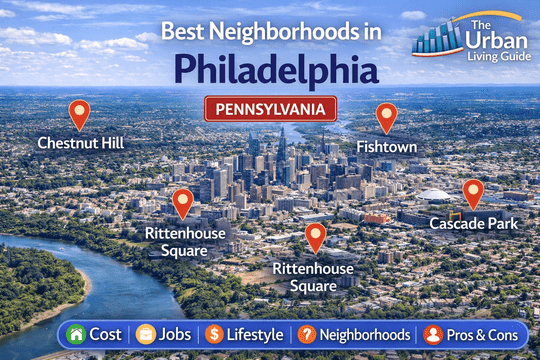
Best Neighborhoods in Philadelphia: Historic Squares, Rowhouse Enclaves & Urban Quarters in 2026
Covering approximately 134.1 square miles of land area across southeastern Pennsylvania at the confluence of the Delaware and Schuylkill Rivers, the consolidated city-county municipality of Philadelphia operates under the mayor-council governance of the City of Philadelphia. Housing an incorporated municipal population exceeding 1.55 million residents and anchoring the Delaware Valley metropolitan region of over 6.24 million people, the “Birthplace of America” stands as an essential economic, biomedical, legal, and higher-education powerhouse on the East Coast.
Relocating across Philadelphia involves evaluating diverse architectural fabrics, historic preservation overlays, and comprehensive public transportation networks managed by the Southeastern Pennsylvania Transportation Authority (SEPTA). Inbound movers consistently balance direct access to primary employment epicenters—such as the Center City Financial District, the expanding life sciences hub in University City, the Navy Yard Corporate Campus, and major healthcare networks anchored by Penn Medicine (Hospital of the University of Pennsylvania) and Jefferson Health—against daily commute routes across Interstate 76 (Schuylkill Expressway), Interstate 95 (Delaware Expressway), Interstate 676 (Vine Street Expressway), and US Route 1 (Roosevelt Boulevard), with regional air links via Philadelphia International Airport (PHL).
Take an authentic street-level tour through the cobblestone corridors, historic park squares, and distinctive residential neighborhoods of Philadelphia:
Key Residential Districts Across Philadelphia at a Glance in 2026
| Neighborhood Name | Location | Distance from Core (City Hall) | Development Status | Transit Connectivity | Cost Level | Best Fit For |
|---|---|---|---|---|---|---|
| Center City | Central Commercial Core | 0 miles (Immediate Core) | High-Density Mixed-Use & Commercial | Exceptional (SEPTA Broad Street/Market-Frankford Lines, Regional Rail) | High-to-Premium | Corporate Commuters, Legal Staff & Urbanites |
| Rittenhouse Square | Southwest Center City | Approximately 0.5 miles southwest | Preserved Historic Ultra-Luxury | Exceptional (SEPTA Subway-Surface Trolleys, Regional Rail) | Ultra-Premium | High-Net-Worth Executives, Physicians & Luxury Buyers |
| Fishtown | Lower River Ward | Approximately 2.5 miles northeast | Adaptive Industrial Infill & Dining Hub | High (SEPTA Market-Frankford Line, Route 15 Trolley) | Mid-to-High Range | Young Professionals, Tech Workers & Creatives |
| Chestnut Hill | Northwest Ridge | Approximately 10 miles northwest | Historic Stone Village & Estate Suburb | High (Dual SEPTA Regional Rail Lines, Germantown Ave) | High-to-Premium | Families, Academics & Nature Enthusiasts |
| Port Richmond | Northeast River Ward | Approximately 4 miles northeast | Historic Working-Class Rowhouse Infill | High (SEPTA Route 15 Trolley, I-95, Richmond St) | Accessible / Budget-Friendly | First-Time Homebuyers, Value Renters & Commuters |
Comprehensive Breakdown of Living Options Across the City
Center City — Walkable Urban Pulse, High-Rise Towers & Historic Cultural Institutions
Positioned in the geographic core between the Delaware and Schuylkill Rivers, Center City represents Philadelphia’s premier business, civic, and cultural nexus. Centered around the grand masonry tower of Philadelphia City Hall and the Market Street commercial spine, the district encompasses iconic corridors including the Avenue of the Arts (South Broad Street) and Logan Square. The neighborhood operates under municipal planning supported by the Center City District management authority.
The urban core delivers an authentic car-optional lifestyle filled with historic residential rows, luxury high-rise condominium towers, corporate headquarters (including Comcast Corporation), and acclaimed fine dining.
- Housing: Real estate stock is dominated by contemporary high-rise luxury condominium towers (such as The Murano and Arthaus), classic 19th-century brick rowhomes, and converted historic mid-rise apartment communities. Condominium purchase valuations typically range from $320,000 to $1,850,000+, while 1-bedroom rental apartments average $1,850 to $3,200 per month.
- Safety & Crime Rate: Patrolled by the Philadelphia Police Department (PPD) 6th and 9th Districts and supported by visible, uniformed Center City District Safety Ambassadors. Commercial thoroughfares and transit hubs maintain steady pedestrian activity, though standard urban vigilance is advised regarding opportunistic property crimes and vehicle larcenies in commercial parking garages.
- School District & Education Quality: Governed by the School District of Philadelphia, featuring top-ranked public magnet campuses such as Masterman School and Central High School, alongside higher-education institutions anchored by Thomas Jefferson University, Temple University Center City, and Moore College of Art & Design.
- Walkability & Daily Conveniences: World-class pedestrian walkability (Walk Score of 98/100). Residents walk to premier retail corridors along Chestnut Street and Walnut Street, specialty markets, and the historic Reading Terminal Market for fresh produce, artisan bakeries, and regional culinary vendors.
- Parks & Green Spaces / Pet-Friendliness: Exceptional urban greenspaces including Franklin Square, Washington Square, Dilworth Park (featuring interactive splash fountains and winter ice skating), and direct access to the scenic walking trails of the Schuylkill River Trail. Highly pet-friendly with luxury high-rise pet amenities.
- Parking & Traffic Congestion: Street parking is strictly managed through the Philadelphia Parking Authority (PPA) residential permit system; private parking garages typically add $250 to $450 per month. Vehicular congestion builds heavily along Broad Street, JFK Boulevard, and on-ramps to the Vine Street Expressway (I-676).
- Noise Levels & Vibe: Vibrant, high-energy, and cosmopolitan, filled with theatergoers along the Avenue of the Arts, corporate commuters, and lively outdoor restaurant patios.
- Medical Facilities & Hospitals: Direct medical infrastructure anchored within the district by Thomas Jefferson University Hospital and Pennsylvania Hospital (the nation’s first hospital, founded in 1751) on Spruce Street.
- Transit Connectivity: Unrivaled public transit hub centered at the SEPTA Jefferson Station and Suburban Station, providing direct access to all SEPTA Regional Rail lines, the Broad Street Line, the Market-Frankford Line, PATCO Speedline to New Jersey, and regional rail at 30th Street Station (Amtrak and NJ Transit).
- Affordability: High-tier urban price structure; premium price-per-square-foot metrics reflect the neighborhood’s unmatched walkability, job proximity, and cultural amenities.
- Who It’s Best For: Finance professionals, corporate attorneys, healthcare staff at Jefferson, Comcast employees, and urbanites seeking a car-free downtown lifestyle.
- Drawbacks: High monthly parking overhead, elevated ambient city noise along primary commercial avenues, and dense pedestrian crowds during rush hours.
Rittenhouse Square — Iconic Parkside Elegance, Michelin Dining & Prestigious Brownstones
Surrounding one of William Penn’s five original open-air public squares in southwest Center City, Rittenhouse Square represents the pinnacle of luxury residential living and historic refinement in Pennsylvania. Operating under city historic preservation guidelines and championed by the Friends of Rittenhouse Square, the neighborhood centers around the tree-canopied lawns of Rittenhouse Square Park.
The district is defined by pre-war limestone cooperatives, historic brownstones, upscale designer boutiques along Walnut Street, and acclaimed open-air bistros along 18th Street.
- Housing: Real estate consists of historic multi-million dollar 19th-century brownstone and brick townhomes on quiet cobblestone lanes (such as Delancey Place), luxury pre-war co-ops on the park, and modern high-rise skyscraper condominiums (such as The Laurel, 10 Rittenhouse, and The Dorchester). Single-family townhome purchases typically range from $1,200,000 to $8,500,000+, while luxury residential rentals average $2,450 to $5,500 per month.
- Safety & Crime Rate: Patrolled by the PPD 9th District and supported by private building doormen and Center City District patrols. Rittenhouse Square consistently records some of the lowest violent and property crime figures in the central city.
- School District & Education Quality: Governed by the School District of Philadelphia, zoned to highly sought-after public catchment schools including Albert M. Greenfield School, alongside prestigious private independent institutions like The Philadelphia School and Friends’ Central City School.
- Walkability & Daily Conveniences: Outstanding pedestrian infrastructure (Walk Score of 99/100). Residents stroll to high-end designer flagships, independent bookshops, artisan bakeries, and grocers including Di Bruno Bros. gourmet specialty market, Trader Joe’s on 22nd Street, and Rittenhouse Market.
- Parks & Green Spaces / Pet-Friendliness: Direct access to the manicured central park at Rittenhouse Square (featuring historic bronze sculptures, reflection fountains, and seasonal art fairs), Fitler Square, and the Schuylkill River Park (featuring lighted tennis courts, basketball courts, and a dedicated turf dog park). Exceptionally dog-friendly.
- Parking & Traffic Congestion: Street parking is strictly limited; private garage parking spaces range from $350 to $600+ per month. Traffic moves slowly along Locust Street and Walnut Street during peak evening dining hours.
- Noise Levels & Vibe: Sophisticated, tranquil, and polished along residential side streets, with lively upscale dining and social activity surrounding the square.
- Medical Facilities & Hospitals: Direct 5-minute access to Pennsylvania Hospital and comprehensive care at the Hospital of the University of Pennsylvania (HUP) just across the river.
- Transit Connectivity: Served directly by the SEPTA Subway-Surface Trolley lines (Routes 10, 11, 13, 34, 36) at 19th and 22nd Street stations, SEPTA Bus Routes (Routes 9, 12, 21, 42), and a 5-minute walk to Suburban Station Regional Rail.
- Affordability: Ultra-premium price tier across real estate acquisitions, property taxes, and dining, offset by historic prestige and long-term equity stability.
- Who It’s Best For: High-net-worth families, corporate CEOs, venture capital partners, medical directors, and buyers seeking classic architectural pedigree and parkside living.
- Drawbacks: High housing costs per square foot, strict historical preservation renovation codes on townhomes, and scarce on-street guest parking.
Fishtown — Creative Waterfront Infill, Destination Gastronomy & Modern Townhomes
Covering the historic industrial corridor along the Delaware River directly northeast of Northern Liberties, Fishtown has emerged as one of the most culturally vibrant and culinary-focused neighborhoods in the United States. Named after its 18th-century shad fishing heritage, the community operates under city administration and is supported by the Fishtown Business Improvement District. Centered along the commercial avenues of Frankford Avenue and Girard Avenue, Fishtown blends historic worker rowhomes with contemporary architectural townhomes, craft coffee roasters, art galleries, and acclaimed music halls.
The neighborhood is a magnet for young professionals, tech workers, and creatives seeking an active community just minutes from Center City.
- Housing: Real estate spans restored 19th-century two-story brick rowhouses, modern multi-story contemporary townhomes with private roof decks, and converted industrial warehouse lofts. Single-family rowhome purchase prices typically range from $340,000 to $780,000+, while modern rental apartments average $1,650 to $2,650 per month.
- Safety & Crime Rate: Patrolled by the PPD 26th District. The central commercial corridors along Frankford Avenue and Girard Avenue maintain safe foot traffic day and night, though standard city awareness is advised regarding vehicle break-ins on peripheral residential streets.
- School District & Education Quality: Governed by the School District of Philadelphia, containing neighborhood public options such as Alexander Adaire School and Horatio B. Hackett School, alongside popular charter institutions.
- Walkability & Daily Conveniences: Outstanding pedestrian walkability (Walk Score of 92-96/100). Residents walk to destination pizzerias, craft distilleries, independent bookshops, vintage boutiques, and grocers including Riverwards Produce Market, City Fitness, and Acme Markets nearby.
- Parks & Green Spaces / Pet-Friendliness: Municipal greenspaces include Penn Treaty Park (a 7-acre waterfront park on the Delaware River where William Penn signed his peace treaty), Palmer Park, Konrad Square, and the Fishtown Recreation Center (featuring public pools and hockey rinks). Exceptionally pet-friendly.
- Parking & Traffic Congestion: Street parking is competitive on narrow residential blocks; newer construction townhomes often feature rear driveways or built-in garages. Traffic slows along Girard Avenue during peak commute hours.
- Noise Levels & Vibe: Energetic, trendsetting, and community-centered, characterized by outdoor dining chatter, craft brewery patrons, and lively weekend farmers markets.
- Medical Facilities & Hospitals: Direct 8-to-10 minute transit or driving access to Temple University Hospital – Episcopal Campus on Lehigh Avenue and Jefferson Health downtown.
- Transit Connectivity: Outstanding rapid transit via the elevated SEPTA Market-Frankford Line (“The El”) at Girard and Berks stations, providing a 7-minute direct train ride into Center City, supplemented by the Route 15 Girard Avenue Trolley and vehicular access to Interstate 95 (Girard Ave Exit).
- Affordability: Mid-to-high urban price profile; delivers generous multi-story living space and roof decks at rates significantly lower than Rittenhouse or Society Hill.
- Who It’s Best For: Young tech professionals, culinary workers, designers, remote creatives, and commuters seeking rapid rail transit into Center City.
- Drawbacks: Street parking shortages on historic blocks, ongoing infill construction noise, and higher purchase prices compared to neighboring Port Richmond.
Chestnut Hill — “Philadelphia’s Garden District,” Wissahickon Gorge & Village Charm
Situated on the elevated northwestern boundary of the city in upper Philadelphia County, Chestnut Hill is widely recognized as one of the most idyllic, architecturally distinguished, and family-friendly communities in the region. Operating under city municipal administration and championed by the Chestnut Hill Community Association, the neighborhood centers along the historic cobblestone corridor of Germantown Avenue.
Celebrated for its preserved 18th- and 19th-century stone architecture, boutique shopping, mature tree canopies, and direct access to 1,800 acres of protected wilderness in the Wissahickon Valley Park, Chestnut Hill combines a quiet suburban village atmosphere with comprehensive commuter rail connectivity.
- Housing: Real estate stock features historic Wissahickon schist stone mansions, 1920s Tudor Revival single-family estates, classic Victorian cottages, and modern luxury townhomes. Single-family purchase prices typically range from $450,000 to $2,400,000+, while residential rental apartments and twin homes average $1,750 to $3,200 per month.
- Safety & Crime Rate: Patrolled by the PPD 14th District, Chestnut Hill consistently records one of the lowest violent and property crime rates in Philadelphia, supported by strong residential stability and active community watch associations.
- School District & Education Quality: Governed by the School District of Philadelphia, featuring public institutions such as John Story Jenks School, alongside premier independent college preparatory academies including Chestnut Hill Academy (Springside Chestnut Hill Academy – SCH) and higher education at Chestnut Hill College.
- Walkability & Daily Conveniences: Outstanding village walkability (Walk Score of 84-88/100 along Germantown Avenue). Residents walk to over 100 independent boutiques, artisan chocolate shops, local bakeries, historic taverns, and specialty grocers like Weavers Way Co-op, Market at the Fareway, and Acme Markets.
- Parks & Green Spaces / Pet-Friendliness: World-class natural recreation anchored by direct trailheads into Wissahickon Valley Park (featuring 50 miles of forested hiking, mountain biking, and horseback trails along Forbidden Drive), Pastorius Park (hosting free summer concerts), and the 92-acre Morris Arboretum of the University of Pennsylvania. Exceptionally pet-friendly.
- Parking & Traffic Congestion: Plentiful private residential driveways, stone carriage garages, and open on-street parking. Commuter traffic on Germantown Avenue and Lincoln Drive moves steadily, with morning slowdowns along the winding gorge curves of Lincoln Drive heading toward Center City.
- Noise Levels & Vibe: Serene, refined, and family-oriented, characterized by birdsong, horse carriages on festival days, and quiet residential evenings.
- Medical Facilities & Hospitals: Direct emergency medical coverage provided within the community by Temple Health – Chestnut Hill Hospital on Germantown Avenue.
- Transit Connectivity: Unrivaled commuter rail service supported by dual passenger lines: the SEPTA Chestnut Hill West Line and SEPTA Chestnut Hill East Line, offering a 30-minute train ride directly into Center City, alongside vehicle access to Route 309 and the Pennsylvania Turnpike (I-276).
- Affordability: High-tier price profile; higher housing acquisition costs are balanced by architectural preservation, exceptional public parks, and historic village independence.
- Who It’s Best For: Families seeking safe, established neighborhoods with strong private and public school access, physicians, university professors, and outdoor trail enthusiasts.
- Drawbacks: Higher entry price point for single-family schist homes, a 10-mile commute into Center City, and narrow cobblestone village driving corridors.
Port Richmond — Historic Maritime Heritage, Community Bakeries & Accessible Starter Homes
Covering the established residential basin along the Delaware River immediately northeast of Fishtown, Port Richmond is one of Philadelphia’s most historically grounded, close-knit, and budget-accessible residential neighborhoods. Settled extensively in the 19th and early 20th centuries by Polish, German, and Irish working families around the historic Reading Railroad coal docks, the community operates under city administration and is supported by active civic associations like the Port Richmond on Patrol and Civic (PROPAC).
The neighborhood centers along Richmond Street, Allegheny Avenue, and Memphis Street, offering traditional brick rowhomes, authentic European bakeries, and straightforward highway connectivity.
- Housing: Real estate consists almost entirely of classic two-story brick rowhouses, renovated starter homes, and modern infill townhouses. Single-family rowhouse purchase prices typically range from $175,000 to $340,000, while rental homes and apartments average $1,100 to $1,750 per month.
- Safety & Crime Rate: Patrolled by the PPD 24th District. Port Richmond maintains stable residential blocks with multi-generational owner-occupants and active block programs, resulting in lower crime rates than adjacent northern districts.
- School District & Education Quality: Governed by the School District of Philadelphia, containing neighborhood public campuses such as Richmond School and Alexander K. McClure School, alongside local parochial and charter options.
- Walkability & Daily Conveniences: High pedestrian accessibility along commercial corridors on Richmond Street and Allegheny Avenue, hosting traditional Polish delis, artisan kielbasa smokehouses, neighborhood diners, corner pharmacies, and grocers like Riverwards Produce nearby and Target on Castor Avenue.
- Parks & Green Spaces / Pet-Friendliness: Municipal recreation is anchored by Campbell Square (a landscaped neighborhood park featuring community festivals and tree lighting events), Cohocksink Recreation Center, and nearby riverfront walking trails along Pulaski Park on the Delaware River. Highly pet-friendly with quiet residential sidewalks.
- Parking & Traffic Congestion: On-street parking is standard and generally more accessible than in neighboring Fishtown; private rear driveways are common on select blocks. Highway on-ramps provide fast access to Interstate 95 (Allegheny Ave Exit) without major surface delays.
- Noise Levels & Vibe: Community-centered, authentic, and grounded, characterized by neighbors chatting on front stoops and quiet residential evenings.
- Medical Facilities & Hospitals: Direct 6-to-8 minute medical access to Temple Health – Episcopal Hospital and Jefferson Frankford Hospital.
- Transit Connectivity: Public transit provided by the SEPTA Route 15 Girard/Richmond Trolley and Bus lines, Bus Route 25, and walking access to the Market-Frankford Line at Allegheny Station, offering a 12-minute commute to Center City, with rapid vehicular access to I-95.
- Affordability: Philadelphia’s most accessible entry-level homeownership and rental price tier along the River Wards corridor, offering lower mortgage entry requirements and solid property appreciation.
- Who It’s Best For: First-time homebuyers, budget-conscious renters, tradespeople, industrial logistics staff, and commuters seeking fast I-95 and transit access.
- Drawbacks: Pockets of aging municipal infrastructure, variable public school test performance ratings, older home heating systems requiring modernization, and industrial highway proximity.
Neighborhood Trade-offs: Living Advantages & Drawbacks Across Philadelphia
| Neighborhood | Core Advantages (Pros) | Core Limitations (Cons) |
|---|---|---|
| Center City | Walkable commute to corporate towers and Comcast Center; Reading Terminal Market; central SEPTA Regional Rail hubs; Avenue of the Arts. | Higher rent and condominium purchase prices; monthly garage parking fees ($300+); ambient city noise on main avenues. |
| Rittenhouse Square | Historic parkside elegance at Rittenhouse Square Park; top-rated Greenfield School; luxury dining along 18th St; low crime rates. | Ultra-premium real estate valuations; strict historic townhome renovation rules; scarce on-street guest parking. |
| Fishtown | Vibrant culinary and craft brewery hub on Frankford Ave; 7-minute Market-Frankford Line subway to downtown; Penn Treaty Park. | Competitive on-street parking on historic blocks; ongoing infill construction; higher purchase prices than Port Richmond. |
| Chestnut Hill | 1,800-acre Wissahickon Valley Park trails; cobblestone village shopping on Germantown Ave; dual SEPTA Regional Rail lines; top private schools. | Higher purchase entry barrier for stone homes; 10-mile drive to Center City; narrow village driving corridors. |
| Port Richmond | Philadelphia’s most affordable rowhome pricing in the River Wards; authentic European delis on Richmond St; fast access to I-95 and trolleys. | Aging housing mechanical systems requiring updates; variable public school performance ratings; industrial corridor proximity. |
Finding Your Ideal Residential Fit in the City of Brotherly Love
Selecting your ideal neighborhood in Philadelphia requires balancing your household budget with daily workplace destinations, schooling preferences, and regional transit realities. Because Philadelphia is served by an integrated network of heavy rail subways, trolley lines, and commuter rail via SEPTA, your chosen location dictates whether your daily commute relies on rapid transit via the Market-Frankford Line (Fishtown, Center City), the Broad Street Line, direct commuter rail via SEPTA Regional Rail (Chestnut Hill, Center City), or vehicle corridors like I-76 and I-95.
Corporate professionals in Center City, healthcare specialists and biomedical researchers in University City, faculty at Temple or Drexel, and logistics employees along the Delaware River should evaluate transit directness to avoid peak-hour highway delays.
Beyond commuter corridors, evaluate essential municipal utility and building infrastructure realities. Southeastern Pennsylvania experiences cold winters with freezing temperatures and snowfall alongside warm, humid summers, making home heating efficiency and utility reliability through the municipally owned Philadelphia Gas Works (PGW)—the nation’s largest municipally owned natural gas utility—and PECO (Exelon) an important factor.
In addition, prospective homebuyers evaluating historic brick rowhouses in Fishtown, Center City, or Port Richmond should inspect masonry pointing, flat roof membranes, and boiler systems, while buyers in Chestnut Hill should budget for stone masonry maintenance. Before executing a residential lease or property purchase agreement, verify high-speed fiber broadband availability (such as Verizon Fios or Xfinity Gigabit) and confirm School District of Philadelphia catchment assignment boundaries.
Essential Relocation FAQs for Philadelphia Communities
Which neighborhood in Philadelphia is considered best for families with children?
Chestnut Hill, Mount Airy, and the Rittenhouse Square catchment (zoned for Albert M. Greenfield School) are widely regarded as premier family communities in Philadelphia. Chestnut Hill provides access to top-rated independent academies (Springside Chestnut Hill Academy), direct trailheads into the 1,800-acre Wissahickon Valley Park, and a safe, village atmosphere. Rittenhouse Square provides access to top-ranked public catchment schools paired with cultural amenities.
What is the most walkable neighborhood in Philadelphia where you can live without a car?
Center City, Rittenhouse Square, and Fishtown offer the highest walkability in Philadelphia, each scoring above 92 on Walk Score. Center City and Rittenhouse Square allow residents to complete all daily errands on foot, walk to hundreds of restaurants, grocery stores like Trader Joe’s and Reading Terminal Market, and connect directly to SEPTA subway and regional rail lines. Fishtown provides dense pedestrian access to shopping, dining, and the Market-Frankford Line.
What are the safest residential neighborhoods to live in within Philadelphia?
Chestnut Hill and Rittenhouse Square consistently report some of the lowest violent and property crime rates in Philadelphia County. Chestnut Hill benefits from an established residential village layout and active community watch associations, while Rittenhouse Square maintains high foot traffic, residential building doormen, and dedicated police patrols.
What are the most affordable neighborhoods for homebuyers and renters in Philadelphia?
Port Richmond, South Philadelphia (near Girard Estate/Lower Moyamensing), and parts of West Philadelphia provide budget-friendly housing opportunities. In Port Richmond, buyers and renters can secure traditional brick rowhouses and starter apartments at price points significantly lower than Center City or neighboring Fishtown.
How bad is traffic congestion when commuting across Philadelphia expressways?
Traffic congestion on major Philadelphia expressways—particularly the Schuylkill Expressway (I-76), Vine Street Expressway (I-676), and the Delaware Expressway (I-95)—is significant during morning and evening rush hours. Utilizing the SEPTA Regional Rail commuter train network, the Market-Frankford Line, or the Broad Street subway provides a dependable, stress-free alternative to bypass highway gridlock.
Which Philadelphia neighborhood is best for healthcare professionals working at Penn Medicine or Jefferson?
Rittenhouse Square, Center City, and University City provide the fastest and most convenient commutes to major medical campuses. Rittenhouse Square and Center City are within a 5-to-10 minute walk or trolley ride to Thomas Jefferson University Hospital and Pennsylvania Hospital, while offering a quick 5-minute transit commute across the Schuylkill River to the Hospital of the University of Pennsylvania (HUP) and Children’s Hospital of Philadelphia (CHOP).
Is Philadelphia an affordable place to live compared to New York City and Washington, D.C.?
Yes, Philadelphia’s overall cost of living and housing prices are significantly lower than both New York City and Washington, D.C., offering historic brownstones, modern luxury apartments, and spacious rowhomes at a fraction of regional East Coast real estate prices.
Relocation Resources & Living Guides
The Urban Living Guide creates deeply researched, practical, and informative city relocation resources designed to help individuals, working professionals, and families navigate complex urban landscapes. By analyzing municipal infrastructure, hyper-local zoning patterns, commuter realities, and housing markets, our guides provide actionable insights so you can make confident, data-backed decisions when moving to major metropolitan areas.
Explore our regional guides across Philadelphia and the Delaware Valley:
- Living in Philadelphia, Pennsylvania
- Cost of Living in Philadelphia, Pennsylvania
- Pros and Cons of Living in Philadelphia, Pennsylvania
Made your decision to move to the City of Brotherly Love? Read our comprehensive relocation roadmap: Moving to Philadelphia, Pennsylvania.
Follow The Urban Living Guide for ongoing regional insights, neighborhood developments, and expert local coverage across Greater Philadelphia and the Commonwealth of Pennsylvania.