

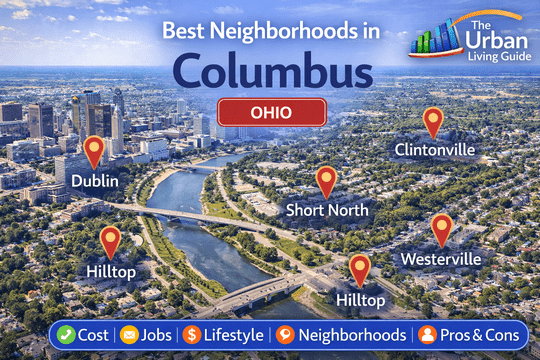
Best Neighborhoods in Columbus: Scioto Riverfront Districts, Historic Brick Villages & Tech Hubs in 2026
Covering approximately 220.5 square miles of land area across the Scioto and Olentangy River plains in Franklin County, the consolidated municipal government of Columbus operates under the mayor-council governance of the City of Columbus. Housing an incorporated municipal core population exceeding 907,000 residents and anchoring a rapidly expanding Central Ohio metropolitan footprint of over 2.18 million people, Ohio’s state capital stands as a primary national powerhouse for technology innovation, banking, venture capital, logistics, and biomedical healthcare.
Relocating across Central Ohio involves navigating distinct architectural districts, seasonal Midwestern weather patterns, and regional commuter transit corridors operated by the Central Ohio Transit Authority (COTA). Inbound movers consistently balance direct daily access to primary employment epicenters—such as the Downtown Capitol Complex, the massive intellectual and healthcare engine at The Ohio State University (OSU), the booming Silicon Heartland Tech Corridor, and healthcare systems anchored by OhioHealth Riverside Methodist Hospital, Nationwide Children’s Hospital, and The Ohio State University Wexner Medical Center—against daily transit commutes across Interstate 270 (The Outerbelt), Interstate 71, Interstate 70, State Route 315 (Olentangy Freeway), and High Street, with regional air links via John Glenn Columbus International Airport (CMH).
Join a local Columbus guide on a detailed neighborhood walkthrough showcasing the architecture, local dining strips, and lifestyle across the city:
Key Residential Areas in Columbus at a Glance in 2026
| Neighborhood | Location | Distance to Downtown | Development Status | Transit Connectivity | Cost Level | Best Fit For |
|---|---|---|---|---|---|---|
| Short North Arts District | North Central Corridor | ~1 mi north | High-Density Urban Arts Hub | Exceptional (COTA CMAX, High St, I-670) | High-to-Premium | Young Professionals, Tech Workers & Creatives |
| German Village | South Central Core | ~1 mi south | Preserved 19th-Century Brick Landmark | High (COTA Bus Lines, S 3rd St, I-70) | High-to-Premium | Attorneys, Physicians & Historic Architecture Lovers |
| Clintonville | North Central Basin | ~5 mi north | Established Tree-Canopied Residential | High (SR-315, N High St, I-71) | Mid-to-High | Families, OSU Faculty & Nature Enthusiasts |
| Dublin | Northwest Suburbs | ~14 mi northwest | Master-Planned Corporate & Village Suburb | High (I-270, US-33 / SR-161) | High-to-Premium | Corporate Executives, Tech Leaders & Families |
| Franklinton | West Scioto Riverfront | ~0.8 mi west | Adaptive Arts Infill & Innovation Basin | Exceptional (COTA Buses, Broad St, I-70/I-71) | Accessible / Mid-Range | First-Time Buyers, Creatives & Tech Renters |
Comprehensive Breakdown of Living Options Across Columbus, Ohio
Short North Arts District — Iconic Lit Arches, Gallery Hops & Modern Urban Condominiums
Stretching along North High Street between Downtown Columbus and the Ohio State University campus, the Short North Arts District is widely celebrated as the cultural, artistic, and social heart of Central Ohio. Operating under City of Columbus municipal planning and championed by the Short North Alliance, the district is defined by its iconic lighted steel street arches spanning High Street, acclaimed art galleries, independent fashion boutiques, craft cocktail lounges, and farm-to-table dining.
The neighborhood delivers a 24/7 walkable lifestyle, connecting seamlessly with the residential historic tree-lined brick streets of Victorian Village to the west and Italian Village to the east.
- Housing: Architectural inventory features sleek luxury high-rise condominium towers, modern podium apartment buildings, converted brick carriage houses, and historic Victorian multi-family homes. Condominium purchase valuations typically range from $320,000 to $1,450,000+, while modern 1-to-2-bedroom rental apartments average $1,650 to $2,850 per month.
- Safety & Crime Rate: Patrolled by the Columbus Division of Police (CPD) 4th Precinct and supported by visible Short North Safety Ambassadors. High pedestrian activity along High Street maintains safe foot traffic, though standard city awareness is advised regarding vehicle larcenies in surface parking lots.
- School District & Education Quality: Governed by Columbus City Schools (CCS), containing nearby magnet options such as Columbus Alternative High School (CAHS), alongside higher-education institutions anchored by the adjacent campus of The Ohio State University.
- Walkability & Daily Conveniences: Outstanding pedestrian infrastructure (Walk Score of 94-97/100). Residents comfortably walk to indie bookstores, specialty coffee houses, artisan bakeries, and grocers including The Hills Market Downtown, Kroger on High, and the historic North Market Downtown (featuring over 30 independent artisan food merchants).
- Parks & Green Spaces / Pet-Friendliness: Direct walking access to the historic 23-acre Goodale Park (the oldest public park in Columbus, featuring picturesque ponds, tennis courts, Victorian gazebos, and the annual ComFest festival) and the paved Olentangy Trail. Exceptionally pet-friendly.
- Parking & Traffic Congestion: Street parking is strictly managed through the city residential permit parking system; parking garage spaces add $150 to $275 per month. Commuter traffic builds along High Street during evening dining hours and major arena events.
- Noise Levels & Vibe: Energetic, trendsetting, and cosmopolitan, filled with Gallery Hop crowds, patio diners, young tech founders, and live music.
- Medical Facilities & Hospitals: Direct 5-minute commute to the massive healthcare complex at The Ohio State University Wexner Medical Center and OhioHealth Grant Medical Center downtown.
- Transit Connectivity: High-frequency public transit provided by COTA Bus Routes (including the CMAX Bus Rapid Transit and Route 2) along High Street, offering a 3-minute ride into Downtown Columbus, with rapid vehicular access to Interstate 670 and SR-315.
- Affordability: High-tier urban price profile; elevated price-per-square-foot valuations reflect the neighborhood’s unmatched walkability, nightlife density, and tech employer proximity.
- Who It’s Best For: Young corporate professionals, tech workers, medical residents, creative entrepreneurs, and urbanites seeking a car-optional lifestyle.
- Drawbacks: Higher rental and parking costs, weekend evening street noise along High Street, and limited inventory of single-family homes with large private yards.
German Village — Brick-Paved Streets, 19th-Century Cottages & Historic Refinement
Positioned immediately south of Downtown Columbus, German Village is celebrated as one of the most meticulously restored and preserved historic residential districts in the United States. Developed primarily in the mid-19th century by German immigrant craftsmen, the neighborhood operates under city historic preservation guidelines and is championed by the German Village Society. Centered along the cobblestone and red brick lanes of South 3rd Street, Beck Street, and City Park Avenue, German Village is renowned for its German brick cottages, iron fences, manicured gardens, and legendary culinary landmarks.
The neighborhood provides an intimate, tranquil residential setting just minutes from the central business district.
- Housing: Real estate stock consists almost exclusively of restored 19th-century red brick cottages, historic Italianate townhomes, and luxury converted brick duplexes. Single-family purchase prices typically range from $450,000 to $1,650,000+, while residential rentals and carriage flats average $1,750 to $3,400 per month.
- Safety & Crime Rate: Patrolled by the CPD 11th Precinct. German Village consistently records some of the lowest violent and property crime rates in the urban core, supported by deep owner-occupancy and active community block watch networks.
- School District & Education Quality: Governed by CCS, containing neighborhood institutions such as Stewart Alternative Elementary School, while being minutes from elite independent college preparatory academies like Columbus School for Girls and The Columbus Academy.
- Walkability & Daily Conveniences: Outstanding pedestrian walkability (Walk Score of 90-94/100). Residents stroll along brick paths to independent cafes, legendary delicatessens (like Schmidt’s Sausage Haus), fine steakhouses, the 32-room labyrinth bookstore at The Book Loft of German Village, and local specialty grocers.
- Parks & Green Spaces / Pet-Friendliness: Municipal recreation is anchored by the 23-acre historic Schiller Park (featuring the German Schiller monument, formal gardens, community recreation center, basketball courts, and free outdoor summer Shakespeare performances) and Frank Fetch Park. Exceptionally pet-friendly.
- Parking & Traffic Congestion: On-street parking along brick-paved lanes is standard; historic properties with private detached garages or dedicated parking pads command premium valuations. Surface traffic moves calmly throughout the residential grid.
- Noise Levels & Vibe: Serene, historic, and community-focused, characterized by birdsong, manicured floral gardens, and quiet residential evenings.
- Medical Facilities & Hospitals: Direct 3-minute access to the world-renowned research and clinical campus at Nationwide Children’s Hospital on Livingston Avenue.
- Transit Connectivity: Served by COTA Bus Routes (Routes 1, 4, and 8) providing a 4-minute commute into Downtown Columbus, with rapid roadway access to Interstate 70/71 and State Route 315.
- Affordability: High-tier price profile for Franklin County; premium acquisition costs are balanced by architectural pedigree, strong community pride, and exceptional long-term property equity.
- Who It’s Best For: Attorneys, corporate executives, medical staff at Nationwide Children’s, historic preservationists, and buyers seeking classic 19th-century brick architecture.
- Drawbacks: High purchase entry costs, narrow brick street driving during winter freeze, and strict historic district exterior architectural renovation restrictions.
Clintonville — Wooded Ravines, Craftsman Architecture & Progressive Community Spirit
Covering the established residential corridor north of the Ohio State University between High Street and the Olentangy River, Clintonville is one of Columbus’s most beloved, progressive, and family-friendly residential enclaves. Operating under City of Columbus municipal administration and championed by the Clintonville Area Commission, the district centers along North High Street and Indianola Avenue.
Clintonville is celebrated for its deep glacial ravines (such as Walhalla Ravine and Glen Echo Ravine), mature oak canopies, diverse independent businesses, and strong neighborhood civic identity.
- Housing: Real estate features classic 1920s Craftsman bungalows, Colonial Revival single-family homes, Sears kit homes, Mid-Century Modern ranches, and brick duplexes. Single-family purchase prices typically range from $310,000 to $720,000+, while residential rentals average $1,350 to $2,350 per month.
- Safety & Crime Rate: Patrolled by the CPD 3rd Precinct. Clintonville maintains low violent and property crime rates, supported by high residential stability and active community watch organizations.
- School District & Education Quality: Governed by CCS, containing highly sought-after public campuses such as Clinton Elementary School and Whetstone High School, alongside alternative charter and private preparatory options.
- Walkability & Daily Conveniences: The central High Street commercial spine is highly walkable, featuring indie coffee roasters, vegetarian bistros, vintage vinyl shops, and grocers including Clintonville Natural Foods, Weiland’s Market (a local gourmet market institution), Kroger, and Giant Eagle.
- Parks & Green Spaces / Pet-Friendliness: World-class municipal parks anchored by the 13-acre Columbus Park of Roses (Whetstone Park) (featuring over 12,000 rose specimens, walking trails, and community centers), Overbrook Ravine, and direct connectivity to the paved 13-mile Olentangy Trail. Exceptionally pet-friendly.
- Parking & Traffic Congestion: Plentiful private residential driveways, detached single-to-two car garages, and open on-street parking. Commuter traffic moves steadily along High Street and Indianola Avenue, with rapid access to SR-315 and I-71.
- Noise Levels & Vibe: Grounded, progressive, and family-oriented, characterized by rustling ravine trees, neighborhood cyclists, and quiet evenings.
- Medical Facilities & Hospitals: Direct 5-to-7 minute drive to comprehensive emergency and specialized care at OhioHealth Riverside Methodist Hospital on Olentangy River Road.
- Transit Connectivity: High-frequency public transit provided by COTA Bus Routes (Routes 2 and 102), offering a 12-minute ride to Downtown Columbus and 5 minutes to OSU, with rapid vehicular access to SR-315 (Olentangy Freeway) and I-71.
- Affordability: Balanced mid-to-high price tier; delivers detached single-family homeownership, spacious yards, and unique ravine geography at competitive price points.
- Who It’s Best For: University professors, medical staff at Riverside Methodist, families seeking community-focused schools, and outdoor nature lovers.
- Drawbacks: Older home electrical and plumbing systems requiring modernization, competitive starter-home inventory, and slower commercial traffic along High Street during school commute hours.
Dublin — Master-Planned Corporate Tech Center, Bridge Park & Top-Tier Public Schools
Situated along the scenic limestone bluffs of the Scioto River in northwestern Franklin County, the incorporated municipality of Dublin operates under its own municipal city government via the City of Dublin Official Portal. Developed throughout the late 20th and early 21st centuries, Dublin is recognized as one of the wealthiest, most innovative, and highly developed suburban cities in the Midwest.
Centering around the dynamic pedestrian pedestrian corridor of Bridge Park and historic Old Dublin along High Street / Route 161, Dublin combines championship golf courses with major corporate headquarters, world-class parks, and elite public education.
- Housing: Real estate stock features modern custom-built luxury executive estates in master subdivisions (such as Muirfield Village and Ballantrae), luxury riverfront condominiums at Bridge Park, and upscale townhomes. Single-family purchase prices typically range from $450,000 to $2,800,000+, while luxury residential rentals average $1,850 to $3,800 per month.
- Safety & Crime Rate: Protected by the dedicated Dublin Police Department (DPD), the city consistently records one of the lowest violent and property crime rates in the United States, supported by advanced city surveillance and proactive patrols.
- School District & Education Quality: Governed by the nationally acclaimed Dublin City Schools, containing top-ranked public institutions such as Dublin Jerome High School, Dublin Coffman High School, and Dublin Scioto High School.
- Walkability & Daily Conveniences: Outstanding mixed-use walkability across the Bridge Park & Historic Dublin district, featuring over 40 restaurants, craft bakeries, rooftop lounges, the North Market Bridge Park, and major grocery supermarkets including Trader Joe’s, Whole Foods Market, and Enson Market.
- Parks & Green Spaces / Pet-Friendliness: World-class natural recreation anchored by Bridge Park Pedestrian Bridge, Riverside Crossing Park, the 60-acre Scioto Park (home to the Leatherlips stone sculpture), and the championship fairways of Muirfield Village Golf Club (designed by Jack Nicklaus, host of the annual PGA Tour Memorial Tournament). Exceptionally pet-friendly.
- Parking & Traffic Congestion: Plentiful private attached multi-car garages and modern structured municipal parking garages at Bridge Park. Commuter traffic builds along US-33 / SR-161 and the Interstate 270 interchange during peak morning rush hours.
- Noise Levels & Vibe: Polished, family-centered, and exclusive, characterized by manicured landscape architecture, outdoor riverfront dining, and quiet residential evenings.
- Medical Facilities & Hospitals: Direct emergency medical coverage provided within city borders by OhioHealth Dublin Methodist Hospital on Hospital Drive.
- Transit Connectivity: Major highway positioning at the junction of Interstate 270 (Outerbelt), US Route 33, and State Route 161, offering a 15-minute drive to Downtown Columbus and 20 minutes to John Glenn International Airport.
- Affordability: High-tier suburban price profile; higher real estate acquisition costs are balanced by nationally ranked Dublin public schools, low municipal income tax credit structures, and pristine public services.
- Who It’s Best For: Corporate executives, tech leaders at Wendy’s HQ or Cardinal Health, golf enthusiasts, and families prioritizing elite public education.
- Drawbacks: High housing costs, automobile reliance outside the Bridge Park core, and morning highway traffic bottlenecks connecting to I-270.
Franklinton — Historic Arts District, Riverfront Infill & Attainable Modern Living
Covering the historic riverfront basin directly west of Downtown Columbus across the Scioto River, Franklinton (founded in 1797 as the first settlement in Franklin County) is one of the Midwest’s most dynamic examples of creative urban revitalization. Operating under City of Columbus municipal planning and championed by the Franklinton Arts District, the neighborhood centers along West Broad Street and Town Street.
The district combines historic industrial manufacturing buildings with contemporary arts maker-spaces, craft breweries, scientific institutions, and attainable modern residential infill.
- Housing: Real estate consists of classic two-story wood-frame single-family homes, modern contemporary townhomes with rooftop patios, and converted industrial loft apartment communities (such as River & Rich and Casto Franklinton). Single-family purchase prices typically range from $145,000 to $340,000, while modern rental apartments average $1,150 to $1,850 per month.
- Safety & Crime Rate: Patrolled by the CPD 8th Precinct. The eastern arts district near COSI and 400 West Rich maintains active foot traffic and steady safety, though targeted street-level research is advised on peripheral residential blocks undergoing transition.
- School District & Education Quality: Governed by CCS, containing neighborhood public campuses such as Avondale Elementary School and West High School, alongside popular public charter academies.
- Walkability & Daily Conveniences: High pedestrian accessibility along West Broad Street, hosting craft breweries (BrewDog Franklinton, Land-Grant Brewing), independent coffee houses, food truck courts, the 400 West Rich Arts Complex, and local convenience markets.
- Parks & Green Spaces / Pet-Friendliness: Municipal recreation is anchored by Dodge Park & Community Center (featuring Olympic-sized swimming pools, lighted baseball diamonds, and public skate parks), Genoa Park & Amphitheater along the Scioto River, and the world-renowned 320,000-square-foot hands-on science center at COSI (Center of Science and Industry). Highly pet-friendly.
- Parking & Traffic Congestion: Plentiful private residential driveways, surface parking lots, and open on-street parking. Highway on-ramps provide fast access to Interstate 70, Interstate 71, and SR-315 with minimal local delay.
- Noise Levels & Vibe: Creative, industrial-rooted, and active, shifting from lively brewery courtyards and art openings to quiet residential evenings in established pockets.
- Medical Facilities & Hospitals: Direct 4-minute access across the river to OhioHealth Grant Medical Center and 6 minutes to Wexner Medical Center.
- Transit Connectivity: High-frequency public transit provided by COTA Bus Routes (Route 10 along Broad St) connecting directly to the downtown core in 3 minutes, with rapid vehicle access to I-70 and I-71.
- Affordability: Columbus’s most accessible central urban homeownership and rental price tier, offering lower purchase barriers and high long-term appreciation potential.
- Who It’s Best For: First-time homebuyers, artists, tech professionals, creative freelancers, real estate investors, and commuters seeking proximity to Downtown Columbus.
- Drawbacks: Pockets of deferred property maintenance on older blocks, variable public school test ratings, and ongoing construction noise during urban infill projects.
Living Trade-offs Across Columbus Communities
| Neighborhood | Core Advantages (Pros) | Core Limitations (Cons) |
|---|---|---|
| Short North Arts District | Walkable High St dining, galleries, and boutique retail; 23-acre Goodale Park; direct COTA CMAX transit to downtown; 5 minutes to OSU. | Higher rent and condominium purchase prices; monthly garage parking fees ($150+); late-night weekend bar street noise. |
| German Village | Historic 19th-century red brick architecture; 23-acre Schiller Park; 3 minutes to Nationwide Children’s Hospital; low crime rates. | High purchase entry barrier; strict historic district renovation codes; narrow brick street driving during winter snow. |
| Clintonville | 13-acre Columbus Park of Roses; unique wooded glacial ravines; top-rated Clinton Elementary; Weiland’s Market gourmet grocer. | Older home plumbing and electrical systems; competitive single-family home market; slower commercial traffic on High St. |
| Dublin | Nationally top-ranked Dublin City Schools; walkable mixed-use dining at Bridge Park; PGA Tour golf at Muirfield Village; lowest crime. | Higher purchase entry price ($450k+); complete automobile dependence outside Bridge Park; morning traffic on I-270. |
| Franklinton | Columbus’s most affordable urban core pricing; vibrant arts hub at 400 West Rich; science center at COSI; 3 minutes to downtown. | Safety and property upkeep vary significantly by street; variable public school performance ratings; ongoing construction noise. |
How to Navigate Your Columbus Neighborhood Selection
Selecting your ideal neighborhood in Columbus requires balancing your household budget with daily workplace destinations, family schooling priorities, and regional highway logistics. Because Central Ohio is connected by an extensive highway network centered around Interstate 270 (The Outerbelt), State Route 315, and Interstate 71, your chosen location dictates whether your daily commute relies on rapid transit via COTA Bus Rapid Transit Lines, walkable sidewalks along High Street, or driving across the outerbelt into corporate campuses.
Tech workers at Intel’s Silicon Heartland or Google campuses, healthcare professionals at Wexner Medical Center, Nationwide Children’s, or Riverside Methodist, and faculty at Ohio State University should evaluate transit corridors to optimize daily convenience.
Beyond transportation corridors, evaluate essential municipal utility and building infrastructure realities. Central Ohio experiences freezing winter temperatures with snowfall alongside humid summer heat, making home heating efficiency and utility reliability through AEP Ohio (American Electric Power) and Columbia Gas of Ohio an important factor.
In addition, prospective homebuyers evaluating historic brick cottages in German Village or Craftsman bungalows in Clintonville should inspect roofs, boiler systems, and foundations for seasonal resilience, while buyers in Dublin should verify city income tax credits and school district property assessments. Before executing a residential lease or property purchase agreement, verify high-speed fiber broadband availability (such as AT&T Fiber, Breezeline, or Spectrum Gigabit) and confirm school assignment boundaries.
Essential Local Insights & FAQs for Columbus
Which neighborhood in the Columbus area is considered best for families with children?
Dublin, Clintonville, and German Village are widely regarded as premier family communities in Greater Columbus. Dublin provides access to the nationally top-ranked Dublin City Schools (including Dublin Jerome and Coffman High Schools) alongside master-planned parks, pristine safety, and the Bridge Park district. Clintonville offers established residential streets, access to Clinton Elementary and the Columbus Park of Roses, and proximity to Ohio State University.
What is the most walkable neighborhood in Columbus where you can live without relying heavily on a car?
The Short North Arts District and German Village offer the highest walkability in Columbus, both scoring above 90 on Walk Score. The Short North allows residents to complete daily errands on foot, walk to dozens of restaurants, art galleries, Goodale Park, North Market, and connect directly to COTA bus rapid transit lines into Downtown Columbus. German Village provides dense pedestrian access to historic brick streets, cafes, bookstores, and Schiller Park.
What are the safest residential neighborhoods to live in within Greater Columbus?
Dublin, German Village, and Clintonville consistently report some of the lowest violent and property crime rates in Central Ohio. Dublin benefits from a dedicated municipal police department with advanced public safety infrastructure, while German Village and Clintonville maintain active community block watch networks and high owner-occupancy.
What are the most affordable neighborhoods for homebuyers and renters in Columbus?
Franklinton, Olde Towne East, and Southern Orchards provide the most budget-friendly housing opportunities in the area. In Franklinton, buyers and renters can secure historic single-family homes and contemporary infill apartments at price points significantly lower than northern suburban developments while retaining fast access to downtown employers.
How bad is traffic congestion when commuting across Columbus expressways?
Traffic congestion on major Columbus expressways—particularly the Interstate 270 Outerbelt, State Route 315 (Olentangy Freeway), and Interstate 71—is noticeable during morning (7:00 AM to 9:00 AM) and evening (4:30 PM to 6:30 PM) rush hours. Utilizing local surface arterials like High Street, Riverside Drive, or COTA bus rapid transit can provide dependable alternatives during peak travel times.
Which Columbus neighborhood is best for healthcare professionals working at local hospitals?
German Village, Clintonville, and the Short North provide the fastest commutes to major medical campuses. German Village is within a 3-minute drive to Nationwide Children’s Hospital, Clintonville is minutes from OhioHealth Riverside Methodist Hospital, and the Short North is adjacent to The Ohio State University Wexner Medical Center.
Is Columbus an affordable place to live compared to major coastal metros?
Yes, Columbus’s overall cost of living and housing prices are significantly lower than Chicago, New York City, and Washington, D.C., offering spacious single-family homes, modern luxury apartments, and large suburban yards at a fraction of coastal real estate costs.
Relocation Resources & Living Guides
The Urban Living Guide creates deeply researched, practical, and informative city relocation resources designed to help individuals, working professionals, and families navigate complex urban landscapes. By analyzing municipal infrastructure, hyper-local zoning patterns, commuter realities, and housing markets, our guides provide actionable insights so you can make confident, data-backed decisions when moving to major metropolitan areas.
Explore our regional guides across Columbus and Central Ohio:
Made your decision to move to the Arch City? Read our comprehensive relocation roadmap: Moving to Columbus, Ohio.
Follow The Urban Living Guide for ongoing regional insights, neighborhood developments, and expert local coverage across Greater Columbus and the state of Ohio.