

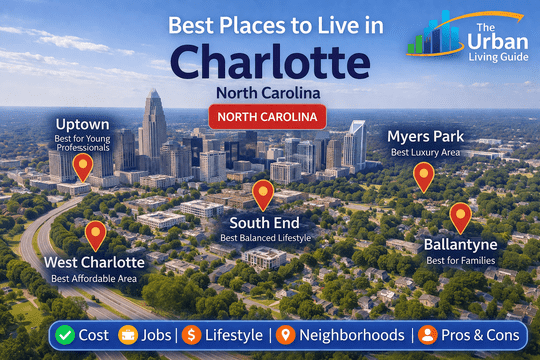
Best Neighborhoods in Charlotte: Queen City Enclaves, Light Rail Corridors & Carolina Living in 2026
Covering approximately 308.6 square miles of land area across the rolling Piedmont landscape of Mecklenburg County, the consolidated municipal core of Charlotte operates under the council-manager governance of the City of Charlotte. Housing an incorporated municipal core population exceeding 900,000 residents and anchoring a rapidly growing regional metropolitan area of over 2.8 million people, the “Queen City” stands as the nation’s second-largest financial and banking hub, alongside major corporate expansions in energy, technology logistics, and motorsports engineering.
Relocating across the Charlotte metropolitan footprint requires navigating distinct radial commuter corridors, tree-canopied historic suburbs, and multi-modal transit systems operated by the Charlotte Area Transit System (CATS). Inbound movers consistently balance direct access to primary regional employers—including global corporate headquarters for Bank of America, Honeywell, Lowe’s, Duke Energy, the massive east-coast hub of Wells Fargo, and healthcare systems anchored by Atrium Health Carolinas Medical Center and Novant Health Presbyterian Medical Center—against daily transit commutes across Interstate 485 (The Outer Loop), Interstate 77, Interstate 85, US Route 74 (Independence Boulevard), and South Boulevard, with global air travel via Charlotte Douglas International Airport (CLT).
Explore Charlotte’s premier neighborhoods, tree-lined avenues, and diverse residential lifestyle pockets with this curated local guide:
Key Residential Districts in Charlotte, North Carolina at a Glance in 2026
| Neighborhood | Location | Distance to Uptown (Trade & Tryon) | Development Status | Transit Connectivity | Cost Level | Best Fit For |
|---|---|---|---|---|---|---|
| South End | South Central Rail Corridor | ~1.5 mi south | High-Density Transit-Oriented Core | Exceptional (LYNX Blue Line, South Blvd) | High-to-Premium | Young Professionals, Tech Workers & Foodies |
| Dilworth | South Central Infill | ~2 mi south | Historic Streetcar Suburb | High (CATS Buses, East Blvd, Morehead St) | High-to-Premium | Physicians, Attorneys & Growing Families |
| Ballantyne | South County Border | ~14 mi south | Master-Planned Corporate Suburb | High (I-485 Outer Loop, Johnston Rd) | High-to-Premium | Corporate Executives & Suburban Families |
| NoDa (North Davidson) | Northeast Arts Corridor | ~2.5 mi northeast | Adaptive Textile Mill Arts District | Exceptional (LYNX Blue Line 36th St, N Davidson St) | Mid-to-High | Creatives, Musicians & Remote Professionals |
| University City | Northeast Tech Basin | ~8.5 mi northeast | Academic & Research Park Suburb | Exceptional (LYNX Blue Line Terminus, I-85, US-29) | Accessible / Mid-Range | First-Time Buyers, Tech Staff & Faculty |
Comprehensive Breakdown of Living Options Across Charlotte
South End — Rapid Light Rail Transit, Adaptive Brewery Corridors & High-Rise Condominiums
Stretching along the LYNX Blue Line rail corridor immediately southwest of Uptown Charlotte, South End is widely recognized as one of the fastest-growing and most vibrant urban districts in the Southeast. Originally developed around historic textile and distribution mills, the community operates under City of Charlotte municipal planning and is championed by Charlotte Center City Partners. Centered along Camden Road, South Boulevard, and the Charlotte Rail Trail, South End seamlessly blends industrial mill conversions with gleaming modern glass towers, craft breweries, art galleries, and chef-driven restaurants.
The neighborhood delivers a true 24/7 car-optional lifestyle with non-stop light rail connectivity directly into the center of the financial district.
- Housing: Real estate is dominated by modern podium mid-rises, luxury high-rise apartment towers (such as The Line and Vantage South End), converted industrial brick lofts, and contemporary multi-story townhomes. Condominium and townhome purchase prices typically range from $320,000 to $950,000+, while 1-bedroom rental apartments average $1,750 to $2,950 per month.
- Safety & Crime Rate: Patrolled by the Charlotte-Mecklenburg Police Department (CMPD) Central Division. The bustling Rail Trail corridor maintains steady foot traffic and continuous security presence, though standard city awareness is recommended for vehicle break-ins in structured parking decks.
- School District & Education Quality: Governed by Charlotte-Mecklenburg Schools (CMS), zoned to institutions such as Dilworth Elementary (Latta Campus), Alexander Graham Middle School, and Myers Park High School (renowned for its International Baccalaureate curriculum).
- Walkability & Daily Conveniences: Outstanding pedestrian walkability (Walk Score of 92-96/100). Residents walk to over 50 local restaurants, craft taprooms (Sycamore Brewing, Wooden Robot), boutique fitness studios, and major grocers including Harris Teeter on South Blvd, Lowes Foods, and Trader Joe’s on Metropolitan.
- Parks & Green Spaces / Pet-Friendliness: Municipal recreation is anchored by the 4.5-mile paved linear Charlotte Rail Trail (featuring public art murals, fitness stations, and outdoor patios), Wilmore Centennial Park, and Latta Park nearby. Exceptionally pet-friendly with luxury high-rise dog spas and pet parks.
- Parking & Traffic Congestion: Assigned parking garage spaces add $100 to $200 per month; on-street visitor parking is competitive during evening entertainment hours. Surface traffic moves steadily with occasional slowdowns on South Boulevard.
- Nearby: Immediate 4-minute train commute into Uptown Charlotte, 12 minutes to Charlotte Douglas International Airport (CLT), and 8 minutes to premier shopping at SouthPark Mall.
- Noise Levels & Vibe: High-tempo, social, and modern, filled with financial tech employees, patio diners, cyclists along the Rail Trail, and bustling weekend brunch crowds.
- Medical Facilities & Hospitals: Direct 3-minute access east to the region’s premier flagship medical campus at Atrium Health Carolinas Medical Center (CMC – Level I Trauma Center).
- Transit Connectivity: Unrivaled rapid transit via the CATS LYNX Blue Line (East/West, Bland St, and Carson Stations), offering a 5-minute direct train ride into Uptown Charlotte, with rapid vehicle access to Interstate 277 and I-77.
- Affordability: High-tier urban price profile; elevated rents and purchase prices per square foot reflect the neighborhood’s unmatched transit convenience and corporate headquarters proximity.
- Who It’s Best For: Young tech workers, financial analysts at Bank of America or Wells Fargo, healthcare residents at CMC, and urbanites wanting car-free mobility.
- Drawbacks: Higher rental and parking garage overhead, late-night weekend bar patio noise, and limited single-family housing stock with private yards.
Dilworth — Historic Streetcar Oaks, Craftsman Bungalows & East Boulevard Dining
Established in the 1890s as Charlotte’s first streetcar suburb, Dilworth is celebrated as one of the city’s most architecturally charming, picturesque, and sought-after residential enclaves. Operating under City of Charlotte municipal administration and championed by the Dilworth Community Association, the district is listed on the National Register of Historic Places.
Centered along the majestic arched willow oak canopies of East Boulevard, Kenilworth Avenue, and Dilworth Road, the community blends historic Craftsman architecture with upscale boutique dining and direct park connectivity.
- Housing: Real estate stock features classic 1910s–1930s Craftsman bungalows with broad front porches, Colonial Revival homes, custom Queen Anne renovations, and boutique modern infill townhomes. Single-family purchase prices typically range from $550,000 to $1,850,000+, while residential rental flats average $1,850 to $3,200 per month.
- Safety & Crime Rate: Patrolled by the CMPD Central Division. Dilworth consistently records below-average violent and property crime rates, supported by high owner-occupancy and active neighborhood block watch committees.
- School District & Education Quality: Governed by CMS, containing top-ranked public neighborhood options including Dilworth Elementary School, Alexander Graham Middle School, and Myers Park High School.
- Walkability & Daily Conveniences: Outstanding pedestrian walkability (Walk Score of 88-92/100). Residents stroll along shaded brick sidewalks to local bakeries, independent bistros, wine tasting shops, and grocers including Harris Teeter on East Blvd and Fresh Market.
- Parks & Green Spaces / Pet-Friendliness: Direct access to the 32-acre Latta Park (featuring winding walking trails, tennis courts, spraygrounds, and soccer fields) and the natural greenways along the Little Sugar Creek Greenway. Exceptionally pet-friendly.
- Parking & Traffic Congestion: Plentiful private residential driveways and detached carriage garages keep neighborhood streets clear. Commuter traffic on East Boulevard and Kenilworth Avenue moves smoothly.
- Nearby: 5-minute drive into Uptown Charlotte, 10 minutes to SouthPark Mall, and 14 minutes to Charlotte Douglas International Airport (CLT).
- Noise Levels & Vibe: Refined, historic, and family-centered, characterized by neighbors chatting on front porches, shaded jogging paths, and calm residential evenings.
- Medical Facilities & Hospitals: Direct walking proximity: borders the primary medical campus of Atrium Health Carolinas Medical Center (CMC) and Levine Children’s Hospital.
- Transit Connectivity: Roadway travel connects via East Boulevard, South Boulevard, and Morehead Street, providing a 4-minute drive to Uptown, supported by CATS Bus Routes (Routes 12 and 19).
- Affordability: High-tier price profile for Mecklenburg County; premium real estate acquisition values are balanced by historic architectural pedigree, top public school feeder patterns, and long-term equity stability.
- Who It’s Best For: Physicians, surgeons, and healthcare administrators at CMC, corporate attorneys, banking executives, and families seeking historic single-family homes.
- Drawbacks: High home purchase entry barrier, older home electrical and plumbing maintenance overhead, and strict historic district exterior architectural renovation guidelines.
Ballantyne — Master-Planned Corporate Hub, Resort Amenities & Top Suburban Schools
Covering approximately 2,000 acres along the South Carolina state line in southern Mecklenburg County, Ballantyne is widely recognized as one of the most successful master-planned corporate and residential developments in the United States. Developed starting in the mid-1990s on former agricultural lands, the community operates under City of Charlotte municipal administration and is guided by the Ballantyne Corporate Park Community.
Centering around Johnston Road (US-521), Ballantyne Commons Parkway, and the mixed-use Ballantyne Reimagined (The Bowl at Ballantyne), the district combines major corporate office parks with championship golf resorts, pristine parks, and top-tier public schools.
- Housing: Real estate stock features modern 1990s–2020s brick two-story single-family executive homes on manicured quarter-to-half-acre lots in subdivisions (like Ballantyne Country Club and Ardrey), luxury townhomes, and upscale modern mid-rises. Single-family purchase prices typically range from $450,000 to $1,750,000+, while residential rentals average $1,650 to $2,950 per month.
- Safety & Crime Rate: Patrolled by the CMPD South Division. Ballantyne consistently records some of the lowest violent and property crime rates in Charlotte, supported by modern environmental design and active security networks.
- School District & Education Quality: Governed by CMS, containing top-ranked public institutions such as Ardrey Kell High School (consistently rated among the highest-performing high schools in North Carolina), Community House Middle School, and Ballantyne Elementary School.
- Walkability & Daily Conveniences: Highly walkable within The Bowl at Ballantyne mixed-use district, featuring upscale retail, open-air amphitheatres, local coffee houses, and major grocery supermarkets including Harris Teeter Supermarket, Trader Joe’s at Piper Glen, and Sprouts Farmers Market.
- Parks & Green Spaces / Pet-Friendliness: Municipal recreation is anchored by the 100-acre Ballantyne Corporate Park Greenways, The AMP Ballantyne (a 3,500-capacity outdoor concert venue), Elon Park (featuring 118 acres of sports fields, ponds, and disc golf courses), and Four Mile Creek Greenway. Exceptionally pet-friendly.
- Parking & Traffic Congestion: Plentiful private attached two-to-three car garages and wide driveways keep neighborhood roads clear. Heavy commuter traffic builds along Johnston Road (US-521) and on-ramps to Interstate 485 during peak morning rush hours.
- Nearby: 20-minute highway drive into Uptown Charlotte, 18 minutes to Charlotte Douglas International Airport (CLT), and 5 minutes across the border to Fort Mill, South Carolina.
- Noise Levels & Vibe: Serene, polished, and family-centered, characterized by manicured landscape boulevards, children riding bicycles, and quiet residential evenings.
- Medical Facilities & Hospitals: Direct emergency medical coverage provided within the district by Novant Health Ballantyne Medical Center on Johnston Road.
- Transit Connectivity: Major highway positioning along Interstate 485 (Exits 61 and 64) and US Route 521, supported by CATS Express Bus Commuter lines connecting straight to Uptown.
- Affordability: Mid-to-high suburban price profile; higher real estate acquisition costs are balanced by nationally ranked Ardrey Kell public schools, pristine safety, and robust corporate employment parks.
- Who It’s Best For: Corporate executives working in Ballantyne Corporate Park, families prioritizing top public high schools, golf enthusiasts, and relocators seeking spacious suburban living.
- Drawbacks: Distance from Uptown (14 miles), automobile reliance for daily errands outside The Bowl, and rush-hour bottlenecks at the I-485 interchange.
NoDa (North Davidson) — Historic Arts District, Live Music Venues & Mill Town Charm
Covering the historic textile mill district approximately two miles northeast of Uptown Charlotte, NoDa (North Davidson) is celebrated as the city’s historic arts, music, and craft brewing capital. Settled around the Highland Park and Mecklenburg textile mills in the early 20th century, the community operates under City of Charlotte municipal governance and is championed by the NoDa Neighborhood Association.
Centered along the colorful street murals and commercial storefronts of North Davidson Street and 36th Street, NoDa combines historic wood-frame mill worker cottages with modern contemporary townhomes, live indie music halls, craft eateries, and rapid light rail transit.
- Housing: Real estate stock features restored 1920s wood-frame mill cottages, modern architectural infill townhouses with private rooftop terraces, and converted historic brick textile lofts (such as Highland Mill Lofts). Single-family and townhome purchase prices typically range from $310,000 to $680,000+, while modern rental apartments average $1,450 to $2,350 per month.
- Safety & Crime Rate: Patrolled by the CMPD Eastway Division. The core commercial strip along North Davidson Street maintains active, well-lit pedestrian foot traffic day and night, though standard city awareness is advised on peripheral residential streets.
- School District & Education Quality: Governed by CMS, containing neighborhood public options such as Villa Heights Elementary School, Eastway Middle School, and Garinger High School, alongside popular arts-focused public charter academies.
- Walkability & Daily Conveniences: Outstanding pedestrian walkability (Walk Score of 86-90/100). Residents walk to destination taco joints, craft bakeries, artisan coffee roasters, independent bookshops, live music halls at The Neighborhood Theatre and The Evening Muse, and grocers like Giant Genie Market and Harris Teeter on Plaza Midwood nearby.
- Parks & Green Spaces / Pet-Friendliness: Municipal recreation includes North Charlotte Park, Alexander Street Park, and the direct walking trail connections along the Little Sugar Creek Greenway Cross Charlotte Trail (XCLT). Exceptionally pet-friendly.
- Parking & Traffic Congestion: On-street parking along narrow residential streets is common; newer construction townhomes feature built-in rear garages. Commuter traffic on North Davidson Street and The Plaza moves steadily.
- Nearby: 6-minute light rail ride into Uptown Charlotte, 5 minutes to Plaza Midwood, and 16 minutes to Charlotte Douglas International Airport (CLT).
- Noise Levels & Vibe: Bohemian, creative, and energetic, filled with live acoustic music, local brewery patrons, and active weekend gallery crawls.
- Medical Facilities & Hospitals: Direct 6-minute drive to Novant Health Presbyterian Medical Center on Hawthorne Lane.
- Transit Connectivity: Outstanding rapid transit via the CATS LYNX Blue Line (36th Street Station and Sugar Creek Station), offering a 7-minute direct train ride into Uptown Charlotte, with roadway access to Route 277 and I-85.
- Affordability: Mid-to-high urban price tier; delivers modern contemporary townhome living and artistic culture at price points lower than South End or Dilworth.
- Who It’s Best For: Artists, musicians, tech workers, young professionals, culinary enthusiasts, and commuters seeking direct light rail access to downtown employers.
- Drawbacks: Street parking competition during live concert nights at the Neighborhood Theatre, ongoing infill construction noise, and variable public school performance ratings.
University City — UNC Charlotte Research Hub, Boardwalk Retail & Attainable Infill Living
Covering the established academic and technology corridor in northeastern Charlotte along University City Boulevard (NC-49) and W.T. Harris Boulevard, University City is one of the region’s most dynamic, international, and budget-accessible residential hubs. Operating under City of Charlotte municipal administration and supported by University City Partners, the district is centered around the 1,000-acre research campus of the University of North Carolina at Charlotte (UNC Charlotte).
The neighborhood combines major corporate research centers at University Research Park with lakefront boardwalk shopping at The Boardwalk at University Place, botanical gardens, and direct light rail transit.
- Housing: Real estate consists of modern 1990s–2010s two-story single-family suburban homes in subdivisions (such as Davis Lake and Mallard Creek), contemporary townhomes, and garden-style apartment communities. Single-family purchase prices typically range from $240,000 to $480,000, while modern rental apartments average $1,150 to $1,850 per month.
- Safety & Crime Rate: Patrolled by the CMPD University City Division and supplemented by UNC Charlotte Campus Police around the university perimeter. The district maintains stable residential tracts with active community vigilance.
- School District & Education Quality: Governed by CMS, containing public institutions such as Vance High School (Julius L. Chambers) and Mallard Creek High School, alongside higher-education anchors at the 30,000-student campus of UNC Charlotte.
- Walkability & Daily Conveniences: Pedestrian-friendly around the lakefront paths at Shoppes at University Place, featuring international restaurants, waterside cafes, paddleboat rentals, and grocers including Harris Teeter, Trader Joe’s on Hanberry, Target, and Patel Brothers.
- Parks & Green Spaces / Pet-Friendliness: Municipal recreation is anchored by the 10-acre UNC Charlotte Botanical Gardens (featuring the McMillan Greenhouse and Susie Harwood Garden), Mallard Creek Greenway, and nearby walking trails at Reedy Creek Nature Center and Preserve (a 927-acre forested park featuring dog parks and fishing ponds). Exceptionally pet-friendly.
- Parking & Traffic Congestion: Plentiful private residential driveways, two-car garages, and wide commercial parking plazas keep neighborhood roads clear. Traffic slows along W.T. Harris Boulevard and NC-49 during peak university class change hours.
- Nearby: 15-minute light rail ride to Uptown Charlotte, 10 minutes to Charlotte Motor Speedway in Concord, and 20 minutes to Charlotte Douglas International Airport (CLT).
- Noise Levels & Vibe: Collegiate, international, and active, shifting from lively campus hubs and lakefront cafes to quiet suburban residential loops.
- Medical Facilities & Hospitals: Direct emergency medical coverage provided within the district by Atrium Health University City on North Tryon Street.
- Transit Connectivity: Major heavy transit hub centered at the CATS LYNX Blue Line Terminus (UNC Charlotte Main and JW Clay Blvd Stations), offering non-stop light rail transit directly into Uptown Charlotte, with rapid highway access to Interstate 85 and Interstate 485.
- Affordability: Charlotte’s most accessible suburban and transit-connected homeownership price tier, offering lower entry barriers, spacious yards, and strong rental yields.
- Who It’s Best For: First-time homebuyers, UNC Charlotte faculty and researchers, tech employees at University Research Park, and commuters wanting light rail transit.
- Drawbacks: Automobile reliance outside the light rail corridor, student rental density near campus borders, and commercial retail traffic along University City Boulevard.
Neighborhood Trade-offs: Living Advantages & Drawbacks Across Charlotte, North Carolina
| Neighborhood | Core Advantages (Pros) | Core Limitations (Cons) |
|---|---|---|
| South End | Direct CATS LYNX Blue Line light rail to Uptown; 4.5-mile Charlotte Rail Trail; craft brewery density; 3 minutes to CMC Hospital. | Higher rent and condominium purchase prices; monthly garage parking fees ($150+); late-night weekend bar street noise. |
| Dilworth | Historic Craftsman bungalows under willow oak canopies; top-rated Myers Park High feeder; 32-acre Latta Park; low crime rates. | High purchase entry barrier ($550k+); older home plumbing and electrical maintenance overhead; strict historic renovation rules. |
| Ballantyne | Nationally top-ranked Ardrey Kell High School; walkable dining at The Bowl at Ballantyne; pristine master-planned safety; resort living. | Higher purchase pricing; 14-mile commute to Uptown; peak-hour traffic bottlenecks at the Interstate 485 interchange. |
| NoDa | Vibrant arts and live music scene on N Davidson St; direct LYNX Blue Line (36th St) train; historic mill cottages; craft eateries. | Competitive on-street parking during concert nights; ongoing infill construction; variable public school performance ratings. |
| University City | Charlotte’s most accessible single-family home prices; UNC Charlotte campus; direct LYNX Blue Line terminal; Boardwalk retail. | Automobile reliance outside the rail corridor; student rental traffic near campus; commercial retail congestion on Harris Blvd. |
Voices of the Community: What Residents Say About Living in Charlotte, North Carolina
“Moving to South End from New York was a game-changer for our work-life balance. I walk out of my apartment, hop on the LYNX Blue Line, and arrive at my banking office in Uptown in under seven minutes, while having dozens of craft taprooms and the Rail Trail right at my doorstep.”
— Tyler Harrison, Senior Financial Analyst (Verified Local Contributor, Reddit r/charlotte Relocation Forum)
“Dilworth offers an incredible blend of historic neighborhood charm and city convenience. The canopy of mature willow oaks over East Boulevard is breathtaking, and being able to walk with our kids to Latta Park and local bakeries on Saturday mornings makes this community feel like a peaceful small town inside a major banking capital.”
— Claire Montgomery, Healthcare Strategy Director (Verified Resident Review, Niche Community Insights)
Finding Your Ideal Residential Fit in the Queen City
Selecting your ideal neighborhood in Charlotte requires balancing your household budget with daily workplace destinations, family schooling priorities, and regional highway logistics. Because Mecklenburg County is connected by an extensive highway network centered around Interstate 485 (The Outer Loop), Interstate 77, and Interstate 85, your chosen location dictates whether your daily commute relies on rapid transit via the CATS LYNX Blue Line (South End, NoDa, University City), walkable sidewalks into Uptown Charlotte or Dilworth, or driving across the outerbelt into corporate campuses.
Financial professionals at Bank of America or Wells Fargo in Uptown, corporate executives at Honeywell or Duke Energy, healthcare workers at Atrium Health Carolinas Medical Center, and research faculty at UNC Charlotte should evaluate transit corridors to optimize daily convenience.
Beyond transportation corridors, evaluate essential municipal utility and building infrastructure realities. Central North Carolina experiences mild winter temperatures with occasional freezing alongside warm, humid summer conditions, making home cooling and heating efficiency through Duke Energy Carolinas and Piedmont Natural Gas an important factor.
In addition, prospective homebuyers evaluating historic Craftsman bungalows in Dilworth or mill cottages in NoDa should inspect crawl spaces, HVAC systems, and foundations for regional humidity resilience, while buyers in master-planned communities like Ballantyne should verify homeowners association (HOA) reserve funds. Before executing a residential lease or property purchase agreement, verify high-speed fiber broadband availability (such as Google Fiber, AT&T Fiber, or Spectrum Gigabit) and confirm Charlotte-Mecklenburg Schools assignment boundaries.
Essential Local Insights & FAQs for Charlotte, North Carolina
Which neighborhood in Charlotte is considered best for families with school-age children?
Ballantyne and Dilworth are widely regarded as premier family communities in Greater Charlotte. Ballantyne provides access to top-ranked public schools like Ardrey Kell High School alongside safe master-planned parks, while Dilworth offers historic tree-lined streets, access to Latta Park, and zoning for Myers Park High School.
What is the most walkable neighborhood in Charlotte where you can live without relying heavily on a car?
South End and Uptown Charlotte offer the highest walkability in the region, both scoring above 92 on Walk Score. South End allows residents to complete all daily errands on foot, walk to dozens of restaurants, grocery stores like Harris Teeter, and connect directly to the CATS LYNX Blue Line light rail.
What are the safest residential neighborhoods to live in within Charlotte?
Ballantyne, Dilworth, and SouthPark consistently report some of the lowest violent and property crime rates in Mecklenburg County. These neighborhoods benefit from high owner-occupancy, active community watch associations, and dedicated CMPD patrols.
What are the most affordable neighborhoods for homebuyers and renters in Charlotte?
University City, Eastland, and Steele Creek provide the most budget-friendly housing opportunities in the area. In University City, buyers and renters can secure single-family homes and contemporary townhomes with direct light rail access at price points significantly lower than inner-loop enclaves.
How bad is traffic congestion when commuting across Charlotte expressways?
Traffic congestion on Interstate 77, Interstate 85, and the Interstate 485 Outer Loop is significant during morning (7:00 AM to 9:00 AM) and evening (4:30 PM to 6:30 PM) rush hours. Utilizing the LYNX Blue Line light rail provides a dependable alternative to bypass highway gridlock.
Which Charlotte neighborhood is best for healthcare professionals working at local hospitals?
Dilworth and South End provide the fastest commutes to Atrium Health Carolinas Medical Center (CMC), allowing medical staff to walk or drive in under 3 minutes. NoDa and Plaza Midwood offer a quick 5-minute commute to Novant Health Presbyterian Medical Center.
Is Charlotte an affordable place to live compared to major coastal metros?
Yes, Charlotte’s overall cost of living and housing prices are significantly lower than New York City, Boston, and Washington, D.C., offering spacious single-family homes, luxury apartments, and large yards at a fraction of northeastern real estate costs.
Relocation Resources & Living Guides
The Urban Living Guide creates deeply researched, practical, and informative city relocation resources designed to help individuals, working professionals, and families navigate complex urban landscapes. By analyzing municipal infrastructure, hyper-local zoning patterns, commuter realities, and housing markets, our guides provide actionable insights so you can make confident, data-backed decisions when moving to major metropolitan areas.
Explore our regional guides across Charlotte and the Piedmont region:
- Living in Charlotte, North Carolina
- Cost of Living in Charlotte, North Carolina
- Pros and Cons of Living in Charlotte, North Carolina
Made your decision to move to the Queen City? Read our comprehensive relocation roadmap: Moving to Charlotte, North Carolina.
Follow The Urban Living Guide for ongoing regional insights, neighborhood developments, and expert local coverage across Greater Charlotte and the state of North Carolina.