

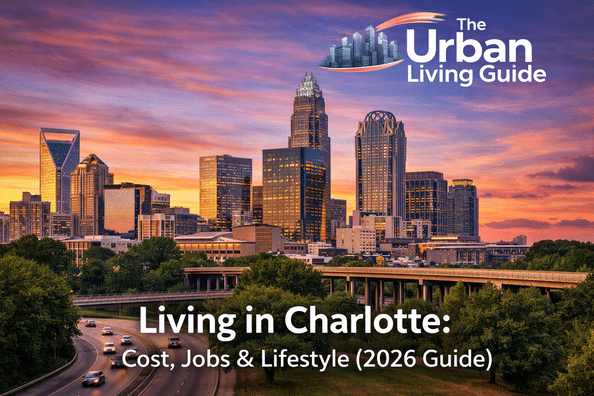
From Banking Towers to Southern Charm: What Living in Charlotte Really Feels Like in 2026
Situated in the rolling Piedmont region of North Carolina near the South Carolina state line, Living in Charlotte, North Carolina offers a compelling blend of Southern hospitality, explosive financial sector growth, and modern urban planning. As the largest city in the state and one of the fastest-growing metropolitan hubs in the United States, Charlotte supports a core population of over 900,000 residents, with the broader metro region exceeding 2.8 million people. Famously recognized as the second-largest banking center in the U.S. behind New York City, the Queen City anchors the financial and commercial powerhouse of the Southeast.
Relocating to the region places you in a booming metropolitan hub anchored by corporate giants like Bank of America and Wells Fargo, alongside a thriving energy, logistics, and healthcare sector. Propelled by business-friendly economic policies and an influx of new residents, the city provides high-earning career pathways while maintaining living costs more manageable than major coastal hubs. However, thriving here requires navigating rising real estate values, suburban car dependency, and humid summer climates. Whether you want a high-rise luxury condo in Uptown or a family-friendly haven in Ballantyne, Charlotte delivers an ambitious, comfortable, and modern lifestyle.
What Makes Charlotte So Popular & Unique
Charlotte commands national attention because it successfully pairs the high-powered economic engine of a major financial capital with the relaxed livability and green landscapes of the Piedmont region. Centered around the dynamic commercial spaces of Uptown and the trendy arts corridor of South End, the city functions as a magnet for professionals, entrepreneurs, and families. For newcomers looking to access municipal services, utility maps, or community event schedules, the official City of Charlotte portal serves as an essential digital gateway.
-
- The Nation’s Second-Largest Banking Hub: Home to massive corporate headquarters, financial exchanges, and banking institutions like Bank of America and Truist.
- Motorsports Capital: Deeply embedded in American culture as the historical heart of NASCAR heritage and professional racing teams.
- Exceptional Geographic Placement: Perfectly positioned within comfortable driving distance of both the majestic Blue Ridge Mountains and the scenic Atlantic Coast.
- Thriving Urban-Suburban Fusion: Offering distinct neighborhood enclaves ranging from historic Dilworth to upscale SouthPark and master-planned Ballantyne.
Charlotte at a Glance: Key Relocation Metrics
Reviewing these baseline statistics helps establish realistic expectations for your transition to Mecklenburg County. These figures reflect current southeastern market conditions and regional economic benchmarks.
| Metric | Charlotte City Data | Metropolitan Context |
|---|---|---|
| City Population | Over 900,000 Residents | Exceeds 2.8 Million across the greater metro area |
| Median Home Price | $380,000 – $450,000 | Reflects strong demand driven by continuous population migration |
| Average 1BR Rent | $1,500 – $1,900 | Competitive rental market near business districts and light rail |
| Average Commute | 25 – 30 Minutes | Navigates I-77, I-485 outer ring, and arterial commuting routes |
| Top Industries | Banking, Finance, Healthcare, Energy, Logistics | Technology startups, professional services, and motorsports |
If you’re not familiar with the area, take a look at the map below to understand where the city is located.
Famous Personalities, Racing Legends & Major Brands in Charlotte
Charlotte’s cultural footprint has shaped American corporate banking, professional motorsports, entertainment, and professional athletics for decades.
- Corporate Titans: The broader region is closely associated with banking founders, corporate executives, and healthcare leaders driving institutions like Bank of America and Atrium Health.
- Professional Sports: Sports run through the community, supported by passionate fanbases cheering for the Carolina Panthers (NFL), Charlotte Hornets (NBA), and Charlotte FC (MLS).
- Corporate Footprint: The regional economy acts as the command center for world-class enterprises like Wells Fargo (large operations), Truist, Lowe’s, and the NASCAR Hall of Fame.
Job Market & Business Opportunities with Major Employers
Charlotte features one of the most robust, high-paying job markets in the American Southeast, anchored by investment banking, corporate law, energy systems, and advanced healthcare. Whether you are managing corporate financial portfolios or directing medical operations, professional opportunities here command competitive salaries.
Key employers driving local prosperity include Bank of America, Wells Fargo, Atrium Health, and Lowe’s corporate headquarters just north in Mooresville. Official economic reference data from the North Carolina Department of Commerce highlights that average salaries typically range between $70,000 and $100,000 annually for mid-level professionals, providing strong middle-class purchasing power.
- Entry-level salaries: Typically range between $45,000 – $60,000 across administrative, banking support, and retail management.
- Mid-career professionals: Generally span $70,000 – $100,000 for experienced financial analysts, engineers, and registered nurses.
- Senior banking and executive roles: Frequently scale to $110,000+, supporting strong upper-middle-class living.
Housing & Real Estate Overview in Charlotte
Housing is universally the single largest monthly expense when evaluating Charlotte, with the real estate market experiencing heightened competition due to sustained migration. In 2026, median home prices range between $380,000 and $450,000, though luxury properties in SouthPark or Dilworth scale much higher.
The rental market commands competitive pricing for apartments and single-family homes alike. Current average monthly rent projections are:
- Studio Apartment: $1,300 – $1,600
- 1 Bedroom Apartment: $1,500 – $1,900
- 2–3 Bedroom Family Apartment: $1,900 – $2,800
- Single-Family Home Rentals: $2,800 – $4,000+
Achieving homeownership requires careful budgeting for property values, though long-term investment potential remains exceptionally strong across the metro area.
Best Neighborhoods in Charlotte: Finding Your Ideal Community
Choosing the right neighborhood in Charlotte defines your daily commute, school access, and architectural surroundings. Each district offers an entirely unique character. Neighborhood insights are based on local housing trends, safety reports, and resident surveys. The table below outlines the most prominent residential zones.
| Neighborhood / Category | Location, Pricing & Community Overview |
|---|---|
| Uptown Charlotte (Financial Core) | The bustling financial heart of the city featuring modern luxury high-rises, skyline views, and high walkability. Popular among banking professionals working at Bank of America. |
| SouthPark (Upscale & Shopping) | An upscale residential area known for luxury apartment complexes, high-end designer shopping at SouthPark Mall, and strong public school catchments. |
| Dilworth (Historic Charm) | Features historic architectural charm with tree-lined streets, renovated craftsman bungalows, and boutique local dining within close proximity to Uptown. |
| Ballantyne (Suburban Master-Planned) | One of the most sought-after suburban areas in the Southeast, renowned for top-rated public schools, safe master-planned communities, and corporate parks. |
| South End (Trendy & Walkable) | A highly walkable urban corridor along the LYNX Blue Line featuring modern apartment developments, craft breweries, and coworking spaces. |
What It’s Really Like Living in Charlotte, North Carolina (Daily Life & Vibe)
Daily life in Charlotte has a steady weekday rhythm centered around corporate work culture. Uptown pulses with professional activity during office hours, while surrounding residential neighborhoods maintain a calm, family-oriented environment. The professional atmosphere is goal-oriented and polite, offering robust networking events and fintech meetups without the hyper-aggressive pace of New York City.
Weekends are typically spent visiting local craft breweries, attending Carolina Panthers games at Bank of America Stadium, walking through the green expanses of Freedom Park, or taking weekend road trips into the nearby Blue Ridge Mountains. While social life tends to be car-dependent outside of the light rail corridor, the community atmosphere feels structured, comfortable, and deeply welcoming.
Watch a recent video by a popular vlogger to understand daily life and vibes in Charlotte:
Cost of Living in Charlotte: Monthly Expenses & Salary Needs
Charlotte’s cost of living sits slightly above the national average, driven primarily by strong real estate demand and population migration. Cost estimates are derived from official statistics and city-level cost databases. To maintain a secure, comfortable standard of living and achieve financial stability, an individual professional should target a salary of $75,000+, while households generally require $110,000+.
- Average Rent: ~$1,600 to $2,400 depending on apartment size and neighborhood.
- Monthly Utilities: $150 – $220 (Covering electricity, water, and internet).
- Groceries & Household Goods: $350 – $450 per month for a single person.
- Transportation: $120 for public transit passes or $300+ for personal vehicle operating expenses.
- Healthcare Costs: Varies by employer coverage, supported by major regional networks like Atrium Health.
Transportation, Commute Dynamics & Transit Realities
Getting around Charlotte and connecting to the wider metropolitan region involves a personal vehicle-oriented transit network:
- LYNX Blue Line Light Rail: Providing modern light rail transit connecting suburban southern corridors directly through South End into Uptown.
- Major Highways & Airport: Excellent driving connectivity anchored by I-77, I-85, and the I-485 outer ring, alongside Charlotte Douglas International Airport (CLT) as a major global aviation hub.
- Commute Times: Average daily commute times hover between 25 and 30 minutes, with moderate traffic congestion occurring during peak morning and evening rush hours.
- Car Dependency: While areas along the LYNX line offer walkability, most residents rely heavily on personal vehicles for daily errands and suburban commuting.
Weather Patterns, Seasonal Realities & Climate Factors
Charlotte experiences a pleasant humid subtropical climate featuring four distinct seasons:
- Spring: Mild temperatures and blooming dogwoods, making it one of the most picturesque times of year to explore city parks.
- Summer: Hot and humid with daytime temperatures regularly pushing into the 90s, ideal for swimming and lake recreation.
- Autumn: Crisp, comfortable weather accompanied by stunning fall foliage across Piedmont parks and mountain getaways.
- Winter: Mild with very little snowfall, though occasional winter storms require brief precautions.
- Climate Reference: Official meteorological tracking and climate data are provided by the National Weather Service North Carolina region.
Education, Schools & Major Universities
Education serves as a major intellectual and talent engine for the entire region. Charlotte is home to the University of North Carolina at Charlotte (UNC Charlotte), Queens University of Charlotte, and multiple comprehensive community colleges. For families navigating K-12 education, public options vary by district, with highly rated suburban public schools concentrated heavily in South Charlotte and Ballantyne.
Medical Facilities, Hospitals & Healthcare Systems
Access to advanced, cutting-edge healthcare is one of Charlotte’s premier community advantages. The city is home to internationally renowned medical centers and research hospitals, anchored by Atrium Health and Novant Health. These premier hospital networks anchor an extensive neighborhood clinic system providing exceptional specialized medical care across every clinical discipline.
Popular Hotels, Cafes, Dining & Culinary Scene
Charlotte’s hospitality and culinary scene blends upscale Southern comfort with modern international gastronomy.
- Popular Hotels: Out-of-town visitors and corporate executives frequently book stays at luxury landmarks like The Ritz-Carlton, Charlotte, The Westin Charlotte, or JW Marriott Charlotte.
- Cafes & Social Hubs: Artisan coffee roasters and historic bakeries like Not Just Coffee and Amélie’s French Bakery thrive throughout NoDa, South End, and Uptown.
- Restaurants: From acclaimed fine dining at Kindred and local barbecue at Midwood Smokehouse to fresh seafood at Sea Level NC, Charlotte’s food scene is diverse and thriving.
Sightseeing, Cultural Spots & Tourist Attractions
Residents live surrounded by world-class motorsports museums, cultural institutions, and thrilling outdoor recreation facilities.
- NASCAR Hall of Fame: A state-of-the-art interactive museum celebrating the history, drivers, and engineering marvels of professional stock car racing.
- U.S. National Whitewater Center: A massive outdoor recreation facility offering artificial whitewater rafting, mountain biking, rock climbing, and festival events.
- Freedom Park: A gorgeous 98-acre park featuring walking trails, sports fields, and a scenic lake situated between Dilworth and Myers Park.
- Discovery Place Science: An engaging downtown science museum offering hands-on exhibits and IMAX screenings for all ages.
Regional Trade-offs: Pros and Cons of Living in Charlotte
Every major city requires compromise. Here is the unvarnished reality for anyone planning a move to the Queen City in 2026:
Pros:
- A powerful banking and corporate finance hub offering exceptional career growth.
- A growing technology and fintech employment sector.
- Mild winters with very little snow accumulation.
- Safe, family-friendly suburbs with top-rated public schools.
- Favorable state tax structures compared to many northern states.
Cons:
- Rising housing costs and a competitive real estate purchase market.
- High car dependency outside of the limited light rail corridor.
- Traffic congestion along major commuter arteries during peak hours.
- Hot, humid summer weather requiring robust air conditioning.
- A competitive apartment rental market near business districts.
Who Is Charlotte Ideal For (and Who Should Avoid It?)
Ideal For: Banking and finance professionals, tech workers, healthcare employees, growing families seeking suburban comfort, and first-time homebuyers aiming for long-term property equity.
Who Should Avoid It: Individuals requiring extensive heavy rail transit networks, buyers seeking ultra-low living costs, and those who despise hot, humid summer climates.
Real Experiences: Perspectives from Long-Term Residents (5 to 10+ Years)
Data gives you the metrics, but daily life gives you the truth. Here is what veteran locals have to say about navigating Charlotte:
“Moving down from New York for a banking role was the best career move I’ve made, and our money went so much further buying a home in Ballantyne. Traffic on I-77 can test your soul during rush hour, but the neighborhoods are green and safe, and the airport gets me anywhere in the country easily.”
[Source: r/Charlotte Community Discussions]
“South End and NoDa have incredible energy if you’re young and working in tech or marketing—the breweries and the light rail make city living easy. Rent has definitely crept up over the last few years, but the quality of life and the weekend trips to the mountains make it hard to leave.”
[Source: Local Neighborhood Survey Threads]
Frequently Asked Questions About Living in Charlotte, North Carolina
Is Charlotte, North Carolina expensive to live in?
Charlotte is moderately priced compared to major U.S. coastal metropolises, though rapid population growth has driven up housing costs and rental rates significantly.
What salary do you need to live comfortably in Charlotte?
An annual salary of $75,000+ is generally sufficient for a single professional to live comfortably, while families typically require $110,000+ to manage housing and childcare.
Is Charlotte safe for residents and families?
Safety varies by neighborhood; established suburban enclaves like Ballantyne and SouthPark, alongside residential areas like Dilworth, are widely considered very secure.
Can you live in Charlotte without a car?
While living car-free is possible if you reside and work directly along the LYNX Blue Line light rail corridor, most residents rely heavily on personal vehicles for daily transportation.
What are the best neighborhoods for families in Charlotte?
Ballantyne, SouthPark, and Dilworth are among the most popular residential areas praised for their exceptional public schools, family parks, and community safety.
How does Charlotte compare to living in Atlanta?
Charlotte is smaller, cleaner, and more financially focused, whereas Atlanta offers a larger metropolitan scale, greater cultural diversity, and more expansive urban nightlife.
🔗 Explore More Cities in North Carolina
If you’re exploring more options beyond Charlotte, The Urban Living Guide has covered several other popular cities in North Carolina. You can also check:
New to Charlotte? These resources can help you get started:
- Cost of Living in Charlotte, NC
- Pros and Cons of Living in Charlotte, NC
- Best Neighborhoods in Charlotte, NC
For a complete moving guide, read: Moving to Charlotte, NC
These guides offer a comprehensive view of life in different cities, covering key aspects like cost of living, housing, job opportunities, neighborhoods, commute, weather, education, popular spots, and major employers.
The Urban Living Guide brings all these insights together in one place, making it easier to compare cities and choose the one that best fits your lifestyle, priorities, and long-term goals.