

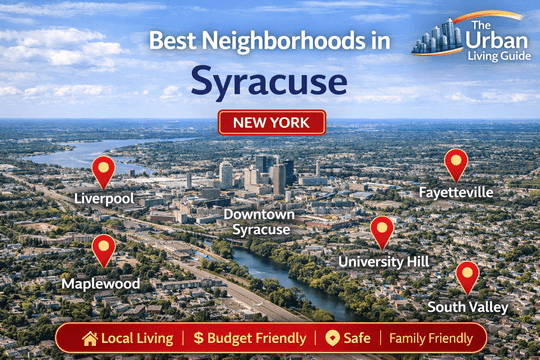
Best Neighborhoods in Syracuse, New York: Historic Squares, University Heights & Salt City Suburbs in 2026
Covering approximately 25.6 square miles of land area in the central Finger Lakes plains of Onondaga County, the City of Syracuse operates under the mayor-council municipal administration of the City of Syracuse. Housing a municipal core population exceeding 146,000 residents and anchoring a regional metropolitan footprint of over 662,000 people, “The Salt City” serves as the primary educational, healthcare, logistics, and industrial research engine of Central New York.
Relocating across Central New York requires evaluating neighborhood redevelopment, lake-effect winter weather patterns, and regional commuter highway corridors managed by the New York State Department of Transportation. Inbound movers consistently balance direct access to primary regional employers—including the extensive medical cluster at Upstate Medical University, St. Joseph’s Health Hospital, the massive semiconductor investments across Central New York, and research programs at Syracuse University (SU)—against daily highway commutes across Interstate 81, Interstate 690, Interstate 481, the New York State Thruway (I-90), and US Route 11.
Watch this video to explore different neighborhoods, suburban corridors, and residential communities across Syracuse:
Best Areas to Live in Syracuse at a Glance in 2026
| Neighborhood Name | Location | Distance from Core (Downtown) | Development Status | Transit Connectivity | Cost Level | Best Fit For |
|---|---|---|---|---|---|---|
| Downtown Syracuse | Central Historic Core | 0 miles (Urban Center) | Revitalized Historic Mixed-Use | Exceptional (Centro Transit Hub, I-81, I-690) | Mid-Range | Young Professionals, Tech Workers & Medical Staff |
| Fayetteville | Eastern Suburbs (Town of Manlius) | Approximately 8 miles east | Historic Master-Planned Suburban Village | High (NY-5 / Genesee St, I-481) | High-to-Premium | Families, Healthcare Directors & Executives |
| Liverpool | North Lake Basin (Town of Salina) | Approximately 5.5 miles north | Established Lakeside Suburban | High (I-90 / NYS Thruway, NY-370, I-81) | Mid-Range | Suburban Families, Commuters & Outdoor Lovers |
| University Hill | East Central Academic Ridge | Approximately 1 mile east | High-Density Academic & Medical Hub | Exceptional (Centro Shuttles, E Genesee St, I-81) | Accessible / Mid-Range | Students, University Faculty & Medical Fellows |
| South Valley | South Onondaga Basin | Approximately 3.5 miles south | Historic Developing Infill Basin | High (S Salina St, I-81, Centro Buses) | Accessible / Budget-Friendly | First-Time Homebuyers, Value Renters & Investors |
Best Neighborhoods in Syracuse Discussed in Detail
Downtown Syracuse — Historic Armory Square, Walkable Lofts & Urban Dining Hub
Positioned along the historic path of the original Erie Canal, Downtown Syracuse serves as the legal, financial, architectural, and culinary heart of Onondaga County. Centered around the cobblestone plazas of Armory Square, Clinton Square, and Hanover Square, downtown has experienced substantial urban revitalization guided by the City of Syracuse and the Downtown Committee of Syracuse.
The urban core blends restored 19th-century limestone and brick industrial buildings with modern luxury lofts, artisan cafes, craft breweries, and live theater within walking distance of major corporate offices.
- Housing: Real estate is dominated by restored brick-and-timber industrial lofts (such as The Lofts at Franklin Square and Armory Square Lofts), upper-floor condominium conversions, and contemporary mixed-use mid-rises. Condominium purchase valuations typically range from $150,000 to $380,000+, while modern rental lofts average $1,150 to $2,100 per month.
- Safety & Crime Rate: Patrolled by the Syracuse Police Department (SPD) First Police District and supported by downtown security ambassadors. Pedestrian dining corridors along Walton and Clinton Streets maintain safe foot traffic, though standard city awareness is advised on peripheral commercial blocks late at night.
- School District & Education Quality: Governed by the Syracuse City School District (SCSD), containing nearby magnet options like Syracuse STEM at Blodgett and Institute of Technology at Syracuse Central (ITSC), alongside higher-education footprints at nearby campuses.
- Walkability & Daily Conveniences: Outstanding pedestrian walkability (Walk Score of 86-90/100). Residents walk to over 50 local restaurants, coffee shops, cultural venues at The Landmark Theatre and Milton J. Rubenstein Museum of Science & Technology (MOST), alongside the seasonal farmers markets in Clinton Square.
- Parks & Green Spaces / Pet-Friendliness: Municipal recreation includes the civic plazas of Clinton Square (featuring an outdoor ice skating rink in winter and splash fountains in summer), Hanover Square, and the 2.5-mile Onondaga Creekwalk Trail connecting directly to Onondaga Lake. Highly pet-friendly with walkable urban streetscapes.
- Parking & Traffic Congestion: Managed through municipal parking garages and surface lots; most residential loft conversions provide assigned tenant garage spaces. Surface street traffic flows smoothly with minimal rush-hour delays.
- Noise Levels & Vibe: Vibrant, historic, and social, filled with live acoustic music from local pubs, outdoor patio chatter, and festival crowds during the annual Syracuse Winterfest and Polish Festival.
- Medical Facilities & Hospitals: Direct 4-minute access to the massive medical cluster on University Hill, including Upstate University Hospital and Crouse Hospital.
- Transit Connectivity: Central public transit hub operated by Centro (Central New York Regional Transportation Authority) at the Centro Transit Hub on Salina Street, with rapid vehicular access to Interstate 81 and Interstate 690. Long-distance air travel is served via Syracuse Hancock International Airport (SYR) located 6 miles north.
- Affordability: Highly accessible urban price tier; delivers authentic architectural lofts and walkable dining convenience at rates significantly lower than downstate metropolitan areas.
- Who It’s Best For: Young professionals, corporate attorneys, medical residents, tech employees, and urbanites seeking a car-optional historic lifestyle.
- Drawbacks: Quieter street foot traffic on weekday evenings outside main restaurant clusters, limited full-scale supermarkets directly within the core, and winter snow removal logistics.
Fayetteville — Historic Canal Village Prestige, Green Lakes Parkland & Top-Tier Schools
Situated in eastern Onondaga County within the town of Manlius, the incorporated village of Fayetteville represents one of the most affluent, architecturally preserved, and sought-after suburban communities in the Syracuse metropolitan area. Operating under municipal administration via the Village of Fayetteville Official Portal, the village centers around the historic intersection of East Genesee Street (NY-5) and South Manlius Street.
Fayetteville blends historic 19th-century architecture and boutique shopping with pristine master-planned subdivisions, world-class state parkland, and elite public education.
- Housing: Real estate stock features historic Greek Revival and Victorian single-family homes, established mid-century colonial estates in neighborhoods like Hunts Point, modern luxury executive builds, and upscale maintenance-free townhomes. Single-family purchase prices typically range from $280,000 to $750,000+, while residential rentals average $1,550 to $2,600 per month.
- Safety & Crime Rate: Protected by the dedicated Manlius Police Department, Fayetteville consistently records one of the lowest violent and property crime rates in Upstate New York, supported by responsive municipal emergency patrols and active community watch networks.
- School District & Education Quality: Governed by the nationally acclaimed Fayetteville-Manlius Central School District (F-M), featuring top-performing public institutions such as Fayetteville-Manlius High School, Wellwood Middle School, and Fayetteville Elementary School.
- Walkability & Daily Conveniences: The historic village center is walkable, offering local bakeries, independent coffee roasters, craft bistros, and pharmacies, while major shopping plazas along East Genesee Street host Tops Friendly Markets, Target, L.L.Bean, and Wegmans Supermarket in Dewitt nearby.
- Parks & Green Spaces / Pet-Friendliness: World-class natural recreation anchored by the 1,900-acre Green Lakes State Park (featuring two rare meromictic lakes with emerald green waters, swimming beaches, 18-hole Robert Trent Jones golf, and 15 miles of trails), Canal Landing Park, and Mill Run Park. Exceptionally pet-friendly.
- Parks & Green Spaces / Pet-Friendliness: Plentiful private two-car garages and wide residential driveways keep neighborhood lanes clear. Commuter traffic moves steadily along NY Route 5 with minor slowdowns during peak morning school drop-off hours.
- Noise Levels & Vibe: Serene, refined, and family-oriented, characterized by quiet tree-canopied lanes, birdsong, and tranquil residential evenings.
- Medical Facilities & Hospitals: Direct 12-minute drive via NY-5 or I-481 to Upstate Medical University, Crouse Hospital, and outpatient clinics in nearby East Syracuse.
- Transit Connectivity: Road travel connects quickly via NY Route 5 (East Genesee St) and Interstate 481 (Exit 3), offering a 12-minute drive into Downtown Syracuse and 10 minutes to the New York State Thruway (I-90).
- Affordability: High-tier suburban price profile for Onondaga County; higher school property taxes are balanced by top-tier public school ratings, expansive parkland, and strong property appreciation.
- Who It’s Best For: Families prioritizing public education (F-M schools), healthcare executives, corporate managers, and outdoor recreation lovers.
- Drawbacks: Higher town and school property tax millage rates, limited starter-home inventory under $250k, and automobile reliance for major shopping centers.
Liverpool — Lakeside Living, Historic Salt Village & Commuter Convenience
Located along the scenic northern shores of Onondaga Lake in the town of Salina, the incorporated village of Liverpool is one of Syracuse’s most dependable, green, and well-connected suburban communities. Settled in the early 19th century as a key center for the historic salt manufacturing industry along the Oswego Canal, Liverpool operates under its own municipal village government via the Village of Liverpool Official Website.
The community combines a walkable historic village core centered along First Street and Oswego Street with expansive lakefront parkland, established mid-century residential subdivisions, and highway access.
- Housing: Real estate spans classic 1920s Craftsman bungalows in the village, 1960s–1980s split-level and single-story ranch homes in mature subdivisions (such as Chestnut Hill and Galeville), modern townhomes, and garden-style apartment complexes. Single-family purchase prices typically range from $165,000 to $340,000, while rental apartments average $1,050 to $1,750 per month.
- Safety & Crime Rate: Protected by the dedicated Liverpool Village Police Department and supported by the Onondaga County Sheriff’s Office, Liverpool maintains low violent and property crime rates across its residential tracts.
- School District & Education Quality: Governed by the highly regarded Liverpool Central School District, featuring public campuses including Liverpool High School, Liverpool Middle School, and Chestnut Hill Elementary.
- Walkability & Daily Conveniences: Outstanding village walkability along First Street and Second Street, featuring local bakeries, craft coffee houses, traditional Italian diners, neighborhood pharmacies, and specialty grocers like Nichols Supermarket and ALDI nearby on Route 57.
- Parks & Green Spaces / Pet-Friendliness: Exceptional natural amenities anchored by the sprawling Onondaga Lake Park (often called the “Central Park of Central New York,” featuring 7.5 miles of paved lakefront trails, skate parks, dog parks, and the Salt Museum), Johnson Park (hosting free summer outdoor concerts), and Heid’s of Liverpool Grounds. Exceptionally pet-friendly.
- Parking & Traffic Congestion: Generous two-car garages and wide residential driveways keep neighborhood streets clear. Commuter traffic on NY Route 370 (Old Liverpool Rd) and Route 57 moves smoothly, with minor delays near the Thruway interchange.
- Noise Levels & Vibe: Grounded, community-centered, and relaxed, characterized by lake breezes, neighborhood cyclists, and calm evenings.
- Medical Facilities & Hospitals: Direct 8-to-10 minute medical access to St. Joseph’s Health Hospital on Prospect Avenue and Upstate Medical University downtown.
- Transit Connectivity: Major highway positioning at the junction of Interstate 81 (Exit 23/24), the New York State Thruway (I-90 Exit 37), and NY Route 370, providing a 7-minute drive to Downtown Syracuse and 5 minutes to Syracuse Hancock International Airport.
- Affordability: Balanced mid-range price tier; delivers lakefront park access, solid school zoning, and suburban comfort at accessible price points.
- Who It’s Best For: Families seeking dependable public schools on a moderate budget, hospital commuters at St. Joseph’s, airport personnel, and outdoor enthusiasts.
- Drawbacks: Older home infrastructure requiring modernization in select mid-century tracts, winter lake-effect winds off Onondaga Lake, and traffic on Route 57 during peak hours.
University Hill — Academic Powerhouse, Medical District & Historic East Side Ridges
Rising directly east of the downtown core, University Hill (known locally as “The Hill”) is the primary intellectual, medical research, architectural, and cultural engine of Syracuse. Anchored by the expansive research campus of Syracuse University and the historic research hospitals along East Adams Street, the neighborhood combines university activity with historic residential enclaves along Comstock Avenue and Berkeley Park.
Operating under City of Syracuse municipal governance and guided by the University Hill Corporation, the district provides walkable academic and medical living within steps of lecture halls, libraries, and athletic stadiums.
- Housing: Real estate stock features historic early 20th-century Tudor and Craftsman single-family homes, student rental duplexes, converted brick fraternity houses, and modern multi-story luxury student and professional apartment complexes. Single-family purchase prices typically range from $175,000 to $390,000, while modern apartment rentals average $1,100 to $1,950 per month.
- Safety & Crime Rate: Patrolled by the SPD Eastside Command and heavily supplemented by the visible, 24/7 Syracuse University Department of Public Safety (DPS) across campus and student residential corridors, maintaining safe pedestrian thoroughfares.
- School District & Education Quality: Governed by SCSD, containing neighborhood institutions like Ed Smith School (Pre-K to 8) and Nottingham High School, alongside higher-education institutions anchored by Syracuse University, SUNY Upstate Medical University, and the SUNY College of Environmental Science and Forestry (ESF).
- Walkability & Daily Conveniences: Outstanding pedestrian infrastructure (Walk Score of 84-88/100). Residents walk to lively coffee shops, international eateries, bookstores, and music venues along Marshall Street and East Genesee Street.
- Parks & Green Spaces / Pet-Friendliness: Municipal recreation includes the rolling forested trails of Thornden Park (a 76-acre park featuring the historic E.M. Mills Rose Garden, public swimming pools, and an outdoor amphitheater), Oakwood Cemetery (historic 19th-century landscaped grounds), and Walnut Park. Highly pet-friendly.
- Parking & Traffic Congestion: Street parking is strictly managed through city residential parking permits; off-street driveway parking is valuable on student-dense blocks. Significant traffic builds along East Adams Street, Comstock Avenue, and I-81 during university sporting events at the JMA Wireless Dome.
- Noise Levels & Vibe: High-energy, intellectual, and spirited, filled with collegiate game-day crowds, medical professionals walking between hospitals, and active sidewalk conversations.
- Medical Facilities & Hospitals: Direct emergency medical coverage provided within the district by Upstate University Hospital, Crouse Hospital, and the Syracuse VA Medical Center on Irving Avenue.
- Transit Connectivity: High-frequency public transit provided by Centro Bus Routes and SU Campus Shuttles, offering rapid 5-minute transit to Downtown Syracuse and direct access to Interstate 81.
- Affordability: Accessible mid-range price tier; delivers strong rental yields for multi-unit property investors alongside accessible purchase opportunities in adjacent residential pockets.
- Who It’s Best For: University faculty, medical residents and nurses, graduate students, healthcare researchers, and sports fans wanting proximity to the JMA Dome.
- Drawbacks: Elevated weekend student noise on blocks immediately adjacent to Marshall Street, parking congestion on game days, and high rental turnover during academic breaks.
South Valley — Historic Wooded Basins, Green Hills & Budget-Conscious Housing
Covering the rolling geographic basin in southern Syracuse stretching along the Onondaga Creek corridor toward Dorwin Avenue, the South Valley (often called The Valley) is one of the city’s most historically grounded, green, and budget-accessible residential sectors. Extending along South Salina Street (US-11) and Seneca Turnpike (NY-173), South Valley combines established single-family homes with wooded parklands and straightforward highway access.
The neighborhood provides an accessible entry point for first-time homebuyers, tradespeople, and budget-conscious families seeking large yards near city transit corridors.
- Housing: Real estate consists of mid-century single-story ranch homes, classic 1920s wood-frame bungalows on generous quarter-acre lots, two-family flats, and value-oriented apartment complexes. Single-family purchase prices typically range from $85,000 to $175,000, while rental homes and apartments average $750 to $1,250 per month.
- Safety & Crime Rate: Patrolled by the SPD Southside Command. Safety and property maintenance metrics can vary from street to street, with established residential enclaves in the southern Valley tracts maintaining active community block clubs and calmer conditions.
- School District & Education Quality: Governed by SCSD, containing neighborhood institutions such as Corcoran High School, Clary Middle School, and Meachem Elementary School.
- Walkability & Daily Conveniences: Automobile-dependent for major shopping, with commercial centers along South Salina Street and Seneca Turnpike hosting local diners, corner convenience markets, hardware supply outlets, and community retail.
- Parks & Green Spaces / Pet-Friendliness: Outstanding recreational amenities anchored by Meachem Park (featuring youth athletic complexes, outdoor ice rinks, and playgrounds), Dorwin Spring Park, Heath Park along Onondaga Creek, and nearby hiking at Webster Pond. Dog-friendly with quiet residential streets.
- Parking & Traffic Congestion: Plentiful private residential driveways and open on-street parking. Highway on-ramps provide fast access to Interstate 81 (Exit 16/17) and US-11 without major traffic delays.
- Noise Levels & Vibe: Community-centered, rustic, and quiet, shifting from commercial avenues to tree-lined residential loops near the southern hills.
- Medical Facilities & Hospitals: Direct 6-to-8 minute medical access north via I-81 or Salina Street to Upstate University Hospital and Crouse Hospital.
- Transit Connectivity: Public bus transit provided by Centro Bus Routes (Route 10 and Route 16) running along South Salina Street directly into the Downtown Transit Hub, with rapid vehicular access to I-81 and I-481.
- Affordability: Syracuse’s most accessible entry-level homeownership and rental price tier, offering low purchase barriers and manageable property assessments.
- Who It’s Best For: First-time homebuyers, budget-conscious renters, tradespeople, real estate investors, and workers seeking quick highway access to downtown or southern suburban employers.
- Drawbacks: Pockets of deferred property maintenance, variable public school test performance ratings, and fewer upscale commercial dining venues.
Comprehensive Neighborhood Pros and Cons Comparison
| Neighborhood | Core Advantages (Pros) | Core Limitations (Cons) |
|---|---|---|
| Downtown Syracuse | High walkability in Armory Square; restored historic brick lofts; central Centro Transit Hub; 4 minutes to medical cluster. | Quieter late-night foot traffic on weekdays; lack of large supermarkets directly in the core; winter snow clearing logistics. |
| Fayetteville | Top-ranked Fayetteville-Manlius (F-M) schools; historic village center; 1,900-acre Green Lakes State Park; lowest crime. | Higher property tax millage rates; limited starter-home inventory under $250k; automobile dependence for shopping. |
| Liverpool | Direct access to Onondaga Lake Park; walkable historic village along First St; Liverpool Central schools; fast access to I-90/I-81. | Older home infrastructure requiring updates; lake-effect winter winds off Onondaga Lake; commercial traffic on Route 57. |
| University Hill | Walkable to Syracuse University and Upstate Medical; 76-acre Thornden Park; vibrant dining on Marshall St; strong rental yields. | Collegiate game-day parking and traffic near the JMA Dome; weekend student noise on certain blocks; annual tenant turnover. |
| South Valley | Syracuse’s most affordable home and rental prices; large residential lots; close to Meachem Park and Webster Pond; fast I-81 access. | Safety and property upkeep vary significantly by street; variable public school test performance ratings; older housing infrastructure. |
How You Decide Which Neighborhood Is Best For You
Selecting your ideal neighborhood in Syracuse requires balancing your housing budget with daily workplace destinations, schooling priorities, and winter weather realities. Because Syracuse serves as the transportation hub of Central New York, your location dictates whether your daily commute relies on central city transit via Centro Bus Routes, walkable sidewalks into Armory Square or University Hill, or major highway expressways like Interstate 81, Interstate 690, and Interstate 481.
Healthcare professionals and medical residents at Upstate University Hospital or St. Joseph’s Health, faculty and students at Syracuse University, corporate employees in Downtown Syracuse, and tech specialists across the expanding manufacturing corridor should evaluate transit routes to optimize daily convenience.
Beyond commuter corridors, evaluate essential municipal utility and building infrastructure realities. Central New York experiences freezing winter temperatures with heavy lake-effect snowfall, making heating efficiency and utility reliability through National Grid an important factor.
In addition, prospective homebuyers evaluating historic Victorian homes in University Hill or traditional bungalows in Liverpool should budget for seasonal maintenance and furnace updates, while buyers in Fayetteville or surrounding towns should verify town and school district property tax assessments. Before executing a lease or purchase agreement, verify high-speed fiber broadband availability (such as Verizon Fios or Spectrum Gigabit) and confirm county school assignment boundaries.
Frequently Asked Questions About Syracuse Neighborhoods
Which neighborhood in the Syracuse area is considered best for families with school-age children?
Fayetteville and Liverpool are widely regarded as premier family communities in Greater Syracuse. Fayetteville provides access to the nationally top-ranked Fayetteville-Manlius Central School District (F-M High School) alongside safe, tree-lined residential neighborhoods and Green Lakes State Park. Liverpool offers dependable public education through the Liverpool Central School District paired with historic village charm and Onondaga Lake Park.
What is the most walkable neighborhood in Syracuse where you can live without relying heavily on a car?
Downtown Syracuse (specifically Armory Square and Hanover Square) and University Hill offer the highest walkability in the city, both scoring above 84 on Walk Score. Downtown Syracuse allows residents to complete daily errands on foot, walk to local cafes, restaurants, art galleries, and connect directly to the Centro Transit Hub. University Hill provides dense pedestrian access to Syracuse University, major hospitals, and dining along Marshall Street.
What are the safest residential neighborhoods to live in within Greater Syracuse?
Fayetteville and Liverpool consistently report the lowest violent and property crime rates in Onondaga County. Fayetteville benefits from dedicated Town of Manlius police patrols, while Liverpool maintains its own active village police department with fast emergency response times.
What are the most affordable neighborhoods for homebuyers and renters in Syracuse?
South Valley, the Northside, and parts of the Westside provide the most budget-friendly housing opportunities in the area. In South Valley, buyers and renters can secure single-family starter homes on generous lots at entry-level price points substantially lower than regional and national averages.
How bad is lake-effect snow when commuting across Syracuse neighborhoods?
Syracuse regularly receives significant lake-effect snowfall originating over Lake Ontario, but the city, county, and state operate comprehensive snowplow fleets across major expressways like I-81, I-690, and the Thruway (I-90). Equipping your vehicle with quality all-season or winter snow tires ensures dependable travel during winter months.
Which Syracuse neighborhood is best for healthcare professionals working at Upstate or Crouse?
University Hill and Downtown Syracuse provide the fastest commutes to major healthcare campuses. University Hill is within a 2-to-5 minute walk or shuttle ride to Upstate University Hospital, Crouse Hospital, and the Syracuse VA Medical Center, making it ideal for medical residents, physicians, and nurses.
Is Syracuse an affordable place to live compared to New York City?
Yes, Syracuse’s overall cost of living and housing prices are significantly lower than New York City, offering spacious single-family homes, lower rental rates, and large residential lots at a fraction of downstate real estate prices.
Relocation Resources & Living Guides
The Urban Living Guide creates deeply researched, practical, and informative city relocation resources designed to help individuals, working professionals, and families navigate complex urban landscapes. By analyzing municipal infrastructure, hyper-local zoning patterns, commuter realities, and housing markets, our guides provide actionable insights so you can make confident, data-backed decisions when moving to major metropolitan areas.
Explore our regional guides across Syracuse and Central New York:
- Living in Syracuse, New York
- Cost of Living in Syracuse, New York
- Pros and Cons of Living in Syracuse, New York
Made your decision to move to the Salt City? Read our comprehensive relocation roadmap: Moving to Syracuse, New York.
Follow The Urban Living Guide for ongoing regional insights, neighborhood developments, and expert local coverage across Greater Syracuse and the state of New York.