

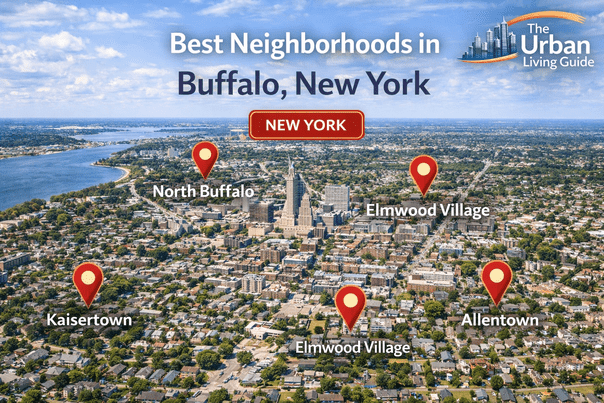
Best Neighborhoods in Buffalo, New York: Elmwood Arts, Historic Parkways & Queen City Enclaves in 2026
Covering approximately 40.4 square miles of land area along the eastern shores of Lake Erie at the head of the Niagara River in Erie County, the City of Buffalo operates under the mayor-council municipal administration of the City of Buffalo. Housing a municipal core population exceeding 276,000 residents and anchoring a broader Western New York regional footprint of over 1.24 million people, New York State’s second-largest city is internationally recognized for its Olmsted-designed parkway networks, historic architecture, and cross-border commercial importance along the Niagara frontier.
Relocating across the “Queen City” requires evaluating localized neighborhood reinvestment, lake-effect snow patterns, winter climate resilience, and public transit corridors operated by the Niagara Frontier Transportation Authority. Inbound movers consistently balance direct access to primary regional employment hubs—including the Buffalo Niagara Medical Campus (BNMC), the Downtown Central Business District, automotive and advanced manufacturing facilities, and research programs at the University at Buffalo (UB)—against daily highway commutes across Interstate 190 (Niagara Section), Interstate 90 (New York State Thruway), the Kensington Expressway (NY-33), the Scajaquada Expressway (NY-198), and Delaware Avenue (NY-384).
Watch this video to explore different neighborhoods, suburban corridors, and residential communities across Buffalo:
Best Areas to Live in Buffalo at a Glance in 2026
| Neighborhood Name | Location | Distance from Core (Downtown) | Development Status | Transit Connectivity | Cost Level | Best Fit For |
|---|---|---|---|---|---|---|
| Elmwood Village | West Side Corridor | Approximately 2 miles north | Historic Walkable Arts & Commercial | Exceptional (NFTA Bus Routes, Delaware Ave, NY-198) | Mid-to-High Range | Young Professionals, Creatives & Medical Staff |
| North Buffalo | Northern Urban Basin | Approximately 4.5 miles north | Established Multi-Family & Residential | High (NFTA Metro Rail, Hertel Ave, Colvin Ave) | Mid-Range | Families, Long-Term Homeowners & Academics |
| Allentown | Midtown Core Edge | Approximately 1 mile north | Historic Bohemian & Medical-Adjacent | Exceptional (NFTA Metro Rail – Allen/Medical, Main St) | Mid-to-High Range | Healthcare Fellows, Artists & Urbanites |
| Kaisertown | Southeast Industrial Basin | Approximately 4 miles southeast | Historic Working-Class Residential | High (I-190, Clinton St, NFTA Buses) | Accessible / Budget-Friendly | First-Time Homebuyers, Renters & Tradespeople |
| Williamsville | Northeast Suburbs (Incorporated Village) | Approximately 10 miles northeast | Historic Master-Planned Suburban Village | High (I-90, I-290, Main St / NY-5) | High-to-Premium | Corporate Executives, Suburban Families & Commuters |
Best Neighborhoods in Buffalo Discussed in Detail
Elmwood Village — Walkable Arts Hub, Victorian Architecture & Parkway Greens
Stretching along Elmwood Avenue between North Street and Forest Avenue, Elmwood Village is celebrated as one of America’s premier walkable urban neighborhoods. Operating with community stewardship from the Elmwood Village Association within the City of Buffalo, the district combines preserved Queen Anne and Victorian homes with independent boutiques, craft coffee shops, and internationally acclaimed art institutions.
Framed by the Frederick Law Olmsted-designed Bidwell and Chapin Parkways and bordering the academic grounds of Buffalo State University, Elmwood Village provides a pedestrian-oriented lifestyle surrounded by green canopy spaces.
- Housing: Architectural inventory features restored Victorian single-family homes, classic Buffalo double-flats (two-family homes), and upscale infill condominium buildings. Property purchase prices typically range from $280,000 to $750,000+, while 2-bedroom rental flats average $1,350 to $2,250 per month.
- Safety & Crime Rate: Patrolled by the Buffalo Police Department (BPD) B-District Command. Elmwood Village maintains active neighborhood watch networks and well-lit commercial streets, resulting in lower violent crime rates, though opportunistic property larceny and car break-ins occur on high-density side streets.
- School District & Education Quality: Governed by Buffalo Public Schools (BPS), containing top-ranked public criteria campuses such as City Honors School at Fosdick-Masten Park (nationally recognized for IB and AP curriculum) and Elmwood Village Charter School, alongside higher-education anchors at SUNY Buffalo State.
- Walkability & Daily Conveniences: Outstanding pedestrian walkability (Walk Score of 90-94/100). Residents easily walk to indie bookshops, bakeries, cafes, and grocers like Lexington Co-op Market and Price Rite Marketplace, alongside exhibits at the Buffalo AKG Art Museum and Burchfield Penney Art Center.
- Parks & Green Spaces / Pet-Friendliness: Direct access to Delaware Park (featuring the historic Hoyt Lake rowboats, golf courses, and the Buffalo Zoo), Bidwell Parkway (hosting the seasonal Elmwood Village Farmers Market), and Colonial Circle. Exceptionally pet-friendly with tree-lined pedestrian lanes.
- Parking & Traffic Congestion: Street parking is managed through municipal seasonal alternate-day parking rules to accommodate winter snowplows; off-street driveway parking adds substantial property value. Commuter traffic slows along Elmwood Avenue during evening dining hours.
- Noise Levels & Vibe: Vibrant, creative, and community-centric, filled with outdoor sidewalk dining chatter, weekend cyclists, and peaceful residential evenings on side avenues.
- Medical Facilities & Hospitals: Direct 5-minute commute to comprehensive emergency and specialized care at the Buffalo Niagara Medical Campus (Oishei Children’s Hospital and Buffalo General Medical Center).
- Transit Connectivity: Served by high-frequency NFTA-Metro Bus Routes (Routes 20 and 22) along Elmwood and Grant, offering a 10-minute commute to Downtown Buffalo, with rapid highway access to the Scajaquada Expressway (NY-198) and I-190.
- Affordability: Mid-to-high urban pricing tier for Western New York; higher real estate costs are offset by unmatched walkability, architectural preservation, and strong resale value.
- Who It’s Best For: Young professionals, healthcare workers at BNMC, university faculty, creatives, and buyers seeking historic charm without car dependency.
- Drawbacks: Competitive street parking during winter snow bans, aging Victorian heating infrastructure requiring weatherization, and higher rental price points relative to surrounding West Side sectors.
North Buffalo — Family-Centric Tree-Lined Avenues, Hertel Avenue Dining & Rail Access
Covering the established residential basin north of Delaware Park between Elmwood Avenue and Main Street, North Buffalo is one of the city’s most dependable and sought-after neighborhoods. Centered along the bustling commercial spine of Hertel Avenue, the community operates under City of Buffalo municipal administration.
North Buffalo is celebrated for its cohesive residential architecture, strong neighborhood business association, and active Italian-American culinary heritage, creating a stable, family-friendly setting within the city limits.
- Housing: Real estate stock is composed of classic 1920s brick and vinyl two-family flats, well-maintained single-family Craftsman and Tudor homes, and modern apartment conversions. Single-family purchase prices typically range from $240,000 to $520,000, while rental flats and apartments average $1,150 to $1,850 per month.
- Safety & Crime Rate: Patrolled by the BPD D-District Command, North Buffalo consistently records below-average property and violent crime rates, supported by high owner-occupancy rates and active community block clubs.
- School District & Education Quality: Governed by BPS, containing strong public and charter options such as School 81 and Nichols School (prestigious independent college prep campus), alongside immediate proximity to the University at Buffalo South Campus on Main Street.
- Walkability & Daily Conveniences: Outstanding pedestrian accessibility along Hertel Avenue, home to the historic North Park Theatre, authentic Italian bakeries, independent grocers, boutiques, and major supermarkets including Dash’s Market and Target on Delaware.
- Parks & Green Spaces / Pet-Friendliness: Direct access to the northern lawns of the 350-acre Delaware Park, Shoshone Park (featuring youth athletic diamonds, hockey rinks, and splash pads), and direct access to the North Buffalo Rails to Trails path. Highly pet-friendly.
- Parking & Traffic Congestion: Plentiful private residential driveways, detached two-car garages, and wide on-street parking. Surface street traffic along Hertel Avenue and Colvin Avenue moves steadily with minimal rush-hour delays.
- Noise Levels & Vibe: Grounded, family-oriented, and relaxed, characterized by children playing on neighborhood sidewalks, quiet evenings, and bustling weekend dining on Hertel.
- Medical Facilities & Hospitals: Direct 8-minute drive to Sisters of Charity Hospital on Main Street and 10 minutes to the Buffalo Niagara Medical Campus.
- Transit Connectivity: Outstanding public transit via the NFTA Metro Rail (LaSalle and Amherst Street Subterranean Stations) along Main Street, providing a 12-minute non-stop train ride to Downtown Buffalo, supplemented by road links to NY-198 and I-190.
- Affordability: Accessible mid-range price tier; delivers generous two-flat rental income potential (owner-occupied living with rental unit) and spacious yard footprints at manageable rates.
- Who It’s Best For: Families prioritizing safe city living, multi-unit real estate investors, UB professors and healthcare workers, and buyers who love walkable commercial strips.
- Drawbacks: Older residential plumbing and heating systems requiring maintenance, winter snow removal overhead, and limited new construction inventory.
Allentown — Historic Bohemian Quarter, Buffalo Medical Campus & Historic Brick Streetscapes
Situated immediately north of Downtown Buffalo, Allentown is the city’s premier historic preservation district and artistic core. Named after 19th-century landowner Lewis F. Allen, the neighborhood centers around the lively corridor of Allen Street and the historic brick-paved lanes of Arlington Place. Operating under city historic district protections and supported by the Allentown Association, the district blends historic 19th-century cottage architecture with an energetic nightlife, art galleries, and direct adjacency to the region’s largest medical cluster.
The neighborhood is ideal for medical fellows, researchers, and urbanites seeking a creative lifestyle within walking distance of downtown employers.
- Housing: Real estate spans historic 1800s brick townhouses, Italianate cottages, restored Victorian flats, and modern mid-rise loft apartments near the medical corridor. Property purchase valuations typically range from $220,000 to $620,000+, while modern apartment rentals average $1,250 to $2,100 per month.
- Safety & Crime Rate: Patrolled by the BPD B-District Command and supplemented by 24/7 security patrols from the adjacent medical campus. Commercial corridors along Allen Street maintain active evening foot traffic, though vigilance regarding vehicle break-ins is advised on outer residential streets.
- School District & Education Quality: Governed by BPS, containing magnet options like Buffalo Academy for Visual and Performing Arts, alongside higher-education and research faculties anchored by the UB Jacobs School of Medicine and Biomedical Sciences.
- Walkability & Daily Conveniences: Exceptional walkability (Walk Score of 92-96/100). Residents walk to over 40 indie coffee houses, music venues, craft cocktail bars, art galleries, and the famous annual Allentown Art Festival.
- Parks & Green Spaces / Pet-Friendliness: Municipal greenspaces include Symphony Circle, Days Park (designed by Frederick Law Olmsted), and Wadsworth Park. Highly pet-friendly with walkable historic avenues.
- Parking & Traffic Congestion: Street parking is strictly regulated with residential permit zones; private driveways are rare on historic cottage lots. Surface street traffic is calm during the day but experiences weekend evening congestion near Allen and Elmwood.
- Noise Levels & Vibe: Bohemian, high-energy, and historic, with live music, theater crowds, and patio conversations giving way to quiet residential pockets on side streets.
- Medical Facilities & Hospitals: Direct walking access to the world-class facilities of the Buffalo Niagara Medical Campus (BNMC), including Buffalo General Medical Center, Roswell Park Comprehensive Cancer Center, and Gates Vascular Institute.
- Transit Connectivity: Unmatched rapid rail transit centered at the NFTA Metro Rail Allen/Medical Campus Station, providing non-stop 4-minute subway service to Downtown Buffalo and the waterfront, with vehicle access to Route 33 (Kensington Expressway).
- Affordability: Mid-to-high urban pricing; strong rental demand driven by the adjacent medical campus maintains solid property appreciation.
- Who It’s Best For: Medical residents, physicians, biomedical researchers, artists, young professionals, and urbanites seeking historic character and 24/7 dining.
- Drawbacks: Scarce private off-street parking, weekend nightlife noise near Allen Street, and older historic home structural maintenance.
Kaisertown — Working-Class Heritage, Historic Community & Practical Starter Value
Covering a compact geographic basin in southeastern Buffalo along the Buffalo River and Cazenovia Creek, Kaisertown is one of the city’s most historically grounded, close-knit, and affordable residential neighborhoods. Settled in the 19th century and centered along Clinton Street, the community operates under City of Buffalo municipal administration. Kaisertown offers an accessible entry point into homeownership with modest single-family homes and traditional double-flats.
The neighborhood provides an authentic neighborhood community, keeping residents within a 7-minute drive of downtown logistics and manufacturing employment corridors.
- Housing: Real estate consists of classic single-story worker cottages, 1920s wood-frame two-family flats, and modest single-family ranches on manageable lots. Single-family purchase prices typically range from $95,000 to $195,000, while rental flats and homes average $750 to $1,250 per month.
- Safety & Crime Rate: Patrolled by the BPD A-District Command. Kaisertown maintains a stable residential core with multi-generational families and active community vigilance, resulting in lower crime rates than neighboring industrial sectors.
- School District & Education Quality: Governed by BPS, containing neighborhood public campuses such as Houghton Academy and South Park High School.
- Walkability & Daily Conveniences: Moderate pedestrian walkability along commercial corridors on Clinton Street, hosting local butcher shops, traditional diners, convenience grocers, neighborhood taverns, and local service shops.
- Parks & Green Spaces / Pet-Friendliness: Municipal recreation is anchored by Houghton Park (featuring public swimming pools, baseball diamonds, and tennis courts) and nearby access to the historic Cazenovia Park along the Olmsted south park system. Dog-friendly with quiet residential streets.
- Parking & Traffic Congestion: Plentiful private residential driveways, detached garages, and open on-street parking. Direct highway on-ramps provide fast access to Interstate 190 (Exit 2) and the New York State Thruway (I-90) with minimal traffic delays.
- Noise Levels & Vibe: Quiet, unpretentious, and community-centered, characterized by neighbors chatting on front porches and calm evenings.
- Medical Facilities & Hospitals: Direct 6-to-8 minute medical access to Mercy Hospital of Buffalo on Abbott Road and BNMC via the I-190.
- Transit Connectivity: Public bus transit provided by NFTA-Metro Bus Routes (Route 2) running along Clinton Street directly into Downtown Buffalo, with rapid highway access to I-190 and NY-400.
- Affordability: Buffalo’s most accessible entry-level homeownership and rental price tier, offering lower mortgage requirements and low property assessments.
- Who It’s Best For: First-time homebuyers, budget-conscious renters, tradespeople, industrial logistics staff, and real estate investors looking for affordable two-family rental flats.
- Drawbacks: Pockets of deferred home maintenance, fewer modern retail or dining options within walking distance, and industrial railway proximity.
Williamsville — Historic Village Prestige, Glen Falls Parkland & Premier Public Schools
Situated in northeastern Erie County within the town of Amherst, the incorporated village of Williamsville operates under its own municipal government via the Village of Williamsville Official Portal. Developed in the early 19th century around the water power of Ellicott Creek, Williamsville is celebrated for its historic Main Street village retail corridor, preserved stone mill landmarks, premier public school system, and peaceful residential neighborhoods.
The community offers a safe, upscale suburban setting while providing quick highway access to the University at Buffalo North Campus and Buffalo Niagara International Airport.
- Housing: Real estate stock features historic 19th-century colonial homes, mid-century executive ranches, modern luxury subdivisions, and upscale townhome condominiums near the village center. Single-family purchase prices typically range from $320,000 to $850,000+, while luxury village apartments average $1,650 to $2,800 per month.
- Safety & Crime Rate: Protected by the dedicated Amherst Police Department, Williamsville consistently records one of the lowest violent and property crime rates in Western New York, supported by responsive emergency patrols and safe, well-maintained streets.
- School District & Education Quality: Governed by the nationally acclaimed Williamsville Central School District, featuring top-ranked public institutions such as Williamsville South High School, Williamsville East High School, and Mill Middle School.
- Walkability & Daily Conveniences: Outstanding village walkability (Walk Score of 80-85/100 along Main Street). Residents easily walk to boutique shops, artisan coffee roasters, upscale bistros, bakeries, and grocers like Tops Friendly Markets and Trader Joe’s nearby.
- Parks & Green Spaces / Pet-Friendliness: Exceptional natural amenities anchored by Glen Park (featuring scenic waterfalls at Glen Falls along Ellicott Creek), Island Park (hosting summer concerts and festivals), and Amherst State Park (featuring 77 acres of wooded walking trails). Exceptionally pet-friendly.
- Parking & Traffic Congestion: Plentiful private two-car garages and wide residential driveways. Commuter traffic moves steadily along Main Street (NY-5), with minor slowdowns near the I-290 Interchange during morning rush hours.
- Noise Levels & Vibe: Serene, refined, and family-oriented, characterized by shaded sidewalks, community parades, and quiet evenings.
- Medical Facilities & Hospitals: Direct 5-minute access to comprehensive healthcare at Millard Fillmore Suburban Hospital on Maple Road.
- Transit Connectivity: Major highway positioning at the junction of Interstate 290 (Youngmann Memorial Highway), Interstate 90 (NYS Thruway Exit 50), and NY Route 5, offering a 15-minute drive to Downtown Buffalo and 5 minutes to Buffalo Niagara International Airport (BUF).
- Affordability: High-tier suburban price profile; higher real estate acquisition costs and school property taxes are balanced by top-tier school ratings and exceptional municipal services.
- Who It’s Best For: Corporate executives, university faculty at UB North, medical professionals at Millard Suburban, and families seeking top-ranked public schools.
- Drawbacks: Higher village and school property tax rates, competitive starter-home inventory, and a 10-to-15 mile highway commute to downtown Buffalo.
Comprehensive Neighborhood Pros and Cons Comparison
| Neighborhood | Core Advantages (Pros) | Core Limitations (Cons) |
|---|---|---|
| Elmwood Village | High walkability to dining, local shops, and Lexington Co-op; direct access to Delaware Park and Buffalo AKG Museum; historic architecture. | Competitive street parking during winter snow bans; higher rents; older home heating systems requiring weatherization. |
| North Buffalo | Walkable dining and indie cinema along Hertel Avenue; 2 NFTA Metro Rail stations; two-flat rental income potential; low crime. | Older plumbing and mechanical systems; winter driveway snow clearing overhead; competitive housing market. |
| Allentown | Walking distance to the Buffalo Niagara Medical Campus; historic 19th-century brick cottages; rapid subway transit at Allen/Medical Station. | Scarce private off-street parking; late-night noise along Allen Street; higher property acquisition costs. |
| Kaisertown | Buffalo’s most accessible home and rental prices; multi-generational neighborhood stability; fast access to I-190 and Houghton Park. | Pockets of deferred property maintenance; fewer modern dining or retail amenities; railway corridor proximity. |
| Williamsville | Top-rated Williamsville Central public school district; walkable village center on Main Street; scenic waterfalls at Glen Park; lowest crime. | Higher property tax rates; 10-mile highway drive to Downtown Buffalo; competitive single-family home prices. |
How You Decide Which Neighborhood Is Best For You
Selecting your ideal neighborhood in Buffalo requires balancing your housing budget with daily workplace destinations, family schooling preferences, and winter weather realities. Because Western New York experiences lake-effect snowstorms originating over Lake Erie, your location dictates whether your daily commute relies on subterranean heavy rail via the NFTA Metro Rail Line (Allentown, North Buffalo, Downtown) or on expressway corridors like NY-33, I-190, and I-290.
Healthcare professionals at the Buffalo Niagara Medical Campus, researchers at the University at Buffalo North or South campuses, and corporate staff in Downtown Buffalo should evaluate transit routes to optimize daily convenience.
Beyond transportation corridors, evaluate essential municipal utility and building infrastructure realities. Western New York experiences sub-freezing winter temperatures and heavy snowfall, making heating efficiency and utility reliability through National Grid and National Fuel Gas an important factor.
In addition, prospective homebuyers evaluating historic Victorian properties or traditional two-flats in Elmwood Village or North Buffalo should inspect roofs, boiler systems, and foundations for winter resilience. Before executing a lease or property purchase, verify high-speed fiber broadband availability (such as Greenlight Networks or Spectrum Gigabit) and confirm school assignment boundaries.
Frequently Asked Questions About Buffalo Neighborhoods
Which neighborhood in Buffalo is considered best for families with school-age children?
North Buffalo and Williamsville are widely regarded as top family choices. North Buffalo offers established tree-lined streets, access to Delaware Park, and top criteria public schools like City Honors School and School 81. Williamsville provides access to the nationally top-ranked Williamsville Central School District alongside exceptionally safe village neighborhoods.
What is the most walkable neighborhood in Buffalo where you can live without relying heavily on a car?
Elmwood Village and Allentown offer the highest walkability in Buffalo, both scoring above 90 on Walk Score. Elmwood Village allows residents to complete daily errands on foot, walk to multiple grocery markets like Lexington Co-op, browse independent shops, and access Delaware Park. Allentown provides dense pedestrian access to dining, arts venues, and direct subway transit at the Allen/Medical Campus Station.
What are the safest residential neighborhoods to live in within Greater Buffalo?
Williamsville and North Buffalo consistently report the lowest violent and property crime rates in the metropolitan area. Williamsville benefits from dedicated Town of Amherst and village police patrols, while North Buffalo maintains high residential stability and active community block watch networks.
What are the most affordable neighborhoods for homebuyers and renters in Buffalo?
Kaisertown, South Buffalo, and parts of the East Side provide the most budget-friendly housing opportunities in the area. In Kaisertown, buyers and renters can secure single-family homes and traditional two-family flats at price points substantially lower than regional and national averages.
How bad is lake-effect snow when commuting across Buffalo neighborhoods?
Lake-effect snowfall in Buffalo varies significantly by geography due to narrow storm bands. Southern suburbs and the Southtowns typically receive the heaviest snowfall, whereas North Buffalo, Elmwood Village, and northern suburbs like Williamsville often receive lighter accumulations. The city and state operate extensive snowplow fleets along major expressways like I-190 and NY-33 to keep transit corridors clear.
Which Buffalo neighborhood is best for healthcare professionals working at the Medical Campus?
Allentown and Elmwood Village provide the fastest commutes to the Buffalo Niagara Medical Campus (Buffalo General, Oishei Children’s Hospital, and Roswell Park), allowing physicians, nurses, and researchers to walk or take a 3-minute subway or bus ride to work.
Is Buffalo an affordable place to live compared to New York City?
Yes, Buffalo’s overall cost of living and housing prices are significantly lower than New York City, offering spacious historic homes, lower rental rates, and large residential lots at a fraction of downstate real estate prices.
Relocation Resources & Living Guides
The Urban Living Guide creates deeply researched, practical, and informative city relocation resources designed to help individuals, working professionals, and families navigate complex urban landscapes. By analyzing municipal infrastructure, hyper-local zoning patterns, commuter realities, and housing markets, our guides provide actionable insights so you can make confident, data-backed decisions when moving to major metropolitan areas.
Explore our regional guides across Buffalo and Western New York:
- Living in Buffalo, New York
- Cost of Living in Buffalo, New York
- Pros and Cons of Living in Buffalo, New York
Made your decision to move to the Queen City? Read our comprehensive relocation roadmap: Moving to Buffalo, New York.
Follow The Urban Living Guide for ongoing regional insights, neighborhood developments, and expert local coverage across Greater Buffalo and the state of New York.