

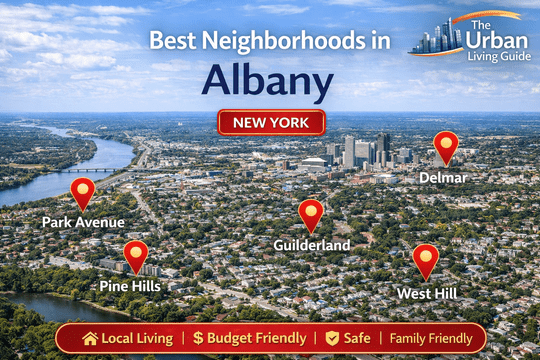
Best Neighborhoods in Albany, New York: Capital City Brownstones, Tech Corridors & Suburban Enclaves in 2026
Covering approximately 21.4 square miles of land area along the western banks of the historic Hudson River in Albany County, the City of Albany operates under the mayor-council municipal administration of the City of Albany. Housing an incorporated municipal core population exceeding 99,000 residents and anchoring New York’s broader Capital District metropolitan footprint of over 1.17 million people, the state capital stands as a primary national center for state governance, higher education, healthcare research, and the booming semiconductor innovation ecosystem of “Tech Valley.”
Relocating across the Capital Region requires evaluating historic district architecture, state office complex accessibility, winter climate resilience, and public transit corridors operated by the Capital District Transportation Authority (CDTA). Inbound movers consistently balance direct daily access to primary regional employment centers—including the Empire State Plaza Government Complex, major healthcare networks anchored by Albany Medical Center Hospital and St. Peter’s Hospital, nanotechnology research at the University at Albany (UAlbany) and Albany NanoTech Complex, and global logistics hubs along the Hudson River—against daily commute routes across Interstate 90, Interstate 87 (Adirondack Northway), Interstate 787, and US Route 20 (Western Avenue).
Watch this video to explore different neighborhoods, suburban corridors, and residential communities across Albany:
Best Areas to Live in Albany at a Glance in 2026
| Neighborhood Name | Location | Distance from Core (Downtown / Empire State Plaza) | Development Status | Transit Connectivity | Cost Level | Best Fit For |
|---|---|---|---|---|---|---|
| Center Square | Downtown Urban Core | Approximately 0.3 miles west | Preserved Historic 19th-Century Urban | Exceptional (Walkable Grids, CDTA BusPlus, I-787) | Mid-to-High Range | State Workers, Young Professionals & Creatives |
| Delmar | Southwest Suburbs (Town of Bethlehem) | Approximately 5 miles southwest | Established Tree-Canopied Suburban | High (CDTA Express Commuter, Delaware Ave, Route 85) | High-to-Premium | Families, State Directors & Healthcare Leaders |
| Pine Hills | Midtown University Corridor | Approximately 2 miles west | Historic Academic & Residential Infill | High (CDTA Lines, Western Ave, Madison Ave) | Accessible / Mid-Range | Academics, Medical Residents, Students & Families |
| Guilderland | Western Suburbs (Town) | Approximately 9 miles west | Modern Master-Planned Suburban | High (I-87, I-90 / NYS Thruway, US-20) | Mid-to-High Range | Tech Professionals, Corporate Commuters & Families |
| West Hill | North Central Urban Basin | Approximately 1.5 miles northwest | Historic Developing Infill Basin | High (CDTA BusPlus Red Line, Central Ave, I-90) | Accessible / Budget-Friendly | First-Time Buyers, Value Renters & Investors |
Best Neighborhoods in Albany Discussed in Detail
Center Square — Historic Brownstone Charm, Lark Street Arts & Walkable Capitol Access
Situated immediately west of the modern marble towers of the Empire State Plaza, the Center Square Historic District is widely celebrated as Albany’s most culturally active, architecturally cohesive, and pedestrian-friendly urban neighborhood. Centered along the bustling commercial spine of Lark Street (often called “Albany’s Greenwich Village”) and bordered by State Street and Washington Avenue, Center Square operates under city preservation guidelines and is supported by the Center Square Association.
The neighborhood is defined by pristine 19th-century brick and brownstone row houses, independent coffee roasters, art galleries, and vibrant sidewalk bistros, offering a car-optional lifestyle for legislative professionals and downtown workers.
- Housing: Dominated by restored 19th-century Greek Revival and Italianate brick brownstones, converted brownstone flats, and historic carriage house apartments. Property purchase prices typically range from $230,000 to $540,000+, while 1-to-2-bedroom rental apartments average $1,250 to $2,100 per month.
- Safety & Crime Rate: Patrolled by the Albany Police Department (APD) Center Station and supplemented by state capitol police around government perimeters. The commercial corridors along Lark Street and State Street maintain active pedestrian vitality and high safety, though standard city awareness regarding opportunistic car break-ins is advised on outer streets.
- School District & Education Quality: Governed by the City School District of Albany (CSDA), with students zoned to Albany High School and Thomas O’Brien Academy of Science and Technology (TOAST), alongside higher-education institutions anchored by Albany Law School and Albany College of Pharmacy and Health Sciences nearby.
- Walkability & Daily Conveniences: Outstanding pedestrian infrastructure (Walk Score of 92-96/100). Residents comfortably walk to indie cafes, bakeries, craft beer taverns, vintage boutiques, and local markets along Lark Street, with full grocery supermarkets like Price Chopper / Market 32 reachable within a short commute.
- Parks & Green Spaces / Pet-Friendliness: Direct pedestrian access to the historic 81-acre Washington Park (designed by Frederick Law Olmsted’s associates, featuring the historic Lakehouse, tennis courts, open lawns, and the world-famous annual Albany Tulip Festival). Exceptionally dog-friendly with shaded tree-lined sidewalks.
- Parking & Traffic Congestion: Street parking is strictly managed through the City of Albany Residential Permit Parking system; off-street parking spots are scarce and add substantial property value. Commuter traffic slows along Washington Avenue and State Street during peak state legislative shifts.
- Noise Levels & Vibe: Vibrant, historic, and civic-minded, filled with state policy discussions on outdoor patios, university scholars, and lively weekend evening dining crowds.
- Medical Facilities & Hospitals: Direct 4-minute commute to the region’s premier Level I Trauma Center at Albany Medical Center Hospital on New Scotland Avenue.
- Transit Connectivity: Unmatched public transit integration via CDTA BusPlus Rapid Transit lines along Washington and Central Avenues, providing non-stop access across the Capital Region, with rapid vehicular access to Interstate 787 and Interstate 90.
- Affordability: Mid-to-high urban pricing tier for Albany County; elevated rental demand driven by state government staff and healthcare residents maintains strong property equity.
- Who It’s Best For: Legislative aides, state government employees, attorneys, medical residents at Albany Med, and urbanites seeking walkable historic charm.
- Drawbacks: Competitive on-street residential parking during winter snow emergencies, older historic building heating overhead, and weekend nightlife noise along commercial intersections.
Delmar — Top-Rated Bethlehem Schools, Family Community & Suburban Tree Canopies
Positioned approximately 5 miles southwest of Downtown Albany in the town of Bethlehem, the unincorporated suburban hamlet of Delmar represents one of the Capital Region’s most desirable and family-centric residential communities. Operating under municipal administration through the Town of Bethlehem Official Portal, Delmar is centered around the Four Corners intersection of Delaware Avenue (NY-443) and Kenwood Avenue.
Celebrated for its mature hardwood canopies, quiet residential subdivisions, community bike trails, and dedicated public safety services, Delmar provides a peaceful suburban setting with a 10-minute commute to the state capitol.
- Housing: Real estate stock features classic 1920s–1950s single-family Craftsman homes, Colonial Revival residences on quarter-to-half-acre landscaped lots, mid-century ranches, and modern executive subdivisions. Single-family purchase prices typically range from $290,000 to $680,000+, while residential rentals and townhomes average $1,550 to $2,650 per month.
- Safety & Crime Rate: Protected by the dedicated Bethlehem Police Department, Delmar consistently records one of the lowest violent and property crime rates in Upstate New York, supported by responsive municipal emergency patrols and active community watch networks.
- School District & Education Quality: Governed by the nationally acclaimed Bethlehem Central School District, featuring top-performing public institutions such as Bethlehem Central High School, Bethlehem Central Middle School, and Hamagrael Elementary School.
- Walkability & Daily Conveniences: The historic Four Corners commercial district along Delaware Avenue is walkable, featuring local bakeries, family diners, independent pharmacies, and community retail, while nearby shopping plazas host Hannaford Supermarket, Price Chopper, and local specialty grocers.
- Parks & Green Spaces / Pet-Friendliness: Outstanding recreational amenities anchored by the paved 9-mile Albany County Helderberg-Hudson Rail Trail (connecting Delmar directly to the Port of Albany), Elm Avenue Park (featuring municipal swimming pool complexes, tennis courts, and winter ice skating), and Henry Hudson Park on the river. Exceptionally pet-friendly.
- Parking & Traffic Congestion: Plentiful private two-car garages and wide residential driveways keep neighborhood lanes clear. Commuter traffic builds along Delaware Avenue (NY-443) and the Route 85 Bypass (Slingerlands Bypass) during peak morning government rush hours.
- Noise Levels & Vibe: Serene, grounded, and family-oriented, characterized by birdsong, children riding bicycles, and quiet residential evenings.
- Medical Facilities & Hospitals: Direct 8-to-10 minute drive to St. Peter’s Hospital on South Manning Boulevard and Albany Medical Center.
- Transit Connectivity: High-frequency express commuter transit provided by CDTA Express Route 214 running straight into Empire State Plaza, with vehicular access via Route 85 and Interstate 87 (NYS Thruway Exit 23).
- Affordability: High-tier suburban pricing profile; higher school property taxes are balanced by top-tier public school ratings, municipal park maintenance, and strong long-term property values.
- Who It’s Best For: Families prioritizing top-ranked public education, state department directors, healthcare leaders, and buyers seeking spacious suburban lots near downtown.
- Drawbacks: Higher town and school property tax millage rates, limited multi-family rental housing inventory, and automobile reliance for major power retail centers.
Pine Hills — University Heritage, Historic Architecture & Mid-Town Convenience
Covering a wide residential basin in midtown Albany between Washington Avenue and Cortland Street, Pine Hills is one of the city’s most historically diverse and conveniently located neighborhoods. Developed extensively starting in the late 19th century around Western Avenue (US-20) and Madison Avenue, the community operates under City of Albany municipal administration and is championed by the Pine Hills Neighborhood Association.
Known for its mix of academic faculty, medical practitioners, college students, and long-term families, Pine Hills blends historic Queen Anne architecture with local dining and movie theaters.
- Housing: Real estate stock spans historic turn-of-the-century Victorian single-family homes, classic brick two-family flats, multi-unit student apartment buildings, and modern garden-style condominiums. Single-family purchase prices typically range from $185,000 to $390,000, while rental apartments and flats average $1,100 to $1,850 per month.
- Safety & Crime Rate: Patrolled by the APD Center and West Stations and heavily supplemented by university campus security. The residential upper Pine Hills area (west of Main Avenue) is quiet and family-centered, while streets closer to the downtown university campus experience higher student activity on weekends.
- School District & Education Quality: Governed by CSDA, containing neighborhood public campuses such as Pine Hills Elementary School and Albany High School, alongside prestigious academic anchors including The College of Saint Rose Campus and the University at Albany Downtown Campus (Rockefeller College of Public Affairs & Policy).
- Walkability & Daily Conveniences: High pedestrian accessibility along commercial corridors on Madison Avenue and Western Avenue, home to the historic Madison Theatre, independent pizzerias, indie coffee houses, bakeries, and grocers like Price Chopper on Madison.
- Parks & Green Spaces / Pet-Friendliness: Direct access to the green lawns of Ridgefield Park (featuring lighted softball diamonds and spray pads), Woodlawn Park, and the western pathways of Washington Park. Highly pet-friendly with quiet residential sidewalks.
- Parking & Traffic Congestion: Private residential driveways are common in upper Pine Hills, while lower student-dense blocks rely on on-street parking permits. Surface traffic along Western Avenue (US-20) moves steadily with minor delays during university commute hours.
- Noise Levels & Vibe: Energetic, academic, and community-focused, shifting from bustling student corridors to tranquil, tree-shaded residential avenues on side streets.
- Medical Facilities & Hospitals: Direct 3-minute medical access to St. Peter’s Hospital on South Manning Boulevard and Albany Medical Center.
- Transit Connectivity: High-frequency public transit provided by CDTA Bus Routes (including Routes 10, 11, and 12) along Western and Washington Avenues, offering a 6-minute commute to Downtown Albany and fast access to I-90 (Exit 4).
- Affordability: Accessible mid-range price structure; provides substantial two-family rental income opportunities (owner-occupied living with rental flat) and spacious vintage floor plans.
- Who It’s Best For: University faculty and graduate students, medical staff at St. Peter’s or Albany Med, first-time homebuyers, and multi-unit real estate investors.
- Drawbacks: Weekend evening student noise on specific blocks east of Main Avenue, older home electrical and heating maintenance overhead, and competitive on-street parking during academic terms.
Guilderland — Suburban Tech Corridor, Crossgates Mall & Modern Master Developments
Situated in western Albany County along the scenic northern bluffs of the Helderberg Escarpment, the town of Guilderland is the primary modern suburban and commercial growth engine of the Capital District. Governed under its own municipal administration via the Town of Guilderland, the community encompasses planned master developments like Westmere, McKownville, and Fort Hunter centered around Western Avenue (US-20) and Carman Road (NY-146).
Guilderland combines premier corporate tech proximity, major retail hubs, and top-tier public school clusters with expansive natural pine barrens.
- Housing: Real estate features modern 1990s–2020s two-story brick and vinyl executive homes in master subdivisions (such as Countryman Estates and Weatherfield), custom residences on wooded multi-acre parcels, and upscale luxury apartment communities. Single-family purchase prices typically range from $320,000 to $780,000+, while modern rental apartments average $1,650 to $2,750 per month.
- Safety & Crime Rate: Protected by the dedicated Guilderland Police Department (GPD), the town maintains exceptionally low violent crime rates, supported by proactive neighborhood patrols and modern community policing.
- School District & Education Quality: Governed by the highly regarded Guilderland Central School District, containing top-rated public campuses including Guilderland High School, Farnsworth Middle School, and Westmere Elementary School.
- Walkability & Daily Conveniences: Suburban residential neighborhoods are automobile-dependent, but major commercial centers along Western Avenue host the region’s largest shopping complex at Crossgates Mall (featuring dining, cinema, and retail), Trader Joe’s, Costco Wholesale, and Market Bistro by Price Chopper.
- Parks & Green Spaces / Pet-Friendliness: Exceptional natural amenities anchored by the unique ecosystem of the Albany Pine Bush Preserve (offering 3,300 acres of inland pine barrens, hiking trails, and rare Karner Blue butterfly habitats), Tawasentha Park (featuring swimming pools, boat rentals along the Normans Kill, and outdoor amphitheaters), and Vosburgh Park. Extremely pet-friendly.
- Parking & Traffic Congestion: Generous attached two-to-three car garages and wide driveways. Heavy commuter traffic builds along Western Avenue (US-20) and the junction of the Northway (I-87) and I-90 during peak shopping and business rush hours.
- Noise Levels & Vibe: Peaceful, modern, and family-centered, characterized by quiet subdivision cul-de-sacs and tranquil residential evenings.
- Medical Facilities & Hospitals: Direct 10-to-12 minute drive to St. Peter’s Hospital and comprehensive outpatient medical centers located along Crossgates Mall Road.
- Transit Connectivity: Unrivaled highway positioning at the convergence of Interstate 87 (Adirondack Northway), Interstate 90 (NYS Thruway Exit 24), and US-20, offering a 12-minute drive to Downtown Albany and 8 minutes to Albany International Airport (ALB).
- Affordability: Mid-to-high suburban cost structure; provides substantial interior square footage, energy-efficient building standards, and larger lot sizes per dollar compared to Delmar.
- Who It’s Best For: Tech professionals working at Albany NanoTech or nearby semiconductor campuses, corporate commuters, retail managers, and families prioritizing top-tier Guilderland schools.
- Drawbacks: Peak-hour commercial traffic along Western Avenue, complete automobile reliance for daily errands, and distance from downtown historic streetscapes.
West Hill — Historic Urban Core Edge, Infill Opportunities & Budget-Conscious Housing
Covering the urban basin immediately northwest of Downtown Albany along the Central Avenue (NY-5) corridor, West Hill is one of the city’s most historically grounded, central, and budget-accessible residential districts. Stretching between Manning Boulevard and Henry Johnson Boulevard, West Hill is undergoing targeted community-driven revitalization guided by the City of Albany and the Albany Community Development Agency (ACDA).
The neighborhood provides an accessible entry point for first-time homebuyers and renters seeking character-rich housing near central employment and retail corridors.
- Housing: Real estate consists of historic two-to-three-story wood-frame and brick homes, traditional two-family rental flats, and newly constructed affordable infill single-family residences. Single-family purchase prices typically range from $85,000 to $185,000, while rental apartments and flats average $750 to $1,300 per month.
- Safety & Crime Rate: Patrolled by the APD West Station. Safety metrics and property maintenance can vary significantly from block to block, making targeted street-level research important before leasing or purchasing.
- School District & Education Quality: Governed by CSDA, containing neighborhood public campuses such as Arbor Hill Elementary School, Stephen and Harriet Myers Middle School, and Albany High School.
- Walkability & Daily Conveniences: High pedestrian accessibility along commercial corridors on Central Avenue, hosting international grocers, authentic ethnic eateries, hardware supply outlets, discount retail, and local service shops.
- Parks & Green Spaces / Pet-Friendliness: Municipal open spaces include Bleecker Stadium, Swinburne Park (featuring public ice rinks, splash pads, and playgrounds), and Tivoli Lake Preserve (featuring 80 acres of urban forest trails, wetlands, and community gardens). Dog-friendly with quiet residential side streets.
- Parking & Traffic Congestion: Plentiful private residential driveway and open on-street parking. Highway on-ramps provide fast access to Interstate 90 (Exit 5) and Central Avenue without major delays.
- Noise Levels & Vibe: Community-centered, urban, and active, shifting from busy commercial daytime avenues to quiet residential evenings in established pockets.
- Medical Facilities & Hospitals: Direct 5-to-7 minute access to Albany Medical Center and St. Peter’s Hospital.
- Transit Connectivity: High-frequency public transit provided by CDTA BusPlus Red Line running along Central Avenue directly between Downtown Albany and Schenectady, with rapid vehicle access to I-90 and I-87.
- Affordability: Albany’s most accessible entry-level homeownership and rental price tier, offering lower mortgage entry requirements and low property tax assessments.
- Who It’s Best For: First-time homebuyers, budget-conscious renters, tradespeople, real estate investors, and workers seeking quick highway access to downtown state agencies or industrial logistics parks.
- Drawbacks: Pockets of deferred property maintenance, variable public school test performance ratings, and older housing stock requiring modern mechanical updates.
Comprehensive Neighborhood Pros and Cons Comparison
| Neighborhood | Core Advantages (Pros) | Core Limitations (Cons) |
|---|---|---|
| Center Square | Walkable commute to Empire State Plaza; historic 19th-century brownstones; vibrant dining and cafes on Lark Street; 81-acre Washington Park. | Competitive street parking during winter snow bans; older home heating overhead; late-night weekend bar street noise. |
| Delmar | Top-rated Bethlehem Central public schools; dedicated municipal police; direct access to Helderberg-Hudson Rail Trail; low crime. | Higher property tax millage rates; limited multi-family rental inventory; morning rush-hour slowdowns along Delaware Avenue. |
| Pine Hills | Midtown positioning between UAlbany and St. Peter’s Hospital; two-flat rental income potential; walkable indie dining and cinema on Madison. | Weekend student noise on specific blocks; older home maintenance; competitive on-street parking during college semesters. |
| Guilderland | Top-performing Guilderland Central schools; close to Albany NanoTech and Crossgates Mall; 3,300-acre Albany Pine Bush Preserve. | Peak-hour commercial traffic on Western Avenue (US-20); complete automobile dependence; distance to downtown core. |
| West Hill | Albany’s most affordable home and rental pricing; CDTA BusPlus Red Line rapid transit; close to Swinburne Park and I-90. | Safety and property upkeep vary significantly by street; variable public school performance ratings; older housing infrastructure. |
How You Decide Which Neighborhood Is Best For You
Selecting your ideal neighborhood in Albany requires balancing your housing budget with daily workplace destinations, family schooling preferences, and regional transit realities. Because the Capital Region serves as the political and economic crossroads of Eastern New York, your location dictates whether your daily commute relies on rapid transit via CDTA BusPlus Lines, walkable sidewalks into Empire State Plaza, or major highway expressways like Interstate 90, Interstate 87 (Adirondack Northway), and Interstate 787.
State government employees at the Capitol Complex, healthcare professionals at Albany Medical Center or St. Peter’s, researchers at Albany NanoTech or UAlbany, and corporate employees along the Wolf Road corridor should evaluate transit routes to optimize daily convenience.
Beyond commuter corridors, evaluate essential municipal utility and building infrastructure realities. Upstate New York experiences freezing winter temperatures with heavy snowfall, making heating efficiency and utility reliability through National Grid an important factor.
In addition, prospective homebuyers evaluating historic brownstones in Center Square or traditional two-flats in Pine Hills should inspect roofs, boiler systems, and foundations for winter resilience, while buyers in Delmar or Guilderland should confirm town and school district property tax assessments. Before executing a lease or property purchase, verify high-speed fiber broadband availability (such as Verizon Fios or Spectrum Gigabit) and confirm county school assignment boundaries.
Frequently Asked Questions About Albany Neighborhoods
Which neighborhood in the Albany area is considered best for families with school-age children?
Delmar and Guilderland are widely regarded as the premier family communities in the Capital District. Delmar offers access to the nationally top-ranked Bethlehem Central School District alongside safe, tree-lined residential neighborhoods and community parks. Guilderland provides top-tier public education through the Guilderland Central School District paired with modern master-planned subdivisions and extensive nature preserves.
What is the most walkable neighborhood in Albany where you can live without relying heavily on a car?
Center Square is the most walkable neighborhood in Albany, boasting Walk Scores above 92. Residents can easily complete daily errands on foot, walk to dozens of restaurants, cafes, and boutiques along Lark Street, access the green lawns of Washington Park, and walk straight into the Empire State Plaza state government offices.
What are the safest residential neighborhoods to live in within Greater Albany?
Delmar and Guilderland consistently report the lowest violent and property crime rates in Albany County. Delmar benefits from dedicated Town of Bethlehem municipal police patrols, while Guilderland maintains its own active town police department with fast emergency response times.
What are the most affordable neighborhoods for homebuyers and renters in Albany?
West Hill, Arbor Hill, and parts of the South End provide the most budget-friendly housing opportunities in the city. In West Hill, buyers and renters can secure single-family homes and traditional two-family flats at price points substantially lower than regional and state averages.
How long is the commute from Delmar or Guilderland to Downtown Albany?
Commuting from Delmar to Downtown Albany via Delaware Avenue or Route 85 typically takes between 8 and 12 minutes during morning and evening rush hours. Commuting from Guilderland via Western Avenue or Interstate 90 generally takes 12 to 20 minutes depending on traffic.
Which Albany neighborhood is best for healthcare professionals working at local hospitals?
Center Square, Pine Hills, and Delmar provide the fastest commutes to major healthcare campuses. Center Square and Pine Hills are within a 3-to-5 minute walk, bike ride, or drive to Albany Medical Center Hospital and St. Peter’s Hospital, making them highly desirable for medical residents and physicians.
Is Albany an affordable place to live compared to New York City?
Yes, Albany’s overall cost of living and housing prices are significantly lower than New York City, offering spacious historic brownstones, lower rental rates, and large suburban lots at a fraction of downstate real estate prices.
Relocation Resources & Living Guides
The Urban Living Guide creates deeply researched, practical, and informative city relocation resources designed to help individuals, working professionals, and families navigate complex urban landscapes. By analyzing municipal infrastructure, hyper-local zoning patterns, commuter realities, and housing markets, our guides provide actionable insights so you can make confident, data-backed decisions when moving to major metropolitan areas.
Explore our regional guides across Albany and New York’s Capital District:
- Living in Albany, New York
- Cost of Living in Albany, New York
- Pros and Cons of Living in Albany, New York
Made your decision to move to New York’s historic capital? Read our comprehensive relocation roadmap: Moving to Albany, New York.
Follow The Urban Living Guide for ongoing regional insights, neighborhood developments, and expert local coverage across Greater Albany and the state of New York.