

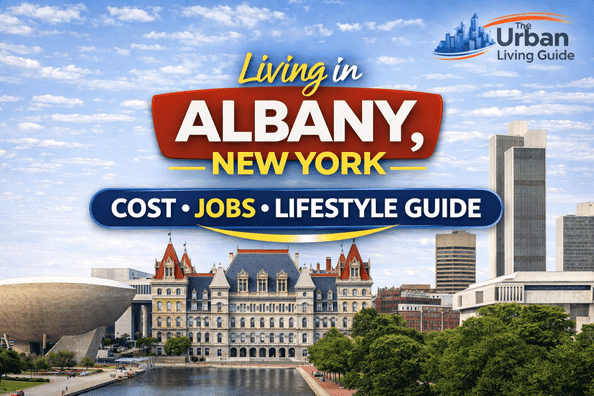
Living in Albany, NY: New York’s Capital City With Stable Jobs & Historic Neighborhoods
Positioned strategically along the western bank of the Hudson River in eastern New York, Living in Albany, New York provides a unique blend of historic architectural charm, government-driven employment stability, and a comfortable mid-sized capital city lifestyle. As the official seat of New York State government, Albany anchors the thriving Capital Region—a metropolitan network that exceeds one million residents when combined with neighboring Troy and Schenectady. For professionals seeking public administration careers, educational leadership, and a lower cost of living than downstate urban centers, the city serves as a premier anchor.
Relocating to the capital city opens doors to a recession-resistant job market dominated by state agencies, legislative offices, and advanced medical centers like Albany Medical Center, alongside major research institutions such as the University at Albany (SUNY). Beyond its white-collar employment stability, Albany places residents within effortless driving distance of world-class outdoor recreation, including the Adirondack Mountains, the Catskills, and the scenic Hudson Valley. However, thriving here requires adjusting to brisk northeastern winters and managing older housing stock. Whether you are a civil servant, healthcare specialist, or family seeking affordable homeownership, Albany offers a grounded and historically rich foundation.
What Makes Albany So Popular & Unique
Albany stands out across upstate New York because it successfully fuses the high-stakes political importance of a state capital with the friendly, accessible pace of a mid-sized community. Anchored by the striking modern architecture of the Empire State Plaza and the historic grandeur of the New York State Capitol, the city is a living monument to 19th- and 20th-century civic engineering. For newcomers looking to access municipal services, local event calendars, and city ordinances, the official City of Albany portal functions as an indispensable digital hub.
- Political and Administrative Nerve Center: Serving as the absolute epicenter of New York State legislation, state departments, and public-sector career stability.
- Gateway to Upstate Nature: Immediate proximity to the Adirondack Mountains, Catskill ski resorts, and the picturesque towns of the Hudson Valley.
- Exceptional Architectural Heritage: Home to magnificent historic brownstones, Victorian row houses, and government landmarks dating back centuries.
- Emerging Tech & Nanotech Hub: Spurred by heavy research investments, semiconductor innovations, and corporate leaders like Regeneron Pharmaceuticals.
Albany at a Glance: Key Relocation Metrics
Reviewing these baseline statistics can help you set realistic expectations for your transition to the Capital Region. These figures reflect current eastern New York market conditions and economic benchmarks.
| Metric | Albany City Data | Regional Context |
|---|---|---|
| City Population | ~100,000 Residents | Exceeds 1 Million across the Capital Region |
| Median Home Price | $300,000 – $380,000 | Significantly below New York City and Boston averages |
| Average 1BR Rent | $1,250 – $1,600 | Manageable rental entry points across urban core |
| Average Commute | 22 Minutes | Shorter than major coastal metropolitan hubs |
| Top Industries | Public Administration, Healthcare, Higher Ed | Biotech research, semiconductors, and finance |
If this city is new to you, use the map below to see exactly where it’s located and what’s nearby.
Famous Personalities, Authors & Major Institutions in Albany
Albany’s cultural footprint is heavily shaped by its historic literary roots, political leadership, and world-class scientific research institutions that anchor the regional economy.
- Literary Legends: The city and the surrounding Hudson Valley region hold deep historical ties to renowned literary figures, including Herman Melville (author of Moby-Dick) and acclaimed author Gregory Maguire (author of Wicked), alongside award-winning actor David Hyde Pierce from the TV series Frasier.
- Athletic Traditions: Collegiate sports play a prominent role in local community pride, led by the passionate fanbases supporting the University at Albany Great Danes (NCAA Division I athletics) and the professional Albany FireWolves lacrosse team.
- Major Enterprises: Rather than commercial consumer brands, the city’s economic backbone is powered by the New York State Government, Albany Medical Center, the Regeneron Pharmaceuticals biotech campus, and nearby GlobalFoundries semiconductor manufacturing operations.
Job Market & Business Opportunities with Major Employers
Albany’s job market is characterized by exceptional stability and low economic volatility, primarily due to its status as the state capital. Because thousands of white-collar positions are tied to state government departments, legislative committees, and public administration, the local economy remains largely insulated from national corporate downturns. Healthcare and higher education serve as the region’s second and third major economic pillars.
Key employers providing thousands of stable, high-quality careers include the New York State Government, Albany Medical Center, the University at Albany (SUNY), and Regeneron Pharmaceuticals. Official economic reference data from the New York State Department of Labor shows that while private-sector tech salaries can be competitive, government positions offer unbeatable job security and comprehensive pension benefits.
- Entry-level salaries: Typically range between $45,000 – $60,000 for administrative and entry research roles.
- Mid-career professionals: Generally span $65,000 – $95,000 for state analysts, registered nurses, and educators.
- Senior state officials or specialized medical roles: Frequently command $100,000+, providing strong middle-class financial stability.
Housing & Real Estate Overview in Albany
Housing remains one of Albany’s greatest advantages for newcomers seeking financial relief from downstate markets. In 2026, median home prices hover comfortably between $300,000 and $380,000, allowing buyers to purchase spacious historic brownstones, classic Victorians, or traditional suburban single-family homes with yards.
The rental market is equally accessible, offering manageable entry points for young professionals and students. Current average monthly rent projections are:
- Studio Apartment: $1,000 – $1,250
- 1 Bedroom Apartment: $1,250 – $1,600
- 2 Bedroom Apartment: $1,600 – $2,200
- Family Home Rentals: $2,400 – $3,200
Securing property here provides outstanding space-to-cost value, though buyers should evaluate local property tax assessments carefully when budgeting long-term homeownership costs.
Best Neighborhoods in Albany: Finding Your Ideal Community
Choosing the right neighborhood in Albany directly impacts your daily commute, architectural preferences, and community atmosphere. Neighborhood insights are based on local housing trends, safety reports, and resident surveys. The table below outlines the most prominent residential zones.
| Neighborhood / Category | Location, Pricing & Community Overview |
|---|---|
| Center Square (Historic & Walkable) | A vibrant historic district featuring stunning 19th-century brownstones, tree-lined streets, independent cafes, and immediate walking proximity to Washington Park and the State Capitol. |
| Pine Hills (Student & Professional) | Extremely popular among university students, faculty, and young professionals due to its active neighborhood energy, local eateries, and easy transit to academic campuses. |
| Buckingham Lake (Quiet Residential) | A peaceful, highly stable residential community surrounding a scenic local park and lake, offering traditional single-family homes and a quiet suburban feel within city limits. |
| Delaware Avenue Area (Family-Focused) | A family-friendly urban corridor featuring local specialty shops, neighborhood schools, community parks, and a welcoming, established residential atmosphere. |
| Downtown Albany (Urban Core) | Features modern loft apartments and historic brick buildings within walking distance of government office complexes, courts, and the Hudson River waterfront. |
What It’s Really Like Living in Albany (Daily Life & Vibe)
Life in Albany offers a quieter, more relaxed rhythm compared to the frantic hustle of downstate New York City. Daily routines are heavily structured around state government office hours, university semesters, and healthcare shift changes. Morning and evening rush hours are notably mild, with most local trips staying under 25 minutes, giving residents an immense amount of free time back in their daily lives.
Weekends are typically spent walking through Washington Park, exploring historic downtown architecture, or driving into the nearby Adirondack Mountains and Hudson Valley for hiking and skiing. While the local nightlife and entertainment options are more modest than a massive metropolis, the city’s rich history, friendly neighborhoods, and central location create a very comfortable, balanced environment.
Step into the rhythm of the Capital Region and explore everyday sights through the lens of local creators:
Cost of Living in Albany: Monthly Expenses & Salary Needs
Albany’s cost of living sits comfortably below major northeastern metropolitan centers, making it an economically attractive destination. Cost estimates are derived from official statistics and city-level cost databases. To live very comfortably, build savings, and manage homeownership, an individual professional should target a salary of $65,000+, while households with children generally require $90,000+.
- Average Rent: ~$1,400 average for well-maintained 1BR and 2BR apartments.
- Monthly Utilities: $150 – $220 (Covering electricity, natural gas, and water).
- Groceries & Household Goods: Aligned closely with national U.S. averages.
- Transportation: Moderate expenses for vehicle fuel or public transit passes.
- Property Taxes: Upstate New York property tax burdens require careful long-term budgeting for homeowners.
Transportation, Commute Dynamics & Transit Realities
Getting around Albany and the broader Capital Region is straightforward and efficient. Key transportation options include:
- CDTA Bus Network: Operated by the Capital District Transportation Authority, offering extensive bus routes across Albany, Troy, Schenectady, and Saratoga Springs.
- Amtrak Rail Service: Convenient passenger rail connections via the historic Albany-Rensselaer station linking directly to New York City, Boston, and Montreal.
- Regional Highways: Excellent driving connectivity anchored by Interstate 90 and Interstate 87 (The Adirondackway).
- Manageable Commutes: The average daily commute is a swift 22 minutes, significantly shorter than major U.S. cities.
- Vehicle Dependency: While public transit serves urban centers well, many residents prefer personal vehicles for regional travel and winter weather convenience.
Weather Patterns, Seasonal Realities & Climate Factors
The city experiences a classic humid continental climate, defined by distinct four-season weather cycles:
- Spring: Mild and rainy, bringing blossoming flowers to Washington Park and green foliage back to the Hudson Valley.
- Summer: Warm and comfortable, offering ideal outdoor weather for riverfront events, farmers markets, and local park gatherings.
- Autumn: Crisp air and world-famous colorful fall foliage across upstate New York state forests.
- Winter: Cold with regular snowfall totals, requiring proper winter gear, snow tires, and seasonal home heating preparation.
- Climate Reference: Official meteorological tracking and forecasts are provided by the National Weather Service Eastern New York region.
Education, Schools & Major Universities
Education is a powerful intellectual and economic catalyst for the entire Capital Region. Albany hosts premier institutions such as the University at Albany (SUNY), the Albany College of Pharmacy and Health Sciences, and The College of Saint Rose. For families navigating K-12 schooling, neighborhood choice plays a major role, with suburban districts offering strong public school performance.
Medical Facilities, Hospitals & Healthcare Systems
Access to advanced, cutting-edge healthcare is one of Albany’s strongest community assets. The capital region is home to internationally recognized medical institutions, including Albany Medical Center, St. Peter’s Hospital, and the Stratton VA Medical Center. These premier hospital networks provide exceptional specialized care, emergency trauma services, and comprehensive medical research facilities locally.
Popular Hotels, Cafes, Dining & Culinary Scene
Albany’s hospitality and dining scene blends historic dignity with an energetic, modern culinary movement.
- Popular Hotels: Out-of-town visitors, legislators, and business travelers frequently book stays at standout local properties like the Renaissance Albany Hotel, Hilton Albany, or The Desmond Hotel.
- Cafes & Social Hubs: Independent coffee roasters and artisan bakeries thrive along Lark Street, downtown Albany, and Delaware Avenue, acting as vibrant remote-work hubs.
- Restaurants: From classic Italian eateries and historic taverns to innovative farm-to-table restaurants sourcing ingredients directly from the Hudson Valley, Albany’s food scene is diverse and welcoming.
Sightseeing, Cultural Spots & Tourist Attractions
Residents live surrounded by remarkable government architecture, historic museums, and cultural monuments.
- New York State Capitol: A magnificent 19th-century masterpiece of Richardsonian Romanesque and Renaissance architecture dominating the city skyline.
- Empire State Plaza: A striking modern modernist government complex featuring reflecting pools, underground concourses, and the Egg performing arts center.
- Albany Institute of History & Art: One of the oldest museum collections in the nation celebrating regional Hudson Valley art and history.
- USS Slater Naval Destroyer Museum: A rare surviving World War II destroyer escort docked permanently along the Hudson River waterfront.
Financial Realities: Pros and Cons of Living in Albany
Every city requires compromise. Here is canyons-deep reality for anyone planning a move to the Capital Region in 2026:
Pros:
- Exceptional job market stability driven by state government administration.
- Affordable housing and real estate markets compared to downstate New York and Boston.
- Effortless access to the Adirondack Mountains, Catskills, and Hudson Valley recreation.
- Rich historic architecture and active cultural institutions.
- Short, stress-free daily commutes averaging around 22 minutes.
Cons:
- Cold, snowy winters requiring serious cold-weather preparation.
- A smaller, more modest late-night nightlife and entertainment infrastructure.
- Limited private-sector job diversity outside of government, health, and education.
- Upstate New York property tax burdens that require careful budgeting.
- Aging municipal infrastructure in certain older urban pockets.
Who Is Albany Ideal For (and Who Should Avoid It?)
Albany offers stability and historic charm. Ideal For:
- Public sector employees, civil servants, and state government administrators.
- Healthcare professionals and academic researchers seeking stable employment.
- First-time homebuyers looking for affordable historic or suburban housing.
- Outdoor enthusiasts who want close proximity to the Adirondacks and Hudson Valley.
Who Should Avoid It:
- Young singles craving a massive, high-energy metropolitan nightlife and arts scene.
- Corporate climbers seeking ultra-high private finance or venture capital salaries.
- Individuals who despise cold winter climates and snow management.
Real Experiences: Perspectives from Long-Term Residents (5 to 10+ Years)
Data gives you the metrics, but daily life gives you the truth. Here is what veteran locals have to say about navigating the capital:
“Working for the state gives you incredible job security, and we were able to buy a gorgeous historic home near Buckingham Lake for a very reasonable mortgage. You aren’t getting NYC nightlife here, but being an hour away from hiking in the Adirondacks every weekend is worth every bit of the winter snow.”
[Source: r/Albany Community Discussions]
“Center Square is gorgeous with all the brownstones and Lark Street cafes, but parking during a snow emergency will test your soul. If you want a stable career, short twenty-minute commutes, and real seasons without going broke, Albany is an absolute hidden gem.”
[Source: Local Neighborhood Survey Threads]
Frequently Asked Questions About Living in Albany, New York
Is Albany, New York expensive to live in?
No, Albany is relatively affordable compared to many cities in the Northeast, particularly regarding housing markets and apartment rental rates across most neighborhoods.
What salary do you need to live comfortably in Albany?
A single adult typically requires around $65,000 annually to live comfortably, while families generally need $90,000+ to manage household expenses and homeownership.
Is Albany safe for raising a family?
Safety varies by neighborhood; established residential communities like Buckingham Lake and parts of Center Square are widely viewed as very secure and family-oriented.
How is the commute and traffic in Albany?
Commuting is exceptionally easy, with average commute times hovering around 22 minutes, allowing residents to bypass the grueling gridlock common in major U.S. cities.
What are the primary industries driving Albany’s economy?
Albany’s economy is anchored by New York State public administration, higher education systems like SUNY Albany, advanced healthcare networks, and emerging tech research.
🔗 Explore More Cities in New York
If you’re exploring more options beyond Albany, The Urban Living Guide has covered several other popular cities in New York. You can also check:
- Living in New York City, New York
- Living in Buffalo, New York
- Living in Rochester, New York
- Living in Syracuse, New York
Thinking about Albany? Here are a few must-read guides:
- Cost of Living in Albany, New York
- Pros and Cons of Living in Albany, New York
- Best Neighborhoods in Albany, New York
And if you’re planning your move, don’t miss our complete guide: Moving to Albany, New York
These guides give you a complete picture of what it’s like living across different cities, covering everything from cost of living, housing, and job opportunities to neighborhoods, commute, weather, education, popular places, and major employers.
The Urban Living Guide brings together these local insights in one place, helping you compare cities easily and make a confident, well-informed decision based on your lifestyle and goals.