

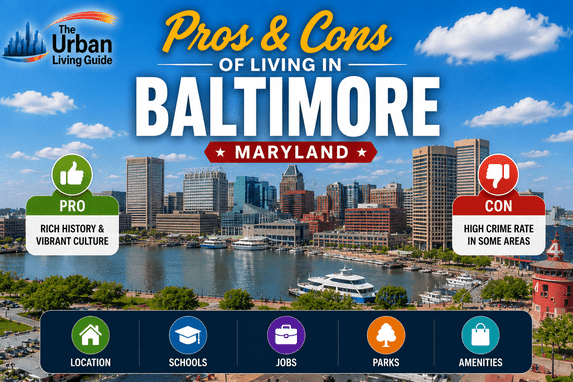
Charm City Is Reinventing Itself — But Old Challenges Remain
Baltimore sits at a crossroads that defines American urban life right now — a city with genuine cultural depth, world-class institutions like Johns Hopkins, and waterfront neighborhoods that rival anywhere on the East Coast, struggling against decades of disinvestment, population loss, and a crime reputation that overshadows everything else. The pros and cons of living in Baltimore, Maryland reveal a place where your block-by-block location choice matters more than almost any comparable American city.
Many residents appreciate that Baltimore offers something increasingly rare — affordable urban living within 45 minutes of Washington DC, genuine neighborhood character that hasn’t been gentrified into sameness, and a creative energy that feels authentic rather than manufactured for transplants. But some newcomers find it challenging that the city’s safety disparities create a lived experience where crossing certain streets fundamentally changes your daily reality.
Here’s what life in Charm City actually demands in 2026.
📺 Watch this for deeper insights from Baltimore locals on what the city really feels like beyond the headlines:
Why People Choose Baltimore and Stay – Pros of Living in Bloomington
Housing Affordability Rare for the East Coast
Baltimore remains one of the last genuinely affordable cities within Amtrak Northeast Corridor reach. Median home prices sit around $220,000-$280,000 — a fraction of Washington DC, Philadelphia, or anywhere in the New York metro. Renovated rowhomes in neighborhoods like Federal Hill, Canton, and Fells Point cost $350,000-$500,000 — prices that wouldn’t buy a parking space in comparable DC neighborhoods. For young professionals specifically, this means actual homeownership remains achievable on middle-class salaries.
World-Class Healthcare and Biotech Job Market
Johns Hopkins Hospital, University of Maryland Medical Center, Mercy Medical Center, and dozens of biotech firms create genuine career density for healthcare professionals, researchers, and medical support staff. Many residents appreciate that Baltimore’s medical ecosystem offers career opportunities and institutional prestige that rival Boston without requiring six-figure salaries just to afford rent.
Genuine Cultural Institutions Without Tourist Pricing
The Walters Art Museum (free admission), American Visionary Art Museum, Lexington Market, and the Inner Harbor waterfront offer cultural depth that punches well above the city’s current reputation. The restaurant scene has quietly become one of Maryland’s best — from Ekiben’s cult-following steam buns to fine dining that doesn’t require DC expense accounts.
DC Job Access Without DC Housing Costs
MARC Train and Amtrak connect Baltimore to Washington DC in 45-60 minutes, making reverse commutes genuinely feasible for federal employees and contractors. Some newcomers find it surprising that living in Baltimore while working in DC saves $1,500-$2,500 monthly in housing costs alone — enough to absorb commute expenses and still come out significantly ahead financially.
Neighborhood Character That Feels Authentic
Baltimore’s rowhouse neighborhoods retain architectural character and local business ecosystems that haven’t been smoothed into chain-store sameness. Hampden, Remington, Mount Vernon, and Station North offer walkable urban living with genuine personality — something increasingly hard to find in gentrified East Coast cities where independent businesses can’t survive rent increases.
No State Income Tax on Military Retirement
Maryland doesn’t tax military retirement pay — a significant advantage for veterans settling near Fort Meade, Aberdeen Proving Ground, or Andrews Air Force Base. Combined with Baltimore’s affordability and proximity to military installations, this creates genuine financial advantages for military families transitioning to civilian life.
The Challenges Baltimore Doesn’t Hide – Cons of Living in Baltimore
Crime Reality Cannot Be Ignored
Baltimore consistently ranks among America’s most dangerous cities, and the statistics aren’t misleading — certain neighborhoods experience violence rates that genuinely affect daily life decisions about where to walk, park, and live. Some newcomers find it challenging that the city’s safety disparities mean extensive neighborhood research isn’t optional paranoia — it’s essential due diligence. Areas like Greenmount, Park Heights, and sections of West Baltimore experience violence levels that make them genuinely dangerous.
School System Quality Remains Deeply Problematic
Baltimore City Public Schools struggle with fundamental infrastructure and performance issues that push middle-class families toward private schools or suburban relocation once children reach school age. Families will find that the handful of quality charter schools like City Neighbors or Patterson Park Public Charter have waiting lists, and the default zoned schools often aren’t viable options. This single issue drives family flight to Baltimore County suburbs at rates that hollow out the city’s tax base.
Car Dependency Despite Urban Density
Baltimore’s public transit system (MTA Maryland) covers basic routes but doesn’t support car-free living outside the immediate downtown corridor. The Metro SubwayLink has exactly one line, buses run infrequently, and the Light RailLink serves limited areas. Most residents find car ownership mandatory despite living in dense urban neighborhoods — a frustrating reality for those expecting Northeast Corridor transit functionality.
Population Loss Creates Abandoned Property Blight
Baltimore has lost over 35 percent of its peak population, leaving approximately 16,000 vacant buildings scattered throughout the city. Some newcomers find it challenging that even gentrifying neighborhoods have boarded-up rowhouses on otherwise desirable blocks — physical reminders of decline that affect property values and neighborhood cohesion in ways potential residents don’t anticipate until they live here.
High Property Taxes Offset Housing Affordability
Baltimore City’s property tax rate is 2.248 percent — roughly double neighboring Baltimore County rates and among the highest in Maryland. For remote workers specifically, this means the upfront housing affordability gets partially eaten by annual tax bills that quickly exceed what suburban homeowners pay on more expensive properties. The financial calculation isn’t as simple as median home prices suggest.
Job Market Limited Outside Healthcare Sector
Beyond medical institutions and government contractors, Baltimore’s private sector job market offers limited depth. Tech workers, finance professionals, and most corporate roles require commuting to DC, Columbia, or Northern Virginia — making Baltimore functionally a bedroom community for many professionals despite its urban character. The local economy simply doesn’t support career growth across industries the way comparable cities do.
Who Is Baltimore Right For?
Baltimore is an outstanding fit for healthcare professionals and biotech workers building careers at world-class institutions, DC commuters willing to trade commute time for housing affordability, artists and creative professionals drawn to genuine urban character without Brooklyn prices, and military retirees near regional installations benefiting from tax exemptions.
Who should reconsider? Families with school-age children unwilling to navigate private school costs or suburban relocation, anyone requiring genuinely safe residential environments across all neighborhoods, professionals in industries without local job depth requiring daily DC commutes, and those expecting functional public transit supporting car-free urban living.
Final Verdict
Baltimore in 2026 remains a city of genuine contradictions — world-class institutions alongside structural dysfunction, beautiful architecture next to abandonment, and affordability that comes with real trade-offs in safety and schools. The pros and cons of living in Baltimore, Maryland ultimately favor risk-tolerant individuals and couples who research neighborhoods extensively, work in healthcare or federal sectors, and value authenticity over polish. Come with realistic expectations about what urban comeback actually looks like on the ground, and Baltimore offers something real.
FAQs
Is Baltimore safe to live in?
Safety varies drastically by neighborhood. Federal Hill, Canton, Fells Point, Mount Vernon, and Roland Park are generally safe. West Baltimore, Park Heights, and Greenmount experience high crime. Extensive neighborhood research is essential.
What salary do you need to live comfortably in Baltimore?
Single professionals need $55,000-$70,000 annually. Families typically need $85,000-$110,000 depending on private school requirements and housing choices.
Is Baltimore cheaper than Washington DC?
Yes, dramatically. Housing costs 40-50 percent less than comparable DC neighborhoods. Property taxes are higher but don’t offset the massive housing savings.
Is Baltimore good for families?
Challenging due to public school quality. Families often choose suburbs like Towson, Catonsville, or Ellicott City for better schools once children reach school age.
How is the job market in Baltimore?
Strong for healthcare and government contractors. Limited for most other industries. Many professionals commute to DC for career opportunities.
Can you live in Baltimore without a car?
Difficult. Transit exists but doesn’t support true car-free living outside downtown core. Most neighborhoods require car ownership for practical daily life.
Explore More
- 📍 Living in Baltimore, Maryland
- 💰 Cost of Living in Baltimore, Maryland
- 🏘️ Best Neighborhoods in Baltimore, Maryland