
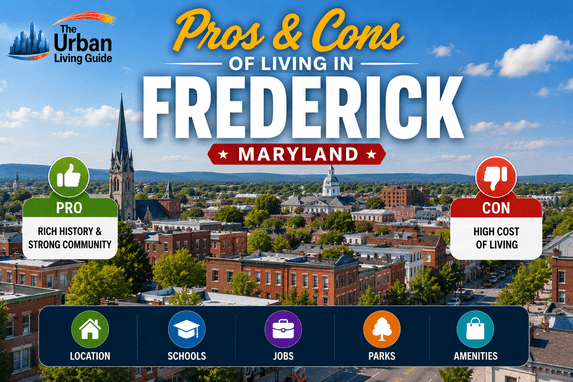
Pros and Cons of Living in Frederick — Maryland’s Fastest-Growing Small City
Frederick has quietly become one of Maryland’s most desirable relocation destinations over the past decade — a city of roughly 75,000 residents that’s grown 25 percent since 2010 while maintaining genuine historic character that attracted people in the first place. The pros and cons of living in Frederick, Maryland reveal a place caught between small-city charm and suburban sprawl, where a walkable downtown coexists with big-box retail sprawl, and where housing affordability compared to DC suburbs meets traffic congestion nobody planned for.
Many residents appreciate that Frederick offers something genuinely balanced — real downtown walkability with suburban amenities, proximity to Washington DC and Baltimore without their housing costs, and four-season outdoor access that rivals anywhere in the mid-Atlantic. But some newcomers find it challenging that rapid growth has strained infrastructure built for a much smaller city, commute times to DC frequently exceed 90 minutes each way, and the small-city identity is being steadily eroded by franchise sprawl and developer-driven expansion.
Here’s what living in Frederick actually looks like when you’re not just visiting the historic downtown on weekends.
📺 Local residents share what makes Frederick unique and what challenges come with the city’s rapid transformation:
What Makes Frederick Genuinely Appealing
Lower Housing Costs Than DC/Baltimore Suburbs
Frederick remains meaningfully more affordable than Montgomery County or Howard County suburbs despite comparable commute times to Washington DC. Median home prices sit around $425,000-$500,000 compared to $600,000-$750,000 in places like Rockville or Columbia. Families will find that this $150,000-$250,000 difference translates into larger homes, better lots, and monthly mortgage payments that don’t consume 40 percent of gross income. For young professionals specifically, homeownership remains achievable here on single professional salaries — something increasingly impossible closer to DC.
Walkable Historic Downtown With Real Local Character
Downtown Frederick isn’t a manufactured lifestyle center — it’s a genuinely functioning historic district with over 200 independent businesses, restaurants, breweries, and shops occupying 18th and 19th-century buildings along Market Street and Patrick Street. Many residents appreciate that you can walk to dinner, drinks, farmers markets, and weekend activities without getting in a car — a rare quality in car-dependent Maryland suburbs. The Weinberg Center for the Arts and multiple local theaters add cultural depth unusual for a city this size.
Strong Biotech and Government Job Market
Fort Detrick employs over 10,000 military, civilian, and contractor personnel in biodefense and medical research, anchoring Frederick’s economy with stable government funding. Aushon BioSystems, Thermo Fisher Scientific, Emergent BioSolutions, and dozens of smaller biotech firms create genuine career density for scientists and researchers who don’t want to live in Rockville or Gaithersburg. One thing people often mention is how the biotech concentration here rivals much larger cities without requiring DC Metro area cost of living.
Outdoor Recreation Access Within City Limits
Catoctin Mountain Park, Gambrill State Park, Cunningham Falls State Park, and the Appalachian Trail all sit within 20-30 minutes of downtown Frederick. The Monocacy River runs through the city, and the C&O Canal towpath offers flat trail access perfect for cycling and running. For outdoor enthusiasts, Frederick provides mountain and river access that requires weekend road trips from DC or Baltimore suburbs — here it’s genuinely part of weekly routine rather than occasional excursion.
Four Genuine Seasons With Manageable Winters
Frederick experiences real seasonal variation — colorful fall foliage in the nearby mountains, mild springs perfect for outdoor activity, warm summers without oppressive heat, and winters that bring snow but rarely create the brutal conditions found in Pennsylvania or New England. Many residents appreciate that winter here means occasional snow days rather than months of subfreezing temperatures, making year-round outdoor lifestyle significantly more viable than Northeast cities.
Strong Public Schools for Maryland Standards
Frederick County Public Schools consistently ranks among Maryland’s better-performing districts, with schools like Tuscarora High School, Oakdale High School, and Governor Thomas Johnson High School offering competitive academics and strong extracurriculars. Families will find that public education here genuinely serves middle-class students well without requiring private school fallback plans common in Baltimore or DC.
The Trade-Offs Downtown Walking Tours Skip
DC Commutes Are Genuinely Brutal
Some newcomers find it challenging that Frederick’s advertised proximity to Washington DC (45-50 miles) translates into 90-120 minute commutes each way during rush hours. I-270 becomes a parking lot between Frederick and Gaithersburg every weekday, and the MARC Brunswick Line offers limited schedule flexibility with the last evening train leaving Union Station before many DC workers finish their day. For remote workers specifically, this matters less, but anyone required in DC offices multiple days weekly should calculate realistic commute time before assuming Frederick works as a bedroom community.
Rapid Growth Straining City Infrastructure
Frederick added 15,000 residents over the past decade, and infrastructure hasn’t kept pace. Route 15, Route 85, and Route 355 corridors experience rush hour congestion that didn’t exist five years ago, schools are adding portable classrooms to handle enrollment growth, and emergency services response times have increased as development sprawls outward. Many residents appreciate the economic vitality growth brings but find daily quality of life genuinely affected by traffic and overcrowding.
Downtown Charm Surrounded by Suburban Sprawl
The historic downtown that attracts people to Frederick represents maybe 5 percent of the city’s geographic footprint — the rest looks like standard suburban development with big-box retail, chain restaurants, and residential subdivisions indistinguishable from anywhere in America. Some newcomers find it challenging that Frederick’s actual lived experience for most residents involves driving between Targets and Chipotles rather than strolling cobblestone streets they saw on relocation visits.
Limited Public Transit Makes Car Ownership Mandatory
Frederick’s bus system (TransIT) covers basic routes but doesn’t support car-free living even for downtown residents. The MARC Brunswick Line serves DC commuters but runs limited schedules and doesn’t connect to local destinations within Frederick. Families relocating from New York, Boston, or even DC proper discover quickly that owning multiple cars isn’t optional here — it’s required for basic household function.
Job Market Narrow Outside Biotech and Government
Beyond Fort Detrick and biotech firms, Frederick’s local job market offers limited depth for most professions. Tech workers, finance professionals, marketing specialists, and corporate roles generally require commuting to DC, Rockville, or Baltimore — making Frederick functionally a bedroom community for many residents despite having a downtown. For remote workers, this limitation matters significantly less than for professionals requiring local career mobility.
Winters Still Mean Winter Despite Mild Reputation
Frederick winters are milder than Pennsylvania or northern Maryland but still involve regular subfreezing temperatures, occasional significant snowfall, and 4-5 months where outdoor lifestyle genuinely pauses unless you embrace winter sports. If you’re moving from California, Texas, or the Southeast, the seasonal adjustment remains significant regardless of how Frederick winters compare favorably to Northeast cities.
Who Is Frederick Right For?
Frederick is an outstanding fit for biotech professionals and Fort Detrick employees working locally, remote workers and flexible schedule professionals avoiding daily DC commutes, families seeking strong schools and outdoor access at lower costs than DC suburbs, and outdoor enthusiasts valuing mountain and trail access integrated into daily life rather than weekend excursions.
Who should reconsider? DC commuters required in offices 3-5 days weekly facing 90-120 minute each-way commutes, young professionals seeking walkable urban lifestyle beyond small downtown core, anyone expecting functional public transit supporting car-light living, and those prioritizing cultural diversity and urban amenities over small-city character and outdoor access.
Final Verdict on Frederick’s Appeal
Frederick in 2026 remains a genuinely attractive option for families and professionals seeking balanced suburban living with outdoor access and historic character — provided they work locally or remotely and accept car-dependent infrastructure. The pros and cons of living in Frederick, Maryland ultimately favor remote workers, biotech professionals, and outdoor-oriented families willing to trade long DC commutes and urban amenities for affordability, strong schools, and mountain access. Come with realistic expectations about infrastructure strain and commute realities, and Frederick delivers quality of life that justifies its growth.
FAQs
Is Frederick, MD safe to live in?
Yes, generally very safe. Downtown, Ballenger Creek, Clover Hill, and most suburban neighborhoods maintain low crime rates. Some East Frederick areas near Route 40 experience higher property crime but nothing approaching urban Baltimore levels.
What salary do you need to live comfortably in Frederick?
Single professionals need $65,000-$80,000 annually. Families typically require $100,000-$130,000 given median home prices around $450,000 and costs running 15-20 percent below DC suburbs but above rural Maryland.
Is Frederick cheaper than Rockville or Gaithersburg?
Yes, significantly. Housing costs 25-35 percent less than Montgomery County suburbs. Trade-off is longer commute to DC and less transit infrastructure for those working in the city.
Is Frederick good for families?
Excellent for families prioritizing outdoor access, strong public schools, and affordability over urban amenities. Frederick County schools rank among Maryland’s best, and mountain recreation is genuinely accessible.
How is the job market in Frederick?
Strong for biotech and government contractors at Fort Detrick. Limited outside those sectors. Most professionals in other industries commute to DC, Rockville, or Baltimore for work.
Can you live in Frederick without a car?
No, not practically. Even downtown residents need cars for groceries, accessing suburban amenities, and daily errands. Public transit exists but doesn’t support car-free lifestyle.
Explore More
- 📍 Living in Frederick, Maryland
- 💰 Cost of Living in Frederick, Maryland
- 🏘️ Best Neighborhoods in Frederick, Maryland