

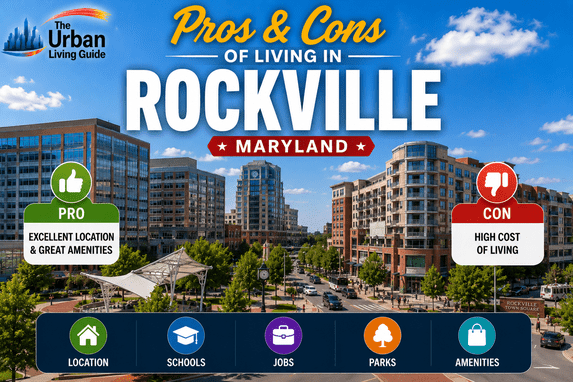
Pros and Cons of Living in Rockville — Where Biotech Meets Metro Access
Rockville serves as Montgomery County’s second-largest city and an economic powerhouse that most Americans have never heard of — home to roughly 68,000 residents, over 700 biotech and life sciences companies, and a downtown that’s been reinvented three times in the past two decades trying to create authentic urban character. The pros and cons of living in Rockville, Maryland reveal a city caught between suburban comfort and urban aspiration, where Red Line Metro access meets car-dependent residential neighborhoods, and where biotech salaries collide with some of the DC Metro area’s highest housing costs.
Many residents appreciate that Rockville offers something genuinely practical — direct Metro access to downtown Washington DC in under 30 minutes, world-class biotech career density rivaling Boston or San Francisco, and Montgomery County’s exceptional public schools without paying Bethesda premiums. But some newcomers find it challenging that Rockville’s urban core feels manufactured rather than organic, housing costs approach DC proper despite suburban geography, and the city lacks genuine neighborhood character that gives places like Takoma Park or Silver Spring their identity.
Here’s what living in Montgomery County’s biotech capital actually delivers in 2026.
📺 Rockville residents explain what the biotech boom and Metro access mean for daily life in this evolving suburb:
What Makes Rockville a Strong Choice
World-Class Biotech Career Density
Rockville has become America’s second biotech capital after Boston — MedImmune (now AstraZeneca), Emergent BioSolutions, Human Genome Sciences, and hundreds of smaller firms create career opportunities for scientists, researchers, and biotech professionals that don’t exist anywhere else in the Mid-Atlantic. For young professionals specifically, the concentration here means career mobility without requiring relocation — something genuinely rare in specialized industries. Many residents appreciate that Rockville offers Cambridge-level career depth without Massachusetts winters or cost of living.
Direct Metro Access to Downtown DC
The Red Line Metro runs through Rockville with three stations (Twinbrook, Rockville, and Shady Grove) providing genuine rapid transit to downtown Washington DC in 25-35 minutes. This isn’t theoretical transit — it’s functional daily commuting that makes car-free DC office work genuinely feasible. Federal employees, Capitol Hill staff, and downtown workers can live in Rockville with authentic transit commutes rather than highway gridlock.
Montgomery County’s Elite Public Schools
Montgomery County Public Schools consistently ranks among America’s top-performing large districts, and Rockville neighborhoods feed into some of the county’s strongest schools. Richard Montgomery High School, Walter Johnson High School, and Thomas S. Wootton High School offer academics, college placement, and extracurriculars that rival elite private schools. Families will find that public education here genuinely competes with $40,000-annual private options found elsewhere.
Diverse Community With Established Immigrant Networks
Rockville has become genuinely multicultural — significant Chinese, Indian, Korean, Ethiopian, and Latin American populations have established businesses, restaurants, and community institutions that make the city feel considerably more diverse than most DC suburbs. One thing people often mention is how Rockville’s ethnic diversity translates into restaurant quality and cultural options unusual for a Maryland suburb.
Town Center Development Creates Urban-Style Living
Rockville Town Square and surrounding development attempted to create walkable downtown living with mixed-use buildings, ground-floor retail, and pedestrian-oriented streets. While opinions vary on authenticity, it genuinely provides apartment living with restaurants, bars, and entertainment within walking distance — something most Montgomery County suburbs completely lack.
Proximity to I-270 Biotech Corridor
Beyond Rockville city limits, the I-270 corridor through Gaithersburg and into Frederick hosts hundreds more biotech firms, making Rockville centrally positioned for industry professionals who might change employers multiple times without relocating. The geographic career flexibility this creates is genuinely valuable for biotech families planning long-term stability.
The Realities Beneath the Biotech Boom
Housing Costs Rival Inner DC Neighborhoods
Some newcomers find it challenging that Rockville housing costs approach $650,000-$800,000 for median single-family homes and $2,400-$3,200 monthly for two-bedroom apartments — prices that buy significantly more space in cities like Charlotte, Austin, or even Philadelphia. The Metro access and schools justify premiums for some buyers, but Rockville has become one of Maryland’s most expensive suburbs without offering the urban character or waterfront access that usually commands such pricing.
Town Center Feels Manufactured Rather Than Organic
Rockville Town Square represents urban planning rather than authentic neighborhood evolution — it’s clean, safe, and functional but lacks the organic messiness that gives real urban districts their character. Many residents appreciate the convenience but find it feels more like an upscale outdoor mall than genuine downtown. For young professionals seeking authentic urban energy, Rockville’s core doesn’t deliver what Silver Spring, Bethesda, or DC neighborhoods provide.
Limited Walkability Beyond Downtown Core
The vast majority of Rockville remains car-dependent suburbs despite Metro access and Town Center development. Residential neighborhoods like Twinbrook, King Farm, and areas east of Route 355 require cars for grocery shopping, schools, and daily errands. Some newcomers find it challenging that Rockville markets itself as urban-adjacent but lives like standard suburbia for most residents outside the immediate downtown radius.
Commute Variability When Metro Fails
Red Line Metro service provides excellent DC access when functioning properly — but delays, maintenance, and weekend disruptions remain frequent enough that backup plans become necessary. Many residents appreciate having Metro as primary commute but find they still need cars for Metro failures and non-DC destinations, eliminating the full car-free lifestyle Metro access theoretically enables.
High Property Taxes Offset by No City Income Tax
Montgomery County property taxes run 1.095 percent plus additional municipal charges, creating annual bills that surprise newcomers expecting suburban rates. Maryland state income tax reaches 5.75 percent, higher than neighboring Virginia but without DC’s added city tax. The total tax burden sits between Virginia suburbs and DC proper but higher than many comparable Mid-Atlantic regions.
Nightlife and Entertainment Require DC Trips
Rockville Town Center has restaurants and a few bars but genuine nightlife, live music, cultural events, and entertainment remain concentrated in DC neighborhoods like U Street, Adams Morgan, or H Street. For young professionals specifically, Rockville functions as residential base requiring Metro rides for social life rather than offering complete urban lifestyle locally.
Who Thrives in Rockville?
Rockville is an outstanding fit for biotech professionals and life sciences researchers building specialized careers, DC commuters via Metro prioritizing transit over driving, families seeking elite Montgomery County schools without paying Bethesda or Potomac premiums, and dual-income professional households able to afford entry costs valuing practical suburban efficiency over neighborhood character.
Who should reconsider? Young professionals seeking authentic urban lifestyle and walkable social scenes, single-income families unable to afford $700,000+ median home prices, anyone expecting genuine small-town character or neighborhood identity, and those requiring diverse local job market outside biotech and government sectors.
Final Verdict on Rockville Living
Rockville in 2026 delivers practical suburban efficiency with genuine Metro access and world-class schools — but charges premium prices for manufactured urban character that never quite feels authentic. The pros and cons of living in Rockville, Maryland ultimately favor biotech professionals and affluent families who prioritize functional infrastructure and excellent schools over organic neighborhood character and urban energy. Come expecting suburban comfort with urban transit access rather than genuine downtown living, and Rockville meets that specific need exceptionally well.
FAQs
Is Rockville, MD safe to live in?
Yes, very safe across all neighborhoods. Crime rates remain well below Maryland and national averages. Town Center, King Farm, and residential areas all maintain low crime typical of affluent suburbs.
What salary do you need to live comfortably in Rockville?
Single professionals need $85,000-$110,000 annually. Families typically require $150,000-$200,000 given median home prices approaching $750,000 and Montgomery County’s high cost of living.
Is Rockville cheaper than Bethesda or Potomac?
Yes, moderately. Housing costs 15-20 percent less than Bethesda and 30-40 percent less than Potomac while maintaining similar school quality and Metro access. Still extremely expensive by national standards.
Is Rockville good for families?
Excellent for families who can afford entry costs. Montgomery County schools rank among America’s best, neighborhoods are safe, and infrastructure supports family life well. High costs remain primary barrier.
How is the job market in Rockville?
Exceptional for biotech and life sciences professionals. Limited outside those specialized sectors. Most non-biotech professionals commute to DC or work for federal contractors in surrounding areas.
Can you live in Rockville without a car?
Possible if you live near Metro stations and work in DC. Most residents need cars for groceries, accessing areas beyond downtown, and non-DC destinations. Transit exists but doesn’t fully replace car ownership.
Explore More
- 📍 Living in Rockville, Maryland
- 💰 Cost of Living in Rockville, Maryland
- 🏘️ Best Neighborhoods in Rockville, Maryland