

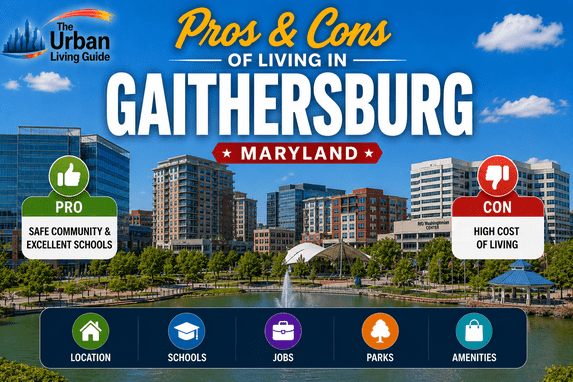
Pros and Cons of Living in Gaithersburg — Suburban Sprawl Meets Scientific Innovation
Gaithersburg has transformed over three decades from sleepy Maryland farmland into Montgomery County’s largest city and a biotech hub that employs tens of thousands — a sprawling suburb of roughly 70,000 residents that stretches along the I-270 corridor with corporate campuses, research parks, and residential subdivisions that all look remarkably similar. The pros and cons of living in Gaithersburg, Maryland reveal a place built entirely for cars and careers, where NIH scientists and biotech professionals have created affluent suburban comfort without any pretense of urban character.
Many residents appreciate that Gaithersburg offers something genuinely practical — major employer concentration creating local jobs, newer housing stock with modern amenities, and Montgomery County schools without paying Bethesda or Rockville premiums. But some newcomers find it challenging that Gaithersburg lacks any authentic downtown or neighborhood identity, traffic on I-270 and Route 355 has become genuinely oppressive, and the city feels like it was designed by corporate site planners rather than people who actually live in communities.
Here’s what daily life looks like in Montgomery County’s sprawling northern suburb.
📺 Local perspectives on what makes Gaithersburg functional for careers but challenging for lifestyle:
Why Professionals Choose – Pros of Living in Gaithersburg
Major Biotech Employer Concentration
Gaithersburg hosts some of America’s most significant life sciences companies — AstraZeneca, MedImmune, Astellas Pharma, Qiagen, Emergent BioSolutions, and the massive NIST (National Institute of Standards and Technology) campus create biotech career density that rivals anywhere outside Boston or San Francisco. For scientists and researchers specifically, living in Gaithersburg means 10-15 minute commutes to world-class employers rather than 60-90 minute slogs from cheaper suburbs. Many residents appreciate that career mobility here doesn’t require home sales and family disruption — you can change biotech employers multiple times without relocating.
Newer Housing Stock With Modern Amenities
Gaithersburg’s rapid development over the past 30 years means housing stock skews considerably newer than older Maryland suburbs. Subdivisions like Kentlands, Lakelands, Crown, and Washingtonian Center offer homes built in the 1990s-2010s with open floor plans, modern kitchens, and energy efficiency older suburbs can’t match. Families will find that newer construction means fewer immediate renovation needs and systems that actually function rather than requiring constant repair.
Montgomery County Schools Without Bethesda Prices
Gaithersburg neighborhoods feed into strong Montgomery County Public Schools including Northwest High School, Watkins Mill High School, and Quince Orchard High School — all solid performers that maintain the county’s academic reputation. Housing here costs $550,000-$650,000 compared to $800,000-$1 million+ in Bethesda for access to the same school district. For families prioritizing education, Gaithersburg offers Montgomery County quality at $200,000-$400,000 discounts.
Rio Washingtonian Center Provides Suburban Entertainment
Rio Washingtonian Center created a lakefront dining and entertainment district with restaurants, bars, iPic Theaters, and walkable paths that provide suburban lifestyle amenities without requiring trips into DC or Rockville. One thing people often mention is how Rio gives Gaithersburg a social gathering space that purely residential suburbs completely lack. It’s manufactured rather than organic, but it functions.
Lower Cost Than Inner Montgomery County
Gaithersburg housing costs run 20-30 percent below Bethesda and 10-15 percent below Rockville while maintaining access to the same school district and I-270 job corridor. For dual-income professional families, this price difference translates into larger homes, better lots, and monthly housing costs that don’t consume 40 percent of gross income like inner county locations demand.
Strong Diversity and Immigrant Communities
Gaithersburg has become genuinely multicultural — significant Asian, Latino, African, and Middle Eastern populations have established businesses and community networks throughout the city. The restaurant scene reflects this diversity in ways that distinguish Gaithersburg from more homogeneous Maryland suburbs, and schools genuinely expose children to varied cultural experiences.
The Suburban Trade-Offs Nobody Advertises – Cons of Living in Gaithersburg
Zero Authentic Downtown or Neighborhood Character
Some newcomers find it challenging that Gaithersburg has no genuine downtown, no historic district, no walkable neighborhood centers — just endless subdivisions connected by arterial roads lined with corporate parks and strip malls. The city was built entirely post-1980 with car infrastructure as primary organizing principle. For young professionals seeking any urban character or walkable lifestyle, Gaithersburg offers absolutely nothing. Even Kentlands — designed as “new urbanist” walkable community — requires cars for actual daily life.
I-270 Traffic Has Become Genuinely Oppressive
The I-270 corridor through Gaithersburg experiences some of Maryland’s worst traffic congestion during rush hours, with backups extending from Frederick through Rockville creating commutes that can take 90+ minutes to cover 15 miles during bad days. Many residents appreciate local job access but find that any commute toward DC, Rockville, or even southern Gaithersburg involves traffic frustration that genuinely affects quality of life. Route 355 and Route 124 serve as backups but experience similar congestion.
Completely Car-Dependent Despite Metro Access
Gaithersburg has a Metro station (Shady Grove on the Red Line) but it sits on the far southern edge of the city, making it inaccessible for most residents without driving. The city sprawls over 10+ square miles of subdivisions with zero walkability — grocery stores, schools, restaurants, everything requires driving. Some newcomers find it challenging that Metro access is theoretical rather than practical for anyone not living in the immediate station area.
Generic Suburban Sprawl Indistinguishable From Anywhere
Gaithersburg could be transplanted to Texas, Arizona, or North Carolina and nobody would notice — it has zero geographic or architectural character distinguishing it from suburban development anywhere in America. For families prioritizing function over character, this matters little. For anyone seeking sense of place or community identity, Gaithersburg offers essentially nothing beyond efficient infrastructure.
Limited Local Retail and Entertainment Beyond Chains
Gaithersburg retail consists almost entirely of chain stores, franchise restaurants, and corporate establishments. Independent businesses, local cafes, unique shops — the things that give places personality — barely exist here. Many residents appreciate the convenience of having every national chain within 10 minutes, but genuine local character remains absent. Cultural activities, live music, art galleries, theater — all require trips to DC, Silver Spring, or Rockville.
School Quality Varies Significantly by Neighborhood
While Montgomery County overall maintains strong schools, Gaithersburg schools show meaningful performance variation. Quince Orchard and Northwest High Schools perform well, while Gaithersburg High School and Watkins Mill struggle with achievement gaps. Families relocating here discover that Gaithersburg address doesn’t guarantee consistent school quality — neighborhood research becomes essential to ensure strong school assignments.
Who Is Gaithersburg Right For?
Gaithersburg is an outstanding fit for biotech professionals and NIST scientists working locally and prioritizing short commutes, families seeking Montgomery County schools at lower prices than inner county, practical suburban families valuing function over character and amenities over walkability, and dual-income professional households wanting newer homes with modern features at accessible price points.
Who should reconsider? Young professionals seeking any urban lifestyle or walkable neighborhoods, anyone requiring authentic downtown character or local business ecosystems, DC commuters facing I-270 gridlock despite geographic proximity, and families expecting consistent school quality across all Gaithersburg neighborhoods without research.
Final Verdict on Gaithersburg
Gaithersburg in 2026 is pure suburban pragmatism — it delivers functional housing, strong jobs, good schools, and modern infrastructure without pretending to offer neighborhood character, walkability, or urban energy. The pros and cons of living in Gaithersburg, Maryland ultimately favor career-focused families who value practical efficiency and can afford Montgomery County entry costs while accepting complete car dependency and generic sprawl. Come expecting suburban function rather than community character, and Gaithersburg delivers exactly what it advertises.
FAQs
Is Gaithersburg, MD safe to live in?
Yes, generally safe across most neighborhoods. Kentlands, Lakelands, Crown, and Montgomery Village maintain low crime rates. Some areas near older apartment complexes along Route 355 experience higher property crime but nothing approaching urban levels.
What salary do you need to live comfortably in Gaithersburg?
Single professionals need $75,000-$95,000 annually. Families typically require $125,000-$165,000 given median home prices around $600,000 and Montgomery County’s high overall cost of living despite lower housing than inner county.
Is Gaithersburg cheaper than Rockville or Bethesda?
Yes, significantly. Housing costs 15-20 percent less than Rockville and 30-40 percent less than Bethesda while accessing the same Montgomery County school district. Trade-off is further from DC and less urban character.
Is Gaithersburg good for families?
Very good for families prioritizing schools and suburban amenities over walkability. Montgomery County schools, newer housing stock, and family infrastructure work well. Complete car dependency and lack of character are main trade-offs.
How is the job market in Gaithersburg?
Exceptional for biotech, life sciences, and government research at NIST. Limited outside those specialized sectors. Geographic location on I-270 provides access to broader DC area jobs with traffic trade-offs.
Can you live in Gaithersburg without a car?
No, absolutely not practically. Even residents near Shady Grove Metro need cars for groceries, schools, and daily errands. This is car-dependent suburbia designed entirely around automobile infrastructure.
Explore More
- 📍 Living in Gaithersburg, Maryland
- 💰 Cost of Living in Gaithersburg, Maryland
- 🏘️ Best Neighborhoods in Gaithersburg, Maryland