

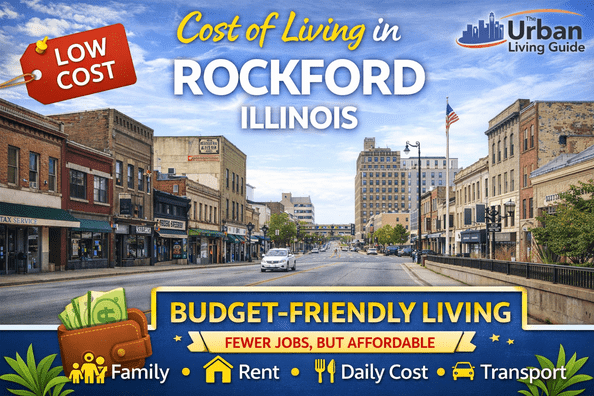
Cost of Living in Rockford, Illinois 2026: Forest City Value, Rock River Heritage & Midwest Financials
Positioned along the scenic banks of the Rock River with a proud heritage rooted in industrial manufacturing and vibrant cultural attractions like the historic Coronado Theatre and the breathtaking Anderson Japanese Gardens, the City of Rockford offers an exceptional blend of Midwestern hospitality, recreational green spaces around Sinnissippi Park, and remarkable residential affordability. While the Forest City delivers outstanding lifestyle amenities—such as community festivals at the downtown Rockford City Market, theatrical performances, and rapid access across northern Illinois via Interstate 90—managing household finances requires an astute understanding of local market conditions and regional economic drivers.
For career professionals, remote workers, and growing families relocating into Winnebago County, housing, utilities, and daily necessities remain significantly more forgiving than national averages and larger metropolitan hubs like Chicago. When evaluating the comprehensive cost of living in Rockford during 2026, you must factor in sub-freezing winter heating cycles, municipal utility structures, vehicular dependency across regional thoroughfares like US Route 20, and everyday lifestyle outlays that scale gracefully relative to median household incomes hovering near $54,752.
Average Monthly Expense Breakdown – Rockford
Monthly expenses in Rockford vary widely depending on household size, lifestyle choices, and exact neighborhood positioning. Below is a structured monthly financial breakdown displayed in a clear comparative table format reflecting current economic conditions in 2026:
| Expense Category | Single Adult | Couple | Family of 4 |
|---|---|---|---|
| Housing / Rent | $810 – $1,180 | $1,100 – $1,600 | $1,650 – $2,450 |
| Groceries & Food | $250 – $370 | $460 – $690 | $800 – $1,200 |
| Transportation & Commute | $140 – $260 | $260 – $460 | $430 – $750 |
| Utilities & Internet | $140 – $220 | $200 – $330 | $320 – $500 |
| Healthcare & Insurance | $130 – $350 | $320 – $700 | $650 – $1,300 |
| Childcare & Education | $0 | $0 | $900 – $1,750+ |
| Entertainment & Leisure | $110 – $260 | $230 – $460 | $360 – $750 |
Residents frequently emphasize that while housing expenses sit roughly 24% below the national average, managing winter heating adjustments requires careful monthly provisioning due to sub-freezing Midwestern temperatures.
Watch this video to get a closer look at housing and neighborhood pricing in Rockford.
Housing Costs, Real Estate & Society Maintenance in Rockford
Housing represents the single largest expenditure for households in Rockford, where real estate valuations run roughly 24% to 28% below the national average. Rental inventories and property purchasing costs differ noticeably between historic intown neighborhoods and expanding suburban developments. Local residential development guidelines and zoning programs are coordinated by the City of Rockford Community and Economic Development Department.
- Studio Apartments: Compact urban living spaces near downtown corridors or university areas generally range from $700–$950/month.
- 1-BHK Apartments: Standard multi-family rental units featuring modern building amenities average $910–$1,337/month across central neighborhoods.
- 2-BHK Apartments: Suited for roommates or small families, ranging from $1,100–$1,600/month depending on proximity to commercial hubs.
- Independent Homes & Properties: Detached single-family real estate across the metropolitan area commands a median purchase price of approximately $181,750 to $225,000, accompanied by local property assessments and mandatory homeowners association (HOA) dues in suburban subdivisions.
Grocery and Food Costs in Rockford
Food expenses benefit from strong regional agricultural distribution across northern Illinois, keeping everyday grocery bills right at or slightly below national benchmarks. Weekly provisions at regional supermarket mainstays and local community markets average $250–$370/month per individual.
- Popular Supermarket Chains: Mid-range regional mainstays like Schnucks, Meijer, and Woodman’s Market provide extensive inventories of fresh produce, meats, and household staples at highly competitive prices.
- Local Farmers Markets & Specialty Stores: Shopping at community staples like the seasonal Edgebrook Farmers Market, the lively Friday evening Rockford City Market along Water Street, and neighborhood specialty stands provides fresh regional produce, artisanal baked goods, and local goods at competitive seasonal price points.
- Everyday Price Benchmarks: A gallon of milk runs $3.10–$4.77; casual dining out at local spots costs $11–$20; and mid-range restaurant dinners average $22–$42 per person.
Education and Childcare Expenses
For families evaluating Rockford, education and childcare represent crucial monthly financial considerations:
- Daycare & Preschool: Full-time infant daycare or private preschool in the metro area averages between $900 to $1,600 per month per child, varying between urban centers and suburban districts.
- Public & Private School Considerations: Families frequently weigh urban public options within Rockford Public School District 205 against highly rated private academies or suburban districts in Winnebago County, such as the Harlem Consolidated School District 120.
- Higher Education Impact: Proximity to major institutions like Rockford University and Rock Valley College provides exceptional academic pathways and stable local employment opportunities.
Transportation and Commute Costs in Rockford
Commuting across the sprawling northern Illinois metropolitan area relies heavily on personal vehicle usage, supplemented by public transit services coordinated by the Rockford Mass Transit District (RMTD) system.
- Public Transit: The RMTD bus network connects major commercial corridors and residential communities, with monthly transit passes priced around $40–$55/month.
- Fuel & Operation: Average monthly gasoline expenditures run $140–$260/month, while total car ownership, insurance, and maintenance costs span $260–$500/month. The average local commute time hovers around a highly manageable 18.5 minutes.
Utilities, Energy & Home Bills
Managing utility overhead benefits from regional efficiency, with primary electricity services coordinated by ComEd and natural gas supplied by regional providers like Nicor Gas.
- Basic Home Utilities: Electricity, natural gas, municipal water, and waste management run $140–$220/month baseline for a standard apartment, maintaining rates slightly below national averages while spiking during sub-freezing winter heating periods.
- High-Speed Fiber Internet: Reliable broadband and fiber connections via providers like Xfinity or AT&T Fiber run about $55–$80/month.
Healthcare & Medical Insurance Costs
Healthcare outlays in Rockford reflect its standing as a major regional medical center, tracking roughly 12% to 14% above the national average and supported by premier medical networks such as OSF HealthCare Saint Anthony Medical Center and Mercyhealth.
- Doctor Consultations: Standard general practitioner visits without insurance coverage range from $110–$190 per consultation.
- Health Insurance: Individual private health insurance premiums average $130–$350/month depending on coverage tiers.
Entertainment, Dining & Lifestyle Costs
Enjoying local culture across the Anderson Japanese Gardens, catching a show at the Coronado Theatre, or dining out involves varied monthly outlays:
- Dining & Recreation: Commercial gym memberships at local fitness centers average $35–$75/month, while casual dining and cultural excursions add $110–$260/month.
- Retail & Shopping: Browsing boutique storefronts in historic districts or shopping at regional commercial centers keeps retail spending flexible.
Pet-Related Living Costs
Pet ownership across dog-friendly green spaces like local forest preserves involves steady monthly maintenance provisions:
- Veterinary Care: Routine checkups and preventative treatments average $35–$70/month.
- Supplies & Grooming: Pet food and professional grooming add $40–$90/month.
City-Specific Living Cost Drivers & Seasonal Expenses
Living in northern Illinois introduces specific environmental and climate cost factors:
- Sub-Freezing Winter Heating Load: Sustained sub-freezing temperatures and heavy lake-effect snows from November through March require continuous heating operation, driving up ComEd and Nicor Gas utility bills during peak winter months.
- Winter Vehicle Preparation: Navigating icy winter roads requires investing in winter tires, windshield treatments, and regular undercarriage washes to combat road salt corrosion.
- Suburban Yard Maintenance: Properties in leafy residential enclaves or suburban Winnebago County require seasonal lawn care, mowing, and landscaping upkeep.
Local Property & Income Taxes in Rockford
Tax structures in Rockford, Illinois during 2026 shape household purchasing power:
- State Income Tax: Illinois levies a flat state income tax rate of 4.95%, while Rockford does not impose a municipal earnings tax.
- Sales Tax Burden: Combined state, county, and local sales tax rates hover near 8.75% within Rockford and Winnebago County.
Downtown vs. Suburbs Cost of Living Comparison
Comparing the urban core of Downtown Rockford against surrounding suburban enclaves highlights critical lifestyle trade-offs:
| Cost Parameter | Downtown Core | Edgebrook (Historic Enclave) | Machesney Park (Northern Suburb) | Cherry Valley (Southern Suburb) |
|---|---|---|---|---|
| Housing (1-2 BHK Rent) | $750 – $1,200 | $1,050 – $1,650 | $1,150 – $1,750 | $1,200 – $1,800 |
| Parking & Garage Fees | Free / Street Parking | Free / Included | Free / Included | Free / Included |
| Transportation & Commute | RMTD bus access, walkable core | Alpine Road driving reliance | I-90 commuter highway traffic | I-39 southern commuter driving |
| Childcare & Schools | District 205 school options | Established neighborhood schools | Harlem school district | Exemplary suburban clusters |
| Entertainment & Dining | Water Street nightlife & dining | Edgebrook boutique shops | Suburban commercial plazas | CherryVale Mall retail center |
| Home Maint. / HOA / Taxes | Minimal historic upkeep | Established property assessments | Suburban property tax rates | Standard community dues |
| Car Ownership vs. Transit | Optional near downtown core | Mandatory | Mandatory | Mandatory |
Strategic Insight: Students and young professionals frequently thrive in transit-accessible urban neighborhoods like Downtown Rockford to minimize vehicle dependence, while growing families gravitate toward northern and southern suburbs like Cherry Valley for spacious real estate and high-performing public school districts.
Local Resident Realities: What Long-Timers Say About Living Costs in Rockford
“Living near downtown Rockford gives you incredible access to the Friday night markets and local restaurants at a fraction of what Chicago charges. Just make sure to budget extra for natural gas and electricity when sub-freezing winter weather arrives.”
“We relocated to Cherry Valley to secure a larger home and yard for our children in a great school district. The overall cost of living is remarkably reasonable, and the savings on housing compared to major metro areas made the move completely worth it.”
Is Rockford Expensive or Affordable?
Rockford occupies a highly accessible position among northern Illinois metropolitan centers, offering robust economic opportunities in manufacturing and healthcare alongside rich cultural amenities without punishing real estate valuations.
Key factors that affect affordability across the metro area include:
- Highly accessible real estate market with home purchase and rental valuations sitting roughly 24% below the national average.
- Favorable grocery and municipal utility pricing tracking closely with national benchmarks.
- Stable employment opportunities anchored by aerospace manufacturing, healthcare systems, and higher education.
- Absence of municipal earnings taxes, allowing local workers to retain a larger share of their take-home pay.
Who May Find Rockford Expensive? — And Who Can Afford It Comfortably?
Navigating the economic landscape of Rockford requires balancing individual earnings against distinct housing, transport, and utility expenses. Financial pressures vary significantly across income brackets, shaping daily life across the northern region.
Residents earning moderate or entry-level wages often experience financial strain when attempting to secure independent housing near central medical or educational hubs without roommate arrangements. Conversely, households exceeding mid-tier income thresholds find the local cost structure highly manageable and sustainable.
- $32K – $45K/year (Financially Strained): Requires strict budgeting, shared housing arrangements, and mindful management of utility and transportation outlays.
- $45K – $70K/year (Moderate Comfort): Supports standard apartment rentals, single-income stability, and consistent monthly savings plans.
- $70K+/year (Comfortable Living): Unlocks independent homeownership in desirable historic or suburban neighborhoods and flexible discretionary spending.
- Service and Hospitality Sector Workers: Individuals earning below $28K/year frequently encounter friction unless utilizing shared living spaces or subsidized commuting options.
Practical Money-Saving Tips for Rockford Residents
Living affordably in Rockford involves combining smart residential choices with localized strategies to trim monthly recurring outlays. By evaluating your lifestyle and optimizing how you manage everyday essentials, you can stretch your household budget significantly without sacrificing quality of life.
Maximizing financial efficiency across northern Illinois requires deliberate planning around housing locations, utility consumption, and transportation habits. Here are comprehensive money-saving strategies tailored specifically for Rockford residents:
- Choose residential locations strategically: Opt for rental properties or homes slightly outside the immediate downtown core or near transit routes to secure lower lease rates while maintaining easy access to cultural amenities.
- Optimize home energy consumption: Program smart thermostats to manage heating loads during sub-freezing winter months and utilize energy-efficient window treatments to lower monthly ComEd and Nicor Gas utility bills.
- Leverage local transit and carpool options: Utilize Rockford Mass Transit District (RMTD) bus routes or coordinate carpools for commuting along Interstate 90 and US Route 20 to reduce fuel and parking expenses.
- Shop value-focused grocers and farmers markets: Purchase weekly provisions at regional supermarkets like Schnucks, Meijer, and Woodman’s Market, and visit seasonal community staples like the Edgebrook Farmers Market and Rockford City Market to secure fresh produce at competitive seasonal prices.
- Balance downtown proximity with suburban savings: Weigh the trade-offs of historic intown home maintenance against modern suburban developments in Cherry Valley or Machesney Park to minimize long-term repair and homeowners association overhead.
- Utilize local community resources and outdoor recreation: Take advantage of free or low-cost regional amenities such as Sinnissippi Park, the Rock River trail systems, and cultural gardens to keep entertainment spending flexible.
Frequently Asked Questions About Living Costs in Rockford
Is Rockford considered an expensive place to live compared to other Illinois cities?
No, Rockford maintains a highly accessible cost-of-living structure, with housing expenses sitting roughly 24% below the national average and overall costs tracking significantly lower than major metro areas like Chicago.
What is the primary driver of monthly household expenses in Rockford?
Housing represents the largest financial commitment, though seasonal utility adjustments during sub-freezing winter months and transportation overhead also play notable roles in monthly budgeting.
What salary is required to live comfortably as a single adult in Rockford?
Single professionals generally need an annual salary between $45,000 and $65,000 to cover independent housing, transportation, and leisure without undue financial stress.
How do winter weather conditions impact monthly utility bills in Rockford?
Severe sub-freezing temperatures from November through March require continuous heating operation, causing utility bills from providers like ComEd and Nicor Gas to spike noticeably.
Is public transportation viable for daily commuting in Rockford?
While the RMTD bus network serves major commercial corridors, having a personal vehicle remains practically mandatory for navigating the broader Winnebago County grid.
Does Rockford impose a local municipal earnings tax on residents?
No, Rockford does not levy a municipal earnings tax, allowing local workers to retain a higher percentage of their earned income.
What are the best budget-friendly neighborhoods for young professionals?
Areas near Downtown Rockford, Edgebrook, and midtown corridors offer vibrant historic character and dining scenes with relatively accessible rental options.
Internal Linking & Resource Hub
Want to learn more about Rockford? Check out these helpful guides:
- Living in Rockford, Illinois
- Pros and Cons of Living in Rockford, Illinois
- Best Neighborhoods in Rockford, Illinois
Ready to make your decision? Explore our complete guide here: Moving to Rockford, Illinois.