

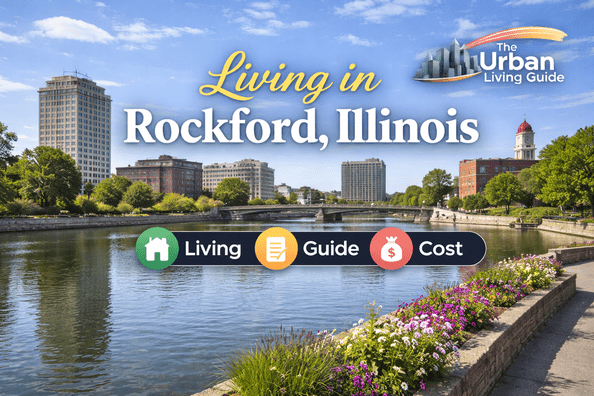
From Outdoor Trails to Manufacturing Jobs: What Living in Rockford, Illinois Is Really Like
Positioned roughly 90 miles northwest of downtown Chicago and near the Wisconsin border, Living in Rockford, Illinois offers one of the most accessible and budget-friendly real estate markets in Northern Illinois while maintaining convenient access to regional economic engines like Chicago and Madison. As the seat of Winnebago County, Rockford supports a population of roughly 145,000 residents, making it the largest city in Illinois outside of the Chicago metropolitan statistical area. Historically celebrated as the Forest City due to its magnificent canopy of trees and scenic location along the Rock River, Rockford has successfully reinvented itself from a traditional manufacturing hub into a diversified center for aerospace components, advanced logistics, and healthcare services.
Relocating to this Northern Illinois hub appeals strongly to first-time homebuyers, manufacturing specialists, healthcare workers, and retirees who want to escape the crushing mortgage pressures and gridlock of the inner Chicago collar counties. While local salary ceilings do not match the corporate executive pay found in Chicago or Naperville, the dramatic difference in home purchase prices provides an immense boost to real purchasing power. However, daily life here requires adapting to a mid-sized industrial rhythm where entertainment options are more localized and winters demand serious cold-weather preparation. Whether you are seeking a quiet suburban pocket in Northeast Rockford or an affordable historic home, the city delivers a practical, community-oriented lifestyle.
What Makes Rockford So Popular & Unique
Rockford stands out in the regional housing market because it provides genuine, uncompromised affordability without sacrificing standard municipal conveniences or green space. The city is nationally recognized for its world-class park district—which has earned the prestigious National Gold Medal Award for excellence—alongside stunning natural assets like the Anderson Japanese Gardens and miles of scenic riverfront trails. For newcomers looking to access municipal utilities, city permits, and community event schedules, the official City of Rockford portal serves as an essential digital gateway.
- Exceptional Real Estate Affordability: Offers some of the lowest median home prices and rental rates in Northern Illinois, allowing middle-income families to easily achieve homeownership.
- The Rockford Park District: A nationally renowned park system featuring thousands of acres of green space, golf courses, sports complexes, and public gardens.
- Strategic Regional Connectivity: Positioned directly along Interstate 90 and Interstate 39, providing straightforward driving access to Chicago, Madison, and Milwaukee.
- Aerospace Manufacturing Heritage: A robust industrial legacy anchored by specialized aviation component suppliers and precision engineering firms.
Rockford at a Glance: Key Relocation Metrics
Reviewing these baseline statistics can help you set realistic expectations for your transition to the Forest City. These figures reflect current northern Illinois market conditions and regional economic benchmarks.
| Metric | Rockford City Data | Regional Context |
|---|---|---|
| City Population | ~145,000 Residents | Largest Illinois city outside the Chicago metro |
| Median Home Price | $160,000 – $220,000 | Significantly cheaper than Chicago and collar suburbs |
| Average 1BR Rent | $850 – $1,100 | Highly accessible rental entry points |
| Average Commute | 20 – 25 Minutes | Minimal traffic congestion across local arterials |
| Top Industries | Manufacturing, Aerospace, Healthcare | Logistics, Distribution, and Public Education |
If you’re not familiar with this part of the state, the map below will help you understand the city’s exact location.
Famous Personalities, Sports Teams & Major Brands in Rockford
Rockford’s cultural and industrial footprint is deeply embedded in Northern Illinois history, having produced celebrated entertainment icons, elite athletes, and critical manufacturing components that support global supply chains.
- Notable Personalities: The city is proud to be the hometown of acclaimed Hollywood actor John Cusack and Olympic speed skating gold medalist Eric Heiden.
- Sports Loyalties: While Rockford features passionate local high school sports and minor-league hockey traditions, professional sports fandom aligns entirely with Chicago teams, including deep loyalties to the Chicago Bears, Chicago Bulls, and Chicago Cubs.
- Industrial Footprint: The city serves as a vital manufacturing base for aerospace components, precision machine tools, and heavy industrial supplies utilized by major corporations throughout the Midwest.
Job Market & Business Opportunities with Major Employers
Rockford’s employment landscape is anchored by a resilient industrial core, advanced healthcare systems, and a rapidly expanding logistics sector driven by its strategic highway access. Key local industries include heavy and precision manufacturing, aerospace engineering, hospital administration, and public education.
Major employers providing thousands of stable careers include Mercerhealth, Rockford Public Schools, and numerous aerospace manufacturing firms. Official economic reference data from the Illinois Department of Commerce & Economic Opportunity highlights that while job competition here is far lower than in Chicago, local salary ceilings are more conservative.
- Entry-level salaries: Typically range between $40,000 – $55,000 for administrative, logistics, and entry-level medical roles.
- Mid-level professional roles: Generally span $60,000 – $80,000 for nurses, mechanical engineers, and skilled technicians.
- Senior executive or specialized medical roles: Frequently command $90,000+, providing strong purchasing power relative to local home prices.
Housing & Real Estate Overview in Rockford
Housing is unquestionably Rockford’s strongest competitive advantage. In 2026, median home prices hover comfortably between $160,000 and $220,000, allowing buyers to acquire spacious single-family homes, historic properties, or modern suburban builds for a fraction of what they would cost in Cook or DuPage counties. Luxury properties in the area rarely exceed $500,000.
The rental market is equally accessible, offering genuine financial breathing room. Current average monthly rent projections are:
- Studio Apartment: $700 – $900
- 1 Bedroom Apartment: $850 – $1,100
- 2 Bedroom Apartment: $1,100 – $1,500
- Family Home Rentals: $1,500 – $2,200+
Securing property here provides one of the strongest cost-to-space values in the state, though buyers should evaluate local property tax assessments carefully when budgeting long-term monthly expenses.
Best Neighborhoods in Rockford: Finding Your Ideal Community
Choosing the right neighborhood in Rockford directly influences safety perceptions, school access, and property value stability. Neighborhood insights are based on local housing trends, safety reports, and resident surveys. The table below outlines the most prominent residential zones.
| Neighborhood / Category | Location, Pricing & Community Overview |
|---|---|
| Northeast Rockford (Family) | Frequently preferred by families for its quiet suburban feel, residential stability, well-maintained parks, and strong property value retention. Features mature trees and traditional single-family homes. |
| Spring Creek Area (Upscale) | A highly desirable, tranquil residential setting situated close to premier nature preserves, local country clubs, and well-regarded neighborhood schools. |
| Midtown Rockford (Affordable) | Features a mix of older housing stock, historic character, and lower home purchase prices, appealing to buyers interested in DIY home renovations and urban proximity. |
| West Rockford (Budget) | Provides budget-friendly, entry-level housing options and ranch-style homes ideal for first-time buyers seeking maximum square footage on a strict budget. |
| Loves Park (Suburban Enclave) | A distinct neighboring community just north of Rockford offering a quieter suburban atmosphere, local parks, and easy access to the Rock River. |
What It’s Really Like Living in Rockford (Daily Life & Vibe)
Life in Rockford moves at a noticeably slower, more relaxed pace compared to the high-pressure bustle of Chicago’s inner suburbs. Daily routines are characterized by short, stress-free commutes, light traffic congestion, and neighborhoods that feel spacious rather than crowded. Residents enjoy a practical, working-class rhythm where community involvement and outdoor recreation take center stage.
Weekends are typically spent exploring the extensive Rockford Park District trail network, visiting local farmers markets, or enjoying casual dining along the riverfront. While the nightlife and entertainment options are more modest than a major metropolis, the city’s emphasis on affordability, lack of gridlock, and friendly neighborhood atmosphere create an inviting environment for practical homeowners.
Watch a recent video by a popular vlogger to understand daily life and vibes in Rockford:
Cost of Living in Rockford: Monthly Expenses & Salary Needs
Rockford’s cost of living sits significantly below most Illinois metropolitan areas, offering exceptional purchasing power. Cost estimates are derived from official statistics and city-level cost databases. To live very comfortably, maintain savings, and enjoy homeownership, a single professional should target a salary of $60,000+, while households with children generally require $90,000+.
- Average Rent (1BR): ~$950 for well-maintained apartments across the city.
- Monthly Utilities: $150–$220 (Covering electricity, heating, and water).
- Groceries & Household Goods: $300–$400 per month for an individual.
- Transportation: $150–$250 accounting for local gas consumption and vehicle maintenance.
- Property Taxes: Moderate to high relative to home value, requiring careful budgeting for homeowners.
Transportation, Highway Bottlenecks & Airport Connectivity
Transportation in Rockford is built around personal vehicle use, as public transit options are more limited than in larger urban centers. The city’s layout allows for swift travel, with the average daily commute hovering around a convenient 20 to 25 minutes.
Highway connectivity is exceptional, anchored by Interstate 90 (running southeast to Chicago and northwest toward Wisconsin) and Interstate 39 (running south toward Bloomington-Normal). For air travel, residents utilize the Chicago Rockford International Airport (RFD), which handles significant cargo operations and growing passenger flights.
Weather Patterns, Seasonal Realities & Climate Factors
The city experiences a classic humid continental climate, defined by distinct four-season weather patterns:
- Winters: Cold and snowy with frequent freezing temperatures, requiring proper vehicle winterization and snow removal gear.
- Summers: Warm and humid, providing ideal weather for enjoying local parks, golf courses, and river recreation.
- Spring and Fall: Crisp transition seasons featuring vibrant autumn foliage across the region’s famous forest preserves.
- Climate Reference: Official meteorological tracking and forecasts are provided by the National Weather Service Northern Illinois region.
Education, Schools & Major Universities
Educational infrastructure spans public school districts and accessible higher learning institutions:
- Rockford Public School District: Managing comprehensive elementary and secondary education across the city with diverse magnet and specialty program options.
- Rock Valley College: A robust local community college offering two-year degrees, vocational certifications, and seamless transfer pathways.
- Regional Proximity: Convenient driving access to Northern Illinois University (NIU) located nearby in DeKalb.
- School Performance: Academic ratings vary by specific school boundary, making neighborhood research important for families.
Medical Facilities, Hospitals & Healthcare Systems
Healthcare serves as a massive pillar of the local economy and ensures residents have elite medical access without traveling to Chicago. The healthcare network is anchored by major regional institutions:
- Mercerhealth: A sprawling healthcare network operating major acute care facilities, emergency rooms, and specialized clinics across the Rockford area.
- UW Health SwedishAmerican Hospital: A prominent regional medical center providing advanced cardiac care, surgical units, and comprehensive patient services.
- Specialized Outpatient Clinics: Numerous urgent care facilities and multi-specialty practices distributed conveniently throughout the city.
Popular Hotels, Cafes, Dining & Culinary Scene
Rockford’s hospitality and dining scene blends historic charm with local Midwestern flavor and evolving culinary concepts.
- Popular Hotels: Visitors and business travelers frequently book stays at landmark properties like the Embassy Suites by Hilton Rockford Riverfront, the Riverview Inn, or modern business hotels along the I-90 corridor.
- Cafes: Independent coffee roasters and local bakeries thrive in Midtown and near the downtown districts, offering cozy spaces for remote work and social meetups.
- Restaurants: The city features historic supper clubs, local Italian eateries, and popular downtown dining spots like The Norwegian, celebrating Rockford’s Scandinavian heritage.
Sightseeing, Cultural Spots & Tourist Attractions
Residents enjoy an abundance of cultural landmarks and outdoor natural attractions within city limits:
- Anderson Japanese Gardens: A breathtaking 12-acre contemplative Japanese garden widely ranked among the finest in North America.
- Rockford Art Museum: Showcasing regional and contemporary art exhibitions in the heart of downtown.
- Klehm Arboretum & Botanic Garden: Featuring 155 acres of beautifully curated plant collections, woodland trails, and educational exhibits.
- Sinnissippi Park & Nicholas Conservatory: Offering stunning tropical plant displays, butterfly houses, and scenic riverfront walking paths.
Honest Trade-offs: Pros and Cons of Living in Rockford
Every city requires compromise. Here is the unvarnished reality for anyone planning a move to the Forest City in 2026:
Pros:
- Exceptional housing affordability and lower overall cost of living.
- Light traffic congestion and short, manageable commute times.
- Storable park districts, forest preserves, and outdoor recreation.
- Stable manufacturing and healthcare employment sectors.
- Straightforward highway access to Chicago, Madison, and Milwaukee.
Cons:
- Lower overall salary ceilings compared to the Chicago job market.
- Cold, snowy winters requiring dedicated winter preparation.
- A more modest nightlife and entertainment infrastructure.
- Property tax burdens that require careful financial planning.
- Fewer corporate headquarters and high-tech white-collar opportunities.
Who Is Rockford Ideal For (and Who Should Avoid It?)
Rockford prioritizes affordability over urban energy. Ideal For:
- First-time homebuyers seeking affordable single-family homeownership.
- Manufacturing specialists, machinists, and healthcare professionals.
- Retirees looking to stretch their nest egg in a scenic, park-rich city.
- Individuals who prefer short commutes and low traffic congestion.
Who Should Avoid It:
- Ambitious corporate climbers seeking high-paying finance or tech roles.
- Young singles craving a dense, high-energy urban arts and nightlife scene.
- Buyers who want extremely low property tax rates.
Real Experiences: Perspectives from Long-Term Residents (5 to 10+ Years)
Data gives you the metrics, but daily life gives you the truth. Here is what veteran locals have to say about living in Rockford:
“We moved up from the Chicago suburbs because we were tired of being house-poor, and buying a four-bedroom home here for under two hundred grand completely changed our finances. The winters are no joke and you have to pick your neighborhood carefully, but the park district and Anderson Gardens make it a wonderful place to raise a family.”
[Source: r/rockford Community Discussions]
“The job market is heavily manufacturing and healthcare, so if you’re in those fields you’re golden. Commuting across town takes twenty minutes max, which is a massive quality-of-life win compared to sitting on I-90 every day. It’s an honest, hard-working city with a lot of green space.”
[Source: Local Neighborhood Survey Threads]
Frequently Asked Questions About Living in Rockford, Illinois
Is Rockford, Illinois expensive to live in?
No, Rockford features one of the most affordable housing markets in Northern Illinois, with median home prices ranging between $160,000 and $220,000.
What salary do you need to live comfortably in Rockford?
A single individual typically requires around $60,000 annually, while families generally need $90,000+ to manage household expenses and homeownership comfortably.
How is the commute from Rockford to Chicago?
Driving into downtown Chicago takes roughly 90 minutes via I-90, making daily commuting exhausting, which is why most residents work locally or in surrounding McHenry/Kane counties.
Which neighborhoods are best for families in Rockford?
Northeast Rockford and the Spring Creek residential area are widely preferred by families due to their suburban feel, parks, and residential stability.
What are the primary industries driving Rockford’s economy?
Rockford’s economy is anchored by aerospace manufacturing, precision machining, health systems like Mercyhealth, and regional logistics distribution.
🔗 Explore More Cities in Illinois
If you’re exploring more options beyond Rockford, The Urban Living Guide has covered several other popular cities in Illinois. You can also check:
- Living in Chicago, Illinois
- Living in Springfield, Illinois
- Living in Naperville, Illinois
- Living in Aurora, Illinois
Want to learn more about Rockford? Check out these helpful guides:
- Cost of Living in Rockford, Illinois
- Pros and Cons of Living in Rockford, Illinois
- Best Neighborhoods in Rockford, Illinois
Ready to make your decision? Explore our complete guide here: Moving to Rockford, Illinois
These guides give you a complete picture of what it’s like living across different cities, covering everything from cost of living, housing, and job opportunities to neighborhoods, commute, weather, education, popular places, and major employers.
The Urban Living Guide brings together these local insights in one place, helping you compare cities easily and make a confident, well-informed decision based on your lifestyle and goals.