

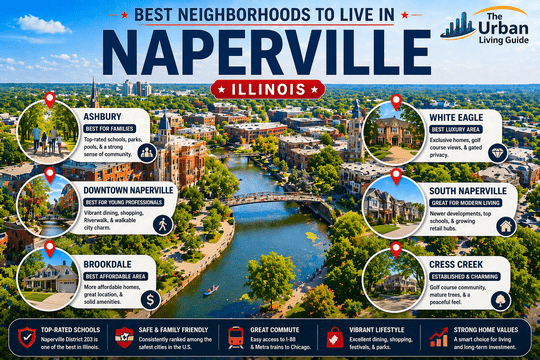
Best Neighborhoods in Naperville, Illinois: Riverwalk Living, Top School Districts & Master-Planned Enclaves in 2026
Covering approximately 39 square miles of land area across DuPage and Will Counties in the outer western Chicago metropolitan basin, the incorporated municipality of Naperville operates under the council-manager governance of the City of Naperville. Housing an affluent core population exceeding 150,000 residents and anchoring the primary commercial and research core of the Illinois Technology and Research Corridor, Naperville consistently ranks as one of the best and safest cities to live in the United States. Relocating across this western suburb requires evaluating municipal public safety resources, multi-tiered school districts, winter climate resilience, and commuter transit lines overseen by Metra Rail.
Residential living in Naperville presents balanced lifestyle environments, separating the dense, historic brick-lined pedestrian core of Downtown Naperville and the DuPage Riverwalk from master-planned swim/tennis subdivisions, championship golf club communities, and accessible corporate corridor enclaves. Inbound movers consistently balance direct access to major regional employers—such as the Corridor Corporate Technology Hubs, research centers at Fermi National Accelerator Laboratory (Fermilab) and Argonne National Laboratory, and healthcare complexes at Edward Hospital—against daily transit commutes into Downtown Chicago. Selecting the right neighborhood defines your daily route across major transportation arteries including Interstate 88 (Ronald Reagan Memorial Tollway), US Route 34 (Ogden Avenue), Illinois Route 59, and 75th Street.
Watch this video to explore different neighborhoods, suburban corridors, and residential communities across Naperville:
Best Areas to Live in Naperville at a Glance in 2026
| Neighborhood Name | Location | Distance from Core (Downtown Naperville) | Development Status | Transit Connectivity | Cost Level | Best Fit For |
|---|---|---|---|---|---|---|
| Ashbury | Southwest Naperville (Will County) | Approximately 6 miles southwest | Master-Planned Swim/Tennis Subdivision | Moderate (Automobile-centric, Route 59, 95th St) | High-to-Premium | Families with Children & Long-Term Homeowners |
| Downtown Naperville | Central Riverfront Core (DuPage County) | 0 miles (Urban Center) | Historic Walkable Mixed-Use Core | Exceptional (Metra BNSF Station, Pace, Washington St) | High-to-Premium | Young Professionals, Chicago Commuters & Down-sizers |
| Brookdale | Northwest Sector (I-88 Corridor) | Approximately 3 miles northwest | Established 1970s–1980s Suburban | High (Metra Route 59 Station, I-88, Route 59) | Mid-Range / Accessible | First-Time Homebuyers, Commuters & Value Seekers |
| White Eagle | West Border (Will/DuPage Border) | Approximately 5 miles west | Gated Private Championship Golf Enclave | Moderate (Route 59, 75th St) | Ultra-Premium | Corporate Executives, Avid Golfers & Luxury Buyers |
| South Naperville | South Will County Corridor | Approximately 7 miles south | Modern Master-Planned Expansion | Moderate (Route 59, Book Rd, Plainfield-Naperville Rd) | Mid-to-High Range | Relocating Families & Tech Professionals |
| Cress Creek | North Central Sector | Approximately 2 miles north | Established Country Club Residential | Exceptional (Downtown Metra Station, I-88, Ogden Ave) | High-to-Premium | Established Executives, Golfers & Commuters |
Best Neighborhoods in Naperville Discussed in Detail
Ashbury — Master-Planned Family Haven, Aquatic Clubhouse & Top School Clusters
Covering an expansive residential footprint in southwestern Naperville near Book Road and 87th Street, Ashbury is one of the city’s most recognized and family-oriented master-planned subdivisions. Built predominantly throughout the 1990s, the community is anchored by the private Ashbury Clubhouse and Aquatic Center. Governed by a dedicated homeowners association and operating under City of Naperville municipal services, Ashbury blends active neighborhood engagement with manicured streetscapes and top-tier public school assignments.
- Housing: Real estate is composed of spacious 1990s traditional two-story brick and cedar executive single-family homes, custom residences on quarter-to-half-acre landscaped lots, and occasional cul-de-sac properties. Single-family purchase prices typically range from $540,000 to $920,000+, with limited single-family rental homes averaging $2,800 to $4,200 per month.
- Safety & Crime Rate: Patrolled by the Naperville Police Department South Precinct. Ashbury consistently maintains one of the lowest property and violent crime rates in Chicagoland, supported by proactive neighborhood watch networks and low commercial through-traffic.
- School District & Education Quality: Governed by the nationally acclaimed Indian Prairie School District 204, containing top-performing public institutions such as Neuqua Valley High School (nationally recognized for academic performance and fine arts), Scullen Middle School, and on-site Patterson Elementary School.
- Walkability & Daily Conveniences: While interior subdivision roads are automobile-dependent, commercial retail centers along 95th Street and Route 59 provide quick driving access to Jewel-Osco, Whole Foods Market, the Naperville Public Library (95th Street Branch), and family dining.
- Parks & Green Spaces / Pet-Friendliness: Exceptional community amenities centered around the private Ashbury Aquatic Center (featuring zero-depth pools, water slides, and swim teams), the on-site Ashbury Park (featuring baseball diamonds and playgrounds), and nearby hiking at Springbrook Prairie Forest Preserve. Extremely pet-friendly.
- Parking & Traffic Congestion: Generous attached two-to-three car garages and wide driveways keep neighborhood lanes clear. Commuter traffic builds along 95th Street and Route 59 during peak morning rush hours.
- Noise Levels & Vibe: Peaceful, safe, and family-centered, characterized by children riding bicycles, sidewalk joggers, and tranquil residential evenings.
- Medical Facilities & Hospitals: Direct 12-minute medical access to comprehensive acute care at Edward Hospital on South Washington Street.
- Transit Connectivity: Roadway connectivity via 87th Street, Book Road, and Illinois Route 59, offering a 12-minute drive to the Route 59 Metra Station for express commuter trains into Chicago Union Station.
- Affordability: High-tier suburban price profile; higher home acquisition costs are offset by top-rated Neuqua Valley school zoning and neighborhood recreation amenities.
- Who It’s Best For: Growing families prioritizing top-tier District 204 public education, active youth sports leagues, and master-planned swim/tennis communities.
- Drawbacks: Higher entry purchase prices, mandatory monthly HOA dues, and a 6-mile drive to reach the downtown core or Metra train stations.
Downtown Naperville — Historic Riverwalk Core, North Central College & Walkable Dining
Positioned along the scenic winding banks of the West Branch DuPage River, Downtown Naperville is the vibrant culinary, shopping, cultural, and transit heart of the city. Centered around Washington Street, Jefferson Avenue, and the iconic 1.75-mile brick-paved Naperville Riverwalk, downtown blends preserved 19th-century architecture with luxury modern condominiums, boutique shopping, and premier dining. Planning is supported by the Downtown Naperville Alliance and City of Naperville municipal preservation overlays.
- Housing: Architectural inventory spans historic Victorian single-family homes in the Naperville Historic District, custom luxury modern infill estates, upscale brownstones, and luxury mid-rise condominium residences. Single-family purchase prices typically range from $650,000 to $2,800,000+, while luxury downtown apartments and condos average $2,100 to $3,900 per month.
- Safety & Crime Rate: Patrolled by the Naperville Police Department Central Division and campus security from North Central College. The pedestrian retail core is safe and well-illuminated, reporting minimal crime.
- School District & Education Quality: Governed by the prestigious Naperville Community Unit School District 203, zoned to high-achieving public schools such as Naperville Central High School and Washington Junior High, alongside the historic higher-education campus of North Central College.
- Walkability & Daily Conveniences: Outstanding pedestrian walkability (Walk Score of 88-92/100). Residents walk to over 100 designer shops, independent bookstores, artisan bakeries, upscale steakhouses, and grocery markets like Trader Joe’s and Dean’s Market.
- Parks & Green Spaces / Pet-Friendliness: Direct access to the historic Naperville Riverwalk (featuring covered bridges, fountains, outdoor amphitheaters, and the Millennium Carillon), Centennial Beach (a historic quarry swimming facility), and Fredenhagen Park. Exceptionally pet-friendly.
- Parking & Traffic Congestion: Free multi-story municipal parking decks (such as the Water Street and Van Buren decks) provide parking, though weekend dining traffic slows along Washington Street and Chicago Avenue.
- Noise Levels & Vibe: Vibrant, historic, and cosmopolitan, filled with outdoor patio dining chatter, college events, and weekend shoppers along the river.
- Medical Facilities & Hospitals: Direct 3-minute access to the primary healthcare campus at Edward Hospital on South Washington Street.
- Transit Connectivity: Unmatched commuter transit centered at the Naperville Metra Station (BNSF Line) on 4th Avenue, offering 30-minute express commuter train service straight to Chicago Union Station, alongside vehicle access to I-88 and US-34 (Ogden Avenue).
- Affordability: High-to-premium pricing tier; elevated property valuations per square foot reflect the unmatched walkability, Metra rail access, and historic prestige.
- Who It’s Best For: Chicago loop commuters, corporate executives, medical staff at Edward Hospital, empty-nesters, and urbanites seeking a walkable suburban lifestyle.
- Drawbacks: High housing acquisition costs, competitive on-street parking during weekend dining peaks, and strict architectural preservation guidelines on historic homes.
Brookdale — Commuter Crossroads, Established Greenways & Attainable Single-Family Living
Situated in northwestern Naperville along the Interstate 88 and Illinois Route 59 research corridor, Brookdale is one of the city’s most established and accessible residential neighborhoods. Developed in the 1970s and 1980s around Brookdale Road and Bond Street, the community offers mature tree canopies, neighborhood swim/tennis facilities, and unbeatable proximity to major expressways and Metra commuter rail stations.
- Housing: Real estate stock features classic 1970s and 1980s two-story colonial homes, split-level single-family properties, attached townhomes, and garden-style condominiums. Single-family purchase prices typically range from $380,000 to $620,000, while rental townhomes and apartments average $1,650 to $2,450 per month.
- Safety & Crime Rate: Patrolled by the Naperville Police Department North Precinct. Brookdale maintains low property and violent crime rates, supported by established community watch networks and active homeowners associations.
- School District & Education Quality: Governed by Naperville Community Unit School District 203, containing top-performing public institutions such as Naperville North High School, Jefferson Junior High School, and on-site Brookdale Elementary School.
- Walkability & Daily Conveniences: The interior residential roads are walkable for recreation, with major commercial power centers along Route 59 and Ogden Avenue hosting Costco Wholesale, Meijer, ALDI, and extensive casual dining.
- Parks & Green Spaces / Pet-Friendliness: Exceptional community amenities managed by the Brookdale Racquet Club (featuring swimming pools and tennis courts), Brookdale Park (offering soccer fields, walking paths, and playgrounds), and direct access to the McDowell Grove Forest Preserve (featuring river trails and kayaking). Highly pet-friendly.
- Parking & Traffic Congestion: Plentiful private two-car garages and wide driveways. Commuter traffic moves efficiently, with minor slowdowns near the Route 59 / I-88 Interchange during morning rush hours.
- Noise Levels & Vibe: Quiet, established, and family-centered, characterized by mature oak trees, neighborhood bicycle riders, and calm evenings.
- Medical Facilities & Hospitals: Direct 8-minute drive to Edward Hospital and local outpatient surgical centers along Diehl Road.
- Transit Connectivity: Unrivaled commuter highway and rail access: 3-minute drive to the Route 59 Metra Station (BNSF Line) and immediate on-ramps to Interstate 88, offering a 35-minute commute to O’Hare International Airport and downtown Chicago.
- Affordability: Naperville’s most accessible entry-level single-family homeownership price tier within the District 203 school boundary, offering strong long-term value.
- Who It’s Best For: First-time suburban homebuyers, Chicago commuters using the Metra BNSF train, corporate tech employees along I-88, and young families seeking top Naperville North schools.
- Drawbacks: Older interior home features requiring modern cosmetic updates, proximity to commercial highway arterials, and automobile reliance for major grocery runs.
White Eagle — Premier Gated Luxury, Arnold Palmer Championship Golf & Custom Estates
Covering an expansive gated footprint along the western boundary of Naperville near 75th Street and White Eagle Drive, White Eagle is one of the most prestigious master-planned luxury golf course communities in the western suburbs. Centered around a 27-hole championship golf course designed by Arnold Palmer at the White Eagle Golf Club, this private enclave offers 24/7 guarded security gates, scenic golf course views, and grand custom residences. The community operates under City of Naperville municipal services with private HOA governance.
- Housing: Real estate is composed exclusively of custom-built luxury brick single-family estates, grand French Provincial and Georgian residences, and luxury maintenance-free golf villas. Single-family purchase prices typically range from $680,000 to $2,200,000+, with very limited executive rental properties averaging $3,500 to $6,500 per month.
- Safety & Crime Rate: Exceptional private security featuring 24/7 guarded entry gates, roving vehicle patrols, and perimeter monitoring, resulting in near-zero violent and property crime rates.
- School District & Education Quality: Governed by the top-rated Indian Prairie School District 204, featuring on-site White Eagle Elementary School, Still Middle School, and Waubonsie Valley High School.
- Walkability & Daily Conveniences: The private gated lanes are pedestrian-safe for jogging and walking, while major shopping centers along Route 59 and 75th Street (featuring Whole Foods Market, Target, and specialty retail) are reachable within a 5-minute drive.
- Parks & Green Spaces / Pet-Friendliness: World-class community amenities centered around the private White Eagle Golf Club, private swimming pool complexes, tennis courts, and the on-site White Eagle Park. Extremely dog-friendly with secure, shaded private streets.
- Parking & Traffic Congestion: Expansive three-to-four car garages and large circular motor courts keep residential streets clear. Traffic moves smoothly along 75th Street heading toward Route 59.
- Noise Levels & Vibe: Serene, exclusive, and refined, punctuated by wildlife sounds, manicured fairway greens, and quiet evenings.
- Medical Facilities & Hospitals: Direct 10-minute access to Edward Hospital on Washington Street and Rush-Copley Medical Center in nearby Aurora.
- Transit Connectivity: Roadway connectivity via 75th Street, Route 59, and Ogden Avenue, providing an 8-minute drive to the Route 59 Metra Station and 12 minutes to I-88.
- Affordability: Ultra-premium price structure; higher acquisition costs, homeowners association (HOA) dues, and optional country club memberships reflect the gated security and amenities.
- Who It’s Best For: Corporate leaders, healthcare directors, avid golfers, and families seeking private gated security with on-site District 204 elementary schooling.
- Drawbacks: High initial purchase prices and ongoing HOA maintenance fees, strict architectural review boards, and driving distance to downtown Naperville dining.
South Naperville — Modern Subdivisions, Commercial Centers & Expanding Family Amenities
Spanning the rapidly developed southern sector of the city in Will County along Route 59, 95th Street, and Plainfield-Naperville Road, South Naperville is the city’s modern suburban growth engine. Developed extensively over the past two decades around master-planned swim/tennis subdivisions (such as Tall Grass, Clow Creek, and River Run), South Naperville delivers contemporary floor plans, newer civic infrastructure, and robust commercial amenities.
- Housing: Real estate stock features modern 2000s–2020s two-story brick and siding executive homes, master-planned subdivisions with private aquatic clubs, modern luxury townhomes, and upscale apartment communities. Single-family purchase prices typically range from $490,000 to $950,000+, while modern rental homes and apartments average $1,850 to $3,100 per month.
- Safety & Crime Rate: Patrolled by the Naperville Police Department South Precinct. South Naperville consistently reports low crime statistics, supported by modern environmental planning and active community watch organizations.
- School District & Education Quality: Governed by top public districts including Indian Prairie School District 204 (Neuqua Valley High School) and Naperville Community Unit School District 203 (Naperville Central High School).
- Walkability & Daily Conveniences: Designed around major commercial power centers along 95th Street and Route 59, offering walkable retail at Naperville Crossings (featuring AMC Theatres, dining, and shops), Amazon Fresh, Meijer, and the 95th Street Public Library.
- Parks & Green Spaces / Pet-Friendliness: Outstanding recreational access anchored by the 300-acre Commissioners Park (featuring synthetic turf sports fields, cricket pitches, skate parks, and splash pads), Frontier Sports Complex, and nature trails at Knoch Knolls Nature Center. Highly pet-friendly.
- Parking & Traffic Congestion: Plentiful private two-to-three car garages and wide driveways. Commuter traffic builds along Route 59 and 95th Street during morning and evening rush hours.
- Noise Levels & Vibe: Energetic, modern, and family-centered, characterized by active youth sports tournaments, neighborhood pools, and quiet residential evenings.
- Medical Facilities & Hospitals: Direct 10-to-12 minute medical access to Edward Hospital and local specialty clinics along 95th Street.
- Transit Connectivity: Roadway connectivity via Illinois Route 59, 95th Street, and Book Road, offering a 12-minute drive to the Route 59 Metra Station and 15 minutes to Interstate 55.
- Affordability: Mid-to-high suburban price tier; delivers newer construction, energy-efficient building standards, and extensive community parks per dollar compared to older central lots.
- Who It’s Best For: Relocating families seeking newer home construction, buyers wanting active swim/tennis subdivision amenities, and professionals working in the western suburbs.
- Drawbacks: Substantial 7-to-9-mile drive to reach the downtown Metra train station, automobile dependence for daily errands, and peak-hour traffic along Route 59.
Cress Creek — Established Country Club Heritage, Mature Oaks & Commuter Positioning
Situated in north-central Naperville just north of Ogden Avenue along the West Branch DuPage River, Cress Creek is one of the city’s most established and architecturally distinguished golf course neighborhoods. Developed starting in the 1960s around the fairways of the Cress Creek Country Club, the community operates under City of Naperville municipal services. Celebrated for its winding tree-lined streets, large private lots, and close proximity to both Downtown Naperville and the I-88 corporate corridor, Cress Creek combines country club living with commuter efficiency.
- Housing: Real estate stock features classic 1960s–1980s custom brick colonial homes, renovated mid-century modern ranches, golf course fairway custom estates, and modern luxury townhomes. Single-family purchase prices typically range from $520,000 to $1,350,000+, with limited rental inventory averaging $2,500 to $4,200 per month.
- Safety & Crime Rate: Patrolled by the Naperville Police Department North Precinct. Cress Creek maintains low violent and property crime rates, supported by established homeowners associations and minimal pass-through traffic.
- School District & Education Quality: Governed by Naperville Community Unit School District 203, zoned to elite public campuses such as Naperville North High School, Jefferson Junior High, and Mill Street Elementary School.
- Walkability & Daily Conveniences: The neighborhood’s interior is popular for walking and jogging, while commercial shopping centers along Ogden Avenue (US-34) host H Mart, Jewel-Osco, pharmacies, and diverse casual dining within a 3-minute drive.
- Parks & Green Spaces / Pet-Friendliness: Direct access to the championship golf course, tennis courts, and swimming pools at Cress Creek Country Club, alongside nearby public trails through McDowell Grove Forest Preserve and the DuPage River trail system. Exceptionally pet-friendly.
- Parking & Traffic Congestion: Generous two-to-three car garages and spacious residential driveways keep neighborhood lanes clear. Commuter traffic on Ogden Avenue and Mill Street moves steadily.
- Noise Levels & Vibe: Serene, refined, and established, characterized by towering mature oak canopies, golf carts, and quiet evenings.
- Medical Facilities & Hospitals: Direct 5-to-7 minute drive to comprehensive acute care at Edward Hospital on South Washington Street.
- Transit Connectivity: Outstanding commuter positioning: 3-minute drive to the Downtown Naperville Metra Station (BNSF Line) and 3 minutes to Interstate 88 (Naperville Road and Winfield Road exits).
- Affordability: Mid-to-high price structure; strong long-term real estate stability and generous lot sizes maintain solid property values.
- Who It’s Best For: Metra rail commuters traveling to Chicago, corporate executives working along I-88, country club members, and families prioritizing Naperville North District 203 schools.
- Drawbacks: Older home infrastructure requiring periodic structural and electrical updates, optional country club membership costs, and higher property acquisition pricing.
Comprehensive Neighborhood Pros and Cons Comparison
| Neighborhood | Core Advantages (Pros) | Core Limitations (Cons) |
|---|---|---|
| Ashbury | Top-rated Neuqua Valley High school zoning; private aquatic clubhouse and pool; established family atmosphere; low crime rates. | Higher purchase entry barrier; mandatory HOA fees; 6-mile drive to reach downtown Naperville and Metra stations. |
| Downtown Naperville | Direct pedestrian access to the Naperville Riverwalk; walkable Metra BNSF train station; premier dining and shopping; historic charm. | High purchase prices per square foot; weekend visitor traffic and parking deck congestion; strict historic renovation codes. |
| Brookdale | Naperville’s most accessible single-family pricing in District 203; 3-minute drive to Route 59 Metra Station and I-88; mature parks. | Older 1970s–1980s housing requiring cosmetic updates; car dependence for shopping; proximity to highway corridors. |
| White Eagle | 24/7 guarded security gates; Arnold Palmer 27-hole championship golf; custom architectural luxury estates; on-site elementary school. | Ultra-premium real estate valuations; high monthly HOA and country club dues; automobile reliance for downtown amenities. |
| South Naperville | Modern master-planned subdivisions (Tall Grass, River Run); 300-acre Commissioners Park; newer retail centers on 95th Street. | Substantial 7-to-9-mile drive to downtown Metra rail; peak-hour traffic along Route 59; car-dependent layout. |
| Cress Creek | Championship Cress Creek Country Club golf; top-ranked Naperville North High zoning; 3 minutes to Metra station and I-88. | Older home systems requiring maintenance; higher purchase entry price point; optional country club membership costs. |
How You Decide Which Neighborhood Is Best For You
Selecting your ideal neighborhood in Naperville requires aligning your household budget with daily commuter routes, lifestyle preferences, and school district assignments. Because Naperville is served by two commuter rail stations on the Metra BNSF Railway Line (Downtown Naperville and Route 59 stations) and highway connectivity along Interstate 88, your location dictates whether your daily commute to Downtown Chicago takes 35 minutes via express rail or involves driving through arterial traffic along Route 59 or Ogden Avenue.
Corporate professionals working along the I-88 corridor, Chicago Loop commuters, healthcare workers at Edward Hospital, and families seeking specific educational pathways should evaluate transit routes carefully to optimize daily convenience.
Beyond transportation corridors, evaluate essential municipal utility and neighborhood infrastructure realities. Northern Illinois experiences freezing winter temperatures with snowfall alongside humid summer conditions, making home heating efficiency and utility reliability through the municipally owned Naperville Electric Utility and Nicor Gas an important factor.
In addition, prospective homebuyers must evaluate school district boundaries—recognizing that Naperville is divided between Naperville Community Unit School District 203 (covering central and northern sectors) and Indian Prairie School District 204 (covering western and southern sectors), both of which rank among the top public districts in Illinois. Before executing a lease or property purchase, verify high-speed fiber broadband availability (such as AT&T Fiber or Xfinity Gigabit) and confirm school assignment boundaries.
Frequently Asked Questions About Naperville Neighborhoods
Which neighborhood in Naperville is considered best for families with school-age children?
Ashbury, South Naperville, and Cress Creek are widely regarded as top family choices. Ashbury offers on-site Patterson Elementary, private swim club amenities, and zoning for the top-ranked Neuqua Valley High School in District 204. Cress Creek provides established tree-lined lots zoned for top-tier Naperville North High School in District 203.
What is the most walkable neighborhood in Naperville where you can live without relying heavily on a car?
Downtown Naperville is the most walkable neighborhood in the city, boasting Walk Scores above 88. Residents can walk to dozens of restaurants, boutiques, coffee shops, grocery stores like Trader Joe’s, the scenic Naperville Riverwalk, and the Downtown Naperville Metra train station for non-stop transit to Chicago.
What are the safest residential neighborhoods to live in within Naperville?
White Eagle, Ashbury, and South Naperville consistently report the lowest property and violent crime rates in the metropolitan area. White Eagle benefits from 24/7 guarded security gates and roving patrols, while Ashbury and South Naperville maintain active community watch programs and dedicated police patrols.
What are the most affordable neighborhoods for homebuyers and renters in Naperville?
Brookdale and surrounding residential pockets along the northern Ogden Avenue and Route 59 corridors offer the most budget-friendly housing opportunities in Naperville. In Brookdale, buyers and renters can secure single-family homes and townhouses at price points significantly lower than custom country club enclaves.
How long is the commute from Naperville to Downtown Chicago?
Commuting from Naperville to Chicago Union Station via the Metra BNSF Line express train typically takes between 30 and 40 minutes during morning and evening rush hours. Driving via Interstate 88 and the Eisenhower Expressway (I-290) generally takes 45 to 75 minutes depending on traffic.
What is the difference between School District 203 and School District 204 in Naperville?
Naperville District 203 serves central and northern Naperville (including Naperville Central and Naperville North High Schools), while Indian Prairie District 204 serves western and southern Naperville along with parts of Aurora (including Neuqua Valley and Waubonsie Valley High Schools). Both districts consistently rank among the top-performing public school systems in the state of Illinois.
Which Naperville neighborhood is best for Chicago Loop commuters?
Downtown Naperville, Cress Creek, and Brookdale provide the fastest and most convenient commutes for train commuters. Downtown Naperville and Cress Creek are minutes from the central Naperville Metra Station, while Brookdale is located directly adjacent to the Route 59 Metra Station.
Relocation Resources & Living Guides
The Urban Living Guide creates deeply researched, practical, and informative city relocation resources designed to help individuals, working professionals, and families navigate complex urban landscapes. By analyzing municipal infrastructure, hyper-local zoning patterns, commuter realities, and housing markets, our guides provide actionable insights so you can make confident, data-backed decisions when moving to major metropolitan areas.
Explore our regional guides across Naperville and the Chicago metropolitan area:
- Living in Naperville, Illinois
- Cost of Living in Naperville, Illinois
- Pros and Cons of Living in Naperville, Illinois
Made your decision to move to Chicagoland’s premier western suburb? Read our comprehensive relocation roadmap: Moving to Naperville, Illinois.
Follow The Urban Living Guide for ongoing regional insights, neighborhood developments, and expert local coverage across Greater Naperville and the state of Illinois.