

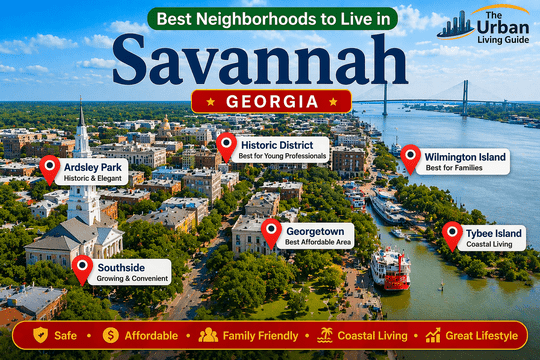
Best Neighborhoods in Savannah, Georgia: Historic Squares, Coastal Islands & Lowcountry Living in 2026
Covering approximately 108 square miles of land area along the tidal estuaries of the Savannah River in coastal Georgia, the City of Savannah operates under the council-manager municipal governance of the City of Savannah while serving as the historic county seat and economic engine of Chatham County. Housing a municipal population exceeding 147,000 residents and anchoring a broader coastal metropolitan footprint of over 410,000 people, Georgia’s oldest city is internationally celebrated for its preserved 18th-century Oglethorpe Plan of shaded public squares, moss-draped live oak canopies, and deepwater logistics driven by the Port of Savannah (Georgia Ports Authority). Relocating across the Lowcountry requires evaluating coastal flood elevations, tidal marsh drainage, humid subtropical weather, and regional highway corridors overseen by the Georgia Department of Transportation.
Residential life across Greater Savannah presents distinct lifestyle environments, separating dense, pedestrian-friendly historic districts and design hubs from oak-lined mid-century neighborhoods, barrier island coastal communities, and accessible mainland suburban enclaves. Inbound movers consistently balance direct daily access to primary regional employment anchors—such as the Savannah Historic Downtown Commercial Core, corporate aerospace operations at Gulfstream Aerospace Corporation, logistics complexes near Garden City Terminal, healthcare networks at Memorial Health University Medical Center, and creative campuses at the Savannah College of Art and Design (SCAD)—against daily commute distances. Selecting the right neighborhood defines your daily route across major transportation arteries including Interstate 16, Interstate 95, Harry S. Truman Parkway, US Route 80 (Islands Expressway), Veterans Parkway, and Abercorn Street (SR 204).
Watch this video to explore different neighborhoods, coastal corridors, and residential communities across Savannah:
Best Areas to Live in Savannah at a Glance in 2026
| Neighborhood Name | Location | Distance from Core (Historic District) | Development Status | Transit Connectivity | Cost Level | Best Fit For |
|---|---|---|---|---|---|---|
| Historic District | Central Riverfront Core | 0 miles (Urban Core) | Preserved National Historic Landmark District | Exceptional (CAT Shuttle, Ferries, Walkable Grids) | High-to-Premium | Young Professionals, SCAD Students & Remote Workers |
| Ardsley Park | Midtown Core | Approximately 2.5 miles south | Historic Early 20th-Century Residential | High (Bull St, Abercorn St, Truman Pkwy) | High-to-Premium | Established Families, Physicians & Long-Term Homeowners |
| Wilmington Island | East Coastal Islands | Approximately 9 miles east | Established Coastal Suburban Island | Moderate (US-80, Islands Expressway) | Mid-to-High Range | Families, Boaters & Maritime Enthusiasts |
| Georgetown | Southwest Metro | Approximately 12 miles southwest | Established Master-Planned Suburban | Moderate (Veterans Pkwy, SR-204, I-95) | Mid-Range / Accessible | Budget-Conscious Buyers, Commuters & Military Staff |
| Southside Savannah | South Central Urban Basin | Approximately 8 miles south | Commercial Core & Modern Residential Infill | High (CAT Bus Routes, Abercorn St, Truman Pkwy) | Accessible / Mid-Range | Renters, Healthcare Workers & Newcomers |
| Tybee Island | Atlantic Barrier Island (Incorporated City) | Approximately 18 miles east | Established Coastal Resort Community | Moderate (US-80 / Ocean Highway) | High-to-Premium | Beach Lovers, Retirees & Remote Professionals |
Best Neighborhoods in Savannah Discussed in Detail
Historic District — Iconic Oglethorpe Squares, Architectural Heritage & Walkable Charm
Stretching from the cobblestone bluffs of River Street south to the shaded lawns of Forsyth Park, the Historic District is the cultural and architectural centerpiece of Savannah. As one of the largest National Historic Landmark Districts in the United States, it is celebrated for its 22 surviving 18th-century garden squares, preserved brick townhomes, and live oak canopies draped in Spanish moss. Operating with historical preservation oversight from the Savannah Historic District Board of Review, the district delivers a vibrant, car-optional lifestyle filled with independent cafes, museums, and artistic energy driven by SCAD.
- Housing: Inventory features 18th- and 19th-century Federal, Georgian, and Greek Revival brick row houses, restored carriage houses, and modern loft conversions. Single-family purchase prices typically range around $680,000 to $2,800,000+, while 1-bedroom apartments and historic flats average $1,850 to $3,200 per month.
- Safety & Crime Rate: Patrolled by the Savannah Police Department (SPD) Downtown Precinct and augmented by mounted patrols and tourism safety officers. Pedestrian corridors along Bull Street and Broughton Street are safe and well-lit, though tourist-heavy areas experience occasional opportunistic larceny and vehicle break-ins.
- School District & Education Quality: Governed by the Savannah-Chatham County Public School System (SCCPSS), containing magnet programs like Savannah Arts Academy and Garrison School for the Arts, alongside the global campus of SCAD.
- Walkability & Daily Conveniences: Outstanding pedestrian infrastructure (Walk Score of 90-94/100). Residents walk to boutique shopping on Broughton Street, artisan bakeries, dining along Bay Street, and grocers including Kroger on Gwinnett Street and local specialty markets.
- Parks & Green Spaces / Pet-Friendliness: Exceptional urban greenspaces centered around the 30-acre Forsyth Park (featuring the iconic Forsyth Fountain, concert bandstands, tennis courts, and a weekly farmers market) and the 22 historic squares. Extremely dog-friendly with shaded paths and water stations throughout.
- Parking & Traffic Congestion: Street parking is strictly metered with residential permit zones enforced; off-street garage spaces are limited. Congestion slows along Bay Street and MLK Jr. Boulevard during peak tourist seasons and freight hours.
- Noise Levels & Vibe: Vibrant, historic, and energetic, filled with horse-drawn carriage tours, outdoor sidewalk dining chatter, and lively weekend evening crowds.
- Medical Facilities & Hospitals: Direct 5-to-8 minute medical access to Memorial Health University Medical Center and St. Joseph’s/Candler (Candler Hospital Campus) on Reynolds Street.
- Transit Connectivity: Served by the free DOT Express Shuttle, the Savannah Belles Ferry crossing the Savannah River to Hutchinson Island, and Chatham Area Transit bus routes, with rapid highway access to Interstate 16 and Interstate 95. Long-distance air travel is accessible via Savannah/Hilton Head International Airport (SAV) located 10 miles northwest.
- Affordability: High-to-premium urban pricing; elevated real estate valuations and historic preservation guidelines are balanced by high rental demand and walkability.
- Who It’s Best For: Young professionals, remote creative workers, SCAD faculty and students, and buyers seeking classic Lowcountry architecture.
- Drawbacks: Heavy seasonal tourist foot traffic, scarce residential off-street parking, and strict historical preservation building codes.
Ardsley Park — Tree-Canopied Residential Grids, 1920s Architecture & Community Stability
Situated in midtown Savannah between Victory Drive and Derenne Avenue, Ardsley Park (often paired with Chatham Crescent) is one of Savannah’s most prestigious and architecturally cohesive 20th-century residential suburbs. Designed in 1910 as a master-planned neighborhood featuring landscaped circles, wide grassy medians, and mature oak canopies, the district operates under City of Savannah municipal administration. Ardsley Park offers a tranquil suburban atmosphere with convenient central access to hospitals, schools, and downtown.
- Housing: Real estate stock features classic 1920s Craftsman bungalows, Colonial Revival homes, Spanish Mediterranean villas, and Tudor residences. Single-family purchase prices typically range around $520,000 to $1,450,000+, while residential rentals and carriage flats average $1,950 to $3,100 per month.
- Safety & Crime Rate: Patrolled by the SPD Central Precinct. Ardsley Park maintains low violent crime rates and strong residential stability, supported by active neighborhood associations and high resident vigilance.
- School District & Education Quality: Governed by SCCPSS, zoned to dependable public options including Charles Ellis Montessori Academy and Jacob G. Smith Elementary, alongside nearby private academies like Blessed Sacrament School and Calvary Day School.
- Walkability & Daily Conveniences: Highly walkable neighborhood streetscapes connecting to commercial centers along Habersham Street (Habersham Village) and Paulsen Street, featuring local bakeries, pharmacies, neighborhood pizzerias, and specialty grocers.
- Parks & Green Spaces / Pet-Friendliness: Exceptional access to the 80-acre Daffin Park (featuring walking trails, athletic stadiums, tennis courts, a dog park, and Historic Grayson Stadium, home of the Savannah Bananas), alongside small landscaped neighborhood pocket parks. Exceptionally pet-friendly.
- Parking & Traffic Congestion: Plentiful private residential driveways, detached carriage garages, and open curbside street parking. Traffic flows smoothly, with minor slowdowns along Derenne Avenue (SR 21) and Victory Drive during rush hours.
- Noise Levels & Vibe: Serene, refined, and family-oriented, characterized by birdsong, tree-shaded sidewalks, and evening neighborhood strolls.
- Medical Facilities & Hospitals: Direct 3-minute access to comprehensive acute care at Memorial Health University Medical Center and Candler Hospital.
- Transit Connectivity: Excellent roadway positioning between Harry S. Truman Parkway, Abercorn Street, and Bull Street, offering a 6-minute drive to Downtown Savannah and 15 minutes to coastal waterways.
- Affordability: High-tier residential pricing; strong property appreciation and stable historic appeal maintain solid long-term equity.
- Who It’s Best For: Medical professionals working at Memorial or Candler, growing families prioritizing outdoor recreation, and long-term homeowners.
- Drawbacks: Higher entry purchase prices, aging plumbing and electrical systems in historic builds, and property insurance considerations.
Wilmington Island — Coastal Estuaries, Boating Lifestyle & Family-Centric Island Living
Positioned east of downtown Savannah along the Wilmington River and tidal salt marshes, Wilmington Island is an established barrier island community offering relaxed coastal living. Governed under Chatham County administration, the island combines deepwater access to the Atlantic Intracoastal Waterway with established residential subdivisions like Olde Towne and Wilmington Park, providing a quiet island lifestyle with easy access to both downtown and the beach.
- Housing: Real estate spans single-story 1970s–1990s brick ranch homes, custom deepwater marshfront estates with private boat docks, and modern townhomes. Single-family purchase prices typically range around $440,000 to $1,350,000+, while rental homes and apartments average $1,800 to $2,750 per month.
- Safety & Crime Rate: Patrolled by the Chatham County Police Department (CCPD), Wilmington Island consistently reports low violent and property crime rates, supported by self-contained island geography and active neighborhood watch groups.
- School District & Education Quality: Governed by SCCPSS, hosting highly regarded coastal public schools including May Howard Elementary School and Islands High School (renowned for its scientific research and logistics magnet programs).
- Walkability & Daily Conveniences: While residential subdivisions are automobile-dependent, commercial shopping centers along Johnny Mercer Boulevard host Publix, Kroger, local seafood markets, hardware stores, and family diners.
- Parks & Green Spaces / Pet-Friendliness: Outstanding coastal recreation featuring the championship fairways of Savannah Golf Club at Wilmington Island, community docks, boat marinas, and nearby public recreation at Skidaway Island State Park. Exceptionally pet-friendly.
- Parking & Traffic Congestion: Plentiful private two-car garages, boat trailer parking pads, and wide driveways. Commuter traffic builds along the Islands Expressway and US-80 during weekday morning rush hours.
- Noise Levels & Vibe: Relaxed, nautical, and family-centered, characterized by river breezes, golf cart paths, and peaceful evenings.
- Medical Facilities & Hospitals: Direct 12-minute drive via the Islands Expressway to Memorial Health University Medical Center and local urgent care clinics.
- Transit Connectivity: Road travel via the Islands Expressway and US Route 80 connects within 12 minutes to Downtown Savannah and 10 minutes east to Tybee Island beaches.
- Affordability: Mid-to-high suburban coastal tier; delivers larger lot sizes, water access, and top-tier public school assignments relative to mainland urban cores.
- Who It’s Best For: Boating and fishing enthusiasts, families seeking top island schools, healthcare professionals, and retirees.
- Drawbacks: Commute bottlenecks across island bridges during peak hours, automobile reliance for daily errands, and mandatory flood insurance requirements on low-elevation marsh lots.
Georgetown — Master-Planned Suburbia, Practical Affordability & Highway Access
Situated in southwestern Chatham County along the Little Ogeechee River basin, Georgetown is an established master-planned suburban community. Governed under Chatham County administration, the area is subdivided into distinct residential villages like King’s Grant and Hunter’s Green. Centered along King George Boulevard, Georgetown offers practical modern suburban living with rapid access to major military and logistics employment hubs.
- Housing: Real estate consists of 1980s–2000s two-story traditional single-family homes, single-story ranch houses, swim/tennis subdivision properties, and garden-style apartments. Single-family purchase prices typically range around $280,000 to $460,000, while modern rental apartments average $1,450 to $2,100 per month.
- Safety & Crime Rate: Patrolled by the CCPD West Precinct, Georgetown maintains low violent crime rates, supported by established homeowners associations and responsive county emergency services.
- School District & Education Quality: Governed by SCCPSS, containing public options such as Georgetown K-8 School and New Hampstead High School.
- Walkability & Daily Conveniences: The commercial center at Georgetown Shopping Center on King George Boulevard hosts Food Lion, pharmacies, casual family restaurants, and local services.
- Parks & Green Spaces / Pet-Friendliness: Exceptional community amenities managed by the Georgetown Community Services Association, including neighborhood swimming pools, tennis courts, clubhouses, and walking trails along the Little Ogeechee River. Highly pet-friendly.
- Parking & Traffic Congestion: Generous two-car garages and private driveways. Commuter traffic slows along Georgia State Route 204 (Abercorn Street) during morning and evening rush hours.
- Noise Levels & Vibe: Quiet, orderly, and family-centered, characterized by shaded subdivision loops, children playing outdoors, and calm evenings.
- Medical Facilities & Hospitals: Direct 8-minute access to comprehensive emergency care at St. Joseph’s Hospital on Mercy Boulevard.
- Transit Connectivity: Unmatched highway connectivity via Veterans Parkway, Interstate 95 (Exit 94), and SR-204, offering a 15-minute commute to Downtown Savannah and 10 minutes to Hunter Army Airfield.
- Affordability: Greater Savannah’s most accessible single-family homeownership tier, delivering strong square footage and community amenities per dollar.
- Who It’s Best For: First-time homebuyers, budget-conscious families, military personnel stationed at Hunter AAF or Fort Stewart, and logistics commuters.
- Drawbacks: Substantial 12-to-15-mile commute to the historic downtown core, automobile reliance for daily shopping, and peak-hour traffic along SR-204.
Southside Savannah — Commercial Retail Epicenter, Healthcare Hub & Rental Options
Covering an expansive geographic basin south of Derenne Avenue along the Abercorn Street corridor, Southside Savannah is the primary retail, commercial, and healthcare engine of modern Savannah. Anchored by major retail shopping plazas, the campus of Georgia Southern University (Armstrong Campus), and regional hospital centers, Southside offers diverse housing, gated condominium communities, and garden-style apartment complexes.
- Housing: Real estate inventory consists of established 1960s–1980s single-family ranch homes in subdivisions like Windsor Forest and Coffee Bluff, modern townhomes, and multi-family rental communities. Single-family purchase prices typically range around $260,000 to $450,000, while rental apartments average $1,350 to $1,950 per month.
- Safety & Crime Rate: Patrolled by the SPD Southside Precinct. Master-planned residential tracts and gated complexes maintain safe environments, while commercial retail corridors along Abercorn Street experience typical property and retail-related incidents.
- School District & Education Quality: Governed by SCCPSS, containing institutions like Windsor Forest High School and Hesse K-8 School, alongside higher-education opportunities at Georgia Southern University Armstrong Campus.
- Walkability & Daily Conveniences: While residential subdivisions require vehicles, commercial corridors along Abercorn Street host Target, Publix, The Home Depot, Oglethorpe Mall, and diverse multicultural dining.
- Parks & Green Spaces / Pet-Friendliness: Municipal recreation is anchored by Lake Mayer Community Park (featuring a 1.5-mile paved jogging loop, lighted tennis courts, freshwater fishing, and dog-friendly lawns) and coastal access at the historic Coffee Bluff Marina. Highly pet-friendly.
- Parking & Traffic Congestion: Plentiful residential driveway and commercial plaza parking. Heavy commercial traffic builds along Abercorn Street (SR 204) and Hodgson Memorial Drive during business rush hours.
- Noise Levels & Vibe: Active, convenient, and commercial, shifting from busy daytime retail avenues to quiet residential subdivisions.
- Medical Facilities & Hospitals: Direct medical infrastructure anchored within the district by St. Joseph’s Hospital on Mercy Boulevard and nearby specialized clinics.
- Transit Connectivity: High-frequency public transit provided by Chatham Area Transit (CAT Routes 14 and 28), with rapid highway access to Harry S. Truman Parkway, Veterans Parkway, and I-95.
- Affordability: Accessible mid-range price tier; delivers modern retail convenience, competitive apartment rental rates, and lower initial purchase requirements.
- Who It’s Best For: Renters, healthcare workers, university students and faculty, military families, and newcomers seeking central retail convenience.
- Drawbacks: Heavy daytime commercial traffic along Abercorn Street, personal vehicle dependence, and fewer historic architectural features.
Tybee Island — Atlantic Coastal Living, Barrier Island Beaches & Laid-Back Community
Situated 18 miles east of Downtown Savannah at the mouth of the Savannah River, the incorporated municipality of Tybee Island is Georgia’s premier public barrier island community. Operating under its own independent municipal government via the City of Tybee Island Official Portal, the island offers 3 miles of Atlantic oceanfront beaches, salt marsh tidal creeks, seafood dining, and a relaxed coastal lifestyle centered along Butler Avenue and 1st Street (US-80).
- Housing: Real estate stock features classic raised wood-frame beach cottages, modern oceanfront multi-story custom homes, and beachside condominiums. Single-family purchase prices typically range around $590,000 to $2,400,000+, while long-term residential leases average $2,200 to $4,200 per month.
- Safety & Crime Rate: Protected by the dedicated Tybee Island Police Department (TIPD). Residential streets maintain a safe, tight-knit environment, while the beachfront commercial pier area experiences elevated crowds during peak summer weekends.
- School District & Education Quality: Governed by SCCPSS, with island students attending May Howard Elementary and Islands High School on nearby Wilmington Island, alongside the local Tybee Island Maritime Academy (public charter school).
- Walkability & Daily Conveniences: Outstanding walkability and golf cart mobility across the island. Residents easily walk or bike to the Tybee Beach Pier and Pavilion, local seafood shacks, art galleries, and the historic Tybee Island Light Station.
- Parks & Green Spaces / Pet-Friendliness: Exceptional coastal recreation anchored by North Beach, South Beach, Back River Beach (famed for sunset views and dolphin watching), Memorial Park, and Jaycee Park. Dog access is restricted on public beach sands to protect coastal wildlife, but residential paths and parks are pet-friendly.
- Parking & Traffic Congestion: Residential driveways and raised stilt carports are standard. Commuter traffic builds along the two-lane causeway of US Route 80 during summer holiday weekends and during extreme seasonal King Tides.
- Noise Levels & Vibe: Laid-back, nautical, and casual, characterized by ocean surf, bicycle bells, golf carts, and lively outdoor patio dining.
- Medical Facilities & Hospitals: Supported by local island emergency medical services, with comprehensive acute care located 20 minutes away at Memorial Health in Savannah.
- Transit Connectivity: Road travel relies exclusively on US Route 80 (Tybee Road), connecting within 20 to 25 minutes to Downtown Savannah and Truman Parkway.
- Affordability: High-tier coastal price structure; property acquisitions, windstorm coverage, and coastal flood insurance premiums are offset by direct oceanfront living and vacation rental potential.
- Who It’s Best For: Beach lovers, retirees, remote professionals, avid anglers, and buyers seeking an authentic coastal island lifestyle.
- Drawbacks: Vulnerability to tropical storm surges and tidal flooding along US-80, limited grocery retail on the island, and tourist crowding in summer.
Comprehensive Neighborhood Pros and Cons Comparison
| Neighborhood | Core Advantages (Pros) | Core Limitations (Cons) |
|---|---|---|
| Historic District | Exceptional walkability; 22 historic garden squares; 30-acre Forsyth Park; free DOT Express Shuttle; vibrant cultural arts and dining. | Higher purchase and rental costs; scarce off-street parking; peak-season tourist foot traffic; strict historical renovation codes. |
| Ardsley Park | Preserved 1920s architecture; mature live oak canopies; direct access to 80-acre Daffin Park; 3-minute commute to Memorial Health. | High single-family acquisition prices; aging home infrastructure requiring maintenance; limited multi-family inventory. |
| Wilmington Island | Deepwater boat docks and marina access; top-rated Islands High zoning; peaceful island community; 10 minutes to Tybee beaches. | Commuter slowdowns on the Islands Expressway; automobile reliance for errands; mandatory coastal flood insurance. |
| Georgetown | Greater Savannah’s most affordable single-family homes; master-planned amenities (pools, tennis); fast access to I-95 and Hunter AAF. | 12-to-15-mile commute to Downtown Savannah; car-dependent suburban layout; peak-hour traffic bottlenecks along SR-204. |
| Southside Savannah | Dense commercial shopping on Abercorn Street; proximity to St. Joseph’s Hospital and Georgia Southern; Lake Mayer Park. | Heavy commercial thoroughfare traffic; car dependence outside commercial nodes; fewer historic architectural features. |
| Tybee Island | Direct 3-mile Atlantic beach access; walkable golf-cart lifestyle; vibrant seafood dining; active coastal outdoor recreation. | Vulnerability to King Tide flooding on US-80; elevated coastal wind and flood insurance; summer tourist traffic. |
How You Decide Which Neighborhood Is Best For You
Selecting your ideal neighborhood in Greater Savannah requires balancing your gross household finances with daily workplace destinations, family schooling preferences, and coastal flood zone resilience. Because Savannah is characterized by tidal rivers, salt marsh estuaries, and barrier island bridges, your chosen location dictates whether your daily commute relies on express parkways like Harry S. Truman Parkway and Veterans Parkway, surface arterials like Abercorn Street, or causeway crossings along US-80. Aerospace engineers at Gulfstream, healthcare professionals at Memorial Health or Candler, port logistics specialists near Garden City, and SCAD faculty should prioritize living within their respective quadrant to minimize cross-county travel delays.
Beyond transportation corridors, evaluate essential municipal utility and environmental realities. Coastal Georgia experiences warm, humid summer weather with high air conditioning demand, making electric reliability through Georgia Power and municipal water services an important factor. Furthermore, prospective homebuyers evaluating properties on Wilmington Island, Tybee Island, or marshfront basins must evaluate FEMA flood zone classifications (Flood Zone X vs. AE/VE), elevation certificates, and coastal windstorm insurance premiums. Prior to executing a residential lease or property closing, verify high-speed fiber broadband availability (such as AT&T Fiber or Xfinity Gigabit) and check Chatham County school assignment boundaries.
Frequently Asked Questions About Savannah Neighborhoods
Which neighborhood in Savannah is considered best for families with school-age children?
Wilmington Island and Ardsley Park are widely regarded as the premier family communities in Greater Savannah. Wilmington Island offers access to top-rated public schools like May Howard Elementary and Islands High School alongside safe, marshfront suburban streets. Ardsley Park provides a historic community setting near Daffin Park with access to Charles Ellis Montessori and prestigious private preparatory academies.
What is the most walkable neighborhood in Savannah where you can live without a car?
The Historic District is the most walkable neighborhood in Savannah, boasting a Walk Score above 90. Residents can complete daily errands on foot, walk to restaurants, cafes, and museums, access the green lawns of Forsyth Park, and utilize the free DOT Express Shuttle and Savannah Belles Ferry for transit.
What are the safest residential neighborhoods to live in within Greater Savannah?
Wilmington Island, Ardsley Park, and Tybee Island consistently report the lowest violent crime rates in Chatham County. Wilmington Island and Tybee Island benefit from self-contained island geography and dedicated community policing, while Ardsley Park maintains active neighborhood watch associations.
What are the most affordable neighborhoods for homebuyers and renters in Savannah?
Georgetown and Southside Savannah provide the most budget-friendly housing opportunities in the area. In Georgetown, buyers can find master-planned single-family homes with community amenities at accessible price points, while Southside offers competitive rental rates and starter homes near major retail centers.
How bad is traffic congestion when commuting across Savannah?
Traffic congestion in Savannah is generally manageable compared to larger metros, with peak slowdowns concentrating along Abercorn Street (SR 204), Derenne Avenue, and the Islands Expressway during morning and evening rush hours. Commuters heading to Tybee Island experience seasonal delays along US-80 on summer weekends.
Do all Savannah neighborhoods require flood insurance?
No, flood insurance requirements depend on FEMA flood zone designations and mortgage lender mandates. High-elevation inland neighborhoods like Ardsley Park and portions of Southside are largely located in Flood Zone X (non-mandatory zones), whereas low-elevation barrier island properties on Tybee Island and marshfront parcels on Wilmington Island reside in Zone AE/VE, requiring mandatory flood insurance coverage.
Which Savannah neighborhood is best for healthcare professionals working at Memorial Health or Candler?
Ardsley Park and Southside Savannah provide the fastest and most convenient commutes to Memorial Health University Medical Center and Candler Hospital, allowing physicians, nurses, and medical staff to reach hospital campuses within a 3-to-8 minute drive.
Know More About the City
The Urban Living Guide creates deeply researched, practical, and informative city relocation resources designed to help individuals, working professionals, and families navigate complex urban landscapes. By analyzing municipal infrastructure, hyper-local zoning patterns, commuter realities, and housing markets, our guides provide actionable insights so you can make confident, data-backed decisions when moving to major metropolitan areas.
Explore our comprehensive guides to the Savannah and Lowcountry region:
- Living in Savannah, Georgia
- Cost of Living in Savannah, Georgia
- Pros and Cons of Living in Savannah, Georgia
- Moving to Savannah, Georgia
Follow The Urban Living Guide for ongoing regional insights, neighborhood developments, and expert local coverage across Greater Savannah and the state of Georgia.