

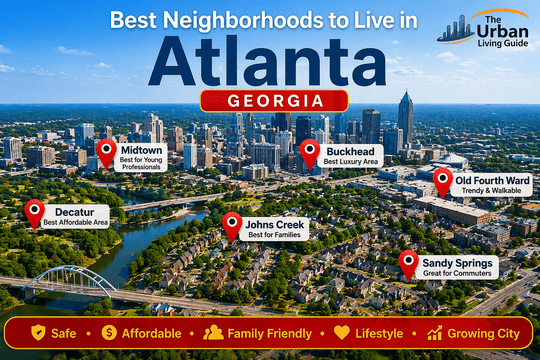
Best Neighborhoods in Atlanta, Georgia: BeltLine Corridors, Midtown High-Rises & Historic Enclaves in 2026
Covering approximately 136 square miles of land area across the rolling Appalachian foothills of the Piedmont plateau in Northwest Georgia, the City of Atlanta operates under the mayor-council municipal administration of the City of Atlanta while serving as the primary county seat and economic engine of Fulton County and partially extending into DeKalb County. Housing an incorporated municipal core population exceeding 510,000 residents and anchoring a massive Metro Atlanta footprint of over 6.3 million people, “The City in a Forest” has solidified its standing as the undisputed commercial, technological, media, healthcare, and air logistics capital of the American Southeast.
Relocating across the Atlanta metropolitan area requires evaluating localized tree canopy topography, historic neighborhood zoning overlays, humid subtropical seasonal shifts, and extensive regional transportation networks managed by the Georgia Department of Transportation.
Residential living in Greater Atlanta presents dynamic lifestyle contrasts, separating dense high-rise arts and innovation corridors from historic Victorian parkside boroughs, culturally rich adaptive-reuse BeltLine districts, and premier master-planned suburban corporate centers. Inbound movers consistently balance direct daily access to major regional corporate headquarters—such as the Midtown Technology Square Innovation Corridor, the Downtown Financial & Legal Center, the Buckhead Financial Hub, healthcare networks at the Emory University / CDC Corridor, and aviation operations anchored by Hartsfield-Jackson Atlanta International Airport (ATL)—against daily highway and surface transit commute corridors.
Selecting the right neighborhood defines your daily commute along primary transportation corridors including Interstate 75, Interstate 85 (The Downtown Connector), Interstate 285 (The Perimeter), Georgia State Route 400 (GA-400), Interstate 20, and the expanding multi-use trails of the Atlanta BeltLine, while shaping your family’s access to municipal services, public greenways, and regional school systems.
Watch this video to explore different neighborhoods, suburban corridors, and residential communities across Atlanta:
Best Areas to Live in Atlanta at a Glance in 2026
| Neighborhood Name | Location | Distance from Core (Downtown) | Development Status | Transit Connectivity | Cost Level | Best Fit For |
|---|---|---|---|---|---|---|
| Midtown | Central Urban Core | Approximately 1.5 miles north | High-Density Arts & Tech Core | Exceptional (MARTA Rail, I-75/85, Bike Grids) | High-to-Premium | Young Professionals, Tech Workers & Academics |
| Buckhead | North Urban Sub-Center | Approximately 6.5 miles north | High-Density Luxury Commercial & Estate Subdivisions | High (MARTA Rail, GA-400, Peachtree Rd) | Ultra-Premium | Corporate Executives, Wealth Managers & Luxury Buyers |
| Decatur | East Metro (Independent City) | Approximately 6 miles east | Historic Walkable Master-Planned | High (MARTA Blue Line, Ponce de Leon Ave) | Mid-to-High Range | Families, Educators, Healthcare Staff & Creatives |
| Johns Creek | Northeast Outer Suburbs (Fulton County) | Approximately 26 miles northeast | Established Master-Planned Suburban | Moderate (Automobile-centric, GA-141, GA-120) | High-to-Premium | Suburban Families & Long-Term Homeowners |
| Old Fourth Ward | Eastside BeltLine Corridor | Approximately 1.8 miles east | Historic Adaptive-Reuse & Modern Infill | High (BeltLine Eastside Trail, Streetcar, Freedom Pkwy) | Mid-to-High Range | Renters, Creatives, Tech Founders & Food Enthusiasts |
| Sandy Springs | North Perimeter (Independent City) | Approximately 14 miles north | Established Suburban & Perimeter Center | High (MARTA Red Line, GA-400, I-285) | Mid-to-High Range | Fortune 500 Employees, Medical Professionals & Families |
Best Neighborhoods in Atlanta Discussed in Detail
Midtown — High-Density Arts Nexus, Technology Square & Urban Walkability
Positioned immediately north of Downtown Atlanta between North Avenue and the Buford Spring Connector, Midtown functions as the cultural, artistic, and technological powerhouse of the Southeast. Operating under the urban management and planning framework of the Midtown Alliance within the City of Atlanta, the district concentrates world-class cultural institutions, corporate tech campuses, and dense vertical residential towers along Peachtree Street and West Peachtree Street. Framed by the 185-acre expanse of Piedmont Park to the east and the prestigious research grounds of the Georgia Institute of Technology (Georgia Tech) to the west, Midtown provides true 24/7 walkable urban living.
- Housing: Architectural inventory is dominated by modern glass luxury high-rise condominium towers (such as 1010 Midtown, Viewpoint, and Spire), converted historic brick lofts, and contemporary podium mid-rise apartment communities. Condominium purchase valuations typically range around $320,000 to $1,450,000+, while modern 1-bedroom apartment rentals average $1,950 to $3,200 per month.
- Safety & Crime Rate: Patrolled by the Atlanta Police Department (APD) Zone 5 Command and supplemented by the dedicated, visible Midtown Public Safety Corps and Clean Team patrols. Pedestrian corridors along Peachtree Street maintain strong security, though opportunistic property larceny and vehicle break-ins occur in commercial parking decks.
- School District & Education Quality: Governed by Atlanta Public Schools (APS), with students zoned to Midtown High School (celebrated for top AP participation and college placement) and David T. Howard Middle School, alongside higher-education anchors at Georgia Tech and the John Marshall Law School.
- Walkability & Daily Conveniences: Outstanding pedestrian infrastructure (Walk Score of 88-92/100). Residents comfortably walk to major grocery markets including Whole Foods Market on 14th Street, Trader Joe’s at Midtown Promenade, and Publix at The Plaza Midtown, as well as Broadway performances at the historic Fox Theatre and exhibitions at the High Museum of Art.
- Parks & Green Spaces / Pet-Friendliness: Exceptional urban green spaces anchored by Piedmont Park (featuring public swimming pools, active sports fields, and access to the Atlanta Botanical Garden), the Piedmont Dog Park, and direct connectivity to the Atlanta BeltLine Eastside Trail. Highly pet-friendly with off-leash zones and dog-welcoming dining patios.
- Parking & Traffic Congestion: Assigned garage parking spaces typically add $125 to $250 per month for apartment tenants. Surface street traffic slows significantly along 10th Street, 14th Street, and Spring Street during morning and evening rush hours, particularly near Interstate 75/85 (Downtown Connector) on-ramps.
- Noise Levels & Vibe: Energetic, cosmopolitan, and fast-paced, filled with tech entrepreneurs, university students, outdoor dining patrons, and weekend festival crowds at Piedmont Park.
- Medical Facilities & Hospitals: Direct emergency medical coverage provided within the district by Emory University Hospital Midtown on Peachtree Street.
- Transit Connectivity: Unmatched public transit access supported by three major MARTA Rail Stations (North Avenue, Midtown, and Arts Center) along the Red and Gold Lines, offering direct 20-minute train rides south to Hartsfield-Jackson Atlanta International Airport, with rapid vehicular access to I-75/I-85.
- Affordability: High-to-premium urban pricing tier; elevated rents and square-footage purchase prices are balanced by lower vehicle dependency and premier access to Fortune 500 employers (Google, Microsoft, NCR).
- Who It’s Best For: Young professionals, software engineers, corporate attorneys, Georgia Tech researchers, and urbanites seeking a car-optional lifestyle surrounded by arts and green space.
- Drawbacks: High rental and parking overhead, peak-hour traffic bottlenecks at expressway access points, and noise near major event venues.
Buckhead — Luxury Financial Capital, Historic Mansions & High-End Retail
Situated in northern Atlanta, Buckhead is globally renowned as the luxury retail, private banking, and prestigious estate capital of the American South. Known historically as the “Beverly Hills of the East,” the district operates under City of Atlanta governance with targeted infrastructure advocacy led by Livable Buckhead. Buckhead presents a stark architectural contrast, blending dense corporate financial skyscrapers and high-rise condominiums along Peachtree Road with quiet, heavily wooded multi-million dollar residential estates tucked into deep forest canopies in subdivisions like Tuxedo Park and Peachtree Heights.
- Housing: Real estate stock spans ultra-luxury high-rise condominium towers (such as The Sovereign, The Waldorf Astoria Residences, and The Charles), sprawling classic Southern brick colonial and Greek Revival estates on multi-acre parcels, and modern executive townhomes. Single-family home valuations typically range around $950,000 to $15,000,000+, while luxury condominium purchases average $450,000 to $3,200,000 and apartment rentals average $2,200 to $4,500 per month.
- Safety & Crime Rate: Patrolled by the APD Zone 2 Command. Buckhead maintains active private neighborhood security patrols in its single-family residential neighborhoods, keeping violent crime low, while commercial retail and entertainment corridors experience property incidents and vehicle larcenies in commercial valet zones.
- School District & Education Quality: Governed by APS, featuring highly rated public campuses such as Sarah Smith Elementary School, Sutton Middle School, and North Atlanta High School (housed on a state-of-the-art corporate-style campus), alongside the nation’s premier private preparatory academies including The Westminster Schools, Pace Academy, and The Lovett School.
- Walkability & Daily Conveniences: The commercial core surrounding Peachtree and Lenox Roads is highly walkable, home to high-end designer shopping at Lenox Square, Phipps Plaza (featuring Nobu Hotel and Citizens Market), and the luxury outdoor retail district at Buckhead Village District.
- Parks & Green Spaces / Pet-Friendliness: Natural outdoor recreation includes the 268-acre Chastain Park (Atlanta’s largest city park, featuring an 18-hole public golf course, equestrian center, tennis complex, and the Cadence Bank Amphitheatre), Sunny Brook Park, and the PATH400 Greenway Trail. Highly pet-friendly with shaded neighborhood running paths.
- Parking & Traffic Congestion: Wide private multi-car garages, motor courts, and extensive commercial valet infrastructure. Heavy vehicular traffic gridlock builds along Peachtree Road (SR 141), Piedmont Road (SR 237), and Lenox Road during rush hours and holiday shopping seasons.
- Noise Levels & Vibe: Upscale, sophisticated, and polished, shifting from vibrant corporate and fine-dining activity in the commercial core to serene, private forest tranquility in estate neighborhoods.
- Medical Facilities & Hospitals: Direct emergency medical coverage provided within the district by Piedmont Atlanta Hospital on Peachtree Road, recognized for premier cardiovascular and surgical care.
- Transit Connectivity: Major rail access anchored by two MARTA Rail Stations (Buckhead Station on the Red Line and Lenox Station on the Gold Line), with direct expressway access to GA-400, I-85, and Interstate 285.
- Affordability: Ultra-premium price profile; represents one of the most expensive housing, dining, and property tax submarkets in the state of Georgia.
- Who It’s Best For: High-net-worth families, corporate CEOs, private equity directors, fashion and luxury lifestyle enthusiasts, and buyers seeking premier private school access.
- Drawbacks: High cost of living, heavy pass-through commuter traffic on Peachtree and Piedmont Roads, and high automobile dependence in estate subdivisions outside the commercial core.
Decatur — Independent Municipal Charm, Academic Culture & Premier Public Schools
Situated immediately east of the Atlanta city limits in central DeKalb County, the incorporated municipality of Decatur offers an authentic, community-centric, and historic small-town environment with direct rapid transit connectivity into the urban core. Operating under its own independent municipal charter via the City of Decatur Official Portal, Decatur is centered around the historic Decatur Square. Renowned for its locally owned bookshops, award-winning craft gastropubs, preserved 1920s Craftsman bungalows, and an independently administered school district, Decatur consistently ranks among the most livable communities in the South.
- Housing: Real estate is composed of restored 1920s Craftsman bungalows, historic Queen Anne Victorian homes in the MAK Historic District, modern high-performance infill single-family residences, and boutique condominiums near the square. Single-family purchase prices typically range around $580,000 to $1,450,000+, while rental apartments and townhomes average $1,750 to $2,850 per month.
- Safety & Crime Rate: Protected by the dedicated Decatur Police Department, the city consistently records violent crime rates well below the regional average, supported by dedicated municipal officers and high neighborhood community engagement.
- School District & Education Quality: Governed by its own independent, nationally recognized public school system, City Schools of Decatur (CSD), featuring top-ranked institutions such as Decatur High School, Beacon Hill Middle School, and Clairemont Elementary, alongside higher-education campuses at Agnes Scott College and nearby Emory University.
- Walkability & Daily Conveniences: Outstanding walkability (Walk Score of 86-90/100 around the square). Residents walk to indie coffee shops, artisan bakeries, celebrated restaurants along Ponce de Leon Avenue, and the weekly open-air Decatur Farmers Market.
- Parks & Green Spaces / Pet-Friendliness: Exceptional community parks including Glenlake Park (featuring municipal swimming pools, dog parks, and lighted tennis courts), Oakhurst Park, Adair Park, and the scenic trails winding through Dearborn Park. Extremely pet-friendly with dog bowls outside nearly every downtown storefront.
- Parking & Traffic Congestion: Plentiful private residential driveways, curbside street parking, and municipal parking decks surrounding the square. Morning traffic builds along West Ponce de Leon Avenue, Scott Boulevard (US-78), and Clairmont Road heading toward Emory University.
- Noise Levels & Vibe: Grounded, progressive, and family-oriented, characterized by shaded residential sidewalks, front porch socializing, and relaxed evening dining on the square.
- Medical Facilities & Hospitals: Direct 5-to-8 minute medical access to Emory University Hospital, Children’s Healthcare of Atlanta (CHOA), and Emory Decatur Hospital on North Decatur Road.
- Transit Connectivity: Direct public transit integration centered at the Decatur MARTA Rail Station (located directly underneath Decatur Square on the Blue Line), offering a 12-minute train commute west into Downtown Atlanta, supported by surface vehicle links to I-285 and US-78.
- Affordability: Mid-to-high cost structure; higher municipal property tax rates (which fund the independent school system) are offset by exceptional municipal service responsiveness and high property appreciation.
- Who It’s Best For: Families prioritizing independent public education, university faculty and researchers at Emory and CDC, medical practitioners, and buyers seeking a walkable, close-knit community.
- Drawbacks: Higher municipal property taxes compared to surrounding unincorporated DeKalb County, competitive starter home inventory, and limited late-night commercial nightlife.
Johns Creek — Top-Ranked Public Schools, Master-Planned Security & Suburban Tranquility
Positioned along the scenic banks of the Chattahoochee River in northeastern Fulton County, the incorporated municipality of Johns Creek is widely celebrated as one of the safest, most affluent, and family-friendly suburban communities in the United States. Operating under its own municipal administration via the City of Johns Creek Official Website, the city was master-planned from premier residential golf club communities and corporate business parks centered along the Medlock Bridge Road (GA-141) and State Bridge Road (GA-120) corridors.
- Housing: Real estate consists almost entirely of spacious two-story brick and stone executive single-family residences in gated golf and country club subdivisions (such as Country Club of the South, St Ives Country Club, and Rivermont), alongside modern luxury townhomes. Single-family purchase prices typically range around $590,000 to $3,200,000+, while modern rental homes and apartments average $1,950 to $3,100 per month.
- Safety & Crime Rate: Protected by the dedicated Johns Creek Police Department (JCPD), the city consistently ranks among the top 5 safest cities in Georgia and the United States, reporting exceptionally low violent and property crime rates.
- School District & Education Quality: Governed by the Fulton County School System, containing some of the highest-rated public high schools in the nation, including Northview High School, Chattahoochee High School, and Johns Creek High School, alongside top-performing feeder middle and elementary schools.
- Walkability & Daily Conveniences: Suburban residential subdivisions are automobile-dependent, but commercial retail power centers at Johns Creek Town Center, Saddle Brook Shopping Center, and Medlock Bridge host Whole Foods Market, Trader Joe’s, H Mart, and diverse multicultural dining.
- Parks & Green Spaces / Pet-Friendliness: Exceptional outdoor recreation anchored by Newtown Park (featuring youth athletic complexes, amphitheaters, and the nationally acclaimed Newtown Dream Dog Park), Autrey Mill Nature Preserve & Heritage Center (featuring 46 acres of forest trails and animal exhibits), and public access points to the Chattahoochee River National Recreation Area.
- Parking & Traffic Congestion: Plentiful private two-to-three car garages, large suburban driveways, and expansive commercial parking plazas. Heavy commuter traffic builds along GA-141 (Medlock Bridge Road) and Abbotts Bridge Road during peak morning rush hours heading toward GA-400.
- Noise Levels & Vibe: Extremely serene, safe, and family-centered, characterized by quiet cul-de-sacs, birdsong, weekend youth soccer tournaments, and tranquil evenings.
- Medical Facilities & Hospitals: Direct emergency medical coverage provided within city borders by Emory Johns Creek Hospital on McGinnis Ferry Road.
- Transit Connectivity: Road-centric travel via GA-141, GA-120, Peachtree Parkway, and GA-400, with express commuter bus options connecting to the North Springs MARTA Rail Station.
- Affordability: High-to-premium suburban pricing; delivers substantially larger home square footage, private multi-car garages, and extensive community amenities (tennis courts, pools) per dollar compared to inner-loop Atlanta neighborhoods.
- Who It’s Best For: Families prioritizing elite public schools and community safety, healthcare executives, tech professionals working in Alpharetta/North Fulton, and golf enthusiasts.
- Drawbacks: Substantial 26-to-32-mile highway commute into Downtown Atlanta during rush hours, total automobile dependence for daily errands, and lack of historic urban walkability.
Old Fourth Ward (O4W) — BeltLine Energy, Historic Heritage & Adaptive Reuse
Covering a dynamic urban basin immediately east of Downtown Atlanta, the Old Fourth Ward (O4W) is the historic and cultural heart of the city’s modern revitalization. Famous as the birthplace of Dr. Martin Luther King Jr. and home to the Martin Luther King, Jr. National Historical Park, O4W has transformed into a national model for transit-oriented urban infill. Guided by City of Atlanta planning and the non-profit Atlanta BeltLine project, the neighborhood is centered along the multi-use BeltLine Eastside Trail and the massive adaptive reuse complex at Ponce City Market.
- Housing: Real estate stock features contemporary multi-story loft developments (such as Ponce City Market Flats and Studioplex Lofts), restored 1920s historic single-family wood-frame bungalows, and sleek modern townhome infill developments. Single-family purchase prices typically range around $490,000 to $1,150,000, while modern apartment rentals average $1,800 to $2,950 per month.
- Safety & Crime Rate: Patrolled by the APD Zone 6 Command. While the central BeltLine corridor and Ponce City Market maintain active private security and high pedestrian safety, opportunistic vehicular break-ins and property crimes occur in open surface parking lots and peripheral streets.
- School District & Education Quality: Governed by APS, containing neighborhood options such as Hope-Hill Elementary School, David T. Howard Middle School, and Midtown High School.
- Walkability & Daily Conveniences: Outstanding pedestrian and cycling walkability (Walk Score of 86-91/100). Residents walk along the BeltLine to food halls, rooftop lounges, independent boutiques, and major retail at Ponce City Market, alongside grocers like Kroger at 725 Ponce and Whole Foods Market nearby.
- Parks & Green Spaces / Pet-Friendliness: Exceptional urban greenspace anchored by the 17-acre Historic Fourth Ward Park (featuring a scenic storm-water detention lake, splash pads, outdoor amphitheater, and the Historic Fourth Ward Skatepark), Central Park, and the Freedom Park Trail. Extremely pet-friendly with thousands of residents walking dogs daily on the BeltLine.
- Parking & Traffic Congestion: Assigned garage parking is typical in multi-family buildings, while street parking is competitive near BeltLine access points. Roadway traffic slows along Ponce de Leon Avenue, North Highland Avenue, and Boulevard NE on weekends and during evening commutes.
- Noise Levels & Vibe: Vibrant, creative, and energetic, characterized by scooter riders, live outdoor acoustic music, bustling dining patios, and active weekend markets.
- Medical Facilities & Hospitals: Direct 5-minute access to Emory University Hospital Midtown and comprehensive care at Grady Memorial Hospital downtown.
- Transit Connectivity: Unmatched pedestrian and micro-mobility transit via the Atlanta BeltLine Eastside Trail, with street transit provided by MARTA Bus Routes (Route 2 and Route 102), Atlanta Streetcar links, and direct vehicle access to Freedom Parkway, I-75/I-85, and I-20.
- Affordability: Mid-to-high urban price profile; competitive pricing on modern rental units and condos relative to Midtown, offset by rising property values across the Eastside corridor.
- Who It’s Best For: Tech workers, creatives, marketing professionals, remote workers, culinary enthusiasts, and anyone seeking a car-optional lifestyle centered around Atlanta’s most active trail network.
- Drawbacks: High weekend visitor foot traffic and congestion along the BeltLine, limited street parking for guests, and ongoing localized construction.
Sandy Springs — Perimeter Business Epicenter, Riverfront Parks & Suburban Connectivity
Situated immediately north of Atlanta along the northern arc of the Interstate 285 Perimeter, the incorporated municipality of Sandy Springs is Georgia’s seventh-largest city. Operating under its own municipal governance via the City of Sandy Springs Official Portal, the city balances the dense Fortune 500 corporate headquarters of the Perimeter Center (home to companies like UPS and Mercedes-Benz USA) with serene, heavily wooded single-family residential neighborhoods stretching westward to the Chattahoochee River.
- Housing: Real estate spans established 1970s–1990s brick executive single-family homes in wooded subdivisions (such as Riverside, Huntcliff, and Mount Vernon), custom luxury riverfront estates, modern mixed-use townhomes near City Springs, and contemporary mid-rise apartments. Single-family purchase prices typically range around $550,000 to $2,800,000+, while rental apartments average $1,650 to $2,750 per month.
- Safety & Crime Rate: Protected by the dedicated Sandy Springs Police Department (SSPD), the city maintains low violent crime rates, supported by proactive community policing, modern municipal traffic monitoring, and rapid emergency response units.
- School District & Education Quality: Governed by the Fulton County School System, containing strong public campuses such as Riverwood International Charter School (renowned for its International Baccalaureate and Dual Enrollment programs), North Springs High School, Sandy Springs Middle School, and Heards Ferry Elementary, alongside premier private academies like Holy Innocents’ Episcopal School and Mount Vernon School.
- Walkability & Daily Conveniences: The newly developed municipal core at City Springs is pedestrian-friendly, featuring outdoor civic greens, the Sandy Springs Performing Arts Center, artisan restaurants, and retail. Daily grocery shopping is supported by Whole Foods Market, Trader Joe’s, Publix, and Costco.
- Parks & Green Spaces / Pet-Friendliness: World-class natural recreation featuring over 16 miles of parkland along the Chattahoochee River National Recreation Area (Island Ford and East Palisades units), Morgan Falls Overlook Park (featuring paddleboard rentals, fishing docks, and dog parks), Abernathy Greenway, and Heritage Sandy Springs.
- Parking & Traffic Congestion: Generous two-to-three car garages, large suburban driveways, and expansive shopping center parking garages. Major highway bottlenecks concentrate daily at the intersection of Interstate 285 and GA-400 (The Perimeter Interchange) during peak rush hours.
- Noise Levels & Vibe: Balanced, professional, and family-oriented, shifting from corporate daytime activity in Perimeter Center to peaceful, bird-filled forest serenity in residential river neighborhoods.
- Medical Facilities & Hospitals: Direct medical infrastructure supported by the renowned “Pill Hill” medical healthcare cluster, home to three major acute-care hospital campuses: Northside Hospital Atlanta (nationally recognized for maternity and surgical care), Emory Saint Joseph’s Hospital, and Children’s Healthcare of Atlanta at Scottish Rite.
- Transit Connectivity: Unmatched northern transit connectivity served by four MARTA Rail Stations (Medical Center, Dunwoody, Sandy Springs, and North Springs) on the Red Line, offering direct rail transit to Downtown and the airport, alongside vehicle access to GA-400, I-285, and Roswell Road (SR 9).
- Affordability: Mid-to-high cost tier; delivers a strong balance of substantial square footage, mature tree lots, and top-tier healthcare access without the full premium of Buckhead estate pricing.
- Who It’s Best For: Corporate executives working in Perimeter Center, healthcare professionals and physicians at Pill Hill, families seeking strong public charter and private schools, and outdoor river enthusiasts.
- Drawbacks: Heavy commuter highway traffic along I-285 and GA-400, automobile dependence outside the City Springs and Perimeter transit cores, and elevated single-family housing prices.
Comprehensive Neighborhood Pros and Cons Comparison
| Neighborhood | Core Advantages (Pros) | Core Limitations (Cons) |
|---|---|---|
| Midtown | High walkability to Piedmont Park and Whole Foods; 3 MARTA rail stations; tech innovation hub near Georgia Tech; rich cultural arts venues. | Higher rent and condominium purchase prices; monthly parking garage fees; rush-hour congestion on 10th and 14th Streets. |
| Buckhead | World-class shopping at Lenox Square and Phipps Plaza; top private schools (Westminster, Pace); 268-acre Chastain Park; low residential crime. | Ultra-premium real estate valuations; heavy commuter traffic along Peachtree and Piedmont Roads; car dependence in estate subdivisions. |
| Decatur | Independent City Schools of Decatur (CSD) system; highly walkable Decatur Square; direct MARTA Blue Line station; proximity to Emory University. | Higher municipal property tax rates; competitive single-family home inventory; quieter nightlife compared to Midtown. |
| Johns Creek | Nationally top-ranked public high schools (Northview, Chattahoochee); ranked among safest cities in America; spacious gated country club homes; Newtown Park. | Substantial 26-mile commute to Downtown Atlanta; total automobile dependence; lack of historic walkable urban streetscapes. |
| Old Fourth Ward | Direct pedestrian access to the Atlanta BeltLine Eastside Trail; dynamic dining and retail at Ponce City Market; 17-acre Historic Fourth Ward Park. | Elevated visitor foot traffic and trail crowding on weekends; competitive street parking; property larceny in commercial lots. |
| Sandy Springs | Major healthcare cluster at Pill Hill (Northside, St. Joseph’s); 4 MARTA Red Line rail stations; 16 miles of Chattahoochee River trails; City Springs civic center. | Heavy peak-hour highway congestion at the I-285 / GA-400 Interchange; car reliance outside transit hubs; elevated housing costs. |
How You Decide Which Neighborhood Is Best For You
Selecting your ideal neighborhood in Greater Atlanta requires balancing your gross household finances with daily workplace destinations, family schooling preferences, and regional transit realities. Because the Atlanta metropolitan area is geographically defined by the Interstate 285 Perimeter loop—dividing the region into “ITP” (Inside the Perimeter) and “OTP” (Outside the Perimeter)—your chosen location dictates whether your daily commute relies on direct rail transit via the MARTA Red, Gold, and Blue Lines, pedestrian trails along the Atlanta BeltLine, or vehicle travel on major expressway corridors like I-75, I-85, and GA-400.
Tech workers in Midtown’s Technology Square, corporate bankers in Buckhead, healthcare researchers at Emory, and healthcare staff at Pill Hill in Sandy Springs should prioritize living within their specific employment quadrant to eliminate cross-metro traffic delays.
Beyond transportation corridors, evaluate essential municipal utility and environmental realities. Georgia experiences warm, humid summer weather patterns with high air conditioning demand, making utility reliability through Georgia Power and municipal water services an important factor. In addition, prospective homebuyers must evaluate municipal tax structures—noting that independent municipalities like the City of Decatur and City of Atlanta have distinct property tax millage rates and independent school systems compared to Fulton or DeKalb County at large. Prior to executing a residential lease or property closing, verify high-speed fiber broadband availability (such as AT&T Fiber or Google Fiber) and check local school assignment boundaries.
Frequently Asked Questions About Atlanta Neighborhoods
Which neighborhood in the Atlanta area is considered best for families with school-age children?
Decatur and Johns Creek are widely regarded as the premier family communities in Greater Atlanta. Decatur offers an exceptional, independent public school district through City Schools of Decatur (including Decatur High School) paired with a safe, walkable downtown square. Johns Creek provides access to some of the highest-ranked public high schools in the United States (Northview, Chattahoochee, and Johns Creek High) alongside master-planned security and spacious single-family homes.
What is the most walkable neighborhood in Atlanta where you can live without a car?
Midtown and Old Fourth Ward offer the highest walkability in Atlanta, both boasting Walk Scores near 90. Midtown allows residents to complete daily errands on foot, walk to grocery markets like Whole Foods and Trader Joe’s, access Piedmont Park, and utilize three MARTA Rail stations. Old Fourth Ward offers unmatched pedestrian and cycling connectivity along the Atlanta BeltLine Eastside Trail directly into Ponce City Market and surrounding dining districts.
What are the safest residential neighborhoods to live in within Greater Atlanta?
Johns Creek and Buckhead’s residential estate enclaves consistently report the lowest violent crime rates in the metropolitan region. Johns Creek is regularly ranked among the top safest cities in the nation, protected by its dedicated municipal police force, while Buckhead’s residential neighborhoods benefit from active private security patrols and low pass-through traffic.
What are the most affordable neighborhoods for homebuyers and renters near central Atlanta?
While Decatur and Old Fourth Ward offer balanced mid-range housing options, surrounding eastside and westside pockets like West End, East Lake, and select suburban areas outside the perimeter provide accessible starter home prices and rental rates compared to premium enclaves like Buckhead and Midtown.
How bad is traffic congestion when commuting across Atlanta?
Atlanta experiences heavy traffic congestion during morning and evening rush hours, particularly along the Downtown Connector (I-75/85), the top-end Perimeter (I-285), and GA-400. Utilizing MARTA rail transit or selecting a home along the Atlanta BeltLine provides a reliable alternative to bypass major highway delays.
What is the difference between living ITP (Inside the Perimeter) versus OTP (Outside the Perimeter)?
ITP refers to neighborhoods located inside Interstate 285 (like Midtown, Buckhead, Decatur, and Old Fourth Ward), characterized by higher density, historic housing, walkable amenities, and shorter commutes to central business districts. OTP refers to communities outside I-285 (like Johns Creek and outer Sandy Springs), offering larger lot sizes, newer suburban master-planned developments, and top-tier public school clusters.
Which Atlanta neighborhood is best for healthcare professionals working at Pill Hill or Emory?
Sandy Springs provides immediate 5-minute access to the Pill Hill medical complex (Northside Hospital, Emory Saint Joseph’s, and Scottish Rite), while Decatur and Midtown offer the fastest and most convenient commutes to Emory University Hospital, CHOA, and Emory University Hospital Midtown.
Know More About the City
The Urban Living Guide creates deeply researched, practical, and informative city relocation resources designed to help individuals, working professionals, and families navigate complex urban landscapes. By analyzing municipal infrastructure, hyper-local zoning patterns, commuter realities, and housing markets, our guides provide actionable insights so you can make confident, data-backed decisions when moving to major metropolitan areas.
Explore our comprehensive guides to the Atlanta metropolitan region:
- Living in Atlanta, Georgia
- Cost of Living in Atlanta, Georgia
- Pros and Cons of Living in Atlanta, Georgia
- Moving to Atlanta, Georgia
Follow The Urban Living Guide for ongoing regional insights, neighborhood developments, and expert local coverage across Greater Atlanta and the state of Georgia.