

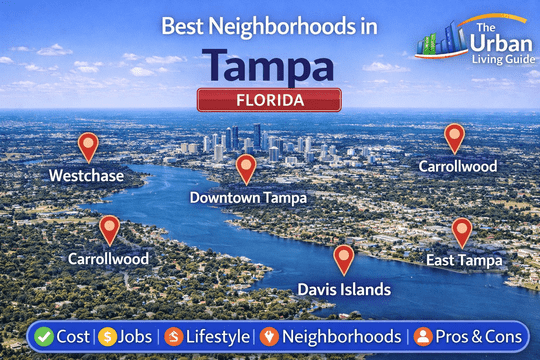
Best Neighborhoods in Tampa, Florida: Bayfront Enclaves, Water Street Towers & Suburban Pockets in 2026
Spanning approximately 114 square miles of land area along the natural harbors of Hillsborough Bay and Old Tampa Bay, the City of Tampa operates under the mayor-council municipal administration of the City of Tampa while serving as the economic capital and county seat of Hillsborough County. Housing a municipal core population exceeding 403,000 residents and anchoring a broader four-county Tampa Bay metropolitan footprint of over 3.25 million people, this dynamic waterfront city has transformed into a premier national hub for financial technology, healthcare systems, defense technology, and maritime shipping. Relocating across the Suncoast requires understanding localized coastal flood zones, seasonal subtropical storm tracks, high humidity corridors, and multi-layered highway networks managed by the Florida Department of Transportation.
Residential life across Greater Tampa presents pronounced contrasts, separating high-density urban waterfront skyscraper districts and barrier island enclaves from established tree-canopied suburban tracts and culturally rich historic districts. Inbound movers consistently balance direct daily access to primary corporate employment engines—such as the Downtown Tampa Central Business District, the Westshore Business District (Florida’s largest commercial office market), the USF Health / Moffitt Cancer Center research corridor, and defense commands at MacDill Air Force Base—against peak-hour causeway commute times.
Selecting the right neighborhood defines your daily route across major transportation corridors, including Interstate 275 (Howard Frankland Bridge corridor), Interstate 4, Selmon Expressway (State Road 618), Veterans Expressway (State Road 589), and the Courtney Campbell Causeway (State Road 60), while shaping your family’s access to municipal services, waterfront trail networks, and public school systems.
Watch this video to explore different neighborhoods, coastal corridors, and residential communities across Tampa:
Best Areas to Live in Tampa at a Glance in 2026
| Neighborhood Name | Location | Distance from Core (Downtown) | Development Status | Transit Connectivity | Cost Level | Best Fit For |
|---|---|---|---|---|---|---|
| Westchase | Northwest Hillsborough County | Approximately 14 miles northwest | Master-Planned Neo-Traditional Suburban | Moderate (HART Commuter Buses, SR-589, Linebaugh Ave) | Mid-to-High Range | Growing Families & Corporate Professionals |
| Downtown Tampa (Water Street & Riverwalk) | Central Waterfront Core | 0 miles (Urban Center) | High-Density Mixed-Use Urban Core | Exceptional (TECO Line Streetcar, Selmon Expressway, I-275) | High-to-Premium | Young Professionals, Tech Workers & Urbanites |
| Davis Islands | South Central Bay Islands | Approximately 1.5 miles south | Historic Mediterranean Coastal Enclave | Moderate (Bicycle grids, Davis Blvd Bridge) | Ultra-Premium | High-Net-Worth Executives, Physicians & Boaters |
| Carrollwood (Original & North) | North Central Suburbs | Approximately 9 miles north | Established Mid-Century Suburban | High (Dale Mabry Hwy, SR-589, I-275) | Mid-Range | Suburban Families & Commuters |
| East Tampa | East Central Urban Basin | Approximately 4 miles east | Historic Developing Infill / Urban Core Edge | High (HART Bus Network, I-4, I-275, US-41) | Accessible / Budget-Friendly | First-Time Homebuyers, Renters & Investors |
Best Neighborhoods in Tampa Discussed in Detail
Westchase — Neo-Traditional Master-Planned Haven & Walkable Town Centers
Situated in the northwestern quadrant of Hillsborough County bordering Pinellas County, Westchase is an award-winning, 3,000-acre master-planned community founded on neo-traditional town planning principles. Operating under the county governance of the Hillsborough County Board of County Commissioners, the area is subdivided into distinct residential villages such as The Bridges, The Fords, Woodbay, and West Park Village. Defined by brick-paved sidewalks, manicured street medians, historic-style streetlamps, and two bustling town commercial plazas, Westchase provides a structured suburban lifestyle with rapid transit connections to both Tampa and the Gulf beaches.
- Housing: Architectural inventory spans single-family traditional Florida ranch and Craftsman homes on tree-lined lots, modern two-story residences with front porches, gated golf villas, and luxury townhomes in West Park Village. Single-family purchase prices typically range around $480,000 to $980,000+, while modern apartment and townhome rentals average $1,850 to $2,950 per month.
- Safety & Crime Rate: Patrolled by the Hillsborough County Sheriff’s Office (HCSO) District III Substation, Westchase consistently reports some of the lowest property and violent crime rates in the region, supported by proactive neighborhood watch groups and neighborhood security patrols.
- School District & Education Quality: Governed by the highly regarded Hillsborough County Public Schools (HCPS), containing top-performing public campuses such as Westchase Elementary School, Davidsen Middle School, and Alonso High School (featuring an authorized International Baccalaureate Programme).
- Walkability & Daily Conveniences: The central pedestrian core of West Park Village along Montague Street is exceptionally walkable, featuring sidewalk cafes, artisan bakeries, indie pizzerias, and local service shops, while major commercial plazas along Linebaugh Avenue host Sprouts Farmers Market, Publix, and boutique fitness gyms.
- Parks & Green Spaces / Pet-Friendliness: Exceptional community amenities managed by the Westchase Community Association, including two Olympic-sized swimming pools, 10 lighted tennis courts, nature boardwalks, and direct access to Baybridge Park and the Upper Tampa Bay Trail (a 16-mile paved cycling corridor). Highly pet-friendly with dedicated off-leash zones.
- Parking & Traffic Congestion: Plentiful private two-car garages, rear alley driveways, and open town center parking. Commuter traffic builds along Linebaugh Avenue and the on-ramps to the Veterans Expressway (SR-589) heading south toward Westshore during peak morning drive times.
- Noise Levels & Vibe: Peaceful, orderly, and family-oriented, characterized by quiet neighborhood streets, active morning joggers, and tranquil evening cul-de-sacs.
- Medical Facilities & Hospitals: Direct emergency medical coverage supported by AdventHealth Westchase ER on Sheldon Road and St. Joseph’s Hospital-North located 12 minutes north.
- Transit Connectivity: Roadway connectivity via the Veterans Expressway (SR-589), Linebaugh Avenue, and Hillsborough Avenue (SR 580), offering 15-minute drives to Westshore and 20 minutes to Downtown Tampa. Regional bus transit is operated by the Hillsborough Area Regional Transit Authority (HART).
- Affordability: Mid-to-high suburban pricing; competitive price-per-square-foot ratios relative to South Tampa are balanced by homeowners association (HOA) and Community Development District (CDD) assessments.
- Who It’s Best For: Growing families prioritizing exemplary public schools, corporate professionals working in Westshore or Downtown, and buyers seeking a walkable suburban neighborhood layout.
- Drawbacks: Substantial 14-to-18-mile daily highway commute into central Tampa, recurring CDD fees on annual property tax bills, and mandatory toll expenses for express highway commuting.
Downtown Tampa — Urban Waterfront Renaissance, Water Street & Cultural Core
Positioned along the mouth of the Hillsborough River where it meets Hillsborough Bay, Downtown Tampa is the central business, legal, financial, and cultural engine of the metropolitan region. Transformed by the multi-billion-dollar Water Street Tampa development (the world’s first WELL-certified community), downtown combines sleek glass skyscraper living with the historic 2.6-mile pedestrian Tampa Riverwalk. Operating under city master plans and civic enhancements managed by the Tampa Downtown Partnership, the district offers vibrant, walkable urban living.
- Housing: Dominated by luxury glass high-rise condominium towers (such as The Residences at the Tampa EDITION and Skypoint), converted loft developments in the Channel District, and contemporary mixed-use podium apartments. Condominium purchase valuations typically range around $350,000 to $2,500,000+, while modern 1-bedroom apartment rentals average $2,100 to $3,650 per month.
- Safety & Crime Rate: Patrolled by the Tampa Police Department (TPD) District 1 and supported by the yellow-shirted Downtown Clean & Safe Guides. The Riverwalk and Water Street corridors maintain clean, safe foot traffic, though late-night property incidents occur near commercial bars and transit stations.
- School District & Education Quality: Governed by HCPS, containing choice options like Tampa Bay Boulevard Elementary and Blake High School (Magnet School for the Arts), alongside higher-education footprints anchored by the University of Tampa (UT) across the river and the USF Health Morsani College of Medicine in Water Street.
- Walkability & Daily Conveniences: Outstanding walkability (Walk Score of 88-92/100). Residents comfortably walk to grocery markets including Publix Super Market at Channel Club and GreenWise Market, Broadway shows at the Straz Center for the Performing Arts, and NHL games at Amalie Arena (home of the Tampa Bay Lightning).
- Parks & Green Spaces / Pet-Friendliness: Exceptional waterfront parklands along the Tampa Riverwalk, including the 5-acre Curtis Hixon Waterfront Park, Water Works Park, and Julian B. Lane Riverfront Park (featuring boat ramps, splash pads, and dog runs). Highly pet-friendly with indoor residential dog lounges.
- Parking & Traffic Congestion: Assigned garage parking spaces typically add $150 to $275 per month for apartment residents. Street parking is strictly metered, with traffic building along Channelside Drive, Ashley Drive, and I-275 during arena events and peak business hours.
- Noise Levels & Vibe: Vibrant, fast-paced, and cosmopolitan, filled with riverboat taxi bells, outdoor dining chatter, arena event crowds, and active weekend festival energy.
- Medical Facilities & Hospitals: Direct 5-minute access to the region’s premier Level I Trauma Center and academic teaching facility at Tampa General Hospital (TGH) on Davis Islands.
- Transit Connectivity: Unrivaled central public transit hub: free direct rail transit via the TECO Line Streetcar System connecting Downtown, Water Street, and historic Ybor City, complemented by HART bus lines and rapid vehicle on-ramps to Interstate 275, I-4, and the Selmon Expressway. Long-distance air travel is accessible via Tampa International Airport (TPA) located just 6 miles west.
- Affordability: High-tier urban cost profile; premium rents and square-footage purchase prices reflect the neighborhood’s premier walkability, waterfront views, and luxury building amenities.
- Who It’s Best For: Corporate finance professionals, medical researchers, attorneys, tech entrepreneurs, university faculty, and urbanites seeking a luxury car-optional lifestyle on the water.
- Drawbacks: Elevated building HOA dues and parking fees, noise from arena concert nights, and construction traffic in expanding development districts.
Davis Islands — Historic Mediterranean Grandeur, Coastal Waterfront & Golf Cart Living
Situated immediately south of Downtown Tampa in the mouth of the Hillsborough River, Davis Islands is an affluent, historic archipelago community originally developed in the 1920s by visionary developer D.P. Davis. Built upon dredged bay islands, the neighborhood is celebrated for its historic Mediterranean Revival architecture, lush tropical landscaping, waterfront yacht basins, and unique golf cart culture. Operating under City of Tampa municipal oversight, Davis Islands provides an exclusive, self-contained coastal enclave with immediate proximity to the urban core.
- Housing: Real estate stock spans historic 1920s Mediterranean Revival homes, multi-million dollar open-bay deep-water estates along Davis Boulevard and Bahama Circle, mid-century waterfront ranch houses, and boutique luxury garden condominiums. Detached home valuations typically range around $950,000 to $12,000,000+, while luxury residential rentals average $2,400 to $6,500 per month.
- Safety & Crime Rate: Patrolled by the TPD District 1 Substation and supported by low traffic access via a single bridge entrance, Davis Islands boasts one of the lowest violent and property crime footprints in the City of Tampa.
- School District & Education Quality: Governed by HCPS, hosting highly rated neighborhood schools such as Gorrie Elementary School (Florida’s oldest operating elementary school, established in 1889), Wilson Middle School, and Plant High School (renowned for high academic achievements and athletic championships).
- Walkability & Daily Conveniences: The charming commercial village along East Davis Boulevard is exceptionally pedestrian-friendly, featuring local sidewalk cafes, independent coffee houses, upscale bistros, dog bakeries, and neighborhood pharmacies.
- Parks & Green Spaces / Pet-Friendliness: Outstanding recreational amenities anchored by Davis Islands Beach, Davis Islands Dog Beach & Dog Park, Roy Jenkins Pool, public tennis courts, the private Davis Island Yacht Club, and aviation facilities at Peter O. Knight Airport.
- Parking & Traffic Congestion: Wide private driveways and residential garages keep residential streets clear. Traffic bottlenecks occur along the single northern bridge entry on Davis Boulevard during peak morning hospital shift changes.
- Noise Levels & Vibe: Peaceful, coastal, and relaxed, characterized by gentle bay breezes, golf cart neighborhood transit, and quiet residential evenings.
- Medical Facilities & Hospitals: Direct medical infrastructure anchored directly on the northern tip of the island by the massive flagship campus of Tampa General Hospital (TGH).
- Transit Connectivity: Road-centric travel via Davis Boulevard directly into Downtown Tampa and the Selmon Expressway; public transit is supported by HART route connections across the main bridge.
- Affordability: Ultra-premium price structure across property acquisitions, ad valorem property taxes, and private coastal flood and windstorm insurance premiums.
- Who It’s Best For: High-net-worth families, physicians and surgeons at Tampa General Hospital, boating and sailing enthusiasts, and corporate leaders seeking privacy with waterfront views.
- Drawbacks: High home purchase entry barrier, mandatory coastal flood insurance requirements across all low-elevation properties, and bridge vulnerability during major tropical storm surges.
Carrollwood — Established Suburban Stability, Shaded Oak Canopies & Lake Living
Positioned in north-central Hillsborough County, Carrollwood (comprising the historic 1960s enclave of Original Carrollwood and the expansive master-planned areas of Carrollwood Village) is one of Tampa’s most established, green, and stable suburban communities. Governed under Hillsborough County administration, Carrollwood is characterized by mature tree-canopied streets, private freshwater lake access on Lake Carroll, championship golf facilities, and extensive commercial convenience along North Dale Mabry Highway.
- Housing: Real estate consists of classic 1960s–1980s single-story brick and stucco ranch-style single-family homes on spacious half-acre lots, lakeside properties with private docks, golf villas, and modern garden-style apartment communities. Single-family purchase prices typically range around $390,000 to $850,000, while apartment rentals average $1,650 to $2,600 per month.
- Safety & Crime Rate: Patrolled by the HCSO District I Command, Carrollwood consistently maintains below-average property and violent crime rates, supported by established homeowners associations and active community watch programs.
- School District & Education Quality: Governed by HCPS, featuring strong neighborhood public schools including Carrollwood Elementary School and Chamberlain High School, alongside premier private college preparatory academies like Carrollwood Day School (CDS) (an authorized International Baccalaureate World School).
- Walkability & Daily Conveniences: Suburban residential streets are automobile-dependent, but commercial power centers along Dale Mabry Highway and Ehrlich Road host Whole Foods Market, The Fresh Market, Publix, and extensive casual dining venues.
- Parks & Green Spaces / Pet-Friendliness: Exceptional family recreation, including the 50-acre Carrollwood Village Park (featuring splash pads, skate parks, outdoor amphitheaters, and dog parks), Original Carrollwood Park, private lake access at White Sands Beach on Lake Carroll, and championship golf at Carrollwood Country Club.
- Parking & Traffic Congestion: Generous two-car garages and spacious residential driveways. Commuter traffic slows along North Dale Mabry Highway (SR 597) and Himes Avenue during peak morning rush hours heading toward I-275 and Downtown.
- Noise Levels & Vibe: Serene, grounded, and family-oriented, characterized by birdsong, shaded residential streets, and quiet evenings.
- Medical Facilities & Hospitals: Direct emergency medical coverage provided within the district by St. Joseph’s Hospital-North and AdventHealth Carrollwood on North Dale Mabry Highway.
- Transit Connectivity: Major highway transit via Dale Mabry Highway, the Veterans Expressway (SR-589), and Interstate 275, providing a 15-to-20 minute commute to Downtown Tampa and Tampa International Airport.
- Affordability: Balanced mid-range pricing; delivers substantially larger lot sizes, private pools, and mature landscaping per dollar compared to South Tampa enclaves.
- Who It’s Best For: Growing families seeking established neighborhood stability, medical professionals working at North Tampa hospitals, and buyers desiring larger yards with lake recreation.
- Drawbacks: Heavy daytime commercial traffic on Dale Mabry Highway, personal vehicle reliance for daily shopping, and aging home systems requiring periodic renovation.
East Tampa — Historic Cultural Heritage, Urban Infill & Value-Conscious Living
Covering an expansive geographic basin east of Interstate 275 and stretching between Hillsborough Avenue and Martin Luther King Jr. Boulevard, East Tampa is one of the city’s most historically rich, culturally dynamic, and affordable residential districts. Comprising established neighborhoods such as Belmont Heights, College Hill, and Jackson Heights, East Tampa is undergoing historic economic revitalization and infrastructure modernization guided by the East Tampa Community Redevelopment Area (CRA) and the City of Tampa.
- Housing: Real estate inventory consists of classic 1940s–1960s single-story wood frame and concrete block starter homes on generous lot sizes, historic bungalows, and newly constructed modern infill single-family residences and townhomes. Single-family purchase prices typically range around $210,000 to $360,000, while rental apartments and homes average $1,250 to $1,850 per month.
- Safety & Crime Rate: Patrolled by the TPD District 3 Substation. While the community has historically experienced higher property crime rates near major commercial arterial strips, targeted municipal investments, increased street lighting, and community policing continue to enhance safety across residential blocks.
- School District & Education Quality: Governed by HCPS, containing neighborhood institutions such as Young Middle Magnet School (Creative Science Center), Ferrell Girls Preparatory Academy, and Middleton High School (celebrated for its premier STEM and engineering magnet academies).
- Walkability & Daily Conveniences: Moderate pedestrian walkability along commercial corridors on MLK Jr. Boulevard and 22nd Street, home to traditional soul food restaurants, international grocers, community churches, and neighborhood retail plazas.
- Parks & Green Spaces / Pet-Friendliness: Municipal open spaces include Fair Oaks Park, Cyrus Greene Park, and the 240-acre Hillsborough River State Park located a short drive northeast, alongside direct recreation at Giddens Park.
- Parking & Traffic Congestion: Plentiful private residential driveway and open street parking. Easy highway on-ramps provide quick access to Interstate 4, Interstate 275, and US Highway 41, bypassing western causeway gridlock.
- Noise Levels & Vibe: Community-centered, resilient, and undergoing transformation, shifting from bustling commercial daytime avenues to quiet residential evenings in established subdivisions.
- Medical Facilities & Hospitals: Direct emergency medical coverage provided nearby by St. Joseph’s Hospital on MLK Jr. Boulevard and Tampa General Hospital downtown.
- Transit Connectivity: High-frequency public transit provided by HART Bus Routes (including Route 6 and Route 9) and the Netpark Transfer Center, connecting directly to Downtown Tampa and university hubs, with rapid vehicle access to I-4 and I-275.
- Affordability: Greater Tampa’s most accessible entry-level homeownership and rental price tier, offering substantial residential lot acreage and lower initial purchase capital requirements.
- Who It’s Best For: First-time homebuyers, budget-conscious renters, real estate investors, and commuters seeking large residential lots within a 7-minute drive of Downtown Tampa and Ybor City.
- Drawbacks: Pockets of elevated property crime, variable public school test ratings across individual non-magnet campuses, and older housing inventory requiring modern structural renovation.
Comprehensive Neighborhood Pros and Cons Comparison
| Neighborhood | Core Advantages (Pros) | Core Limitations (Cons) |
|---|---|---|
| Westchase | Neo-traditional walkable town center at West Park Village; top-rated HCPS schools; low crime; direct access to the Upper Tampa Bay Trail. | 14-mile commute to Downtown Tampa; recurring CDD bond tax assessments; mandatory highway toll expenses on SR-589. |
| Downtown Tampa | Direct pedestrian access to the Tampa Riverwalk and Water Street; free TECO Line Streetcar; walkable dining, Publix, and Amalie Arena. | Elevated monthly building HOA and parking fees; arena event crowds and noise; higher purchase price per square foot. |
| Davis Islands | Prestigious waterfront enclave; top-ranked Plant High School zoning; golf cart culture; private airport and yacht club; lowest crime rates. | High capital entry barrier; mandatory coastal flood insurance premiums; traffic bottlenecks at the single island bridge entrance. |
| Carrollwood | Spacious single-family lots with mature oak trees; access to Lake Carroll; 50-acre Carrollwood Village Park; strong community stability. | Heavy commercial traffic congestion along Dale Mabry Highway; automobile dependence for daily errands; older housing infrastructure. |
| East Tampa | Tampa’s most accessible entry-level home and rental prices; large residential lot sizes; close proximity to Downtown and Ybor City. | Pockets of elevated property crime; variable public school performance ratings; older housing stock requiring renovation. |
How You Decide Which Neighborhood Is Best For You
Selecting your ideal neighborhood in Greater Tampa requires balancing your gross household finances with daily workplace destinations, family schooling preferences, and coastal flood zone resilience. Because the Tampa Bay region is geographically divided by expansive open waters and connected by major bridge causeways like the Howard Frankland Bridge (I-275) and Gandy Bridge, your chosen location dictates whether your daily commute involves heavy cross-bay traffic or smooth travel along tollways like the Selmon Expressway or Veterans Expressway. Healthcare workers at Tampa General Hospital, corporate executives in Westshore, and defense personnel at MacDill Air Force Base should prioritize living on the Tampa side of the bay to eliminate causeway delays.
Beyond transportation corridors, evaluate essential municipal utility and environmental realities. Central Florida experiences high summer electricity demands due to air conditioning usage during extended heat waves exceeding 90 degrees Fahrenheit, making municipal utility rates through Tampa Electric (TECO) and municipal water services an important factor. Furthermore, prospective homebuyers must evaluate FEMA flood zone classifications (such as Flood Zone X vs. AE/VE) and property insurance premiums, especially on low-lying coastal enclaves like Davis Islands. Prior to executing a residential lease or property closing, verify high-speed fiber broadband availability (such as Frontier Fiber or Spectrum Gigabit) and check Hillsborough County school assignment boundaries.
Frequently Asked Questions About Tampa Neighborhoods
Which neighborhood in the Tampa area is considered the best for families with school-age children?
Westchase and Davis Islands are widely regarded as the premier family communities in Greater Tampa. Westchase offers master-planned neighborhoods, neo-traditional town centers, and top-rated public schools like Westchase Elementary and Alonso High. Davis Islands provides access to top-performing public education zoned for Gorrie Elementary and Plant High School alongside peaceful golf cart island living.
What is the most walkable neighborhood in Tampa where you can live without a car?
Downtown Tampa (specifically Water Street Tampa and the Channel District) is the most walkable neighborhood in the region, boasting an 88+ Walk Score. Residents can complete daily errands on foot, walk to grocery markets like Publix and GreenWise Market, access restaurants and cultural venues along the Tampa Riverwalk, and utilize the free TECO Line Streetcar for transit to Ybor City.
What are the safest residential neighborhoods to live in within Tampa?
Davis Islands and Westchase consistently report the lowest violent and property crime rates in Hillsborough County. Davis Islands benefits from its isolated island geography with a single bridge entry and low pass-through traffic, while Westchase maintains active community watch programs and dedicated sheriff substation patrols.
What are the most affordable neighborhoods for homebuyers and renters in Tampa?
East Tampa and parts of North Tampa provide the most budget-friendly housing opportunities in the city. In East Tampa, buyers and renters can secure single-family starter homes on generous lot sizes and apartments at price points significantly lower than South Tampa or suburban master-planned developments.
How bad is traffic congestion when commuting across Tampa Bay causeways?
Commuting across the bay between Tampa and St. Petersburg/Clearwater along the Howard Frankland Bridge (I-275) or Courtney Campbell Causeway during peak morning and evening rush hours typically takes between 35 and 60 minutes. Living and working on the same side of the bay significantly reduces daily commute fatigue.
Do all Tampa neighborhoods require flood insurance?
No, flood insurance requirements depend on FEMA flood zone designations and mortgage lender mandates. High-elevation inland neighborhoods like Carrollwood and portions of Westchase are typically located in Flood Zone X (non-mandatory flood zones), whereas low-elevation waterfront enclaves like Davis Islands and coastal South Tampa reside in Zone AE/VE, requiring mandatory flood insurance coverage.
Which Tampa neighborhood is best for healthcare professionals working at Tampa General Hospital?
Davis Islands, Downtown Tampa, and Hyde Park provide the fastest and most convenient commutes to Tampa General Hospital, allowing healthcare workers and medical residents to reach the hospital campus within a 3-to-8 minute walk, bike ride, or drive.
Know More About the City
The Urban Living Guide creates deeply researched, practical, and informative city relocation resources designed to help individuals, working professionals, and families navigate complex urban landscapes. By analyzing municipal infrastructure, hyper-local zoning patterns, commuter realities, and housing markets, our guides provide actionable insights so you can make confident, data-backed decisions when moving to major metropolitan areas.
Explore our comprehensive guides to the Tampa Bay metropolitan region:
- Living in Tampa, Florida
- Cost of Living in Tampa, Florida
- Pros and Cons of Living in Tampa, Florida
- Moving to Tampa, Florida
Follow The Urban Living Guide for ongoing regional insights, neighborhood developments, and expert local coverage across Greater Tampa and Florida’s Suncoast.