

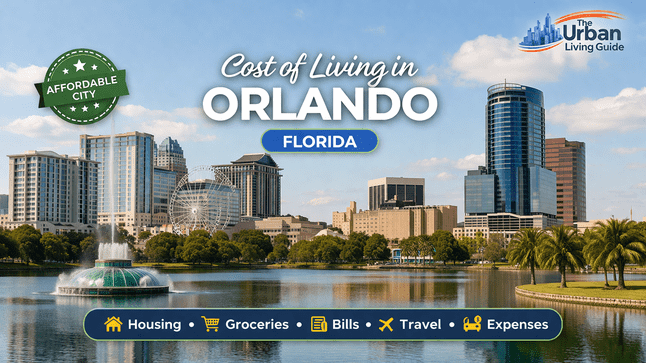
Cost of Living in Orlando, Florida 2026: Theme Park Capital Realities, Lake Nona Tech Growth & Central Florida Budgets
Thriving brightly across the sub-tropical flatwoods of Central Florida far beyond its world-famous entertainment corridors, the City of Orlando functions as a major economic powerhouse in biotechnology, aerospace engineering, and global hospitality. From the innovative medical hub of Lake Nona Medical City and corporate aviation tech clusters to the historic brick-lined streets of Winter Park and the vibrant residential enclaves of Thornton Park and Baldwin Park, this dynamic metropolitan center delivers diverse career tracks and robust lifestyle appeal. Driven by major regional entities like Orlando International Airport (MIA), Walt Disney World, and Universal Orlando Resort, the region supports a solid local median household income of approximately $64,128.
For aerospace engineers, medical specialists, remote workers, and growing families relocating into Orange County, residential valuations and daily operational expenses require careful budgeting. When analyzing the comprehensive cost of living in Orlando, Florida during 2026, you must factor in intense sub-tropical summer cooling electricity loads, heavy vehicular commuting demands across Interstate 4 (I-4), the East-West Expressway (SR 408), and Florida’s Turnpike, local property tax appraisal rates governed by the Orange County Property Appraiser, and everyday consumer pricing that positions Orlando roughly 2% to 4% below the national average overall.
Average Monthly Expense Breakdown – Orlando
Monthly expenses in Orlando fluctuate considerably based on neighborhood selection, proximity to downtown employment hubs, and household sizing across Orange County. Below is a structured monthly financial breakdown displayed in a clear comparative table format reflecting current economic conditions in 2026:
| Expense Category | Single Adult | Couple | Family of 4 |
|---|---|---|---|
| Housing / Rent | $1,300 – $1,850 | $1,750 – $2,600 | $2,600 – $3,900 |
| Groceries & Food | $300 – $480 | $580 – $850 | $1,050 – $1,550 |
| Transportation & Commute | $170 – $290 | $280 – $460 | $400 – $680 |
| Utilities & Internet | $150 – $260 | $220 – $360 | $320 – $520 |
| Healthcare & Insurance | $140 – $320 | $280 – $650 | $580 – $1,200 |
| Childcare & Education | $0 | $0 | $950 – $2,000+ |
| Entertainment & Leisure | $150 – $350 | $300 – $650 | $450 – $950 |
Local residents frequently highlight that while baseline grocery expenditures and average utility rates stay close to national medians, intense summer air conditioning demands and tourist-driven entertainment pricing require smart weekly budgeting.
Watch this video to get a closer look at housing and neighborhood pricing in Orlando.
Housing Costs, Real Estate & Society Maintenance in Orlando
Housing represents the single largest expenditure for households in Orlando, where overall real estate and rental valuations track roughly 5% to 8% higher than the national average due to rapid regional population inflows. Residential inventories and property values vary drastically based on urban core proximity, managed HOA communities, and zoning policies regulated by the City of Orlando Planning Division.
- Studio Apartments: Compact managed spaces and high-rise retrofits generally span $1,100–$1,550/month across central urban districts like Downtown Orlando and Parramore.
- 1-BHK Apartments: Standard multi-family rentals average $1,300–$1,850/month, scaling past $2,200/month in premium lifestyle corridors like Lake Nona, Thornton Park, and Winter Park.
- 2-BHK Apartments: Suited for roommates or growing households, ranging from $1,700–$2,500/month.
- Independent Homes & Properties: Detached single-family real estate across the metropolitan area commands a median purchase price near $374,302, accompanied by Orange County property tax appraisals and annual homeowner insurance obligations.
Grocery and Food Costs in Orlando
Food and grocery expenditures reflect Central Florida’s robust agricultural distribution network and intense regional supermarket competition, keeping daily consumer provisions roughly 1% to 4% above the national average. Weekly shopping provisions leverage a mix of major corporate supermarkets and specialty grocers.
- Supermarket Chains: Weekly shopping relies heavily on corporate mainstays like Publix Super Markets, Winn-Dixie, Trader Joe’s, and Whole Foods Market.
- Everyday Price Benchmarks: Whole milk averages $4.70–$4.85; fresh eggs run $4.40–$4.55; casual dining out at local bistros costs $15–$28; and mid-range restaurant dinners average $25–$50 per person.
Education and Childcare Expenses
Managing educational outlays involves navigating public, charter, and private institutions across the region, heavily influenced by programs managed through Orange County Public Schools (OCPS) alongside higher education hubs like the University of Central Florida (UCF) and Valencia College.
- Childcare & Preschool: Full-time licensed daycare facilities and infant care centers run $950–$1,850/month per child depending on neighborhood prestige.
- Private & Charter School Tuition: Specialized private elementary and high schools across Winter Park and Doctor Phillips average $10,000–$24,000+ annually per student.
- Higher Education Impact: In-state tuition at local public universities like UCF averages $6,300/year, making regional degree completion financially accessible for resident families.
Transportation and Commute Costs in Orlando
Navigating the dense traffic corridors of Central Florida requires understanding major highway systems and regional public transit managed by LYNX (Central Florida Regional Transportation Authority).
- Public Transit Networks: Local transit options include the LYNX bus network and the SunRail commuter train connecting downtown to northern and southern suburbs. Monthly transit passes run $50–$105.
- Fuel, Tolls & Vehicle Operation: Average monthly gasoline expenditures run $150–$260/month, while mandatory electronic toll payments (via E-Pass or SunPass on the East-West Expressway SR 408 and I-4 Express lanes) add $40–$120/month for daily commuters. Total car ownership and auto insurance expenses span $300–$600/month.
Utilities, Energy & Home Bills in Orlando
Managing home utility overhead requires preparing for intense sub-tropical humidity and continuous air conditioning operation spanning May through October, with primary electrical transmission provided by the Orlando Utilities Commission (OUC) within city limits or Duke Energy Florida across surrounding Orange County.
- Basic Home Utilities: Electricity, natural gas via TECO Peoples Gas, water, and waste collection average $150–$260/month for standard apartments, while detached single-family homes regularly experience summer electric bills reaching $280–$450/month.
- High-Speed Fiber Internet: Unlimited broadband connections via AT&T Fiber or Spectrum average $50–$80/month.
Healthcare & Medical Insurance Costs in Orlando
Healthcare outlays track slightly below national norms due to competitive regional care facilities, supported by world-class medical networks including Orlando Health, AdventHealth Orlando, and the Orlando VA Medical Center in Lake Nona.
- Doctor Consultations: Standard general practitioner primary care visits without insurance range from $85–$145.
- Specialist Visits & Copays: Specialist medical consultations and private health insurance premiums average $140–$320/month for single adults, scaling past $1,100/month for comprehensive family coverage packages.
Entertainment, Dining & Lifestyle Costs in Orlando
Accessing world-class cultural venues, theme parks, dining districts, and outdoor recreation involves flexible lifestyle budgeting:
- Dining & Nightlife: Exploring upscale dining hubs in Winter Park’s Park Avenue or attending cultural events at the Dr. Phillips Center for the Performing Arts involves average dinner costs of $30–$85 per person.
- Fitness & Recreation: Premium commercial gym memberships average $25–$90/month. Visiting public outdoor spaces like Lake Eola Park or exploring the Orlando Science Center offers affordable local recreation.
Pet-Related Living Costs in Orlando
Caring for dogs and cats across urban neighborhoods and local dog parks involves steady recurring provisions:
- Veterinary Care: Routine checkups, flea/tick preventatives (vital in sub-tropical climates), and vaccinations average $45–$95/month.
- Supplies & Grooming: Premium pet food and professional grooming services add $50–$115/month per pet.
City-Specific Living Cost Drivers & Seasonal Expenses
Residing in Central Florida introduces specific environmental and structural cost factors:
- Intense Summer Cooling Loads: Sustained high temperatures and heavy humidity require continuous air conditioning usage, driving monthly OUC or Duke Energy electricity outlays to seasonal peaks.
- Tourist Traffic Congestion: High tourist density around theme park corridors creates recurring commuting slowdowns along major arterial routes like I-4.
- Pollen & Allergy Maintenance: Heavy seasonal oak and pine pollen counts frequently necessitate specialized over-the-counter allergy care outlays during spring months.
Local Property & Income Taxes in Orlando
Tax structures in Orlando, Florida during 2026 shape household disposable income:
- State Income Tax: Florida implements no state personal income tax, offering a notable financial advantage that offsets municipal property tax assessments.
- Sales Tax Burden: Combined state, county, and local sales tax rates hover near 6.5% to 7.0% across Orange County.
Annual & Yearly Expenses in Orlando
When calculating the comprehensive cost of living in Orlando, analyzing monthly line items is only half the battle. Managing a sustainable household budget also requires forecasting recurring annual and yearly expenses:
- Automotive Protection & Licensing: Florida vehicle insurance premiums range from $1,500–$2,800 yearly, alongside vehicle registration fees of $100–$220.
- Property & Liability Insurance: Renters insurance adds $120–$250 yearly, while single-family homeowner insurance policies range from $2,200–$4,500 annually due to regional weather patterns.
- Memberships & Subscriptions: Digital streaming subscriptions add $150–$350 yearly, while commercial gym memberships range from $300–$1,080 annually.
- Professional & Administrative Fees: Mandatory annual vehicle inspections and professional tax preparation add $150–$400 yearly.
- Total Estimated Annual Non-Housing Outlays: $3,500–$7,500 per household.
Downtown vs. Suburbs Cost of Living Comparison – Orlando
Comparing the urban core of Downtown Orlando against surrounding historic neighborhoods and outer suburban corridors highlights critical lifestyle trade-offs:
| Cost Parameter | Downtown Core | Thornton Park (Lifestyle) | Winter Park (Upscale Historic) | Suburban Corridors (Lake Nona / Dr. Phillips) |
|---|---|---|---|---|
| Housing (1-2 BHK Rent) | $1,400 – $2,200 | $1,600 – $2,500 | $1,800 – $2,900 | $1,500 – $2,400 |
| Parking & Garage Fees | $100 – $220/mo | Street / Lot parking | Driveway / Included | Free / Included |
| Transportation & Commute | SunRail hub, highly walkable core | Bicycle friendly lakeside streets | Park Avenue pedestrian access | Highway commuter vehicle reliance |
| Childcare & Schools | Limited local options | Urban professional focus | Premier school district zones | Top-tier suburban school districts |
| Entertainment & Dining | Lake Eola and nightlife venues | Boutique cafes and wine bars | Upscale Park Avenue dining | Master-planned retail plazas |
| Home Maint. / HOA / Taxes | High-rise HOA dues | Historic property upkeep | Established neighborhood dues | Suburban property assessments |
| Car Ownership vs. Transit | Optional for core city living | Recommended | Recommended | Mandatory |
Strategic Insight: Young professionals frequently thrive in vibrant urban enclaves like Thornton Park or downtown where the SunRail network reduces vehicle reliance, while families seeking space and top school districts gravitate toward outer suburban corridors like Lake Nona or Doctor Phillips.
Local Resident Realities: What Long-Timers Say About Living Costs
“Living near Lake Eola gives you fantastic walkability to farmers markets and local restaurants, but July and August electric bills from running the AC nonstop along with I-4 traffic are real financial figures you have to manage.”
“We relocated to Lake Nona for a healthcare tech role and found that buying a home here gave us exceptional master-planned community stability and great schools, though insurance and property taxes in Florida definitely require careful planning.”
Is Orlando Expensive or Affordable?
Orlando maintains an equitable financial position, offering major metropolitan scale and world-class lifestyle amenities at prices sitting right around the national average. Housing costs track slightly above U.S. medians due to high migration demand, but overall living expenses remain manageable compared to coastal Florida hubs.
Key factors that affect affordability across the metro area include:
- Zero state income tax which preserves a larger percentage of gross earnings for working households.
- Competitive consumer pricing supported by heavy supermarket retail competition across Orange County.
- Robust employment growth anchored by technology clusters in Lake Nona, medical networks, and aerospace.
- Expanding commuter rail networks like SunRail providing viable transit alternatives.
Who May Find Orlando Expensive? — And Who Can Afford It Comfortably?
Navigating the local economic landscape requires aligning household earnings with regional cost standards. For aerospace engineers, healthcare specialists at AdventHealth or Orlando Health, and tech professionals in Lake Nona, the market offers strong purchasing power and accessible real estate.
However, the city presents distinct financial friction for service-sector employees and hospitality workers facing competitive rental adjustments.
- Hospitality and service-sector staff earning under $42K annually who experience tight monthly budgeting margins.
- Prospective home buyers attempting to acquire single-family real estate in exclusive districts like Winter Park without substantial equity.
- Newcomers unaccustomed to high summer cooling loads that increase monthly utility outlays from June through September.
Segment-wise salary mapping reveals distinct affordability thresholds across the metropolitan area in 2026:
| Income Bracket | Affordability Status | What to Expect |
|---|---|---|
| $45K – $60K/year | Financially Strained / High Pressure | Requires careful monthly budgeting, shared living arrangements, and suburban rental positioning. |
| $60K – $90K/year | Moderate / Stable Comfort | Supports standard apartment rentals, reliable vehicle ownership, and attainable homeownership. |
| $90K+/year | Comfortable Living | Unlocks independent homeownership, property upgrades, and flexible recreational spending. |
Practical Money-Saving Tips for Orlando Residents
Maximizing purchasing power across Central Florida requires strategic navigation of local housing, utility systems, and grocery networks. Exploring outer suburban enclaves or utilizing regional public transit options yields substantial annual savings.
- Target suburban or transit-oriented rentals: Explore housing along the SunRail corridor to reduce vehicle dependency and secure lower monthly rent.
- Shop regional value grocers: Stock up on weekly provisions at budget-friendly supermarkets like Publix or Winn-Dixie to keep food expenditures manageable.
- Utilize free urban recreation: Enjoy zero-cost weekend fitness and cultural outings by visiting public spaces like Lake Eola Park.
- Optimize summer cooling efficiency: Schedule regular seasonal air conditioning maintenance and program smart thermostats to manage peak OUC energy bills.
- Leverage institutional healthcare benefits: Seek positions with major regional employers like AdventHealth or Orlando Health to access robust employee healthcare packages.
Frequently Asked Questions About Living Costs in Orlando
Is Orlando significantly more expensive than other major Florida metro areas?
No, Orlando maintains a cost of living very close to the national average, making it generally more affordable than coastal hubs like Miami while offering robust career opportunities.
What annual salary is required to live comfortably as a single adult in Orlando?
Single professionals typically require an annual income between $65,000 and $85,000 to independently cover urban housing, utilities, and daily living expenses without financial pressure.
How do summer cooling cycles impact monthly household utility bills?
Sustained high temperatures and intense humidity require continuous air conditioning operation from May through October, causing monthly electric bills through OUC or Duke Energy to scale between $150 and $450 depending on home size.
Is the regional job market strong for healthcare and tech professionals?
Yes, employment is heavily anchored by the medical hub of Lake Nona Medical City, major hospital networks, and aerospace technology clusters.
What are the most popular neighborhoods for families and young professionals?
Thornton Park, Winter Park, Lake Nona, and suburban Doctor Phillips remain premier destinations, offering vibrant lifestyle amenities alongside established family-oriented communities.
How do property taxes and insurance compare for home buyers in Orange County?
Florida features no state personal income tax, but local property tax assessments and homeowner insurance premiums require careful annual budgeting due to regional weather patterns.
Is a personal vehicle necessary for navigating daily life in Orlando?
While residents living directly along the SunRail corridor can reduce car dependence, owning a personal vehicle remains essential for commuting across the broader Central Florida metropolitan grid.
Internal Linking & Resource Hub
Want to learn more about Orlando? Check out these helpful guides:
- Living in Orlando, Florida
- Pros and Cons of Living in Orlando, Florida
- Best Neighborhoods in Orlando, Florida
Ready to make your decision? Explore our complete guide here: Moving to Orlando, Florida.