

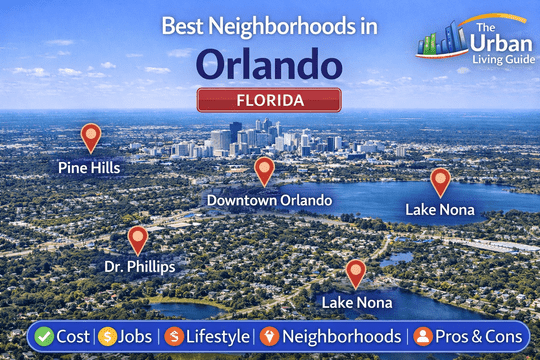
Best Neighborhoods in Orlando, Florida: Lakeside Charms, Medical City Innovations & Family Enclaves in 2026
Spanning an expansive 119 square miles of land area across the subtropical lake basin of Central Florida, the City of Orlando operates under the mayor-council governance of the City of Orlando while serving as the county seat and economic engine of Orange County. Housing an urban core population of approximately 316,000 residents and anchoring a broader metropolitan statistical area exceeding 2.81 million people, the “Theme Park Capital of the World” has rapidly transformed into a premier national hub for digital media, simulation technologies, aerospace engineering, aviation logistics, and advanced life sciences.
Relocating across “The City Beautiful” requires understanding localized geography dotted with hundreds of freshwater sinkhole lakes, seasonal afternoon convective thunderstorms, intense subtropical summer humidity corridors, and multi-layered toll expressway networks managed by the Central Florida Expressway Authority.
Residential living in Greater Orlando presents distinct lifestyle options, separating historic brick-lined lake enclaves and high-rise downtown business districts from master-planned biotech hubs, upscale restaurant corridors, and affordable mainland residential basins. Inbound movers consistently balance direct daily access to primary corporate employment anchors—such as the Downtown Orlando Financial Core, the Lake Nona Medical City Complex, the Universal Orlando and Walt Disney World Resort corridors, Lockheed Martin Rotary and Mission Systems, and the Central Florida Research Park adjacent to UCF—against daily highway commute times.
Selecting the right neighborhood defines your daily route across major transportation arteries, including Interstate 4 (I-4 Ultimate Express), State Road 408 (Spessard L. Holland East-West Expressway), State Road 417 (Central Florida GreeneWay), State Road 528 (Beachline Expressway), and Florida’s Turnpike, while shaping your family’s access to municipal services, community lake chains, and top-tier public school systems.
Watch this video to explore different neighborhoods, suburban corridors, and residential communities across Orlando:
Best Areas to Live in Orlando at a Glance in 2026
| Neighborhood Name | Location | Distance from Core (Downtown) | Development Status | Transit Connectivity | Cost Level | Best Fit For |
|---|---|---|---|---|---|---|
| Winter Park | Northern Metro (Independent City) | Approximately 5 miles north | Historic Luxury Lakeside | High (SunRail Station, I-4, US-17/92) | High-to-Premium | Families, Academics & Established Executives |
| Downtown Orlando | Central City Core | 0 miles (Urban Center) | High-Density Commercial & Arts Core | Exceptional (SunRail, LYMMO, I-4, SR-408) | Mid-to-High Range | Young Professionals, Tech Workers & Urbanites |
| Lake Nona | Southeast Metro (Medical City) | Approximately 18 miles southeast | Master-Planned Smart City & Biotech Hub | High (Autonomous Shuttles, SR-417, SR-528) | High-to-Premium | Healthcare Professionals, Tech Innovators & Families |
| Dr. Phillips | Southwest Metro (Sand Lake Basin) | Approximately 11 miles southwest | Established Upscale Master-Planned | Moderate (Automobile-centric, I-4, Apopka-Vineland Rd) | Mid-to-High Range | Affluent Families, Foodies & Hospitality Executives |
| Pine Hills | West Urban Basin | Approximately 5.5 miles northwest | Established Developing Infill | High (LYNX Bus Network, SR-408, SR-414) | Accessible / Budget-Friendly | First-Time Buyers, Value Renters & Commuters |
Best Neighborhoods in Orlando Discussed in Detail
Winter Park — Historic Brick-Lined Enclave, Cultural Arts & Scenic Lake Chains
Situated immediately north of Orlando, the incorporated municipality of Winter Park is one of Florida’s most historically affluent, culturally rich, and architecturally protected communities. Founded in the late 19th century as a winter resort haven for northern philanthropists and business leaders, the city operates under its own municipal charter via the City of Winter Park Official Portal. Defined by preserved red-brick roadways, towering moss-draped live oak canopies, interconnected waterways on the Winter Park Chain of Lakes, and upscale dining along Park Avenue, Winter Park delivers classic Old Florida refinement combined with premier educational institutions.
- Housing: Architectural inventory spans restored 1920s Spanish Mediterranean Revival estates, lakeside custom mid-century modern residences, traditional Craftsman bungalows, and boutique luxury townhomes. Single-family purchase prices typically range around $650,000 to $4,500,000+, while luxury residential apartment and condominium rentals average $2,200 to $4,200 per month.
- Safety & Crime Rate: Protected by the dedicated Winter Park Police Department, the city consistently reports violent crime rates far below regional averages, supported by rapid municipal emergency response units and proactive community patrol initiatives.
- School District & Education Quality: Governed by Orange County Public Schools (OCPS), containing top-performing public institutions such as Winter Park High School (renowned for its International Baccalaureate Diploma Programme) and Lakemont Elementary, alongside premier private academies like Trinity Preparatory School and higher education at historic Rollins College.
- Walkability & Daily Conveniences: Outstanding pedestrian activity along the 10-block Park Avenue retail spine, featuring open-air sidewalk bistros, designer boutiques, independent bookstores, artisan bakeries, and gourmet markets like the weekly Winter Park Farmers’ Market.
- Parks & Green Spaces / Pet-Friendliness: Exceptional municipal recreation featuring the 11-acre Central Park along Park Avenue (hosting world-class art festivals), Mead Botanical Garden (featuring 47 acres of nature trails and an amphitheater), and Kraft Azalea Garden on Lake Maitland. The community is exceptionally pet-friendly, with dog-friendly dining patios and Fleet Peeples Park (Lake Baldwin Dog Park) located nearby.
- Parking & Traffic Congestion: Plentiful free multi-story municipal parking garages along Park Avenue and private residential driveways. Commuter traffic builds along Fairbanks Avenue (SR 426) and on-ramps to Interstate 4 during morning rush hours.
- Noise Levels & Vibe: Serene, refined, and peaceful, characterized by quiet shaded residential streets with strictly enforced municipal sound and commercial delivery ordinances.
- Medical Facilities & Hospitals: Direct emergency medical care and specialized treatment are anchored within city boundaries by AdventHealth Winter Park on North Lakemont Avenue.
- Transit Connectivity: Excellent multi-modal public transit centered at the Winter Park SunRail Station on Morse Boulevard (connecting commuter rail throughout Orange, Seminole, and Volusia Counties alongside Amtrak lines), with rapid vehicular connections via I-4 and US-17/92 (Orlando Avenue).
- Affordability: High-to-premium price profile; elevated municipal property valuations and historical preservation requirements are balanced by pristine street maintenance and independent city services.
- Who It’s Best For: Families prioritizing exemplary public and private education, academic professionals, healthcare executives, retirees, and buyers who value historic walkable tree-canopied living.
- Drawbacks: High home purchase entry barrier, limited vacant land leading to competitive tear-down rebuild cycles, and rush-hour bottlenecks on Fairbanks Avenue.
Downtown Orlando — High-Rise Urban Innovation, Lake Eola Arts & Tech Core
Centering around the iconic fountain of Lake Eola Park, Downtown Orlando is the central financial, governmental, legal, and tech-innovation capital of Central Florida. Featuring distinct sub-districts—including the Central Business District (CBD), the historic brick streets of Thornton Park, the nightlife corridor of Church Street Station, and the developing Creative Village tech and education precinct—downtown delivers walkable vertical urbanism. Municipal planning is guided through city initiatives and the Downtown Development Board (DDB).
- Housing: Dominated by modern luxury high-rise condominium towers (such as The Vue at Lake Eola, 55 West, and Waverly on Lake Eola), converted urban lofts, and contemporary podium apartment mid-rises. Condominium purchase valuations typically range around $280,000 to $1,200,000, while modern 1-bedroom apartment rentals average $1,650 to $2,800 per month.
- Safety & Crime Rate: Patrolled by the Orlando Police Department (OPD) Downtown Division and supported by the Downtown Clean and Safe Ambassador team. Residential zones around Lake Eola and Thornton Park maintain safe pedestrian foot traffic, while commercial entertainment streets along Orange Avenue experience late-night property and bar-district incidents.
- School District & Education Quality: Governed by OCPS, containing choice campuses such as Howard Middle School (Academy of Arts) and Jones High School, alongside major higher-education footprints anchored by UCF Downtown Campus and Valencia College Downtown in Creative Village.
- Walkability & Daily Conveniences: Outstanding walkability (Walk Score of 88-92/100). Residents stroll around Lake Eola to grocery markets like Publix Super Market at The Paramount, independent coffee roasters, live Broadway performances at the Dr. Phillips Center for the Performing Arts, and sports events at the Kia Center (home of the Orlando Magic).
- Parks & Green Spaces / Pet-Friendliness: Centered around the famous 23-acre Lake Eola Park (featuring swan paddleboat rentals, a 0.9-mile paved perimeter jogging loop, and the Walt Disney Amphitheater), complemented by Constitution Green (home to a historic 200-year-old live oak tree). Highly pet-friendly with dedicated dog runs across residential towers.
- Parking & Traffic Congestion: Assigned garage parking typically costs an additional $125 to $225 per month for apartment tenants. Street parking is strictly metered, with traffic slowdowns common along Rosalind Avenue and South Street during arena events and peak business hours.
- Noise Levels & Vibe: Energetic, fast-paced, and cosmopolitan, filled with sidewalk patio chatter, live theater crowds, commuter train bells, and active weekend farmers’ market activity.
- Medical Facilities & Hospitals: Direct 5-minute access to the sprawling medical complex in the Orlando Health Downtown Campus, anchored by Orlando Health Orlando Regional Medical Center (ORMC), home to Central Florida’s only Level I Trauma Center.
- Transit Connectivity: Unmatched regional transit hub centered at Lynx Central Station and Church Street SunRail Station, providing commuter rail and free LYMMO Bus Rapid Transit (BRT) city loops, with rapid vehicle on-ramps to Interstate 4 and State Road 408. Long-distance air travel is accessible via Orlando International Airport (MCO) located 10 miles southeast.
- Affordability: Mid-to-high urban cost structure; competitive price-per-square-foot ratios on modern condos are offset by monthly HOA assessments and vehicle parking fees.
- Who It’s Best For: Corporate professionals, attorneys, software developers, simulation engineers, university students, and urbanites seeking a walkable lifestyle near cultural venues.
- Drawbacks: Late-night weekend noise near Orange Avenue entertainment zones, elevated apartment parking fees, and pass-through arena event traffic.
Lake Nona — Master-Planned Smart City, Medical City & Sports Innovation Capital
Situated across 17 square miles in the southeastern quadrant of Orlando, Lake Nona is a globally recognized, forward-thinking master-planned community developed by the Tavistock Development Company. Designed around principles of wellness, high-speed fiber gigabit infrastructure, and sustainability, the district is famously anchored by the 650-acre Lake Nona Medical City health sciences cluster. Operating under City of Orlando municipal governance, Lake Nona integrates modern residential villages (such as Laureate Park, Lake Nona Golf & Country Club, and Somerset Park) with world-class athletic headquarters.
- Housing: Dominated by newly constructed solar-powered single-family homes, modern neo-traditional residences with detached rear-entry garages and front porches, luxury golf estates, and sleek mid-rise apartment communities. Single-family purchase prices typically range around $480,000 to $2,800,000+, while modern rental apartments average $1,850 to $3,200 per month.
- Safety & Crime Rate: Patrolled by the OPD Southeast Division. Lake Nona maintains one of the lowest crime rates in Central Florida, supported by modern environmental design, smart community monitoring, and active residential engagement.
- School District & Education Quality: Governed by OCPS, containing modern top-performing public institutions such as Lake Nona High School (featuring specialized collegiate academies), Laureate Park Elementary, alongside premier higher-education and research faculties at the UCF College of Medicine and University of Florida Research & Academic Center.
- Walkability & Daily Conveniences: The bustling Lake Nona Town Center is highly pedestrian-friendly, featuring boutique hotels like the Lake Nona Wave Hotel, interactive public art displays (including “The Beacon”), artisan dining, and the open-air shipping container food park Boxi Park. Daily grocery needs are met by Publix, GreenWise Market, and retail plazas along Narcoossee Road.
- Parks & Green Spaces / Pet-Friendliness: Exceptional community wellness infrastructure featuring over 40 miles of paved multi-use trails, Nona Adventure Park (featuring a cable wakeboard park and inflatable aqua park), and world-class athletic facilities at the 64-court USTA National Campus (Home of American Tennis). Extremely pet-friendly with community dog parks in every residential village.
- Parking & Traffic Congestion: Wide multi-car residential garages and ample open parking across town center garages. Traffic congestion concentrates primarily along Narcoossee Road and the on-ramps to State Road 417 during peak morning and afternoon school rush hours.
- Noise Levels & Vibe: Modern, active, and wellness-oriented, characterized by outdoor fitness enthusiasts, autonomous electric shuttles (Beep), and quiet residential evenings.
- Medical Facilities & Hospitals: Direct medical infrastructure anchored within community borders by the Orlando VA Medical Center and Nemours Children’s Hospital, Florida.
- Transit Connectivity: Exceptional regional connectivity: 5-minute direct access to Orlando International Airport (MCO) and the high-speed Brightline Intercity Rail Station, supported by regional tollway connections via SR-417 (Central Florida GreeneWay) and SR-528 (Beachline Expressway).
- Affordability: Mid-to-high cost profile; homeowners association (HOA) fees and Community Development District (CDD) infrastructure bond assessments apply to residential properties.
- Who It’s Best For: Healthcare practitioners, biotech researchers, simulation engineers, tennis and sports enthusiasts, frequent business travelers, and families seeking innovative modern schooling.
- Drawbacks: Recurring CDD tax assessments on property tax bills, 20-to-25-minute highway commutes to Downtown Orlando, and mandatory toll expenses for daily highway commuting.
Dr. Phillips — Established Master-Planned Luxury, Sand Lake Dining & Lake Chains
Named after the legendary Central Florida citrus pioneer Dr. Philip Phillips, Dr. Phillips is an affluent, established unincorporated suburban enclave in southwestern Orange County. Bordered by the picturesque waters of the Butler Chain of Lakes to the west and Universal Orlando Resort to the east, the community is celebrated for its mature tree canopies, executive gated subdivisions, and premier commercial dining along Sand Lake Road. Operating under the governance of the Orange County Government, Dr. Phillips provides a balance of suburban luxury and business connectivity.
- Housing: Real estate spans custom single-family lakefront estates on multi-acre parcels, established 1980s–2000s executive subdivisions (such as Bay Hill, Turtle Creek, and Bristol Park), and upscale garden-style townhomes. Single-family purchase prices typically range around $520,000 to $3,600,000+, while luxury apartment rentals average $1,800 to $2,950 per month.
- Safety & Crime Rate: Patrolled by the Orange County Sheriff’s Office (OCSO) Sector 3 Substation, the community maintains below-average violent crime rates, supported by private gate guards in numerous master-planned enclaves.
- School District & Education Quality: Governed by OCPS, containing top-rated public schools such as Dr. Phillips High School (renowned for its Center for International Studies and Visual and Performing Arts Magnet) and Southwest Middle School.
- Walkability & Daily Conveniences: The famous “Restaurant Row” along Sand Lake Road is a walkable commercial corridor featuring over 50 upscale culinary venues, fine steakhouses, seafood bistros, and gourmet markets like Trader Joe’s, Whole Foods Market, and The Grove Orlando shopping center.
- Parks & Green Spaces / Pet-Friendliness: Outstanding recreational amenities anchored by the 43-acre Dr. P. Phillips Community Park (featuring lakeside hiking trails, splash pads, youth soccer complexes, and an enclosed off-leash dog park), alongside private championship golf at the Arnold Palmer’s Bay Hill Club & Lodge (home of the PGA Tour Arnold Palmer Invitational).
- Parking & Traffic Congestion: Wide two-to-three car garages and spacious suburban driveways. Heavy commercial traffic builds along Sand Lake Road (SR 482) and the interchange at Interstate 4 due to nearby tourist and convention centers.
- Noise Levels & Vibe: Upscale, active, and family-centered, shifting from tranquil residential lakefront streets to lively evening patio dining on Restaurant Row.
- Medical Facilities & Hospitals: Direct emergency medical coverage supported within the district by Orlando Health Dr. P. Phillips Hospital on Turkey Lake Road.
- Transit Connectivity: Major roadway positioning between Interstate 4, Apopka-Vineland Road (SR 535), and Florida’s Turnpike, offering 15-minute drives to Downtown Orlando and 10 minutes to the Orange County Convention Center.
- Affordability: Mid-to-high suburban pricing; property values offer substantial square footage, private pools, and established landscaping compared to coastal Florida metros.
- Who It’s Best For: Corporate executives, hospitality leaders, healthcare physicians, golf enthusiasts, and families prioritizing established schools and fine dining.
- Drawbacks: Pass-through tourist traffic congestion near I-4 and Sand Lake Road, higher property insurance rates for older lakefront builds, and car dependence outside commercial retail strips.
Pine Hills — Cultural Heritage, Central Roadways & Accessible Mainland Living
Covering an expansive geographic footprint in west-central Orange County just northwest of Downtown Orlando, Pine Hills is one of the region’s oldest, most diverse, and budget-friendly residential districts. Established in the 1950s as a postwar suburban enclave, Pine Hills today serves as a culturally dynamic mainland community celebrated for its rich Caribbean, Haitian, and African American culinary and business presence. Governed under Orange County municipal administration, the area is undergoing community-driven economic revitalization led by the Pine Hills Neighborhood Improvement District (PHNID).
- Housing: Real estate inventory consists of classic 1950s and 1960s single-story concrete block single-family ranch homes on generous quarter-to-half-acre lots, duplexes, and value-oriented apartment complexes. Single-family purchase prices typically range around $230,000 to $360,000, while rental apartments and single-family rentals average $1,250 to $1,850 per month.
- Safety & Crime Rate: Patrolled by the Orange County Sheriff’s Office Sector 2 Substation. While the community has historically experienced higher property and violent crime rates along major commercial thoroughfares like Silver Star Road and Pine Hills Road, targeted county investments, community policing, and infrastructure upgrades continue to improve neighborhood stability.
- School District & Education Quality: Governed by OCPS, containing neighborhood institutions such as Evans High School (recognized as an innovative Community Partnership School), Meadowbrook Middle School, and Pine Hills Elementary.
- Walkability & Daily Conveniences: High pedestrian activity along commercial avenues like Silver Star Road and Colonial Drive (SR 50), featuring international grocers, Caribbean bakeries, authentic jerk smokehouses, and local retail centers.
- Parks & Green Spaces / Pet-Friendliness: Municipal recreation is anchored by the Barnett Park multi-use recreational complex on West Colonial Drive (featuring a 159-acre park with splash pads, cricket fields, disc golf, fishing piers, and a dedicated dog park), alongside pedestrian trail links to the 22-mile paved Pine Hills Trail (part of the Central Florida Coast-to-Coast Trail).
- Parking & Traffic Congestion: Plentiful private residential driveway and open street parking. Easy highway on-ramps provide quick access to State Road 408 (East-West Expressway) and State Road 414 (Maitland Boulevard Extension).
- Noise Levels & Vibe: Community-centered, multicultural, and active, shifting from lively commercial business avenues to quiet residential evenings in established subdivisions.
- Medical Facilities & Hospitals: Direct emergency medical coverage provided nearby by AdventHealth Orlando (flagship campus on Rollins Street) and Orlando Health ORMC.
- Transit Connectivity: High-frequency public transit provided by LYNX Bus Routes (including Link 37 and Link 105) connecting directly to the central LYNX station downtown, with vehicular access via SR-408, SR-50, and I-4.
- Affordability: Greater Orlando’s most accessible entry-level homeownership and rental price tier, offering substantial residential lot acreage and lower entry costs.
- Who It’s Best For: First-time homebuyers, budget-conscious renters, culinary enthusiasts, and commuters seeking large residential lots within a 10-minute drive of Downtown Orlando.
- Drawbacks: Pockets of higher property crime, variable public school test performance ratings across individual campuses, and older housing inventory requiring modern renovation.
Comprehensive Neighborhood Pros and Cons Comparison
| Neighborhood | Core Advantages (Pros) | Core Limitations (Cons) |
|---|---|---|
| Winter Park | Historic brick streetscapes; top-ranked Winter Park High and Rollins College; dedicated WPPD public safety; walkable dining on Park Avenue. | High single-family purchase pricing; limited vacant land; peak-hour traffic bottlenecks along Fairbanks Avenue. |
| Downtown Orlando | Direct SunRail and free LYMMO transit; walkable access to Lake Eola Park and Publix; proximity to Dr. Phillips Performing Arts Center. | Elevated monthly apartment parking fees; late-night bar street noise near Orange Avenue; arena event traffic. |
| Lake Nona | Modern master-planned smart city infrastructure; major healthcare cluster at Medical City; 40+ miles of paved trails; USTA National Campus. | Recurring CDD bond tax assessments; substantial 18-mile commute to Downtown Orlando; highway toll expenses on SR-417. |
| Dr. Phillips | Executive homes near the Butler Chain of Lakes; world-class dining along Restaurant Row; top-rated Dr. Phillips High; Bay Hill golf. | Heavy tourist traffic congestion along Sand Lake Road; higher property insurance on older lakeside homes; car-dependent suburban layout. |
| Pine Hills | Orlando’s most accessible entry-level home and rental prices; large quarter-to-half-acre lot sizes; direct recreation at Barnett Park. | Pockets of elevated property crime; variable school performance ratings; older housing stock requiring maintenance. |
How You Decide Which Neighborhood Is Best For You
Selecting your ideal neighborhood in Greater Orlando requires balancing your gross household finances with daily employment locations, family schooling preferences, and highway toll logistics. Because Central Florida is interconnected by express tollways (SR-408, SR-417, SR-528) and the main spine of Interstate 4, your chosen location dictates whether your daily commute relies on free interstate travel or recurring electronic tolling via an E-PASS or SunPass transponder. Tech workers in Creative Village, simulation engineers in the Research Park, healthcare professionals in Lake Nona, and hospitality leaders in the tourism corridors should prioritize living within their respective quadrant to eliminate cross-county gridlock.
Beyond transportation routes, evaluate essential municipal utility and environmental realities. Central Florida experiences high summer electricity demands due to air conditioning usage during extended heat waves exceeding 90 degrees Fahrenheit, making municipal utility rates through the Orlando Utilities Commission (OUC)—often recognized for reliable electric and clean drinking water sourced from the Lower Floridan Aquifer—or regional providers like Duke Energy an important factor. In addition, examine sinkhole history, property insurance premiums, and Community Development District (CDD) bond assessments on newer master-planned homes. Before executing a residential lease or property closing, verify high-speed fiber broadband availability (such as Quantum Fiber or AT&T Fiber) and check Orange County school assignment boundaries.
Frequently Asked Questions About Orlando Neighborhoods
Which neighborhood in the Orlando area is considered the best for families with school-age children?
Winter Park and Lake Nona are widely regarded as the premier family communities in Greater Orlando. Winter Park provides access to top-ranked public institutions like Winter Park High School alongside historic community parks and tree-lined streets. Lake Nona offers modern master-planned neighborhoods, new schools with specialized collegiate tracks, and extensive youth recreational facilities.
What is the most walkable neighborhood in Orlando where you can live without a car?
Downtown Orlando (including the Lake Eola and Thornton Park districts) and central Winter Park offer the highest walkability in the region, both scoring above 88 on Walk Score. Downtown Orlando allows residents to walk to grocery markets like Publix, restaurants, and entertainment venues while connecting to SunRail commuter trains and the free LYMMO bus system. Winter Park offers dense pedestrian shopping along Park Avenue with direct SunRail rail access.
What are the safest residential neighborhoods to live in within Greater Orlando?
Winter Park, Dr. Phillips, and Lake Nona consistently report the lowest violent and property crime rates in the metropolitan area. Winter Park maintains its own municipal police department with fast emergency response times, while Dr. Phillips and Lake Nona benefit from private gated subdivisions and active community watch programs.
What are the most affordable neighborhoods for homebuyers and renters in Orlando?
Pine Hills and surrounding west-central Orange County communities provide the most budget-friendly housing opportunities in the area. In Pine Hills, buyers and renters can secure single-family starter homes on generous lots and apartments at price points significantly lower than eastern master-planned suburbs or central lakeside enclaves.
How bad is traffic congestion when commuting along Interstate 4 in Orlando?
Interstate 4 experiences heavy congestion during morning and evening rush hours, particularly around the Downtown corridor and tourist attractions near Sand Lake Road. Utilizing the I-4 Express toll lanes or taking the SunRail commuter train provides a reliable alternative to avoid peak-hour highway delays.
What are CDD fees and do they apply to all Orlando neighborhoods?
Community Development District (CDD) fees are special assessments added to property tax bills in newer master-planned developments (like Lake Nona) to finance roads, utilities, and community amenities. Older, established neighborhoods such as Winter Park, Downtown Orlando, and Pine Hills do not have CDD fees.
Which Orlando neighborhood is best for healthcare and biotech professionals?
Lake Nona is the leading residential destination for healthcare practitioners, medical researchers, and biotech professionals, offering direct walking or golf-cart commutes to the Lake Nona Medical City cluster, including Nemours Children’s Hospital and the UCF College of Medicine.
Know More About the City
The Urban Living Guide creates deeply researched, practical, and informative city relocation resources designed to help individuals, working professionals, and families navigate complex urban landscapes. By analyzing municipal infrastructure, hyper-local zoning patterns, commuter realities, and housing markets, our guides provide actionable insights so you can make confident, data-backed decisions when moving to major metropolitan areas.
Explore our comprehensive guides to the Orlando metropolitan region:
- Living in Orlando, Florida
- Cost of Living in Orlando, Florida
- Pros and Cons of Living in Orlando, Florida
- Moving to Orlando, Florida
Follow The Urban Living Guide for ongoing regional insights, neighborhood developments, and expert local coverage across Greater Orlando and Central Florida.