

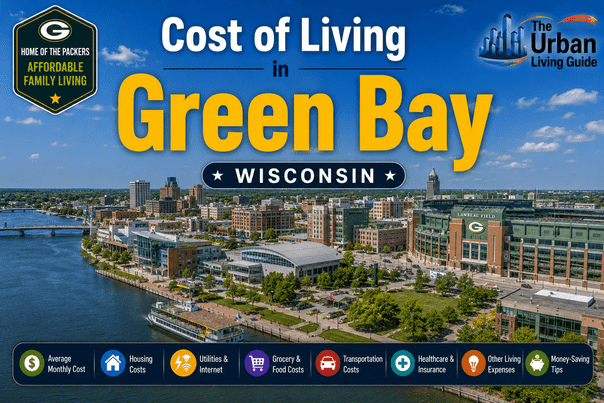
Cost of Living in Green Bay, Wisconsin 2026: Packers Heritage, Healthcare Jobs & Midwest Affordability
Resting gracefully along the southwestern shores of Green Bay, an arm of Lake Michigan, the City of Green Bay represents a powerful economic center driven by heavy industrial manufacturing, paper production, top-tier healthcare systems, and the legendary presence of the Green Bay Packers. Anchored by major employers like Bellin Health, Schneider National, and the University of Wisconsin-Green Bay, this historic Wisconsin city delivers authentic urban services and vibrant cultural districts without the crushing financial burdens found in larger metropolitan corridors.
For healthcare professionals, logistics experts, remote workers, and growing families relocating into Brown County, housing and daily necessities remain remarkably accessible compared to national medians or regional hubs like Milwaukee and Madison. When evaluating the comprehensive cost of living in Green Bay, Wisconsin during 2026, you must factor in sub-freezing winter heating cycles, vehicular commuting habits across extensive county grids, local sales tax structures, and everyday lifestyle outlays that scale exceptionally well relative to the local median household income of $62,546.
Average Monthly Expense Breakdown – Green Bay
Monthly expenses in Green Bay vary widely depending on household size, lifestyle choices, and exact neighborhood positioning. Below is a structured monthly financial breakdown displayed in a clear comparative table format reflecting current economic conditions in 2026:
| Expense Category | Single Adult | Couple | Family of 4 |
|---|---|---|---|
| Housing / Rent | $904 – $1,200 | $1,100 – $1,500 | $1,400 – $1,800 |
| Groceries & Food | $341 – $450 | $550 – $750 | $1,100 – $1,400 |
| Transportation & Commute | $160 – $280 | $220 – $400 | $300 – $550 |
| Utilities & Internet | $161 – $220 | $180 – $260 | $220 – $310 |
| Healthcare & Insurance | $45 – $120 | $90 – $240 | $135 – $360 |
| Childcare & Education | $0 | $0 | $800 – $1,600+ |
| Entertainment & Leisure | $140 – $300 | $200 – $450 | $250 – $550 |
Residents frequently emphasize that while baseline utility and grocery figures remain exceptionally favorable, long winter heating cycles and game-day ticketing outlays require consistent budgeting throughout the year.
Watch this video to get a closer look at housing and neighborhood pricing in Green Bay.
Housing Costs, Real Estate & Neighborhood Dynamics in Green Bay
Housing forms one of the most astonishing economic advantages for households in Green Bay, with average home values sitting roughly 16% to 18.7% lower than the national average. Rental inventory is remarkably affordable, allowing residents to secure quality space at rates that feel exceptional compared to major regional metros. Municipal zoning, historic preservation rules, and neighborhood development initiatives are overseen by the Green Bay Department of Community Development.
- Studio Apartments: Compact urban living spaces and managed retrofitted units generally span $700–$900/month across central corridors.
- 1-BHK Apartments: Standard multi-family units featuring modern community amenities average $904–$1,084/month, with affordable neighborhood pockets offering great value.
- 2-BHK Apartments: Suited for roommates or small families, ranging from $1,200–$1,500/month.
- Independent Homes & Properties: Detached single-family real estate across the metropolitan area commands a median purchase price circling $449,735 to $477,675, accompanied by manageable property tax assessments and regional insurance considerations.
Utilities & Bills Costs in Green Bay
Managing utility overhead requires preparing for winter heating demands across Brown County, with primary electricity and natural gas services coordinated by regional providers like Wisconsin Public Service (WPS).
- Basic Home Utilities: Electricity, natural gas, water, and waste management run $161–$220/month baseline for a standard apartment, tracking roughly 12% to 16% below the national average. Single-family homes experience moderate winter heating spikes from November through March.
- High-Speed Fiber Internet: Reliable broadband and fiber connections via local providers run about $50–$75/month for unlimited high-speed connectivity.
Grocery and Food Costs in Green Bay
Food expenses benefit from strong regional agricultural supply chains across Wisconsin, keeping everyday grocery bills roughly 14.7% below the national average. Weekly provisions at regional mainstays like Woodman’s Food Market or Pick ‘n Save average $341–$450/month per individual, with Wisconsin law exempting groceries from sales tax.
- Mainstream Supermarkets: Stores like Woodman’s, Aldi, Pick ‘n Save, and Costco offer highly competitive pricing on household consumer goods.
- Everyday Price Benchmarks: A gallon of milk runs $4.72; casual dining out costs $11–$22; and mid-range restaurant dinners average $18–$35 per person.
Transportation and Commute Costs in Green Bay
Commuting across the Brown County grid involves a blend of personal vehicle usage and public transit networks managed by Green Bay Metro Transit.
- Public Transit: Green Bay Metro bus routes provide fixed-route public transit within city limits, featuring monthly passes priced around $60–$70.
- Fuel & Operation: Average monthly gasoline expenditures run $160–$280/month, while total car ownership and maintenance costs span $300–$600/month. Most residents rely primarily on personal vehicles for daily errands and commuting.
Healthcare Costs in Green Bay
Healthcare outlays remain highly affordable, tracking roughly 9% to 12% below the national average and anchored by world-class medical institutions such as Bellin Health and HSHS St. Vincent Hospital.
- Doctor Consultations: Standard general practitioner visits without insurance coverage range from $85–$150.
- Health Insurance: Individual private premiums average $160–$390/month for employer-sponsored plans, with robust health networks supporting regional employment.
Entertainment & Lifestyle Costs in Green Bay
Accessing vibrant community attractions, sports venues, and recreational parks across the city involves flexible budgeting:
- Fitness & Recreation: Commercial gym memberships average $30–$70/month, while utilizing municipal parks and river greenways eliminates recreational outlays.
- Packers Culture: Exploring Lambeau Field tours, the Packers Hall of Fame, and community events around the Titletown District provides unique local entertainment value.
Pet-Related Costs in Green Bay
Caring for dogs and cats across local parks and neighborhood pathways involves steady recurring provisions:
- Veterinary Care: Routine checkups and preventative treatments average $40–$90/month.
- Supplies & Grooming: Pet food and professional grooming add $45–$110/month.
City-Specific Living Costs in Green Bay
Living in northeastern Wisconsin introduces specific environmental and seasonal cost factors:
- Sub-Freezing Winter Heating Demands: Experiencing freezing winter temperatures requires continuous heating operation from November through March, causing natural gas and electric bills to rise notably.
- Winter Vehicle Maintenance and Salt Damage: Freezing temperatures and salted winter roads necessitate dedicated vehicle care, winter tires, and undercarriage washing to prevent premature rust and mechanical wear.
- Gameday Population Influx: Home football weekends at Lambeau Field generate temporary local price inflations and high demand across hospitality and dining sectors.
Taxes in Green Bay
Tax structures in Green Bay, Wisconsin during 2026 shape household purchasing power:
- State Income Tax: Wisconsin implements a progressive state income tax structure with brackets ranging from 3.54% to 7.65% across middle and upper earning tiers.
- Sales Tax Burden: Combined state, county, and local sales tax rates hover near 5.5% across Brown County, with food and grocery items fully exempt from state sales tax.
Annual & Yearly Expenses in Green Bay
When calculating the comprehensive cost of living in Green Bay, analyzing monthly line items is only half the battle. Managing a sustainable household budget also requires forecasting recurring annual and yearly expenses:
- Automotive Protection & Licensing: Car insurance premiums range from $800–$1,300 yearly in Wisconsin, alongside vehicle registration fees of $150–$250 and seasonal winter tire purchases spanning $200–$400.
- Property & Liability Insurance: Renters insurance adds $100–$200 yearly, while homeowners insurance policies for single-family properties range from $700–$1,300 annually.
- Memberships & Subscriptions: Digital streaming subscriptions add $150–$350 yearly, while commercial gym memberships range from $300–$600 annually.
- Professional & Administrative Fees: Mandatory annual vehicle inspections cost $30–$50, and professional tax preparation adds $100–$300 yearly.
- Total Estimated Annual Non-Housing Outlays: $2,500–$4,500 per household.
Downtown vs. Suburbs Cost of Living Comparison – Green Bay
Comparing the urban core of Downtown Green Bay against surrounding neighborhood enclaves highlights critical lifestyle trade-offs:
| Cost Parameter | Downtown Core | Eastside (Established Corridor) | Westside (Residential Value) | Lambeau Vicinity (Packers District) |
|---|---|---|---|---|
| Housing (1-2 BHK Rent) | $1,100 – $1,500 | $1,000 – $1,400 | $900 – $1,300 | $1,200 – $1,700 |
| Parking & Garage Fees | $50 – $100/mo | Free / Included | Free / Included | Gameday restrictions / Permits |
| Transportation & Commute | Walkable core, Metro hub | Arterial road connectivity | Highway and suburban driving | Gameday traffic congestion |
| Childcare & Schools | Limited local options | Established family clusters | Top-tier suburban school districts | Active family neighborhoods |
| Entertainment & Dining | Riverfront dining and local pubs | Retail centers and casual eateries | Quiet community spots | Titletown District and sports bars |
| Home Maint. / HOA / Taxes | Urban maintenance overhead | Low maintenance overhead | Master-planned community dues | Gameday property considerations |
| Car Ownership vs. Transit | Optional for core city living | Mandatory | Mandatory | Mandatory |
Strategic Insight: Young professionals frequently thrive in Downtown Green Bay for walkable riverfront amenities, while families seeking space gravitate toward residential enclaves like the Westside for superior value.
Local Resident Realities: What Long-Timers Say About Living Costs
“Green Bay gives you amazing community spirit and incredible football culture without the insane housing costs of Madison or Milwaukee. Our utility bills in January require budgeting, but overall life here is wonderfully affordable.”
“Working in healthcare at Bellin Health, my salary goes remarkably far here. We bought a spacious home on the Westside for a fraction of what our friends paid in other major Midwest metros.”
Is Green Bay Expensive or Affordable?
Green Bay is widely celebrated as one of the most remarkably affordable mid-size metropolitan areas in the Upper Midwest. Overall living costs track roughly 3% to 8% below the national average, providing exceptional financial breathing room across housing, utilities, and everyday groceries.
Key factors that affect affordability across the metro area include:
-
- Highly accessible real estate valuations with average home prices sitting nearly 16% below national benchmarks.
- Favorable utility and electricity pricing operating roughly 16% below U.S. medians.
- Stable regional healthcare and logistics employment anchored by Bellin Health and Schneider National.
- Compact commute corridors minimizing daily vehicle fuel and maintenance overhead across Brown County.
Who May Find Green Bay Expensive? — And Who Can Afford It Comfortably?
Navigating the local economic landscape requires aligning household earnings with regional cost standards. For logistics specialists at Schneider National, healthcare professionals at Bellin Health, and manufacturing experts, the local market offers outstanding purchasing power, low home purchase barriers, and secure financial stability.
However, the city can present distinct financial friction for particular demographic segments. Career fields outside healthcare, logistics, and heavy manufacturing are relatively scarce, and specialized professionals seeking advanced corporate headquarters or venture capital may find opportunities constrained locally.
-
-
- Workers in highly specialized niche industries lacking local corporate headquarters who may find career advancement restricted.
- Hourly service-sector employees earning entry-level wages navigating tight rental adjustments in central districts.
- Newcomers sensitive to prolonged cold winters who must budget for recurring heating and vehicle protection outlays.
-
Segment-wise salary mapping reveals distinct affordability thresholds across the metropolitan area in 2026:
| Income Bracket | Affordability Status | What to Expect |
|---|---|---|
| $38K – $50K/year | Financially Strained / High Pressure | Requires careful monthly budgeting, shared living arrangements, and frugal household management. |
| $50K – $80K/year | Moderate / Stable Comfort | Supports standard apartment rentals, moderate savings, and reliable vehicle ownership. |
| $80K+/year | Comfortable Living | Unlocks independent homeownership, property upgrades, and flexible recreational spending. |
Practical Money-Saving Tips for Green Bay Residents
Maximizing your purchasing power in northeastern Wisconsin requires strategic navigation of local housing, utility systems, and consumer markets. Because neighborhoods offer distinct price points based on historical development, exploring established communities like the Westside or outer Eastside yields substantial annual savings. Additionally, leveraging municipal transit options and free public greenways helps buffer against unexpected cost pressures.
-
-
- Target affordable neighborhood pockets: Explore housing options on the Westside or outer Eastside where rental values and home purchase prices offer exceptional square-footage value.
- Take advantage of public transit corridors: Utilize Green Bay Metro bus routes to commute efficiently across urban corridors while minimizing monthly fuel expenses.
- Shop regional value grocers: Stock up on weekly provisions at budget-friendly supermarkets like Woodman’s, Aldi, and Costco to keep food expenditures below national norms.
- Leverage free municipal park recreation: Enjoy zero-cost weekend fitness and family outings by utilizing local river greenways and public parks instead of maintaining a paid commercial gym membership.
- Explore institutional healthcare benefits: Seek positions with major regional employers like Bellin Health or UW-Green Bay to access robust employee healthcare packages.
- Bundle regional insurance policies: Combine automotive coverage with renter’s or homeowner’s insurance to secure multi-policy discounts tailored to Upper Midwest driving conditions.
- Maintain winter vehicle readiness: Schedule regular seasonal maintenance and invest in quality winter tires early to prevent expensive cold-weather mechanical repairs.
-
Frequently Asked Questions About Living Costs in Green Bay
Is Green Bay significantly cheaper than Milwaukee and Madison?
Yes, Green Bay offers some of the most accessible housing markets in Wisconsin, running roughly 15% to 25% cheaper than Milwaukee and Madison overall.
What annual salary is required to live comfortably as a single adult in Green Bay?
Single professionals typically require an annual income between $38,000 and $48,000 to independently cover housing, utilities, and daily living expenses without financial pressure.
How do winter heating cycles impact monthly household utility bills?
Experiencing freezing winter temperatures requires budgeting for natural gas and heating during peak winter months, though regional utility rates sit roughly 16% below national averages.
Is the regional job market strong for healthcare and logistics professionals?
Yes, employment is heavily anchored by major regional enterprises like Bellin Health Systems and Schneider National.
What are the most popular neighborhoods for families and young professionals?
Downtown Green Bay, the Eastside, and suburban Westside remain premier destinations, offering walkable urban amenities alongside active family-oriented communities.
How do property taxes compare for home buyers in Brown County?
Wisconsin features a progressive state income tax structure alongside local property assessments, requiring careful long-term budgeting for residential real estate purchases.
Is a personal vehicle necessary for navigating daily life in Green Bay?
While central districts feature Green Bay Metro bus transit, owning a personal vehicle is recommended for exploring outer neighborhoods and commuting across the county.
Internal Linking & Resource Hub
Want to learn more about Green Bay? Check out these helpful guides:
Ready to make your decision? Explore our complete guide here: Moving to Green Bay, Wisconsin.