

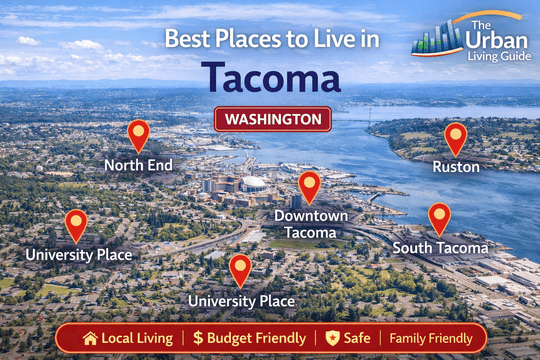
Best Neighborhoods in Tacoma, Washington: Puget Sound Waterfronts, Historic Districts & South Sound Pockets in 2026
Covering approximately 49.7 square miles of land area along the saltwater bluffs and deepwater inlets of Commencement Bay in Pierce County, the City of Tacoma operates under the council-manager municipal administration of the City of Tacoma. Housing a municipal core population exceeding 222,000 residents and anchoring a broader South Puget Sound regional footprint of over 930,000 people, the “Grit City” has evolved from a historic railroad terminal into an essential regional powerhouse for maritime container logistics at The Northwest Seaport Alliance, specialized healthcare systems, and higher education.
Relocating across the South Sound requires navigating steep shoreline bluffs, marine layer microclimates, historic neighborhood preservation overlays, and regional mass transit systems operated by Sound Transit and Pierce Transit. Inbound movers consistently balance direct access to primary regional employers—including the extensive medical cluster at MultiCare Tacoma General Hospital and Virginia Mason Franciscan Health (St. Joseph Medical Center), military personnel at Joint Base Lewis-McChord (JBLM), and higher-education research at the University of Washington Tacoma (UWT)—against daily highway commutes across Interstate 5, State Route 16 (Tacoma Narrows Bridge corridor), State Route 7 (Pacific Avenue), and State Route 509.
Take a virtual walking tour through the historic tree-canopied streets, waterfront promenades, and distinctive residential neighborhoods of Tacoma, Washington:
Key Residential Districts Across Tacoma, Washington in 2026
| Neighborhood Name | Location | Distance from Core (Downtown Tacoma) | Development Status | Transit Connectivity | Cost Level | Best Fit For |
|---|---|---|---|---|---|---|
| North End | North Puget Sound Peninsula | Approximately 2 miles northwest | Preserved Historic Residential | High (Pierce Transit Bus Routes, N 30th St) | High-to-Premium | Families, Physicians & University Faculty |
| Downtown Tacoma | Central Commencement Bay Core | 0 miles (Urban Center) | Revitalized Historic Commercial & Arts Core | Exceptional (T Line Light Rail, Sounder Train, I-5) | Mid-Range | Young Professionals, Seattle Commuters & Students |
| Ruston | North Waterfront Peninsula (Incorporated Town) | Approximately 4 miles northwest | Master-Planned Mixed-Use Waterfront | High (Ruston Way, N Pearl St, Ferry Access) | Ultra-Premium | Luxury Homebuyers, Boaters & Remote Executives |
| University Place | West Coastal Suburbs (Incorporated City) | Approximately 6 miles southwest | Established Master-Planned Coastal Suburban | Moderate (Bridgeport Way, SR-16) | High-to-Premium | Suburban Families, Golfers & Long-Term Residents |
| South Tacoma | South Central Urban Basin | Approximately 4 miles south | Historic Working-Class Residential & Rail Infill | Exceptional (South Tacoma Sounder Station, I-5, SR-512) | Accessible / Budget-Friendly | First-Time Homebuyers, Military Families & Renters |
Comprehensive Breakdown of the Best Neighborhoods in Tacoma, Washington
North End — Historic Craftsman Mansions, Proctor District & Puget Sound Overlooks
Covering the elevated peninsula overlooking Commencement Bay and the Tacoma Narrows, the North End is widely recognized as Tacoma’s most prestigious, architecturally rich, and family-oriented residential enclave. Comprising distinct micro-neighborhoods including the historic Proctor District, Old Town, and the grand estates of Stadium District, the area operates under City of Tacoma municipal governance. North End is celebrated for its brick-paved historic lanes, mature cherry and maple trees, pristine mountain vistas, and preserved early 20th-century estates.
The neighborhood provides an established community atmosphere paired with quick 5-minute access to the downtown core and medical systems, making it the primary choice for healthcare directors, university faculty, and growing families.
- Housing: Architectural inventory features grand Queen Anne Victorians, classic 1920s Craftsman bungalows, Tudor Revival brick estates, and view condominiums along N 30th Street. Single-family purchase prices typically range from $550,000 to $1,650,000+, while residential rentals and apartment flats average $1,750 to $2,850 per month.
- Safety & Crime Rate: Patrolled by the Tacoma Police Department (TPD) Sector 2 Command. North End consistently records some of the lowest violent and property crime rates in Pierce County, supported by active neighborhood councils and neighborhood watch block programs.
- School District & Education Quality: Governed by Tacoma Public Schools (District 10), containing top-performing public institutions such as Stadium High School (the famous French chateau-style castle landmark), Mason Middle School, and Washington Elementary School, alongside higher education at the University of Puget Sound (UPS).
- Walkability & Daily Conveniences: Outstanding pedestrian walkability (Walk Score of 86-90/100 within Proctor and Stadium). Residents walk to indie cinemas at the Blue Mouse Theatre, artisan bakeries, coffee roasters, local boutiques, and grocers like Metropolitan Market on Proctor, Safeway, and the weekly Proctor Farmers’ Market.
- Parks & Green Spaces / Pet-Friendliness: Exceptional natural amenities anchored by the sprawling 760-acre Point Defiance Park (featuring old-growth forests, Point Defiance Zoo & Aquarium, Owen Beach, and formal rose gardens), Puget Park, and Kandle Park (featuring wave pools and walking paths). Exceptionally dog-friendly.
- Parking & Traffic Congestion: Plentiful private residential driveways, detached carriage garages, and open on-street parking. Commuter traffic builds along Schuster Parkway and N Pearl Street (SR-163) during peak morning drive times.
- Noise Levels & Vibe: Serene, refined, and family-oriented, characterized by maritime breezes, college campus strolls, and quiet residential evenings.
- Medical Facilities & Hospitals: Direct 3-to-5 minute commute to the extensive medical cluster on the hill, anchored by MultiCare Tacoma General Hospital and Mary Bridge Children’s Hospital on Martin Luther King Jr. Way.
- Transit Connectivity: Served by high-frequency Pierce Transit Bus Routes (Routes 11 and 16), providing direct access into Downtown Tacoma, with rapid roadway access to State Route 16 and I-5.
- Affordability: High-tier price profile for Pierce County; higher real estate entry costs are offset by historic architectural preservation, school quality, and waterfront views.
- Who It’s Best For: Families prioritizing top-performing public and private schools, university faculty, physicians at Tacoma General, and buyers seeking historic charm.
- Drawbacks: Higher initial home purchase pricing, competitive parking near the Proctor retail hub on weekends, and older home mechanical systems requiring periodic updates.
Downtown Tacoma — Urban Brewery District, Museum Row & Sounder Commuter Transit
Rising along the hillsides directly overlooking the bustling docks of Commencement Bay and the Thea Foss Waterway, Downtown Tacoma serves as the civic, judicial, artistic, and academic engine of the South Sound. Guided by urban revitalization led by the City of Tacoma and the Downtown Tacoma Partnership, the urban core blends beautifully restored 19th-century brick and masonry architecture along Pacific Avenue with modern loft conversions, craft breweries, world-class glass art museums, and university research facilities.
The district provides a walkable urban lifestyle within steps of regional rail transit, waterfront esplanades, and expanding dining corridors.
- Housing: Real estate is dominated by converted historic industrial brick-and-timber lofts (such as The Perkins Building and Albers Mill Lofts), contemporary high-rise condominium towers, and modern mixed-use mid-rise apartment communities along Fawcett Avenue and Market Street. Condominium purchase valuations typically range from $240,000 to $650,000+, while modern rental apartments average $1,350 to $2,350 per month.
- Safety & Crime Rate: Patrolled by the TPD Sector 1 Command and supported by downtown security ambassadors. Pedestrian dining corridors along Pacific Avenue and the UW Tacoma campus maintain safe, well-illuminated foot traffic, though standard city awareness is advised on peripheral commercial blocks late at night.
- School District & Education Quality: Governed by Tacoma Public Schools, containing specialized choice campuses such as School of the Arts (SOTA), alongside higher-education institutions anchored by the expanding urban campus of University of Washington Tacoma (UWT).
- Walkability & Daily Conveniences: Outstanding pedestrian infrastructure (Walk Score of 88-92/100). Residents walk to over 40 local restaurants, coffee shops, performance halls at the Broadway Center for the Performing Arts (Pantages and Rialto Theaters), and museums along Museum Row (including the Museum of Glass, Tacoma Art Museum, and Washington State History Museum).
- Parks & Green Spaces / Pet-Friendliness: Direct access to the scenic walking trails of the Thea Foss Waterway Esplanade, Fireman’s Park, Wright Park (a 27-acre historic arboretum featuring the W.W. Seymour Botanical Conservatory), and Tol养成lefson Plaza. Highly pet-friendly with paved linear water trails.
- Parking & Traffic Congestion: Managed through municipal street meters and multi-level parking garages; most apartment and loft developments provide designated tenant parking. Surface street traffic flows smoothly with minimal rush-hour delays.
- Noise Levels & Vibe: Vibrant, historic, and creative, filled with streetcar bells, university student energy, live theater crowds, and active weekend craft market crowds.
- Medical Facilities & Hospitals: Direct 3-minute access up the hill to St. Joseph Medical Center on South J Street and Tacoma General Hospital.
- Transit Connectivity: Unrivaled regional transit hub centered at the Tacoma Dome Station, offering the non-stop commuter rail service of the Sound Transit Sounder Train (S Line) straight to King Street Station in Seattle, the Sound Transit T Line Light Rail (connecting the Dome, UWT, and the Hilltop Medical District), Sound Transit Express Buses, and direct vehicular access to Interstate 5 and State Route 509. Regional flights connect via Seattle-Tacoma International Airport (SEA) located 22 miles north.
- Affordability: Mid-range urban price structure; delivers authentic vintage architectural lofts and transit convenience at rates substantially lower than central Seattle.
- Who It’s Best For: Young professionals, Seattle commuters utilizing the Sounder train, UWT students and staff, medical fellows, and urbanites seeking a car-optional lifestyle.
- Drawbacks: Quieter late-night retail foot traffic on weekdays outside main dining pockets, limited full-scale supermarkets directly in the central commercial grid, and ongoing urban development transitions.
Ruston — Master-Planned Waterfront Luxury, Point Ruston & Puget Sound Views
Perched along the scenic northern tip of the Tacoma peninsula facing the waters of Dalco Passage and Vashon Island, the incorporated municipality of Ruston operates under its own town government via the Town of Ruston Official Website. Formerly a historic industrial smelter settlement, Ruston has undergone a multi-billion-dollar environmental and residential transformation anchored by the premier Point Ruston mixed-use resort waterfront village.
The community combines modern luxury condominium living with panoramic Puget Sound views, premier dining promenades, and direct connectivity to Point Defiance Park.
- Housing: Real estate stock features luxury high-end waterfront condominiums (such as The Copperline and The Century Condominiums), modern custom single-family view estates, and upscale townhomes along Ruston Way and N Pearl Street. Single-family and condominium purchase prices typically range from $620,000 to $2,800,000+, while luxury waterfront rental apartments average $2,200 to $4,500 per month.
- Safety & Crime Rate: Protected by the dedicated Ruston Police Department in coordination with the Tacoma Police Department, Ruston consistently posts some of the lowest violent and property crime figures in the South Sound, benefiting from high pedestrian activity and private village security.
- School District & Education Quality: Governed by Tacoma Public Schools, zoned to dependable public campuses such as Point Defiance Elementary School, Truman Middle School, and Silas High School.
- Walkability & Daily Conveniences: Outstanding village walkability (Walk Score of 84-88/100 within Point Ruston). Residents walk to over 25 waterfront restaurants, seafood bistros, artisan ice cream parlors, wine tasting rooms, the 9-screen Cinemark Luxury Theatre, and specialty markets.
- Parks & Green Spaces / Pet-Friendliness: Direct pedestrian access to the paved Waterwalk Trail connecting to the 2-mile Ruston Way Waterfront Path, the scenic gardens of Point Defiance Park, Dune Peninsula Park (featuring the Frank Herbert hiking trail and sliding mounds), and ferry connections at the Point Defiance Ferry Terminal to Tahlequah (Vashon Island). Exceptionally pet-friendly.
- Parking & Traffic Congestion: Assigned parking garages in multi-family developments and private driveways in residential tracts keep roads orderly. Commuter traffic builds along Ruston Way and N Pearl Street (SR-163) on warm summer weekends.
- Noise Levels & Vibe: Resort-like, scenic, and active, characterized by splashing waves, passing sailboat masts, waterfront joggers, and lively outdoor restaurant patios.
- Medical Facilities & Hospitals: Direct 8-minute drive to MultiCare Tacoma General Hospital and Mary Bridge Children’s Hospital.
- Transit Connectivity: Road travel connects via Ruston Way, N Pearl Street (SR-163), and N 46th Street, providing an 8-minute drive into Downtown Tacoma and 10 minutes to SR-16, supported by local Pierce Transit bus routes.
- Affordability: Ultra-premium price tier for the Pierce County market; elevated property values and rental rates reflect the community’s premier water views, resort-style amenities, and direct park access.
- Who It’s Best For: Luxury buyers, remote tech executives, boating and kayak enthusiasts, empty-nesters down-sizing to maintenance-free condominiums, and medical leaders.
- Drawbacks: High housing costs per square foot, heavy summer weekend visitor crowding along the waterfront promenade, and higher homeowners association (HOA) dues on luxury waterfront buildings.
University Place — Chambers Bay Golf, Top-Tier Public Schools & Coastal Suburbia
Situated in western Pierce County along the saltwater shores of the Puget Sound overlooking the Olympic Mountains, the incorporated municipality of University Place (UP) operates under its own municipal government via the City of University Place Official Portal. Developed throughout the mid-to-late 20th century, the city is world-famous as the home of Chambers Bay Golf Course, host of the 2015 U.S. Open.
Centering along Bridgeport Way and Grandview Drive W, University Place combines quiet master-planned subdivisions with championship golf facilities, scenic coastal walking trails, and premier public education.
- Housing: Real estate features 1970s–1990s custom single-family ranch and two-story homes in mature subdivisions (such as Beckonridge and Chambers Creek), modern luxury golf-adjacent residences, and contemporary townhomes near the Town Center at University Place. Single-family purchase prices typically range from $480,000 to $1,450,000+, while residential rentals and townhomes average $1,650 to $2,850 per month.
- Safety & Crime Rate: Protected by the dedicated University Place Police Department (contracted through the Pierce County Sheriff’s Department), UP consistently records low violent and property crime rates, supported by proactive neighborhood patrols and active community engagement.
- School District & Education Quality: Governed by the nationally acclaimed University Place School District (UPSD 83), featuring top-performing public institutions such as Curtis Senior High School, Curtis Junior High School, and Chambers Primary School.
- Walkability & Daily Conveniences: The newly developed municipal core at Town Center on Bridgeport Way is pedestrian-friendly, featuring Whole Foods Market, the University Place Public Library, local coffee houses, and dining, while shopping power centers host Trader Joe’s and Safeway.
- Parks & Green Spaces / Pet-Friendliness: World-class natural recreation centered around the 250-acre Chambers Creek Regional Park (featuring the championship links course, coastal walking loops, public dog beaches, and mountain views), Cirque Park, and Curran Apple Orchard Park. Exceptionally pet-friendly.
- Parking & Traffic Congestion: Plentiful private two-to-three car garages and wide residential driveways keep neighborhood lanes clear. Commuter traffic on Bridgeport Way and 67th Avenue W moves smoothly, with minor delays near the State Route 16 Interchange during morning rush hours.
- Noise Levels & Vibe: Serene, grounded, and family-oriented, characterized by sound of pine trees, golf carts, children riding bicycles, and calm evenings.
- Medical Facilities & Hospitals: Direct 10-minute drive to St. Anthony Hospital in nearby Gig Harbor or Tacoma General Hospital via SR-16.
- Transit Connectivity: Roadway connectivity via Bridgeport Way, Grandview Drive, and State Route 16, offering a 12-minute drive to Downtown Tacoma and 15 minutes to Interstate 5, supported by Pierce Transit Bus Routes (Routes 2 and 53).
- Affordability: Mid-to-high suburban price profile; higher real estate acquisition costs are balanced by top-tier UPSD school ratings, manicured municipal parks, and strong property equity stability.
- Who It’s Best For: Families prioritizing top-performing public education (Curtis High), avid golfers, corporate commuters working in Pierce County, and buyers seeking tranquil coastal suburban living.
- Drawbacks: Higher single-family home purchase prices, automobile reliance for daily errands outside the Town Center, and longer commute times into central Seattle during peak highway traffic.
South Tacoma — Working-Class Heritage, Direct Rail Transit & Attainable Starter Homes
Covering the historic railway basin south of central Tacoma along the South Tacoma Way and Pacific Avenue (SR-7) corridors, South Tacoma is one of the city’s most historically grounded, culturally diverse, and budget-accessible residential sectors. Originally founded as the primary heavy repair shop for the Northern Pacific Railway in the late 19th century, South Tacoma operates under City of Tacoma municipal administration and is championed by the South Tacoma Business District.
The neighborhood provides an accessible entry point for first-time homebuyers, military personnel, and tradespeople seeking starter homes with direct commuter rail access.
- Housing: Real estate consists of early 20th-century Craftsman bungalows, classic 1940s–1960s single-story wood-frame ranch homes on generous lots, attached duplexes, and value-oriented apartment complexes. Single-family purchase prices typically range from $280,000 to $460,000, while rental apartments and homes average $1,150 to $1,850 per month.
- Safety & Crime Rate: Patrolled by the TPD Sector 3 Command. Crime metrics and property upkeep can vary by block, making targeted street-level research important before leasing or purchasing, though established residential tracts in the Edison and Manitou neighborhoods maintain active block clubs and calmer conditions.
- School District & Education Quality: Governed by Tacoma Public Schools, containing neighborhood institutions such as Mount Tahoma High School, Baker Middle School, and Manitou Park Elementary, alongside nearby higher education at Bates Technical College South Campus.
- Walkability & Daily Conveniences: High pedestrian walkability along the historic South Tacoma Way business district, hosting local international grocers, authentic Mexican and Asian eateries, hardware supply outlets, vintage auto shops, and community diners, with regional retail at Tacoma Mall located just north.
- Parks & Green Spaces / Pet-Friendliness: Municipal recreation is anchored by the historic Wapato Park (a 80-acre park featuring a freshwater lake, historic walking paths, spray pads, and a dedicated 3-acre dog park), South Park, and natural walking trails through Oak Tree Park. Highly pet-friendly.
- Parking & Traffic Congestion: Plentiful private residential driveways, detached garages, and open on-street parking. Direct highway on-ramps provide fast access to Interstate 5 (Exits 129 through 132) and State Route 512 with minimal local delay.
- Noise Levels & Vibe: Community-centered, industrial-rooted, and active, shifting from commercial and freight corridors to quiet residential evenings in established subdivisions.
- Medical Facilities & Hospitals: Direct 8-to-10 minute access north to St. Joseph Medical Center and Tacoma General Hospital.
- Transit Connectivity: Outstanding regional commuter rail transit centered at the South Tacoma Sounder Station, offering direct train service to Downtown Seattle, supported by Pierce Transit Bus Routes (Routes 3 and 53) and rapid highway access to I-5.
- Affordability: Tacoma’s most accessible entry-level homeownership and rental price tier, offering lower purchase barriers and manageable property assessments.
- Who It’s Best For: First-time homebuyers, budget-conscious renters, real estate investors, military personnel stationed at JBLM, and commuters seeking direct Sounder rail transit.
- Drawbacks: Pockets of deferred property maintenance, variable public school test performance ratings, older home infrastructure requiring mechanical modernization, and industrial railway freight noise.
Neighborhood Trade-offs: Living Advantages & Drawbacks Across Tacoma, Washington
| Neighborhood | Core Advantages (Pros) | Core Limitations (Cons) |
|---|---|---|
| North End | Preserved historic Craftsman architecture; walkable Proctor District; top-rated Stadium High school; 760-acre Point Defiance Park. | Higher purchase entry barrier; older home heating and plumbing systems; weekend parking competition in Proctor. |
| Downtown Tacoma | Direct Sound Transit Sounder Train to Seattle; T Line Light Rail; historic lofts on Pacific Ave; Museum Row; UWT campus. | Quieter weekday late-night foot traffic; lack of large grocery stores directly in the core; ongoing infill transitions. |
| Ruston | Modern luxury waterfront condominiums at Point Ruston; direct access to Dune Peninsula Park and beaches; fine dining; lowest crime. | Ultra-premium real estate valuations; high monthly HOA dues; heavy summer tourist and visitor parking congestion. |
| University Place | Top-ranked University Place (Curtis High) schools; world-class Chambers Bay Golf Course; Town Center Whole Foods; quiet suburbia. | Automobile dependence for daily errands; higher single-family home prices; longer commute to Seattle employment centers. |
| South Tacoma | Tacoma’s most affordable home and rental prices; direct South Tacoma Sounder Station train; 80-acre Wapato Park; fast I-5 and JBLM access. | Safety and property upkeep vary significantly by street; variable public school performance ratings; industrial freight noise. |
Finding Your Ideal Fit Among Tacoma, Washington Neighborhoods
Selecting your ideal neighborhood in Tacoma requires balancing your gross household budget with daily workplace destinations, family schooling priorities, and regional transit logistics. Because the South Puget Sound region is connected by major transportation corridors like Interstate 5 and State Route 16, your chosen location dictates whether your daily commute relies on direct commuter rail via the Sounder Train (Downtown Tacoma, South Tacoma), walkable sidewalks along Proctor District, or driving commutes across the Tacoma Narrows Bridge.
Healthcare professionals at MultiCare Tacoma General or St. Joseph Medical Center, military personnel stationed at Joint Base Lewis-McChord (JBLM), faculty and students at UW Tacoma or UPS, and corporate commuters traveling northward into Seattle should evaluate transit routes to optimize daily convenience.
Beyond transportation corridors, evaluate essential municipal utility and building infrastructure realities. The Pacific Northwest experiences extended overcast skies and rainfall during winter months with mild marine summer weather, making heating efficiency, moisture ventilation, and utility reliability through Tacoma Public Utilities (TPU)—the municipally owned electric, water, and rail utility—and Puget Sound Energy (PSE) an important factor.
In addition, prospective homebuyers evaluating historic Craftsman homes in North End or South Tacoma should budget for roof and moisture maintenance, while condominium buyers in Point Ruston should verify homeowners association (HOA) reserve funds. Before executing a residential lease or property purchase agreement, verify high-speed fiber broadband availability (such as CenturyLink Fiber or Xfinity Gigabit) and confirm Pierce County school assignment boundaries.
Essential FAQs About Living in Tacoma, Washington Neighborhoods
Which neighborhood in Tacoma is considered best for families with school-age children?
North End and University Place are widely regarded as premier family communities in Greater Tacoma. North End offers access to top-performing public institutions like Stadium High School alongside safe, tree-lined residential neighborhoods and Point Defiance Park. University Place provides access to the nationally top-ranked University Place School District (Curtis Senior High School) paired with quiet master-planned subdivisions and Chambers Creek Regional Park.
What is the most walkable neighborhood in Tacoma where you can live without relying heavily on a car?
Downtown Tacoma and the Proctor District within North End offer the highest walkability in the city, both scoring above 86 on Walk Score. Downtown Tacoma allows residents to complete daily errands on foot, walk to local restaurants, museums along Museum Row, and connect directly to the Sounder commuter train and T Line Light Rail. The Proctor District offers dense pedestrian access to boutique shopping, cafes, and grocery markets like Metropolitan Market.
What are the safest residential neighborhoods to live in within Greater Tacoma?
Ruston, North End, and University Place consistently report some of the lowest violent and property crime rates in Pierce County. Ruston benefits from modern master-planned security and dedicated town policing, while North End and University Place maintain active community block watch networks and low through-traffic.
What are the most affordable neighborhoods for homebuyers and renters in Tacoma?
South Tacoma, Eastside, and parts of Central Tacoma provide the most budget-friendly housing opportunities in the area. In South Tacoma, buyers and renters can secure historic single-family starter homes and apartments with direct commuter rail access at price points substantially lower than north Tacoma enclaves.
How long is the commute from Tacoma to Downtown Seattle?
Commuting from Tacoma to Seattle via the Sound Transit Sounder Train (S Line) takes approximately 60 minutes from Tacoma Dome Station straight into King Street Station in Seattle, offering a reliable, stress-free alternative to driving. Driving via Interstate 5 northbound typically takes between 50 and 90 minutes depending on peak morning rush-hour traffic.
Which Tacoma neighborhood is best for military personnel stationed at JBLM?
South Tacoma and University Place provide the fastest and most convenient commutes to Joint Base Lewis-McChord (JBLM). South Tacoma offers immediate access to Interstate 5 and SR-512, allowing service members to reach base gates within a 10-to-15 minute drive.
Is Tacoma an affordable place to live compared to Seattle?
Yes, Tacoma’s overall cost of living and housing prices are significantly lower than Seattle, offering spacious historic homes, lower rental rates, and large residential lots at a fraction of King County real estate prices while remaining connected via regional transit.
Tacoma, Washington Relocation Resources & Living Guides
The Urban Living Guide creates deeply researched, practical, and informative city relocation resources designed to help individuals, working professionals, and families navigate complex urban landscapes. By analyzing municipal infrastructure, hyper-local zoning patterns, commuter realities, and housing markets, our guides provide actionable insights so you can make confident, data-backed decisions when moving to major metropolitan areas.
Explore our regional guides across Tacoma and the South Puget Sound region:
- Living in Tacoma, Washington
- Cost of Living in Tacoma, Washington
- Pros and Cons of Living in Tacoma, Washington
Made your decision to move to the South Sound’s premier hub? Read our comprehensive relocation roadmap: Moving to Tacoma, Washington.
Follow The Urban Living Guide for ongoing regional insights, neighborhood developments, and expert local coverage across Greater Tacoma and the state of Washington.