

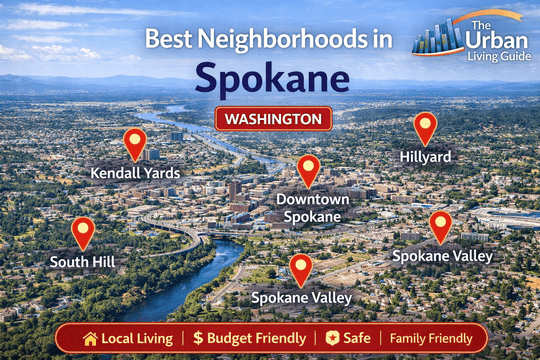
Best Neighborhoods in Spokane, Washington: Riverfront Promenades, South Hill Parks & Inland Northwest Enclaves in 2026
Covering approximately 69.5 square miles of land area across the elevated pine plateaus and basalt river bluffs of Eastern Washington, the City of Spokane functions under the mayor-council municipal governance of the City of Spokane while serving as the primary county seat and economic hub of Spokane County. Housing a municipal core population exceeding 230,000 residents and anchoring an expansive Inland Northwest metropolitan area of over 600,000 people, the region serves as the leading commercial, medical, aerospace supply, and higher-education center between the Cascade Range and the Rocky Mountains.
Relocating across the Inland Empire requires evaluating four-season climate patterns, river canyon topography, localized neighborhood revivals, and transit networks operated by the Spokane Transit Authority (STA). Inbound movers consistently balance direct access to primary regional employment hubs—including the University District Healthcare & Innovation Corridor, healthcare networks at Providence Sacred Heart Medical Center and MultiCare Deaconess Hospital, Fairchild Air Force Base, and aerospace facilities adjacent to Spokane International Airport (GEG)—against daily commute routes across Interstate 90, US Route 2, US Route 395 (North Spokane Corridor), and Division Street.
Take a virtual walking tour through the basalt bluffs, tree-lined avenues, and distinctive residential neighborhoods of Spokane, Washington:
Key Residential Districts Across Spokane, Washington in 2026
| Neighborhood Name | Location | Distance from Core (Downtown Spokane) | Development Status | Transit Connectivity | Cost Level | Best Fit For |
|---|---|---|---|---|---|---|
| South Hill | South Central Ridge | Approximately 2 miles south | Historic Olmsted-Canopied Residential | High (STA Route Networks, Grand Blvd, Ray St) | Mid-to-High Range | Families, Medical Directors & Long-Term Homeowners |
| Downtown Spokane | Central River Basin | 0 miles (Urban Center) | Revitalized Historic Commercial & Arts Core | Exceptional (STA Plaza, City Line BRT, I-90) | Mid-Range | Young Professionals, Healthcare Staff & Urbanites |
| Kendall Yards | North River Gorge Bluff | Approximately 0.8 miles northwest | Master-Planned Mixed-Use Waterfront | Exceptional (Centennial Trail, Bridge Ave) | High-to-Premium | Remote Workers, Creatives & Down-sizers |
| Spokane Valley | Eastern Valley (Incorporated City) | Approximately 9 miles east | Established Suburban & Commercial | High (I-90, Sprague Ave, Pines Rd) | Accessible / Mid-Range | Families, Tradespeople & Interstate Commuters |
| Hillyard | Northeast Rail Corridor | Approximately 4.5 miles northeast | Historic Industrial & Revitalizing Infill | High (Market St, North Spokane Corridor / US-395) | Accessible / Budget-Friendly | First-Time Homebuyers, Renters & Investors |
Comprehensive Breakdown of the Best Neighborhoods in Spokane, Washington
South Hill — Historic Basalt Mansions, Manicured Parks & Premier Residential Living
Rising along the southern basalt plateau overlooking Downtown Spokane, South Hill is widely recognized as the city’s most architecturally distinguished and sought-after residential district. Encompassing historic micro-enclaves like Manito, Rockwood, Cliff-Cannon, and Comstock, the area operates under City of Spokane municipal services and is guided by the South Hill Coalition. South Hill is celebrated for its lush park systems designed in the early 20th century by the Olmsted Brothers, towering ponderosa pine canopies, and preserved historic stone architecture.
The neighborhood provides an established residential environment paired with swift 5-minute access to the downtown medical centers, making it the primary choice for physicians, healthcare executives, and growing families.
- Housing: Architectural inventory features grand early 20th-century Craftsman bungalows, Tudor Revival stone estates, mid-century brick ranches, and contemporary single-family homes in newer upper-hill developments. Single-family purchase prices typically range from $360,000 to $1,250,000+, while residential rentals and historic conversion flats average $1,350 to $2,350 per month.
- Safety & Crime Rate: Patrolled by the Spokane Police Department (SPD) South Precinct. South Hill consistently records some of the lowest violent and property crime rates in the metropolitan core, supported by active neighborhood councils and neighborhood watch programs.
- School District & Education Quality: Governed by Spokane Public Schools (District 81), containing top-performing public institutions such as Lewis and Clark High School, Sacajawea Middle School, and Hutton Elementary School, alongside premier private academies like St. George’s School nearby.
- Walkability & Daily Conveniences: The historic commercial village along Grand Boulevard and 29th Avenue is pedestrian-friendly, featuring artisan bakeries, indie coffee houses, specialty wine shops, and full-service grocers like Huckleberry’s Natural Market, Rosauers Supermarkets, and Trader Joe’s.
- Parks & Green Spaces / Pet-Friendliness: World-class municipal parks anchored by the 90-acre Manito Park and Botanical Gardens (featuring sunken rose gardens, the Nishinomiya Tsutakawa Japanese Garden, and Gaiser Conservatory), Cannon Hill Park, and Comstock Park (featuring public aquatic centers and shaded picnic groves). Exceptionally dog-friendly.
- Parking & Traffic Congestion: Plentiful private residential driveways and detached multi-car garages keep neighborhood streets clear. Winter driving requires caution on steep roads like Freya Way and Grand Boulevard during snow and freezing rain events.
- Noise Levels & Vibe: Peaceful, refined, and family-oriented, characterized by pine scents, birdsong, and quiet residential evenings.
- Medical Facilities & Hospitals: Direct 4-minute commute to the Lower South Hill medical district, anchored by Providence Sacred Heart Medical Center & Children’s Hospital and MultiCare Deaconess Hospital.
- Transit Connectivity: High-frequency public transit provided by STA Bus Routes (including Route 4 and Route 43) connecting directly to the central transit plaza downtown, with vehicular access via Grand Boulevard, Ray Street, and Interstate 90.
- Affordability: Mid-to-high price profile for Spokane County; higher real estate acquisition costs are balanced by strong school ratings, park access, and solid property appreciation.
- Who It’s Best For: Families prioritizing top-tier Spokane District 81 public schools, physicians and medical staff at Sacred Heart, and buyers seeking classic architectural charm surrounded by manicured parklands.
- Drawbacks: Higher entry home purchase prices, winter driving challenges on steep downhill icy streets, and older home mechanical systems requiring modernization.
Downtown Spokane — Riverfront Urban Core, Historic Brick Architecture & The City Line BRT
Centering around the roaring waters of the Spokane Falls on the Spokane River, Downtown Spokane serves as the financial, cultural, judicial, and entertainment capital of the Inland Northwest. Operating under City of Spokane municipal planning and championed by the Downtown Spokane Partnership, the urban core blends beautifully preserved brick and terracotta architecture from the early 20th century with modern residential lofts, corporate headquarters, and regional arts centers.
The district provides a walkable urban lifestyle filled with craft breweries, farm-to-table restaurants, and direct access to urban waterfall trails along Main Avenue and Riverside Avenue.
- Housing: Real estate is dominated by restored brick-and-timber industrial lofts (such as The Morgan Lofts and Symons Building), contemporary mid-rise apartments, and converted upper-floor condominiums. Condominium purchase valuations typically range from $180,000 to $480,000+, while modern rental lofts average $1,150 to $1,950 per month.
- Safety & Crime Rate: Patrolled by the SPD Downtown Precinct and supported by downtown security ambassadors. Well-lit dining corridors and riverfront paths maintain safe pedestrian traffic, though standard city awareness is advised on peripheral commercial blocks late at night.
- School District & Education Quality: Governed by Spokane Public Schools, alongside higher-education anchors in the adjacent University District hosting campuses for Gonzaga University, Washington State University Spokane (Elson S. Floyd College of Medicine), and Eastern Washington University.
- Walkability & Daily Conveniences: Outstanding pedestrian walkability (Walk Score of 88-92/100). Residents walk to over 60 local restaurants, coffee roasters, performing arts halls at the First Interstate Center for the Arts and historic Martin Woldson Theater at The Fox, and indoor shopping at River Park Square.
- Parks & Green Spaces / Pet-Friendliness: Direct access to the historic 100-acre Riverfront Park (site of the 1974 World’s Fair, featuring the Numerica Skate Ribbon, Looff Carrousel, and Spokane Falls skyride gondolas) and the paved 40-mile Spokane River Centennial State Park Trail. Highly pet-friendly with walkable riverside promenades.
- Parking & Traffic Congestion: Managed through municipal on-street meters, parking structures, and connected elevated skywalk networks; most residential loft developments provide assigned tenant parking. Surface street traffic flows smoothly with minimal delays.
- Noise Levels & Vibe: Vibrant, historic, and active, filled with waterfall roar, live theater crowds, outdoor dining chatter, and weekend festival crowds at Riverfront Park.
- Medical Facilities & Hospitals: Direct 3-minute access south to MultiCare Deaconess Hospital and Providence Sacred Heart.
- Transit Connectivity: Central regional transit hub operated by the Spokane Transit Authority (STA Plaza), featuring the zero-emission City Line Bus Rapid Transit (BRT) connecting Downtown to the University District and Brownder’s Addition, with immediate vehicular access to Interstate 90 and Division Street (US-2). Regional air transit is served via Spokane International Airport (GEG) located 6 miles west.
- Affordability: Accessible urban cost structure; delivers authentic vintage architectural lofts and dining convenience at rates substantially lower than coastal Washington cities.
- Who It’s Best For: Young professionals, medical fellows, university staff, corporate employees, and urbanites seeking walkable riverfront living.
- Drawbacks: Quieter late-night foot traffic on weekdays, lack of large traditional supermarkets directly in the retail core (relying on urban markets and delivery), and winter street parking restrictions during major snow plowing operations.
Kendall Yards — Master-Planned Urban Village, River Gorge Promenades & Modern Design
Situated along the northern bluffs of the Spokane River gorge directly across from downtown, Kendall Yards is one of the most successful urban infill and master-planned mixed-use communities in the Pacific Northwest. Developed starting in the late 2000s on a reclaimed historic railroad yard, the neighborhood operates under City of Spokane municipal services and private HOA architectural oversight.
The community is designed around pedestrian-first principles, energy-efficient modern architecture, dedicated public art installations, and direct access to the scenic Centennial Trail along Summit Parkway.
- Housing: Real estate stock features modern contemporary townhomes, sleek energy-efficient single-family cottages with detached garages, urban flat condominiums, and upscale mid-rise rental communities. Single-family home and townhome purchase prices typically range from $390,000 to $920,000+, while modern apartment rentals average $1,400 to $2,450 per month.
- Safety & Crime Rate: Patrolled by the SPD North Precinct. Kendall Yards maintains low crime rates, supported by high pedestrian foot traffic, modern environmental lighting, and active community engagement.
- School District & Education Quality: Governed by Spokane Public Schools, zoned to public campuses such as North Central High School, Glover Middle School, and Holmes Elementary School.
- Walkability & Daily Conveniences: Outstanding pedestrian walkability (Walk Score of 86-90/100). Residents walk along Summit Parkway to independent cafes, artisan bakeries, award-winning craft bistros, wellness studios, local bookstores, and neighborhood grocers like My Fresh Basket.
- Parks & Green Spaces / Pet-Friendliness: Exceptional natural amenities anchored by the paved Centennial Trail running directly along the neighborhood’s southern edge, Olmsted Brothers Green, Nesting Park, and immediate pedestrian bridge access to Riverfront Park. Exceptionally dog-friendly with scenic walking paths.
- Parking & Traffic Congestion: Attached private garages, rear alley driveways, and open village street parking keep roads orderly. Vehicular traffic flows smoothly with quick access to Monroe Street and Maple Street bridges.
- Noise Levels & Vibe: Modern, active, and lifestyle-focused, characterized by evening joggers along the river bluffs, outdoor patio dining conversations, and quiet residential streets.
- Medical Facilities & Hospitals: Direct 5-minute drive across the river bridges to MultiCare Deaconess Hospital and Providence Sacred Heart.
- Transit Connectivity: Outstanding multi-modal transit: 10-minute walk into Downtown Spokane via the Monroe Street Bridge, direct cycling access along the Centennial Trail, and public bus transit provided by STA Bus Routes (including Route 11).
- Affordability: Mid-to-high price structure; premium price-per-square-foot metrics reflect the neighborhood’s modern energy-efficient construction, river views, and walkable lifestyle amenities.
- Who It’s Best For: Remote tech workers, young professionals, healthcare practitioners, empty-nesters down-sizing from larger suburban estates, and culinary enthusiasts.
- Drawbacks: Higher purchase prices per square foot compared to older Spokane neighborhoods, mandatory monthly HOA fees, and competitive street parking near commercial restaurants on weekends.
Spokane Valley — Expansive Suburban Acreage, Retail Centers & Outdoor Recreation
Positioned in the eastern valley basin along the Spokane River stretching toward the Idaho state border, the incorporated municipality of Spokane Valley is the region’s primary suburban, commercial, and industrial growth engine. Operating under its own independent municipal government via the City of Spokane Valley Official Portal, the community encompasses established residential neighborhoods centered along Sprague Avenue, Pines Road (WA-27), and Sullivan Road.
Spokane Valley combines generous residential lot sizes, mountain foothill views, extensive retail power centers, and direct highway travel into both downtown Spokane and Coeur d’Alene, Idaho.
- Housing: Real estate features mid-century single-story ranch homes, 1980s–2000s two-story suburban family residences on quarter-to-half-acre lots, modern subdivision tracts, and garden-style apartment communities. Single-family purchase prices typically range from $280,000 to $580,000, while rental apartments and homes average $1,150 to $1,850 per month.
- Safety & Crime Rate: Protected by the dedicated Spokane Valley Police Department (SVPD) in partnership with the Spokane County Sheriff’s Office, maintaining stable residential subdivisions with low violent crime rates.
- School District & Education Quality: Governed by the highly regarded Central Valley School District (CVSD) and West Valley School District, containing top-rated public campuses including Central Valley High School, University High School, and Barker High School.
- Walkability & Daily Conveniences: Suburban residential streets are car-dependent, but major commercial shopping corridors along Sprague Avenue and Broadway Avenue host Spokane Valley Mall, Costco Wholesale, WinCo Foods, Target, and extensive family dining.
- Parks & Green Spaces / Pet-Friendliness: Outstanding recreational amenities anchored by Mirabeau Point Park (featuring waterfalls, walking trails, and the Discovery Playground), Plante’s Ferry Sports Complex along the Spokane River, Sullivan Park, and nearby hiking at Dishman Hills Conservation Area. Extremely pet-friendly.
- Parking & Traffic Congestion: Plentiful private two-to-three car garages, large suburban driveways, and boat/RV parking pads. Commuter traffic moves efficiently, with minor slowdowns along Interstate 90 and Pines Road during peak morning rush hours.
- Noise Levels & Vibe: Grounded, spacious, and family-centered, characterized by mountain views, quiet residential loops, and calm evenings.
- Medical Facilities & Hospitals: Direct emergency medical coverage provided within city borders by MultiCare Valley Hospital on East Mission Avenue.
- Transit Connectivity: Unmatched highway connectivity along Interstate 90 (Exits 287 through 295), offering a 10-minute drive into Downtown Spokane and 20 minutes to Coeur d’Alene, supported by STA Bus Routes (Routes 90, 96, 98).
- Affordability: Greater Spokane’s most balanced mid-range price tier, offering larger lot sizes, attached garages, and lower square-footage purchase costs compared to South Hill or Kendall Yards.
- Who It’s Best For: Families seeking strong public schools in the Central Valley district, tradespeople, RV/boat owners needing expansive yard storage, and commuters traveling between Spokane and North Idaho.
- Drawbacks: Automobile reliance for daily shopping and errands, suburban commercial strip density along Sprague Avenue, and longer commute times into downtown medical centers during winter highway slowdowns.
Hillyard — Historic Railroad Heritage, Antique Corridors & Budget-Conscious Housing
Covering the historic northeast sector of the city, Hillyard is one of Spokane’s most historically grounded, culturally authentic, and budget-accessible residential neighborhoods. Originally founded as an independent railroad town around the massive Great Northern Railway repair yards, Hillyard operates under City of Spokane municipal administration and is listed on the National Register of Historic Places. Centered along the historic brick storefronts of Market Street, the district is undergoing community-driven revitalization supported by the Historic Hillyard Association.
The neighborhood provides an accessible entry point for first-time homebuyers, tradespeople, and budget-conscious renters seeking affordable starter homes near expanding transportation corridors.
- Housing: Real estate consists of early 20th-century Craftsman bungalows, classic wood-frame worker cottages, modest single-story ranch homes on generous lots, and value-oriented multi-family duplexes. Single-family purchase prices typically range from $160,000 to $295,000, while rental homes and apartments average $850 to $1,350 per month.
- Safety & Crime Rate: Patrolled by the SPD North Precinct. Safety and property maintenance metrics can vary from block to block, making targeted street-level research important before leasing or purchasing, though ongoing civic investments continue to stabilize residential corridors.
- School District & Education Quality: Governed by Spokane Public Schools, containing neighborhood public campuses such as Rogers High School (featuring state-of-the-art career and technical training facilities), Garry Middle School, and Whitman Elementary School.
- Walkability & Daily Conveniences: High pedestrian accessibility along the historic Market Street commercial district, hosting local antique shops, diners, bakeries, neighborhood taverns, hardware supply outlets, and community grocers like Hillyard Market.
- Parks & Green Spaces / Pet-Friendliness: Municipal recreation is anchored by Harmon Park (featuring youth athletic complexes and playgrounds), Beacon Hill Park (the region’s premier mountain biking and hiking trail system located immediately east), and nearby walking paths along the Children of the Sun Trail. Highly pet-friendly.
- Parking & Traffic Congestion: Plentiful private residential driveways, detached garages, and open on-street parking. Highway on-ramps provide fast access to the newly completed sections of the North Spokane Corridor (US-395) without major traffic delays.
- Noise Levels & Vibe: Community-centered, unpretentious, and active, shifting from commercial daytime avenues to quiet residential evenings in established pockets.
- Medical Facilities & Hospitals: Direct 8-to-10 minute access to Providence Holy Family Hospital on North Lidgerwood Street.
- Transit Connectivity: Public bus transit provided by STA Bus Routes (Routes 27 and 33) running along Market and Wellesley Streets directly into the Downtown STA Plaza, with rapid vehicle access to the North Spokane Corridor (US-395) and Wellesley Avenue.
- Affordability: Spokane’s most accessible entry-level homeownership and rental price tier, offering low purchase barriers and manageable property assessments.
- Who It’s Best For: First-time homebuyers, budget-conscious renters, real estate investors, mountain biking enthusiasts wanting proximity to Beacon Hill trails, and tradespeople.
- Drawbacks: Pockets of deferred property maintenance, variable public school test performance ratings, older home infrastructure requiring mechanical updates, and ongoing highway construction nearby.
Neighborhood Trade-offs: Living Advantages & Drawbacks Across Spokane, Washington
| Neighborhood | Core Advantages (Pros) | Core Limitations (Cons) |
|---|---|---|
| South Hill | 90-acre Manito Park and botanical gardens; top-performing Lewis and Clark High school; historic stone architecture; lowest crime rates. | Higher purchase entry barrier; steep downhill streets during icy winter conditions; older home mechanical systems. |
| Downtown Spokane | High walkability along the Spokane River and Riverfront Park; restored historic lofts; zero-emission City Line BRT; central transit hub. | Quieter late-night foot traffic on weekdays; lack of large supermarkets in the central retail core; winter snow plow parking bans. |
| Kendall Yards | Master-planned energy-efficient townhomes; direct access to the 40-mile Centennial Trail; walkable cafes on Summit Pkwy; river gorge views. | Higher price-per-square-foot entry point; mandatory monthly HOA assessments; weekend restaurant visitor parking congestion. |
| Spokane Valley | Top-rated Central Valley public schools; spacious half-acre lots with RV/boat parking; Spokane Valley Mall; fast I-90 access. | Automobile dependence for all daily errands; suburban commercial strip density on Sprague Ave; longer winter highway commutes. |
| Hillyard | Spokane’s most affordable home and rental prices; historic brick antique district on Market St; close to Beacon Hill mountain bike trails. | Safety and property upkeep vary significantly by street; variable public school performance ratings; older housing infrastructure. |
Finding Your Ideal Fit Among Spokane, Washington Neighborhoods
Selecting your ideal neighborhood in Spokane requires balancing your gross household budget with daily workplace destinations, family schooling priorities, and winter driving logistics. Because the Inland Northwest experiences true four-season weather with freezing temperatures and snowfall from November through March, your chosen location dictates whether your daily commute involves a simple 5-minute drive via the City Line BRT or Grand Boulevard, or navigating highway interchanges along Interstate 90 and US-395 (North Spokane Corridor).
Healthcare professionals and medical residents at Sacred Heart or Deaconess, faculty and students at Gonzaga or WSU Spokane, corporate employees in Downtown Spokane, and aerospace personnel at Fairchild Air Force Base should evaluate transit corridors to optimize daily convenience.
Beyond transportation routes, evaluate essential municipal utility and building infrastructure realities. Eastern Washington experiences sub-freezing winter weather alongside warm, dry summers, making heating efficiency, insulation, and utility reliability through Avista Utilities and municipal water services an important factor.
In addition, prospective homebuyers evaluating historic Craftsman homes on South Hill or bungalows in Hillyard should budget for furnace and roof winter maintenance, while townhome buyers in Kendall Yards should verify homeowners association (HOA) reserve funds. Before executing a residential lease or property purchase agreement, verify high-speed fiber broadband availability (such as Quantum Fiber, TDS Telecom, or Xfinity Gigabit) and confirm county school assignment boundaries.
Essential FAQs About Living in Spokane, Washington Neighborhoods
Which neighborhood in the Spokane area is considered best for families with school-age children?
South Hill and Spokane Valley are widely regarded as premier family communities in Greater Spokane. South Hill provides access to top-performing public schools in Spokane District 81 (such as Lewis and Clark High School and Hutton Elementary) alongside world-class community parks like Manito Park. Spokane Valley offers spacious suburban lots and access to the top-rated Central Valley School District.
What is the most walkable neighborhood in Spokane where you can live without relying heavily on a car?
Downtown Spokane and Kendall Yards offer the highest walkability in the region, both scoring above 86 on Walk Score. Downtown allows residents to complete daily errands on foot, walk to local restaurants, performing arts theaters, Riverfront Park, and the STA Transit Plaza. Kendall Yards provides dense pedestrian connectivity along Summit Parkway and the paved Centennial Trail directly into the urban core.
What are the safest residential neighborhoods to live in within Greater Spokane?
South Hill, Kendall Yards, and outer suburban enclaves in Spokane Valley consistently report the lowest violent and property crime rates in Spokane County. South Hill benefits from established residential stability and active neighborhood block watch networks, while Kendall Yards maintains modern environmental lighting and clean pedestrian corridors.
What are the most affordable neighborhoods for homebuyers and renters in Spokane?
Hillyard, Bemiss, and parts of Northwest Spokane provide the most budget-friendly housing opportunities in the area. In Hillyard, buyers and renters can secure historic single-family starter homes and duplex apartments at price points substantially lower than regional and state averages.
How bad is winter weather when commuting across Spokane neighborhoods?
Spokane experiences cold winters with average annual snowfall between 40 and 50 inches. While the city and county operate comprehensive snowplow fleets along major arterials like I-90 and Division Street, having an all-wheel-drive (AWD) vehicle with quality all-season or dedicated winter snow tires is essential for navigating steep hills like South Hill during freezing events.
Which Spokane neighborhood is best for healthcare professionals working at Sacred Heart or Deaconess?
South Hill (specifically the Lower South Hill / Cliff-Cannon area) and Downtown Spokane provide the fastest commutes to major healthcare campuses. Both neighborhoods are within a 2-to-5 minute drive, bike ride, or bus trip to Providence Sacred Heart Medical Center and MultiCare Deaconess Hospital.
Is Spokane an affordable place to live compared to Seattle?
Yes, Spokane’s overall cost of living and housing prices are significantly lower than Seattle and the Puget Sound region, offering spacious single-family homes, lower rental rates, and larger residential lots at a fraction of coastal Washington real estate prices.
Spokane, Washington Relocation Resources & Living Guides
The Urban Living Guide creates deeply researched, practical, and informative city relocation resources designed to help individuals, working professionals, and families navigate complex urban landscapes. By analyzing municipal infrastructure, hyper-local zoning patterns, commuter realities, and housing markets, our guides provide actionable insights so you can make confident, data-backed decisions when moving to major metropolitan areas.
Explore our regional guides across Spokane and the Inland Northwest:
- Living in Spokane, Washington
- Cost of Living in Spokane, Washington
- Pros and Cons of Living in Spokane, Washington
Made your decision to move to the Inland Northwest’s premier hub? Read our comprehensive relocation roadmap: Moving to Spokane, Washington.
Follow The Urban Living Guide for ongoing regional insights, neighborhood developments, and expert local coverage across Greater Spokane and the state of Washington.