

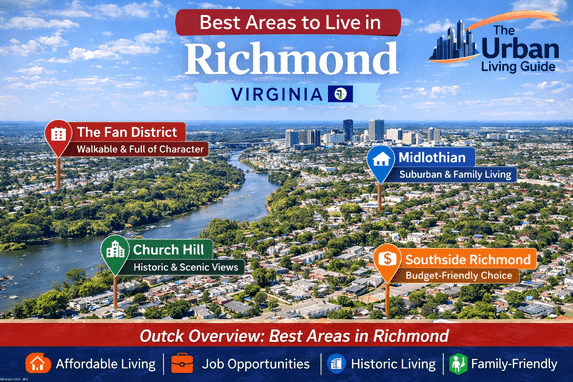
Best Neighborhoods in Richmond, Virginia: Historic Fan Corridors, James River Rapids & River City Living in 2026
Covering approximately 62.5 square miles of land area straddling the fall line of the historic James River in the heart of the Commonwealth, the independent municipality of Richmond operates under the mayor-council governance of the City of Richmond. Housing an incorporated municipal core population exceeding 230,000 residents and anchoring a broader regional Greater Richmond metropolitan footprint of over 1.3 million people, the capital of Virginia stands as a major national center for Fortune 500 corporate management, federal judicial finance, advertising innovation, bioscience research, and four-season outdoor river recreation.
Relocating across Central Virginia requires evaluating distinct river basin topography, preserved brick architectural districts, and regional commuter transit corridors operated by the Greater Richmond Transit Company (GRTC). Inbound movers consistently balance direct daily access to primary regional employers—including global corporate headquarters for Altria Group, CarMax, Dominion Energy, Capital One (West Creek Campus), the Federal Reserve Bank of Richmond, and extensive medical systems anchored by VCU Health (Medical College of Virginia Campus) and Bon Secours St. Mary’s Hospital—against daily transit commutes across Interstate 95, Interstate 64, Downtown Expressway (VA-195), Powhite Parkway (VA-76), Broad Street (US-250), and Monument Avenue, with air connectivity via Richmond International Airport (RIC).
Explore Richmond’s premier historic districts, craft brewery hubs, and distinctive residential neighborhoods with this curated local guide:
Key Residential Districts in Richmond, Virginia at a Glance in 2026
| Neighborhood | Location | Distance to State Capitol | Development Status | Transit Connectivity | Cost Level | Best Fit For |
|---|---|---|---|---|---|---|
| The Fan District | West Central Urban Core | ~1.5 mi west | Preserved Victorian Brick Townhome Grid | Exceptional (GRTC Pulse BRT, Main St, Monument Ave) | High-to-Premium | VCU Faculty, Attorneys & Urban Walkers |
| Church Hill | East River Bluffs | ~1.2 mi east | Historic 19th-Century Landmark & Overlooks | High (GRTC Pulse BRT, Broad St, I-95) | Mid-to-High | Preservationists, Foodies & Remote Creatives |
| Scott’s Addition | Northwest Industrial Core | ~2.5 mi northwest | Adaptive Industrial Craft Brewery Hub | Exceptional (GRTC Pulse BRT, Broad St, I-195) | Mid-to-High | Young Tech Workers, Foodies & Startup Founders |
| Museum District (Carytown) | West Urban Basin | ~2.8 mi west | Historic Walkable Arts & Rowhouse Core | Exceptional (GRTC Buses, Cary St, I-195) | High-to-Premium | Art Lovers, Medical Staff & Growing Families |
| Short Pump (Western Henrico) | Far West County Basin | ~14 mi west | Master-Planned Corporate & Retail Suburb | High (I-64, Route 288, Broad St / US-250) | High-to-Premium | Corporate Commuters, Capital One Staff & Families |
Comprehensive Breakdown of Living Options Across Richmond
The Fan District — Late Victorian Brick Townhomes, Tree-Canopied Streets & Front-Porch Culture
Covering approximately 85 blocks immediately west of Downtown Richmond between Belvidere Street and the Boulevard (Arthur Ashe Boulevard), The Fan District is celebrated as the largest contiguous collection of late 19th- and early 20th-century intact Victorian residential architecture in the United States. Operating under City of Richmond municipal administration and championed by the Fan District Association, the neighborhood gets its name from the way its tree-lined streets “fan” outward from east to west.
The neighborhood is defined by ornate Queen Anne, Italianate, and Colonial Revival brick townhouses with deep front porches, wrought-iron fences, mature oak canopies, and direct walking proximity to Virginia Commonwealth University (VCU) and Carytown.
- Housing: Real estate is dominated by historic three-story brick rowhouses with stained-glass transoms and high ceilings, converted multi-family brownstone flats, and historic carriage homes along Hanover Avenue, Grove Avenue, and Floyd Avenue. Single-family townhome purchase prices typically range from $480,000 to $1,450,000+, while residential rental flats average $1,450 to $2,650 per month.
- Safety & Crime Rate: Patrolled by the Richmond Police Department (RPD) 3rd Precinct and supplemented by VCU Police around university borders. The Fan maintains an active, safe pedestrian streetscape day and night, supported by high owner-occupancy and visible neighborhood block watches.
- School District & Education Quality: Governed by Richmond Public Schools (RPS), containing neighborhood institutions such as Fox Elementary School and Binford Middle School, alongside specialized public magnet academies like Open High School and Richmond Community High School.
- Walkability & Daily Conveniences: Outstanding pedestrian walkability (Walk Score of 92-96/100). Residents walk to dozens of corner bistros (Kuba Kuba, Joe’s Inn), artisan coffee roasters, neighborhood bakeries, and grocers including Whole Foods Market on Broad, Kroger on Lombardy, and Shields Market.
- Parks & Green Spaces / Pet-Friendliness: Municipal greenspaces include Scuffletown Park (a hidden neighborhood garden courtyard), Meadow Park, Monroe Park, and walking access to the 100-acre historic Victorian estate at Maymont (featuring Japanese gardens, nature centers, and wildlife habitats). Exceptionally pet-friendly.
- Parking & Traffic Congestion: On-street parking is regulated through the City of Richmond residential Fan parking permit district; private rear alley parking pads add significant property value. Surface traffic on Main Street and Cary Street moves steadily.
- Nearby: 4-minute bus ride into Downtown Financial District, 6 minutes to VCU Medical Center, and 14 minutes to Richmond International Airport (RIC).
- Noise Levels & Vibe: Historic, cultured, and social, filled with neighbors chatting on front porches over evening wine, collegiate energy near VCU, and quiet tree-shaded residential side streets.
- Medical Facilities & Hospitals: Direct 6-minute commute east to VCU Health (Medical College of Virginia – Level I Trauma Center) on East Marshall Street.
- Transit Connectivity: Unmatched public transit integration along the GRTC Pulse Bus Rapid Transit (BRT) line along Broad Street (VCU and Allison St Stations), providing zero-fare rapid transit across Richmond, with quick vehicular access to the Downtown Expressway (VA-195).
- Affordability: High-tier urban price profile; elevated acquisition values reflect irreplaceable historic architectural craftsmanship, premier walkability, and strong equity retention.
- Who It’s Best For: VCU faculty, medical doctors, state government attorneys, architecture preservationists, and urbanites seeking historic front-porch walkability.
- Drawbacks: Competitive on-street parking during evening dinner hours, older home cast-iron radiator heating and plumbing maintenance, and smaller private courtyard footprints.
Church Hill — Historic 18th-Century Architecture, James River Overlooks & Acclaimed Bakeries
Perched high on the bluffs overlooking Downtown Richmond and the James River east of the central business district, Church Hill (the historic St. John’s Church Historic District) is celebrated as Richmond’s oldest and most historically significant neighborhood. Operating under City of Richmond historic preservation guidelines and championed by the Historic Church Hill Association, the district centers around historic St. John’s Episcopal Church (where Patrick Henry gave his famous “Give me liberty, or give me death!” speech in 1775).
The neighborhood combines gaslamp-lit cobblestone streets with Federal, Greek Revival, and Victorian townhomes, panoramic sunset park overlooks of the river, and some of the most acclaimed bakeries and restaurants in the Mid-Atlantic.
- Housing: Real estate stock features historic 1800s brick Federal and Greek Revival townhouses with cast-iron balconies, Victorian worker cottages, contemporary architectural infill homes, and converted historic loft buildings. Single-family purchase prices typically range from $340,000 to $920,000+, while residential rentals average $1,250 to $2,250 per month.
- Safety & Crime Rate: Patrolled by the RPD 1st Precinct. The central historic core around St. John’s Church and Libbie Hill Park maintains a safe, stable residential atmosphere supported by active community civic leagues.
- School District & Education Quality: Governed by RPS, containing neighborhood public campuses such as Chimborazo Elementary School, Martin Luther King Jr. Middle School, and Armstrong High School, alongside premier public charter options.
- Walkability & Daily Conveniences: Outstanding pedestrian walkability (Walk Score of 88-92/100). Residents stroll along brick walkways to nationally acclaimed bakeries (Sub Rosa Bakery), wood-fired pizzerias (The Roosevelt, Proper Pie Co.), artisan cafes, and grocers including The Market at 25th and Farm Fresh on Main.
- Parks & Green Spaces / Pet-Friendliness: Municipal recreation is anchored by the scenic bluffs of Libbie Hill Park (famed for “The View That Named Richmond” overlooking the James River fall line), the 30-acre Chimborazo Park (featuring open dog parks and panoramic eastern valley views), and Jefferson Park. Exceptionally pet-friendly.
- Parking & Traffic Congestion: Plentiful open on-street parking along residential streets; private rear parking pads and detached garages are common on renovated parcels. Surface traffic on Broad Street and Franklin Street moves smoothly.
- Nearby: 3-minute drive into Downtown Richmond & State Capitol, 4 minutes to VCU Health Medical Center, and 10 minutes to Richmond International Airport (RIC).
- Noise Levels & Vibe: Historic, artistic, and peaceful, characterized by sunset park picnics, dog walkers on cobblestone streets, and quiet residential evenings.
- Medical Facilities & Hospitals: Direct 3-minute drive to VCU Health (Medical College of Virginia) on East Marshall Street.
- Transit Connectivity: Served by the zero-fare GRTC Pulse BRT (East End Terminus at 24th & Main), offering non-stop rapid bus transit to downtown, with immediate highway on-ramps to Interstate 95 and I-64.
- Affordability: Mid-to-high urban price tier; provides more yard space and square footage per dollar than The Fan while retaining historic architecture and river views.
- Who It’s Best For: Medical fellows and staff at VCU Health, historic home renovators, culinary enthusiasts, remote creative workers, and buyers wanting river park views.
- Drawbacks: Distance from Western Henrico corporate employers, older historic masonry and plaster upkeep, and block-by-block transitional variance on outer peripheral edges.
Scott’s Addition — Craft Beverage Capital, Industrial Lofts & High-Density Urban Innovation
Covering approximately 150 acres immediately north of Broad Street between the Boulevard and Interstate 195, Scott’s Addition is celebrated as the craft beverage and creative entrepreneurial epicenter of Virginia. Originally developed in the early 20th century as a bustling rail-served industrial manufacturing and warehouse district, the community operates under City of Richmond municipal administration and is championed by the Scott’s Addition Boulevard Association (SABA).
The neighborhood has transformed into a vibrant mixed-use enclave featuring over a dozen craft breweries, cideries, distilleries, urban axe-throwing lounges, rooftop dining venues, and modern loft apartment conversions.
- Housing: Real estate is dominated by converted historic brick-and-timber industrial lofts (such as The Preserve at Scott’s Addition, 1805 Roseneath Lofts, and The Otis), contemporary podium apartment mid-rises, and modern townhome infill developments. Condominium and townhome purchase prices typically range from $280,000 to $680,000+, while modern rental lofts average $1,450 to $2,450 per month.
- Safety & Crime Rate: Patrolled by the RPD 3rd Precinct. The active commercial and entertainment corridors along Roseneath Road and West Moore Street maintain safe, well-illuminated pedestrian foot traffic day and night.
- School District & Education Quality: Governed by RPS, containing public institutions such as Carver Elementary School and Thomas Jefferson High School, alongside alternative public magnet academies.
- Walkability & Daily Conveniences: Outstanding pedestrian walkability (Walk Score of 88-92/100). Residents walk to over 20 craft breweries and cideries (The Veil Brewing Co., Ardent Craft Ales, Blue Bee Cider), boutique movie theaters at The Bow Tie Movieland, rooftop lounges, and grocers like Kroger Marketplace on Broad and Aldi.
- Parks & Green Spaces / Pet-Friendliness: Municipal recreation is anchored by the Science Museum of Virginia Park Green, minor-league baseball at The Diamond (Richmond Flying Squirrels), and direct access to Byrd Park nearby. Highly pet-friendly with apartment dog lounges and pet parks.
- Parking & Traffic Congestion: Assigned parking garage spaces add $100 to $175 per month; on-street industrial parking is common on residential side blocks. Commuter traffic moves smoothly with immediate on-ramps to Interstate 195 and I-64.
- Nearby: 6-minute drive into Downtown Richmond, 8 minutes to VCU Campus, and 12 minutes to Short Pump Town Center.
- Noise Levels & Vibe: High-tempo, creative, and social, filled with young tech professionals, brewery patio crowds, food truck gatherings, and vibrant weekend energy.
- Medical Facilities & Hospitals: Direct 5-minute drive west to Bon Secours St. Mary’s Hospital on Bremo Road and 7 minutes to VCU Health.
- Transit Connectivity: Direct access along the GRTC Pulse BRT (Scott’s Addition / Boulevard Station) on Broad Street, offering rapid connection to downtown, with immediate vehicle access to I-195, I-95, and I-64.
- Affordability: Mid-to-high urban price structure; delivers modern loft living with high entertainment amenities at price points competitive with regional East Coast metros.
- Who It’s Best For: Young tech workers, startup founders, craft beer enthusiasts, design creatives, and urbanites seeking high-energy walkable loft living.
- Drawbacks: Industrial lack of mature shade trees, weekend evening brewery crowds and parking pressure, and ongoing construction on newly transforming blocks.
Museum District (Carytown) — VMFA Art Collections, Historic Rowhouses & Cary Street Shopping
Covering the established residential territory west of Arthur Ashe Boulevard between Broad Street and Cary Street, the Museum District (historically known as West of the Boulevard) is widely celebrated as one of Richmond’s most cultured, walkable, and picturesque residential enclaves. Operating under City of Richmond municipal administration and championed by the Museum District Association, the district is listed on the National Register of Historic Places.
The neighborhood is defined by early 20th-century brick rowhouses, grand Mediterranean and Tudor Revival duplexes, tree-shaded sidewalks, world-class art museums, and direct pedestrian access to the “Mile of Style” shopping along Carytown (West Cary Street).
- Housing: Real estate stock features classic 1910s–1930s brick semi-detached rowhouses with front porches, American Foursquares, Colonial Revival single-family homes, and historic multi-family flats along Park Avenue, Stuart Avenue, and Kensington Avenue. Single-family rowhome purchase prices typically range from $450,000 to $980,000+, while residential rental flats average $1,450 to $2,550 per month.
- Safety & Crime Rate: Patrolled by the RPD 3rd Precinct. The Museum District consistently records low violent and property crime rates, supported by high owner-occupancy and active community block watch networks.
- School District & Education Quality: Governed by RPS, containing public options such as Albert Hill Middle School and Thomas Jefferson High School, alongside premier private college preparatory academies nearby like St. Catherine’s School and St. Christopher’s School.
- Walkability & Daily Conveniences: Outstanding pedestrian walkability (Walk Score of 90-94/100). Residents walk to over 200 independent boutiques, vintage vinyl shops, the historic 1928 Byrd Theatre along Cary Street, and grocers including Kroger on Carytown, Ellwood Thompson’s Local Market (organic co-op), and Fresh Market.
- Parks & Green Spaces / Pet-Friendliness: World-class cultural and natural recreation anchored by the expansive sculpture gardens and galleries of the Virginia Museum of Fine Arts (VMFA – Free Admission 365 Days/Year), the Virginia Museum of History & Culture, the 287-acre Byrd Park (featuring Swan Lake and the Carillon tower), and Barker Field Dog Park. Exceptionally pet-friendly.
- Parking & Traffic Congestion: Plentiful on-street parking with dedicated rear garages in alleys; traffic moves steadily with slight slowdowns along Cary Street during peak weekend shopping hours.
- Nearby: 5-minute drive into Downtown Richmond, 4 minutes to VCU Campus, and 15 minutes to Short Pump.
- Noise Levels & Vibe: Refined, artistic, and relaxed, characterized by museum lawn jazz concerts, dog walkers along shaded avenues, and quiet residential evenings.
- Medical Facilities & Hospitals: Direct 5-minute drive west to Bon Secours St. Mary’s Hospital and 8 minutes to VCU Health.
- Transit Connectivity: Road travel connects quickly via Arthur Ashe Boulevard, Cary Street, and Interstate 195 (Downtown Expressway), supported by GRTC Bus Routes (Routes 20 and 77).
- Affordability: High-tier urban price profile; elevated acquisition values are balanced by VMFA museum garden access, Carytown shopping, and strong property equity stability.
- Who It’s Best For: Art enthusiasts, healthcare staff at St. Mary’s, VCU faculty, young professionals, and families seeking historic walkable charm.
- Drawbacks: Older home electrical and plumbing maintenance overhead, rising purchase prices per square foot, and retail parking congestion near Carytown.
Short Pump (Western Henrico) — Master-Planned Suburbia, Capital One Hub & Top Henrico Schools
Covering the booming western suburban growth corridor of Henrico County along West Broad Street (US-250) and Interstate 64, Short Pump is widely recognized as Greater Richmond’s premier master-planned retail, corporate, and family residential engine. Operating under Henrico County municipal administration, the community centers around the open-air luxury lifestyle center at Short Pump Town Center.
The neighborhood combines master-planned subdivisions with championship golf courses, premier national shopping power centers, top-ranked public schools, and direct access to major corporate headquarters including Capital One, CarMax, and Allianz.
- Housing: Real estate stock features modern 1990s–2020s two-story single-family executive homes in master subdivisions (such as Twin Hickory, Wyndham, and Wellesley), contemporary townhomes, and upscale garden-style apartment communities. Single-family purchase prices typically range from $450,000 to $1,250,000+, while residential rentals average $1,650 to $2,950 per month.
- Safety & Crime Rate: Protected by the dedicated Henrico County Police Division (West Sector). Short Pump consistently records some of the lowest violent and property crime rates in the Richmond metropolitan region.
- School District & Education Quality: Governed by the nationally acclaimed Henrico County Public Schools (HCPS), containing top-performing institutions such as Deep Run High School, Short Pump Middle School, Twin Hickory Elementary, and Rivers Edge Elementary School.
- Walkability & Daily Conveniences: Suburban residential streets are automobile-dependent, but the open-air pedestrian concourses at Short Pump Town Center host over 140 premier retailers, department flagships, and grocers including Trader Joe’s, Whole Foods Market, Wegmans Supermarket, and Costco Wholesale.
- Parks & Green Spaces / Pet-Friendliness: Municipal recreation is anchored by the 67-acre Deep Run Park & Recreation Center (featuring fishing ponds, nature trails, and soccer complexes), Twin Hickory Park & Sprayground, and championship golf at The Dominion Club in Wyndham. Exceptionally pet-friendly.
- Parking & Traffic Congestion: Plentiful private attached two-to-three car garages and wide driveways keep neighborhood lanes clear. Commuter and retail shopping traffic builds heavily along West Broad Street (US-250) and the I-64 interchange during weekend peak shopping hours.
- Nearby: 5-minute drive to Capital One West Creek Campus, 14 minutes to Downtown Richmond, and 24 minutes to Richmond International Airport (RIC).
- Noise Levels & Vibe: Polished, family-centered, and active, characterized by youth sports leagues, manicured subdivision lawns, community pool gatherings, and quiet evenings.
- Medical Facilities & Hospitals: Direct 5-minute drive to Henrico Doctors’ Hospital – Forest Campus and Bon Secours Short Pump Emergency Center.
- Transit Connectivity: Major highway positioning at the junction of Interstate 64 (Exits 178A and 178B), Route 288, and US Route 250, supported by GRTC Express Commuter Bus Routes (Route 19) into downtown.
- Affordability: High-tier suburban price profile; higher real estate acquisition values are balanced by nationally ranked Deep Run High public schools, low Henrico County tax structures, and robust corporate employment.
- Who It’s Best For: Corporate executives at Capital One or CarMax, families prioritizing Deep Run High School, relocators wanting newer construction, and avid shoppers.
- Drawbacks: Heavy retail traffic along Broad Street on weekends, complete automobile reliance for daily errands, and distance from downtown historic attractions (14 miles).
Neighborhood Trade-offs: Living Advantages & Drawbacks Across Richmond, Virginia
| Neighborhood | Core Advantages (Pros) | Core Limitations (Cons) |
|---|---|---|
| The Fan District | Preserved Victorian brick architecture; walkable dining and VCU access; GRTC Pulse BRT; 100-acre Maymont Estate. | Higher purchase pricing; competitive on-street parking; older home radiator heating and plumbing maintenance overhead. |
| Church Hill | Historic 18th-century charm; panoramic James River views at Libbie Hill Park; acclaimed bakeries (Sub Rosa); 3 minutes to downtown. | Distance from West End corporate employment; older masonry upkeep; block-by-block transitional variance on outer edges. |
| Scott’s Addition | Craft brewery and cidery epicenter; modern industrial brick lofts; The Diamond baseball; zero-fare GRTC Pulse BRT. | Lack of mature neighborhood shade trees; weekend brewery crowd noise; monthly apartment parking garage fees. |
| Museum District (Carytown) | Free admission to VMFA Art Museum; walkable dining and boutiques on Carytown; 287-acre Byrd Park; tree-lined avenues. | Older home mechanical updates; competitive weekend retail traffic around Carytown; rising purchase prices per square foot. |
| Short Pump (Henrico) | Nationally top-ranked Deep Run High (HCPS); shopping at Short Pump Town Center (Wegmans); 5 minutes to Capital One. | Heavy commercial traffic along Broad Street; complete automobile dependence; 14-mile commute to Downtown Richmond. |
Voices of the Community: What Residents Say About Living in Richmond, Virginia
“Moving to The Fan from Washington, D.C., gave us our dream brick townhome with historic stained glass and a front porch where we chat with our neighbors every evening. We walk to dinner, take the Pulse bus to work, and have Maymont and the VMFA right down the street without the brutal D.C. traffic.”
— Caroline Vance, Corporate Communications Director (Verified Local Contributor, Reddit r/rva Relocation Forum)
“Living in Short Pump gives our family the perfect suburban balance. Our kids attend top-rated Henrico County schools, we can walk around Short Pump Town Center for dinner and movies, and my commute to the Capital One West Creek campus takes less than seven minutes.”
— Mark Henderson, Senior Cloud Systems Engineer (Verified Resident Review, Niche Community Insights)
Finding Your Ideal Residential Fit in the River City
Selecting your ideal neighborhood in Richmond requires balancing your household budget with daily workplace destinations, family schooling priorities, and regional highway logistics. Because Central Virginia is connected by an extensive highway network centered around Interstate 95, Interstate 64, and Downtown Expressway (VA-195), your chosen location dictates whether your daily commute relies on zero-fare transit via the GRTC Pulse BRT (The Fan, Scott’s Addition, Downtown), walkable sidewalks into Carytown or Church Hill, or driving across regional expressways into suburban corporate parks.
Healthcare professionals and medical residents at VCU Health or Bon Secours St. Mary’s, corporate executives at Capital One, CarMax, or Altria, and state government officials downtown should evaluate transit corridors to optimize daily convenience.
Beyond commuter corridors, evaluate essential municipal utility and building infrastructure realities. Central Virginia experiences four distinct seasons with cold winter temperatures alongside warm, humid summer conditions, making home cooling and heating efficiency through Dominion Energy Virginia and Richmond Gas Works an essential consideration.
In addition, prospective homebuyers evaluating historic Victorian townhomes in The Fan or brick homes in the Museum District should inspect roofs, boiler heating systems, clay sewer laterals, and masonry pointing, while buyers in master-planned communities like Short Pump should verify homeowners association (HOA) reserve funds. Before executing a residential lease or property purchase agreement, verify high-speed fiber broadband availability (such as Verizon Fios or Comcast Xfinity Gigabit) and confirm county school assignment boundaries.
Essential Local Insights & FAQs for Richmond, Virginia
Which neighborhood in Richmond is considered best for families with children?
Short Pump (Western Henrico), Museum District, and The Fan are widely regarded as premier family communities in Greater Richmond. Short Pump provides access to top-ranked public schools in Henrico County (such as Deep Run High School) alongside safe, master-planned parks, while The Fan and Museum District offer historic tree-lined streets, access to Maymont, and Byrd Park.
What is the most walkable neighborhood in Richmond where you can live without relying heavily on a car?
The Fan District, Museum District (Carytown), and Scott’s Addition offer the highest walkability in the city, boasting Walk Scores above 88. Residents can walk to over 100 restaurants, grocery stores like Whole Foods and Kroger, museums like the VMFA, and utilize the zero-fare GRTC Pulse Bus Rapid Transit line.
What are the safest residential neighborhoods to live in within Greater Richmond?
Short Pump, Museum District, and The Fan consistently report some of the lowest violent and property crime rates in the metropolitan region. These communities benefit from high owner-occupancy, dedicated police patrols, and active neighborhood civic associations.
What are the most affordable neighborhoods for homebuyers and renters in Richmond?
Northside (Ginter Park), Manchester, and Forest Hill provide budget-friendly housing opportunities in the area. In Northside and Manchester, buyers and renters can secure historic homes and contemporary riverfront lofts at price points significantly lower than The Fan and West End luxury enclaves.
How bad is traffic congestion when commuting across Richmond expressways?
Traffic congestion on Interstate 95, Interstate 64, and West Broad Street is moderate compared to Northern Virginia, with peak-hour slowdowns typically adding 15 to 25 minutes during morning and evening rush hours. Utilizing the zero-fare GRTC Pulse BRT provides a dependable travel alternative across the central core.
Which Richmond neighborhood is best for healthcare professionals working at VCU Health?
Church Hill, Downtown, and The Fan provide the fastest commutes to VCU Health (Medical College of Virginia Campus), allowing medical staff to walk, bike, or drive to hospital pavilions in under 4 to 6 minutes.
Is Richmond an affordable place to live compared to Northern Virginia and Washington, D.C.?
Yes, Richmond’s overall cost of living and housing prices remain significantly lower than Arlington, Alexandria, and Washington, D.C., offering historic single-family brick homes, spacious yards, and an acclaimed culinary scene at a fraction of Northern Virginia real estate costs.
Richmond, Virginia Relocation Resources & Living Guides
The Urban Living Guide creates deeply researched, practical, and informative city relocation resources designed to help individuals, working professionals, and families navigate complex urban landscapes. By analyzing municipal infrastructure, hyper-local zoning patterns, commuter realities, and housing markets, our guides provide actionable insights so you can make confident, data-backed decisions when moving to major metropolitan areas.
Explore our regional guides across Richmond and Central Virginia:
- Living in Richmond, Virginia
- Cost of Living in Richmond, Virginia
- Pros and Cons of Living in Richmond, Virginia
Made your decision to move to the River City? Read our comprehensive relocation roadmap: Moving to Richmond, Virginia.
Follow The Urban Living Guide for ongoing regional insights, neighborhood developments, and expert local coverage across Greater Richmond and the Commonwealth of Virginia.