

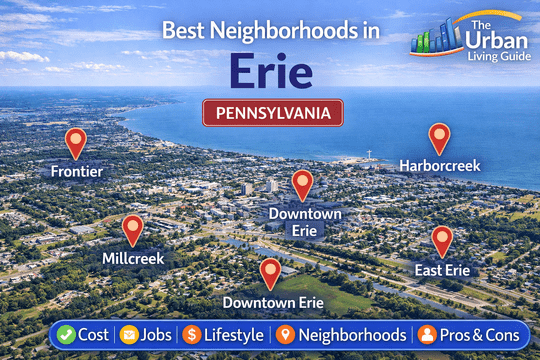
Best Neighborhoods in Erie, Pennsylvania: Presque Isle Waterfronts, Historic Mansions & Bayfront Pockets in 2026
Covering approximately 19.3 square miles of land area along the freshwater southern shoreline of Lake Erie in Erie County, the City of Erie operates under the mayor-council municipal administration of the City of Erie. Housing an incorporated municipal core population exceeding 94,000 residents and anchoring a broader regional metropolitan footprint of over 270,000 people, Pennsylvania’s primary Great Lakes port stands as an essential commercial hub for precision manufacturing, healthcare systems, marine logistics, and four-season outdoor tourism.
Relocating across Northwestern Pennsylvania requires evaluating lake-effect winter weather patterns, bayfront revitalization initiatives, and regional transit corridors operated by the Erie Metropolitan Transit Authority (EMTA / the “e”). Inbound movers consistently balance direct access to primary regional employers—including the extensive medical campuses of UPMC Hamot and AHN Saint Vincent Hospital, major corporate operations such as Erie Insurance Group Headquarters, industrial manufacturing hubs, and academic institutions like Gannon University and Penn State Behrend—against daily highway commutes across Interstate 90, Interstate 79, the Bayfront Parkway, and Peach Street (Route 19), with air connectivity via Erie International Airport (ERI).
Join a local tour to explore the bayfront promenades, historic streetscapes, and distinctive residential neighborhoods across Erie, Pennsylvania:
Key Residential Areas in Erie at a Glance in 2026
| Neighborhood | Location | Distance to Downtown | Development Status | Transit Connectivity | Cost Level | Best Fit For |
|---|---|---|---|---|---|---|
| Frontier | West Bayfront | ~2.5 mi west | Established Parkland Residential | High (EMTA Bus Routes, W 6th St, W 8th St) | Mid-to-High | Physicians, Executives & Families |
| Downtown & Bayfront District | Central Presque Isle Bay | 0 mi (Core) | Waterfront Mixed-Use Revitalization | Exceptional (EMTA Transit Center, Bayfront Pkwy) | Mid-Range | Young Professionals, Gannon Staff & Commuters |
| Millcreek Township | Western/Southern Suburbs | ~5 mi southwest | Master-Planned Suburban | High (I-79, I-90, W 26th St / US-20) | Mid-to-High | Suburban Families & Corporate Staff |
| Glenwood (South Erie) | South Central Ridge | ~3 mi south | Historic Tree-Canopied Residential | High (Peach St / US-19, State St) | Mid-Range | Hospital Employees, Families & Academics |
| Little Italy (West 18th Street) | Central Urban Basin | ~1 mi southwest | Historic Working-Class Infill | High (EMTA Bus Network, Liberty St, W 18th St) | Accessible | First-Time Homebuyers, Renters & Value Seekers |
Comprehensive Breakdown of Living Options Across Erie
Frontier — Historic Parkside Serenity, Lake Erie Breezes & Millionaire’s Row Proximity
Covering the established residential territory west of the historic Millionaire’s Row on West 6th Street stretching toward the bay, the Frontier neighborhood is widely celebrated as one of Erie’s most architecturally distinguished and desirable residential districts. Operating under City of Erie municipal administration and supported by active neighborhood associations, Frontier is defined by mature hardwood canopies, quiet curving lanes, and direct proximity to the freshwater recreation of Presque Isle Bay.
The community provides a peaceful, family-oriented environment within a 6-minute commute of both downtown corporate headquarters and major hospital complexes, making it a premier choice for medical practitioners, legal professionals, and established households.
- Housing: Real estate stock features classic 1920s–1950s Colonial Revival estates, custom brick Tudors, Mid-Century Modern ranches, and stately single-family properties along Frontier Drive and West 8th Street. Single-family purchase prices typically range from $240,000 to $580,000+, while residential rental properties average $1,250 to $2,100 per month.
- Safety & Crime Rate: Patrolled by the Erie Police Department (EPD) West District. Frontier consistently records low violent and property crime rates, supported by high owner-occupancy rates and active neighborhood watch programs.
- School District & Education Quality: Governed by the Erie City School District (EPS), with students zoned to public options such as Grover Cleveland Elementary School and Erie High School, alongside premier private college preparatory institutions nearby including Cathedral Preparatory School and Villa Maria Academy.
- Walkability & Daily Conveniences: The neighborhood features excellent recreational walkability through residential parklands, with commercial shopping plazas along West 8th Street and West 12th Street hosting local bakeries, specialty cafes, pharmacies, and grocers like Wegmans on West Erie Plaza and Tops Friendly Markets.
- Parks & Green Spaces / Pet-Friendliness: Direct walking access to the scenic 33-acre Frontier Park (featuring the Lake Erie Arboretum at Frontier Park – LEAF with over 1,000 trees, walking bridges along Cascade Creek, tennis courts, and winter sledding hills) and direct connectivity to the Bayfront Bikeway. Exceptionally pet-friendly.
- Parking & Traffic Congestion: Plentiful private residential driveways, detached two-car garages, and open on-street parking keep roads clear. Commuter traffic on West 6th Street (Route 5A) and West 8th Street moves smoothly with minimal rush-hour delays.
- Noise Levels & Vibe: Serene, refined, and family-centered, characterized by singing birds, park strollers, and quiet residential evenings.
- Medical Facilities & Hospitals: Direct 5-to-7 minute drive east to UPMC Hamot on State Street and AHN Saint Vincent Hospital on West 25th Street.
- Transit Connectivity: Served by EMTA Bus Routes (Route 22 and Route 28), providing direct transit into Downtown Erie, with immediate vehicular access to the Bayfront Parkway and Route 5.
- Affordability: Mid-to-high price profile for Erie County; higher real estate acquisition values are balanced by pristine parkland access, architectural craftsmanship, and stable long-term property equity.
- Who It’s Best For: Physicians at UPMC or Saint Vincent, corporate managers at Erie Insurance, legal partners, and buyers seeking classic architectural charm surrounded by botanical arboretums.
- Drawbacks: Higher city property tax millage rates, older home heating and plumbing systems requiring maintenance, and limited newly constructed modern housing inventory.
Downtown & Bayfront District — Presque Isle Bay Views, Urban Lofts & Waterfront Dining
Positioned along the southern bluffs of Presque Isle Bay centered around historic Perry Square and the Bayfront Parkway, the Downtown & Bayfront District serves as the civic, corporate, judicial, and entertainment core of Northwestern Pennsylvania. Driven by comprehensive bayfront master planning led by the City of Erie and the Erie Downtown Partnership, the district blends historic 19th-century brick commercial buildings along State Street with modern waterfront hotels, marina piers, and luxury loft conversions.
The urban core delivers a walkable lifestyle within steps of live theater, outdoor waterfront amphitheaters, summer regattas, and corporate headquarters.
- Housing: Real estate is dominated by restored brick-and-timber industrial lofts (such as The Boston Store Lofts and Lovell Place), contemporary waterfront condominiums along the Bayfront Parkway, and urban apartments near Gannon University. Condominium purchase valuations typically range from $140,000 to $390,000+, while modern rental apartments average $1,100 to $1,850 per month.
- Safety & Crime Rate: Patrolled by the EPD Downtown Sector and supplemented by visible downtown safety ambassadors and private campus security. The central State Street and bayfront dining corridors maintain safe foot traffic, though standard city awareness is advised on peripheral side streets late at night.
- School District & Education Quality: Governed by EPS, alongside higher-education institutions anchored directly in the core by the 50-acre downtown campus of Gannon University.
- Walkability & Daily Conveniences: Outstanding pedestrian walkability (Walk Score of 86-90/100). Residents walk to over 30 local restaurants, craft breweries, cultural venues at the historic Warner Theatre and Erie Art Museum, and minor-league baseball games at UPMC Park (home of the Erie SeaWolves).
- Parks & Green Spaces / Pet-Friendliness: Municipal greenspaces include Perry Square Park (hosting summer farmers markets and holiday festivals), the Bayfront Promenade, and the Bicentennial Tower Grounds on Dobbins Landing. Pet-friendly with paved linear bayfront walking paths.
- Parking & Traffic Congestion: Managed through municipal parking garages and surface lots operated by the Erie Parking Authority (EPA); most modern residential loft developments provide assigned tenant parking. Surface street traffic flows smoothly with minimal delays.
- Noise Levels & Vibe: Vibrant, historic, and nautical, filled with passing sailboats, university student energy, live theater patrons, and outdoor bayfront dining chatter.
- Medical Facilities & Hospitals: Direct emergency medical coverage provided within the district by the world-class waterfront campus of UPMC Hamot (Level II Trauma Center) on East 2nd Street.
- Transit Connectivity: Central regional transit hub operated by EMTA at the Intermodal Transportation Center on Holland Street, with vehicular access via the Bayfront Parkway connecting to I-79 and I-90. Rail transit is provided via the Erie Amtrak Station (Lake Shore Limited line).
- Affordability: Highly accessible urban price tier; delivers character-rich architectural lofts and waterfront lifestyle amenities at rates substantially lower than larger East Coast and Midwest metros.
- Who It’s Best For: Young corporate professionals at Erie Insurance, healthcare staff and residents at UPMC Hamot, Gannon faculty and graduate students, and urbanites seeking walkable bayfront living.
- Drawbacks: Quieter late-night retail foot traffic on weekdays outside main dining pockets, limited full-scale traditional supermarkets directly within the core grid, and winter lake-effect winds off the bay.
Millcreek Township — Master-Planned Suburbia, Presque Isle Gateway & Commercial Hub
Surrounding the western and southern municipal borders of the City of Erie, Millcreek Township is the primary suburban, retail, and recreational engine of the region. Operating under its own independent municipal government via the Millcreek Township Official Portal, the community encompasses established residential subdivisions and master-planned neighborhoods centered along West 26th Street (US-20), Peach Street (Route 19), and West 12th Street.
Celebrated as the gateway to the world-famous beaches of Presque Isle State Park, Millcreek combines spacious single-family residential lots, extensive retail power centers, and top-rated public schools with low township municipal tax structures.
- Housing: Real estate stock features modern 1980s–2020s two-story brick and vinyl single-family homes, classic single-story ranches in mature subdivisions (such as Asbury Woods and Belle Valley), modern townhome communities, and upscale garden-style apartment complexes. Single-family purchase prices typically range from $210,000 to $540,000+, while residential rentals and townhomes average $1,350 to $2,250 per month.
- Safety & Crime Rate: Protected by the dedicated Millcreek Township Police Department (MPD), the township consistently records one of the lowest violent and property crime rates in Northwestern Pennsylvania, supported by proactive 24/7 patrol fleets.
- School District & Education Quality: Governed by the highly regarded Millcreek Township School District (MTSD), featuring top-performing public institutions such as McDowell High School (celebrated for its honors curriculum and athletic programs), James S. Wilson Middle School, and Asbury Elementary School.
- Walkability & Daily Conveniences: Suburban residential neighborhoods are automobile-dependent, but major commercial shopping corridors along Peach Street and West 26th Street host Millcreek Mall Complex, Wegmans Supermarket, Target, Costco Wholesale, and extensive casual family dining.
- Parks & Green Spaces / Pet-Friendliness: World-class natural recreation anchored by direct access to the 3,200-acre peninsula at Presque Isle State Park (featuring 13 miles of sandy Lake Erie beaches, surfing, swimming, marina slips, and the 13-mile Karl Boyes Multi-Purpose Trail), the 205-acre Asbury Woods Nature Center, and Scott Park. Exceptionally pet-friendly.
- Parking & Traffic Congestion: Plentiful private attached two-to-three car garages and wide driveways keep neighborhood streets clear. Heavy commercial traffic builds along the Peach Street (Route 19) corridor near the Interstate 90 interchange during peak weekend shopping hours.
- Noise Levels & Vibe: Peaceful, organized, and family-centered, characterized by quiet subdivision cul-de-sacs, school sporting events, and calm evenings.
- Medical Facilities & Hospitals: Direct 8-to-10 minute drive to AHN Saint Vincent Hospital and LECOM Health – Millcreek Community Hospital located on West 38th Street.
- Transit Connectivity: Unrivaled highway positioning at the junction of Interstate 79 (Exits 180 and 182), Interstate 90 (Exit 24), and US-20, offering a 10-minute drive into Downtown Erie and 5 minutes to Erie International Airport (ERI).
- Affordability: Balanced mid-range suburban price tier; lower municipal real estate tax millage rates compared to the city proper provide strong household affordability and long-term property equity.
- Who It’s Best For: Families prioritizing top-ranked McDowell High School public education, retail managers, corporate commuters needing dual-freeway access, and outdoor enthusiasts wanting daily access to Presque Isle beaches.
- Drawbacks: Heavy shopping traffic along Peach Street, automobile reliance for all daily errands, and less historic walkable street architecture.
Glenwood (South Erie) — Historic Country Club Enclaves, Mature Pines & Zoo Parkland
Covering the elevated south-central ridge of the city between Peach Street and State Street, the Glenwood neighborhood is one of Erie’s most historically prestigious and architecturally cohesive residential areas. Developed throughout the early-to-mid 20th century around the private fairways of the historic Kahkwa Club grounds and the wooded banks of Mill Creek, Glenwood operates under City of Erie municipal governance.
The neighborhood combines quiet winding residential lanes with mature hardwood and evergreen canopies, historic brick and stone estates, and direct access to major municipal parks and golf courses.
- Housing: Real estate stock features classic 1920s–1940s brick Tudors, Stone English Cottages, Colonial Revival single-family homes, and mid-century ranches on spacious tree-lined lots. Single-family purchase prices typically range from $180,000 to $420,000, while residential rentals and duplexes average $1,100 to $1,750 per month.
- Safety & Crime Rate: Patrolled by the EPD South District. Glenwood maintains a quiet, stable residential core with low crime rates, supported by high owner-occupancy rates and active community block vigilance.
- School District & Education Quality: Governed by EPS, containing neighborhood public campuses such as Perry Elementary School and Wilson Middle School, alongside higher-education institutions anchored nearby by Mercyhurst University on East 38th Street.
- Walkability & Daily Conveniences: The interior residential roads are pedestrian-friendly for jogging and dog walking, while commercial centers along Peach Street and Liberty Street host local diners, neighborhood bakeries, pharmacies, and grocers like Tops Friendly Markets.
- Parks & Green Spaces / Pet-Friendliness: Municipal recreation is anchored by the 100-acre Glenwood Park, the 15-acre Erie Zoo and Botanical Gardens (featuring over 400 animals and historic gardens), J.C. Martin Golf Course (a historic 9-hole municipal course), and Floyd Lawrence Sports Complex. Exceptionally pet-friendly.
- Parking & Traffic Congestion: Generous private residential driveways, detached carriage garages, and open on-street parking. Surface street traffic moves steadily along Peach Street (US-19) and State Street.
- Noise Levels & Vibe: Serene, traditional, and family-oriented, characterized by rustling pine trees, children playing outdoors, and peaceful residential evenings.
- Medical Facilities & Hospitals: Direct 4-minute commute north to AHN Saint Vincent Hospital on West 25th Street and 8 minutes to UPMC Hamot.
- Transit Connectivity: High-frequency public transit provided by EMTA Bus Routes (Routes 26 and 27) along Peach and State Streets, offering a 7-minute ride to Downtown Erie, with vehicular access to I-79 and I-90.
- Affordability: Accessible mid-range price tier; delivers historic architectural craftsmanship, large private yards, and parkland proximity at competitive price points.
- Who It’s Best For: Healthcare professionals and nurses at AHN Saint Vincent, Mercyhurst University faculty and staff, first-time homebuyers wanting historic stone construction, and families.
- Drawbacks: Older home electrical and radiator heating systems requiring modernization, winter street snow clearing logistics, and higher city property tax rates.
Little Italy (West 18th Street) — Culinary Heritage, Community Roots & Budget-Conscious Housing
Covering the established urban basin along West 18th Street between Sassafras Street and Cranberry Street, Little Italy is one of Erie’s most historically grounded, culturally authentic, and budget-accessible residential neighborhoods. Settled in the late 19th and early 20th centuries by Italian immigrant families around St. Paul Roman Catholic Church, the community operates under City of Erie municipal administration and is supported by active community civic groups.
The neighborhood provides an accessible entry point for first-time homebuyers and renters seeking solid historic wood-frame homes, authentic Italian bakeries, and close proximity to hospital employment centers.
- Housing: Real estate consists of classic two-story wood-frame single-family homes on manageable lots, traditional two-family rental flats, and value-oriented apartment buildings. Single-family purchase prices typically range from $85,000 to $175,000, while rental apartments and flats average $750 to $1,250 per month.
- Safety & Crime Rate: Patrolled by the EPD Central District. Safety and property maintenance metrics can vary from block to block, making targeted street-level research important, though established residential tracts maintain active block associations and steady community stability.
- School District & Education Quality: Governed by EPS, containing neighborhood public campuses such as Pfeiffer-Burleigh Elementary School, Strong Vincent Middle School, and Erie High School.
- Walkability & Daily Conveniences: High pedestrian accessibility along the West 18th Street commercial corridor, hosting authentic Italian bakeries, specialty pasta shops, family-owned pizzerias, neighborhood delis, hardware supply outlets, and corner markets.
- Parks & Green Spaces / Pet-Friendliness: Municipal recreation is anchored by Columbus Park (featuring youth athletic diamonds, basketball courts, and playground structures), Gridley Park (historic 19th-century public square on Liberty Street), and nearby Bayview Park overlooking the bay. Dog-friendly with walkable sidewalk grids.
- Parking & Traffic Congestion: On-street parking is standard along residential blocks; private rear driveways and detached garages are common on select parcels. Surface traffic along West 18th Street and Liberty Street flows smoothly with minimal delays.
- Noise Levels & Vibe: Community-centered, authentic, and active, shifting from commercial daytime bakery visits to quiet residential evenings in established pockets.
- Medical Facilities & Hospitals: Direct 3-minute access to AHN Saint Vincent Hospital on West 25th Street and 6 minutes to UPMC Hamot.
- Transit Connectivity: Public transit provided by EMTA Bus Routes (including Routes 1, 3, and 16) running along Liberty and 18th Streets directly into the Downtown Transit Center, with rapid vehicle access to the Bayfront Parkway and I-79.
- Affordability: Erie’s most accessible entry-level homeownership and rental price tier, offering lower purchase barriers and manageable property assessments.
- Who It’s Best For: First-time homebuyers, budget-conscious renters, tradespeople, hospital support staff at Saint Vincent, and culinary enthusiasts who appreciate authentic local food markets.
- Drawbacks: Pockets of deferred property maintenance, variable public school test performance ratings, older housing stock requiring mechanical updates, and narrower residential streets.
Living Trade-offs Across Erie Communities
| Neighborhood | Core Advantages (Pros) | Core Limitations (Cons) |
|---|---|---|
| Frontier | Direct walking access to the 33-acre Frontier Park (LEAF Arboretum); historic architecture; quiet tree-lined lanes; 5 minutes to hospitals. | Higher city property tax millage rates; older home radiator heating and plumbing; limited new construction. |
| Downtown & Bayfront District | Walkable to UPMC Hamot, Gannon University, and Warner Theatre; bayfront marina dining; central EMTA Transit Hub. | Quieter late-night retail foot traffic on weekdays; lack of large traditional supermarkets in the core; winter lake-effect winds. |
| Millcreek Township | Gateway to Presque Isle State Park beaches; top-rated McDowell High school; major retail on Peach St; lower township property taxes. | Heavy commercial traffic along Route 19 / Peach St; complete automobile dependence; less historic walkable character. |
| Glenwood (South Erie) | Wooded residential lots; Erie Zoo and Botanical Gardens; close to Mercyhurst University; 4 minutes to AHN Saint Vincent. | Older home mechanical systems requiring modernization; winter driveway snow clearing overhead; higher city tax rates. |
| Little Italy (West 18th St) | Erie’s most affordable home and rental prices; authentic Italian bakeries and delis on W 18th St; close to Columbus Park and hospitals. | Safety and property upkeep vary significantly by street; variable public school performance ratings; older housing infrastructure. |
Finding Your Ideal Residential Fit in Northwestern Pennsylvania
Selecting your ideal neighborhood in Erie requires balancing your household budget with daily workplace destinations, family schooling priorities, and winter weather realities. Because Northwestern Pennsylvania experiences lake-effect snowstorms originating over Lake Erie, your chosen location dictates whether your daily commute relies on central transit via EMTA Bus Routes, walkable sidewalks into Downtown Erie or Frontier, or major highway expressways like Interstate 79, Interstate 90, and the Bayfront Parkway.
Healthcare professionals at UPMC Hamot or AHN Saint Vincent, corporate staff at Erie Insurance, faculty at Gannon or Mercyhurst, and manufacturing specialists across the industrial corridor should evaluate transit routes to optimize daily convenience.
Beyond commuter corridors, evaluate essential municipal utility and building infrastructure realities. Northwestern Pennsylvania experiences sub-freezing winter temperatures with significant snowfall alongside mild summer conditions, making home heating efficiency and utility reliability through Penelec (FirstEnergy) and National Fuel Gas an important factor.
In addition, prospective homebuyers evaluating historic homes in Frontier or Glenwood should inspect roofs, boiler systems, and foundations for winter resilience, while buyers in Millcreek Township should verify township school district property tax assessments. Before executing a residential lease or property purchase agreement, verify high-speed fiber broadband availability (such as VNET Fiber or Spectrum Gigabit) and confirm school assignment boundaries.
Essential Local Insights & FAQs for Erie
Which neighborhood in the Erie area is considered best for families with children?
Millcreek Township and Frontier are widely regarded as premier family communities in Greater Erie. Millcreek provides access to the top-ranked Millcreek Township School District (including McDowell High School) alongside safe master-planned subdivisions, Asbury Woods Nature Center, and direct access to Presque Isle State Park beaches. Frontier offers historic tree-lined streets, access to Frontier Park and the LEAF Arboretum, and close proximity to top private preparatory academies.
What is the most walkable neighborhood in Erie where you can live without relying heavily on a car?
Downtown Erie (including the Bayfront District) and the Frontier neighborhood offer the highest walkability in the city, both scoring above 86 on Walk Score. Downtown allows residents to complete daily errands on foot, walk to corporate offices like Erie Insurance, dining along State Street, Gannon University, and connect directly to the EMTA Intermodal Transit Center. Frontier provides dense pedestrian access to neighborhood shopping, cafes, and Frontier Park.
What are the safest residential neighborhoods to live in within Greater Erie?
Millcreek Township, Frontier, and Glenwood consistently report the lowest violent and property crime rates in Erie County. Millcreek benefits from dedicated township police patrols and quiet subdivision street layouts, while Frontier and Glenwood maintain active community block watch networks and high owner-occupancy.
What are the most affordable neighborhoods for homebuyers and renters in Erie?
Little Italy (West 18th Street), East Erie, and parts of Central Erie provide the most budget-friendly housing opportunities in the area. In Little Italy, buyers and renters can secure solid historic homes and apartments at price points significantly lower than western suburban developments while retaining fast access to hospital employers.
How bad is lake-effect snow when commuting across Erie neighborhoods?
Erie regularly receives heavy lake-effect snowfall originating over Lake Erie, with annual totals often exceeding 100 inches. The city and PennDOT operate comprehensive snowplow fleets across major expressways like I-79, I-90, and the Bayfront Parkway. Equipping your vehicle with quality all-season or dedicated winter snow tires ensures dependable travel during winter months.
Which Erie neighborhood is best for healthcare professionals working at local hospitals?
Downtown/Bayfront, Frontier, and Glenwood provide the fastest commutes to major medical campuses. Downtown is centered directly around UPMC Hamot on the bay, while Glenwood and Little Italy are within a 3-to-5 minute drive to AHN Saint Vincent Hospital on West 25th Street.
Is Erie an affordable place to live compared to Pittsburgh and Buffalo?
Yes, Erie’s overall cost of living and housing prices are significantly lower than Pittsburgh, Buffalo, and Philadelphia, offering historic single-family homes, lower rental rates, and spacious lakefront living at a fraction of regional East Coast real estate costs.
Relocation Resources & Living Guides
The Urban Living Guide creates deeply researched, practical, and informative city relocation resources designed to help individuals, working professionals, and families navigate complex urban landscapes. By analyzing municipal infrastructure, hyper-local zoning patterns, commuter realities, and housing markets, our guides provide actionable insights so you can make confident, data-backed decisions when moving to major metropolitan areas.
Explore our regional guides across Erie and Northwestern Pennsylvania:
- Living in Erie, Pennsylvania
- Cost of Living in Erie, Pennsylvania
- Pros and Cons of Living in Erie, Pennsylvania
Made your decision to move to the Flagship City? Read our comprehensive relocation roadmap: Moving to Erie, Pennsylvania.
Follow The Urban Living Guide for ongoing regional insights, neighborhood developments, and expert local coverage across Greater Erie and the Commonwealth of Pennsylvania.