

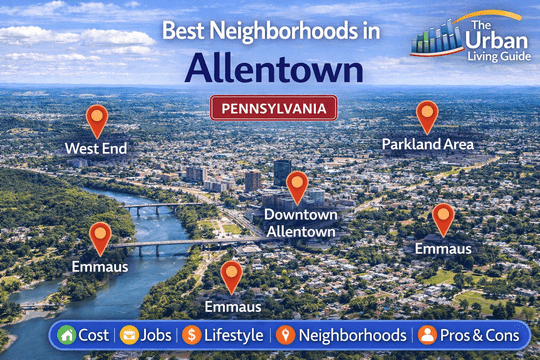
Best Neighborhoods in Allentown, Pennsylvania: Historic Rose Gardens, Parkland Corridors & Queen City Pockets in 2026
Covering approximately 17.5 square miles of land area across the rolling hills of the Lehigh Valley along the Jordan Creek and Lehigh River in Lehigh County, the incorporated municipality of Allentown operates under the mayor-council municipal administration of the City of Allentown. Housing an incorporated municipal core population exceeding 125,000 residents and anchoring Pennsylvania’s third-largest metropolitan region of over 860,000 people, the “Queen City” stands as a vital regional engine for medical innovation, advanced logistics, corporate administration, and higher education.
Relocating across Eastern Pennsylvania requires evaluating distinct neighborhood revivals, four-season climate patterns, and regional commuter highway networks overseen by the Pennsylvania Department of Transportation. Inbound movers consistently balance direct access to primary regional employers—including the extensive medical systems at Lehigh Valley Health Network (LVHN – Cedar Crest) and St. Luke’s University Health Network, major corporate headquarters such as PPL Corporation in the downtown core, manufacturing hubs, and logistics corridors—against daily highway travel across Interstate 78, US Route 22 (Lehigh Valley Thruway), Pennsylvania Route 309, and Hamilton Street, with regional air service connecting via Lehigh Valley International Airport (ABE).
Take a virtual walking tour through the tree-lined streets, historic rose gardens, and distinctive residential neighborhoods of Allentown, Pennsylvania:
Key Residential Districts in Allentown at a Glance in 2026
| Neighborhood | Location | Distance to Center Square | Development Status | Transit Connectivity | Cost Level | Best Fit For |
|---|---|---|---|---|---|---|
| West End (Theater District) | Western Urban Basin | ~1.5 mi west | Historic Tree-Canopied Residential | High (LANTA Bus Routes, Chew St) | Mid-to-High | Professors, Medical Staff & Families |
| Downtown Allentown | Central Business Core | 0 mi (Core) | Modern NIZ Mixed-Use Revitalization | Exceptional (LANTA Transit Hub, Hamilton St) | Mid-Range | Young Professionals, PPL Staff & Commuters |
| Trexlertown (Lower Macungie) | Southwest Suburbs | ~8 mi southwest | Master-Planned Modern Suburban | High (I-78, Route 222, Route 100) | High-to-Premium | Suburban Families & Corporate Leaders |
| South Mountain | Southern Ridge | ~3.5 mi south | Established Wooded Ridge Infill | High (I-78 (Exit 58), Lehigh St) | Mid-Range | Hospital Staff, Commuters & Outdoor Lovers |
| East Side (Midway Manor) | Eastern Basin | ~2.5 mi east | Historic Working-Class Residential | High (US-22, Hanover Ave, LANTA Buses) | Accessible | First-Time Homebuyers, Renters & Trades |
Comprehensive Breakdown of the Best Neighborhoods in Allentown
West End — Historic Boulevard Charm, College Canopies & Malcolm Gross Rose Garden
Covering the established residential basin west of 15th Street stretching toward the municipal border, the West End (anchored by the vibrant 19th Street Theater District and historic West Park) is widely recognized as Allentown’s most architecturally preserved and desirable urban neighborhood. Operating under City of Allentown municipal services and supported by the West End Alliance, the community centers along 19th Street, Chew Street, and Liberty Street.
The district is defined by towering mature oak canopies, preserved early 20th-century estates, boutique sidewalk bistros, and direct proximity to higher-education institutions, delivering an active, walkable community for healthcare leaders and university scholars.
- Housing: Real estate inventory spans historic 1920s brick Tudors, Spanish Colonial Revival homes, classic stone single-family residences, and converted residential flats. Single-family purchase prices typically range from $260,000 to $650,000+, while residential rentals average $1,350 to $2,250 per month.
- Safety & Crime Rate: Patrolled by the Allentown Police Department (APD) 3rd Patrol District. The West End consistently maintains low violent crime rates, supported by high owner-occupancy rates and active community block watch associations.
- School District & Education Quality: Governed by the Allentown School District (ASD), zoned to institutions like William Allen High School, while being minutes from prestigious higher-education campuses anchored by Muhlenberg College and Cedar Crest College.
- Walkability & Daily Conveniences: Outstanding pedestrian walkability (Walk Score of 86-90/100 around 19th Street). Residents easily stroll to indie cinemas at the Civic Theatre of Allentown, local bakeries, craft coffee houses, farm-to-table bistros, and grocers including the Allentown Farmers Market at the Allentown Fairgrounds.
- Parks & Green Spaces / Pet-Friendliness: Direct access to the landscaped paths of the historic Malcolm Gross Rose Garden along Cedar Creek, Trexler Memorial Park (featuring paved walking loops around spring-fed ponds), and historic West Park (designed by J. Franklin West, hosting summer band shell concerts). Exceptionally pet-friendly.
- Parking & Traffic Congestion: Plentiful private residential driveways and detached garages in single-family sections; street parking is well-regulated near the 19th Street commercial corridor. Traffic flows smoothly along Chew Street and Tilghman Street.
- Noise Levels & Vibe: Grounded, cultured, and family-oriented, characterized by collegiate energy near Muhlenberg, neighborhood dog walkers, and peaceful residential evenings.
- Medical Facilities & Hospitals: Direct 5-minute commute west to comprehensive acute care at Lehigh Valley Hospital – Cedar Crest and St. Luke’s Allentown Campus on Hamilton Street.
- Transit Connectivity: High-frequency public transit provided by LANTA (Lehigh and Northampton Transportation Authority) bus routes along Chew and Liberty Streets, offering a 6-minute ride to Center Square, with vehicular links to Route 22 and Route 309.
- Affordability: Mid-to-high price tier for Lehigh County; higher acquisition values are offset by historic architectural preservation, walking access to the Rose Garden, and strong property equity stability.
- Who It’s Best For: University professors, physicians and nurses at LVHN, healthcare executives, and buyers seeking classic architectural charm surrounded by expansive city parks.
- Drawbacks: Older home radiator heating and plumbing systems requiring periodic modernization, higher city school property taxes, and event traffic during the Great Allentown Fair.
Downtown Allentown — PPL Center Entertainment, NIZ Developments & High-Rise Lofts
Situated in the historic central core surrounding Center Square (7th and Hamilton Streets), Downtown Allentown has undergone an extraordinary multi-billion-dollar urban renaissance driven by the state’s innovative Neighborhood Improvement Zone (NIZ) legislation. Supported by the City of Allentown and the Downtown Allentown Business Alliance, the urban center blends restored 19th-century architecture with contemporary glass office towers, luxury apartments, and premier sports entertainment along Hamilton Street.
The urban core offers a walkable downtown lifestyle within steps of minor-league hockey, concerts, craft breweries, and corporate headquarters.
- Housing: Real estate is dominated by modern luxury mid-rise and high-rise apartment complexes (such as The Waterfront, STRATA Flats, and The Hive), converted historic brick lofts, and upper-floor condominiums. Condominium purchase valuations typically range from $150,000 to $340,000, while modern rental apartments average $1,350 to $2,100 per month.
- Safety & Crime Rate: Patrolled by the APD 1st Patrol District and supplemented by visible downtown safety ambassadors. Well-lit entertainment corridors along Hamilton Street and the arena district maintain safe foot traffic, though standard city awareness is advised on peripheral side streets late at night.
- School District & Education Quality: Governed by ASD, containing neighborhood options like Central Elementary School, alongside higher-education footprints anchored by the Lehigh Carbon Community College (LCCC) Donley Center.
- Walkability & Daily Conveniences: Outstanding pedestrian infrastructure (Walk Score of 90-94/100). Residents walk to over 30 local restaurants, craft cocktail bars, art exhibitions at the Allentown Art Museum, live theater at Miller Symphony Hall, and minor-league hockey games at the 10,000-seat PPL Center (home of the AHL Lehigh Valley Phantoms).
- Parks & Green Spaces / Pet-Friendliness: Municipal recreation includes the linear park system of Arts Park, Jordan Meadows, and the riverfront walking paths along the Lehigh River Canal Trail. Pet-friendly with modern residential pet washing stations and urban dog parks.
- Parking & Traffic Congestion: Managed through municipal parking garages operated by the Allentown Parking Authority (APA); most modern residential mid-rises provide attached parking decks. Surface street traffic flows smoothly with occasional delays during major PPL Center arena concerts.
- Noise Levels & Vibe: High-energy, modern, and corporate, filled with arena crowds, business professionals on lunch hours, and active weekend restaurant patios.
- Medical Facilities & Hospitals: Direct 3-minute access to St. Luke’s Hospital – Sacred Heart Campus on Chew Street.
- Transit Connectivity: Central regional transit hub operated by LANTA at the Allentown Transportation Center on 6th Street, offering non-stop bus service throughout the Lehigh Valley, with rapid vehicular access to Route 22 and Interstate 78.
- Affordability: Mid-range urban cost structure; delivers high-end modern building amenities, concierge services, and fitness centers at rates significantly lower than Philadelphia or New York City metros.
- Who It’s Best For: Young corporate professionals working at PPL or ADP, medical fellows, hockey enthusiasts, and urbanites seeking modern luxury rentals.
- Drawbacks: Monthly residential parking garage fees, event traffic congestion around the PPL Center on game nights, and ongoing street-level redevelopment on outer blocks.
Trexlertown (Lower Macungie) — Master-Planned Suburbia, Top Parkland & East Penn Schools
Situated in southwestern Lehigh County within Lower Macungie Township, the unincorporated suburban community of Trexlertown (along with surrounding Lower Macungie neighborhoods) represents one of the Lehigh Valley’s premier family and executive destinations. Governed through Lower Macungie Township Municipal Administration, the area centers along the Route 222 (Hamilton Boulevard) and Route 100 corridors.
Celebrated for its modern master-planned subdivisions, world-class cycling facilities, low crime rates, and elite public education in the East Penn School District, Trexlertown provides an upscale suburban lifestyle within 10 minutes of major corporate business parks.
- Housing: Real estate stock features modern 1990s–2020s two-story single-family colonial homes on spacious quarter-to-half-acre landscaped lots, luxury custom builds in communities like Ancient Oaks and Shepherd’s Corner, and upscale townhome developments. Single-family purchase prices typically range from $380,000 to $850,000+, while residential rentals and townhomes average $1,850 to $2,950 per month.
- Safety & Crime Rate: Protected by the Pennsylvania State Police (Troop M – Fogelsville) and township emergency services, Trexlertown consistently records one of the lowest violent and property crime rates in the region.
- School District & Education Quality: Governed by the nationally acclaimed East Penn School District, containing top-performing public institutions such as Emmaus High School, Lower Macungie Middle School, and Shoemaker Elementary School.
- Walkability & Daily Conveniences: Suburban residential streets are automobile-dependent, but major commercial shopping power centers along Route 222 host Trexlertown Plaza, Whole Foods Market (nearby in Lower Macungie), Target, Costco Wholesale, and diverse family dining.
- Parks & Green Spaces / Pet-Friendliness: World-class natural and athletic recreation anchored by the international track cycling venue at the Valley Preferred Cycling Center (T-Town Velodrome), Bob Rodale Cycling & Fitness Park (featuring 100+ acres of paved loops, cricket fields, and dog paths), and Lower Macungie Community Center Grounds. Exceptionally pet-friendly.
- Parking & Traffic Congestion: Plentiful private two-to-three car garages and expansive residential driveways keep neighborhood streets clear. Commuter traffic builds along Hamilton Boulevard (Route 222) and the Route 100 Bypass during peak morning rush hours.
- Noise Levels & Vibe: Serene, refined, and family-centered, characterized by manicured subdivision lawns, youth sports tournaments, and quiet residential evenings.
- Medical Facilities & Hospitals: Direct 6-to-8 minute drive east via Route 222 to Lehigh Valley Hospital – Cedar Crest.
- Transit Connectivity: Unmatched highway positioning at the junction of Route 222, Route 100, and Interstate 78 (Exit 49), offering a 10-minute drive into Downtown Allentown and rapid access to the Pennsylvania Turnpike (I-476).
- Affordability: High-tier suburban price profile; higher real estate acquisition costs are balanced by top-tier East Penn public school ratings, large lot sizes, and strong long-term property equity.
- Who It’s Best For: Families prioritizing top-ranked public schools (Emmaus High), healthcare executives, cycling enthusiasts, and corporate commuters working across the Lehigh Valley tech and manufacturing corridor.
- Drawbacks: Higher purchase prices per square foot, complete automobile reliance for daily shopping, and commercial traffic along Route 222 during peak hours.
South Mountain — Wooded Hillside Enclaves, Lehigh Street Corridor & Valley Overlooks
Rising along the scenic wooded northern slopes of South Mountain in southern Allentown, this established residential district offers a blend of natural hillside living and convenient highway access. Operating under City of Allentown municipal administration, the community stretches from the Lehigh Street commercial corridor up toward the ridgelines bordering Salisbury Township along Mountainville and South 4th Street.
The neighborhood provides generous tree-shaded lots, quiet residential loops, and fast highway access to both downtown employment and major regional medical centers.
- Housing: Real estate stock spans mid-century single-story brick ranch homes, 1960s–1980s split-levels on wooded hillside parcels, modern infill single-family properties, and garden-style apartment complexes. Single-family purchase prices typically range from $210,000 to $420,000, while rental apartments and duplexes average $1,150 to $1,850 per month.
- Safety & Crime Rate: Patrolled by the APD 2nd Patrol District. South Mountain maintains a quiet, stable residential core with low violent crime rates, supported by long-term homeowners and active community vigilance.
- School District & Education Quality: Governed by ASD, containing neighborhood institutions such as Dieruff High School and South Mountain Middle School, alongside proximity to private and parochial options.
- Walkability & Daily Conveniences: Automobile-dependent for major errands, with commercial centers along Lehigh Street and South 4th Street hosting auto services, home improvement centers, pharmacies, and grocers like Giant Food Stores and ALDI.
- Parks & Green Spaces / Pet-Friendliness: Municipal recreation is anchored by the wooded trails of the South Mountain Reservoir Park, Percy Ruhe Park (Alton Park) (featuring youth baseball diamonds and basketball courts), and hiking access to the Walking Purchase Park conservation lands. Exceptionally pet-friendly.
- Parking & Traffic Congestion: Generous private driveways and single-to-two car garages keep neighborhood streets clear. Commuter traffic moves steadily, with quick access to Interstate 78 (Exit 58 – Lehigh St).
- Noise Levels & Vibe: Peaceful, rustic, and relaxed, characterized by mountain breezes, wildlife, and quiet evenings.
- Medical Facilities & Hospitals: Direct 5-to-7 minute medical access to Lehigh Valley Hospital – Cedar Crest and St. Luke’s University Hospital – Bethlehem across the mountain.
- Transit Connectivity: Road travel connects quickly via Lehigh Street, South 4th Street, and Interstate 78, offering a 6-minute drive to Downtown Allentown and 15 minutes to Bethlehem, supported by LANTA Bus Routes (Route 104).
- Affordability: Balanced mid-range price tier; delivers larger lot sizes, mature trees, and solid brick construction at accessible price points.
- Who It’s Best For: Healthcare workers at LVHN, first-time homebuyers wanting larger yards, corporate commuters using I-78, and outdoor nature lovers.
- Drawbacks: Steep hillside driveways requiring winter maintenance during snowstorms, car dependence for daily retail, and older home mechanical systems.
East Side (Midway Manor) — Historic Brick Rows, Canal Parks & Attainable Infill Living
Covering the established residential basin east of the Lehigh River stretching toward the Bethlehem city line, the East Side (including micro-enclaves like Midway Manor and Overlook Park) is one of Allentown’s most historically grounded, community-focused, and budget-accessible sectors. Operating under City of Allentown municipal governance, the district centers along Hanover Avenue and Union Boulevard.
The neighborhood provides an accessible entry point for first-time homebuyers and renters seeking solid construction, community parks, and straightforward travel between Allentown and Bethlehem.
- Housing: Real estate consists of classic 1940s–1960s brick twin homes, single-story ranch properties in Midway Manor, two-story brick rowhouses, and value-oriented apartment complexes. Single-family and twin home purchase prices typically range from $165,000 to $310,000, while rental apartments and flats average $1,050 to $1,650 per month.
- Safety & Crime Rate: Patrolled by the APD 4th Patrol District. Established residential blocks in Midway Manor and along Hanover Avenue maintain stable, family-oriented streets with active community civic associations.
- School District & Education Quality: Governed by ASD, containing neighborhood public campuses such as Louis E. Dieruff High School, Ritter Elementary School, and Mosser Elementary School.
- Walkability & Daily Conveniences: Moderate pedestrian walkability along commercial corridors on Union Boulevard and Hanover Avenue, hosting local diners, authentic bakeries, pharmacies, auto supply outlets, and community grocers, with major retail at Lehigh Valley Mall located a short drive away.
- Parks & Green Spaces / Pet-Friendliness: Municipal recreation is anchored by Keck Park, Overlook Park, and the natural wetlands at Canal Park along the historic Lehigh River (featuring boat launch ramps, fishing piers, and multi-use cycling paths). Highly pet-friendly.
- Parking & Traffic Congestion: Plentiful private residential driveways, rear alley garages, and open on-street parking. Highway on-ramps provide fast access to US Route 22 (Airport Road Exit) without major surface delays.
- Noise Levels & Vibe: Community-centered, unpretentious, and active, shifting from commercial daytime avenues to quiet residential evenings in established subdivisions.
- Medical Facilities & Hospitals: Direct 6-to-8 minute medical access to St. Luke’s University Hospital – Bethlehem Campus and LVHN Muhlenberg.
- Transit Connectivity: High-frequency public transit provided by LANTA Bus Routes (including Routes 101, 107, and 220) connecting directly to Downtown Allentown and Downtown Bethlehem, with rapid vehicle access to US-22 and Lehigh Valley International Airport (ABE).
- Affordability: Allentown’s most accessible entry-level homeownership and rental price tier, offering lower purchase barriers and manageable property assessments.
- Who It’s Best For: First-time homebuyers, budget-conscious renters, tradespeople, airport personnel, and commuters working across both Allentown and Bethlehem.
- Drawbacks: Pockets of aging municipal infrastructure, variable public school test performance ratings, older housing infrastructure requiring updates, and commercial traffic along Union Boulevard.
Neighborhood Trade-offs: Living Advantages & Drawbacks Across Allentown
| Neighborhood | Core Advantages (Pros) | Core Limitations (Cons) |
|---|---|---|
| West End | Preserved historic architecture; walkable 19th St Theater District; Malcolm Gross Rose Garden; close to Muhlenberg College. | Older home radiator heating and plumbing; higher city property taxes; event traffic during the Great Allentown Fair. |
| Downtown Allentown | Modern NIZ luxury high-rises; hockey and concerts at PPL Center; walkable corporate offices; LANTA Transit Center. | Monthly residential parking garage fees; game-night event traffic; ongoing redevelopment on outer blocks. |
| Trexlertown (Lower Macungie) | Top-rated East Penn (Emmaus High) schools; modern master-planned subdivisions; T-Town Velodrome cycling; lowest crime. | Higher purchase entry barrier; complete automobile dependence; commercial traffic congestion along Route 222. |
| South Mountain | Wooded hillside lots; immediate access to Interstate 78; 5 minutes to LVHN Cedar Crest; quiet residential loops. | Steep hillside driveways during winter snow; automobile dependence for shopping; older home mechanical systems. |
| East Side (Midway Manor) | Allentown’s most affordable home and rental prices; fast access to Route 22 and ABE Airport; close to Canal Park trails. | Variable public school test ratings; older housing infrastructure; commercial traffic along Union Boulevard. |
Finding Your Ideal Residential Fit in the Lehigh Valley
Selecting your ideal neighborhood in Allentown requires balancing your household budget with daily workplace destinations, family schooling priorities, and regional highway travel. Because Allentown serves as the central hub of the Lehigh Valley, your chosen location dictates whether your daily commute relies on local transit via LANTA Bus Routes, walkable sidewalks into Center Square or West End, or major highway expressways like Interstate 78, US Route 22, and Route 309.
Healthcare professionals at LVHN Cedar Crest or St. Luke’s, corporate employees at PPL Corporation, faculty at Muhlenberg or Cedar Crest, and logistics specialists across the I-78 corridor should evaluate transit routes to optimize daily convenience.
Beyond transportation corridors, evaluate essential municipal utility and building infrastructure realities. Eastern Pennsylvania experiences cold winters with freezing temperatures and snowfall alongside warm, humid summers, making home heating efficiency and utility reliability through PPL Electric Utilities and UGI Utilities (Natural Gas) an important factor.
In addition, prospective homebuyers evaluating historic homes in the West End or brick twin homes on the East Side should inspect roofs, boiler systems, and electrical panels, while buyers in Trexlertown should verify township and school district property tax assessments. Before executing a residential lease or property purchase agreement, verify high-speed fiber broadband availability (such as Service Electric Cablevision, Astound Broadband, or Verizon Fios) and confirm school assignment boundaries.
Essential Local Insights & FAQs for Allentown, PA
Which neighborhood in the Allentown area is considered best for families with children?
Trexlertown (Lower Macungie) and the West End are widely regarded as premier family communities. Trexlertown provides access to the top-ranked East Penn School District (including Emmaus High School) alongside safe master-planned subdivisions and parks like Bob Rodale Cycling Park. The West End offers historic tree-lined streets, access to the Malcolm Gross Rose Garden, and close proximity to top private and collegiate academies.
What is the most walkable neighborhood in Allentown where you can live without relying heavily on a car?
Downtown Allentown and the West End offer the highest walkability in the city, both scoring above 88 on Walk Score. Downtown allows residents to complete daily errands on foot, walk to corporate offices, dining, the Allentown Art Museum, and the PPL Center, while connecting directly to LANTA’s primary bus hub. The West End provides dense pedestrian access to neighborhood bistros, theater venues, and the Allentown Farmers Market.
What are the safest residential neighborhoods to live in within Greater Allentown?
Trexlertown, Lower Macungie Township, and the West End consistently report some of the lowest violent and property crime rates in Lehigh County. Trexlertown benefits from dedicated Pennsylvania State Police patrols and quiet subdivision street designs, while the West End maintains active community block watches and high owner-occupancy.
What are the most affordable neighborhoods for homebuyers and renters in Allentown?
The East Side (including Midway Manor) and South Mountain provide the most budget-friendly housing opportunities in the area. On the East Side, buyers and renters can secure brick twin homes and apartments at price points significantly lower than western suburban developments while retaining fast access to Route 22.
How bad is traffic congestion when commuting across the Lehigh Valley?
Traffic congestion on major Lehigh Valley expressways—particularly US Route 22 (the Lehigh Valley Thruway) and Interstate 78—is significant during morning and evening rush hours. Utilizing local surface arterials like Hamilton Boulevard, Tilghman Street, or LANTA bus routes can provide dependable alternatives during peak travel times.
Which Allentown neighborhood is best for healthcare professionals working at LVHN or St. Luke’s?
The West End, Trexlertown, and South Mountain provide the fastest commutes to Lehigh Valley Hospital – Cedar Crest, allowing physicians, nurses, and medical staff to reach the hospital campus within a 5-to-8 minute drive. Downtown Allentown offers immediate walking access to St. Luke’s Sacred Heart Campus on Chew Street.
Is Allentown an affordable place to live compared to Philadelphia and New York City?
Yes, Allentown’s overall cost of living and housing prices are significantly lower than Philadelphia and New York City, offering spacious single-family homes, modern luxury apartments, and large suburban yards at a fraction of regional East Coast real estate costs.
Relocation Resources & Living Guides
The Urban Living Guide creates deeply researched, practical, and informative city relocation resources designed to help individuals, working professionals, and families navigate complex urban landscapes. By analyzing municipal infrastructure, hyper-local zoning patterns, commuter realities, and housing markets, our guides provide actionable insights so you can make confident, data-backed decisions when moving to major metropolitan areas.
Explore our regional guides across Allentown and the Lehigh Valley:
- Living in Allentown, Pennsylvania
- Cost of Living in Allentown, Pennsylvania
- Pros and Cons of Living in Allentown, Pennsylvania
Made your decision to move to the Queen City? Read our comprehensive relocation roadmap: Moving to Allentown, Pennsylvania.
Follow The Urban Living Guide for ongoing regional insights, neighborhood developments, and expert local coverage across Greater Allentown and the Commonwealth of Pennsylvania.