

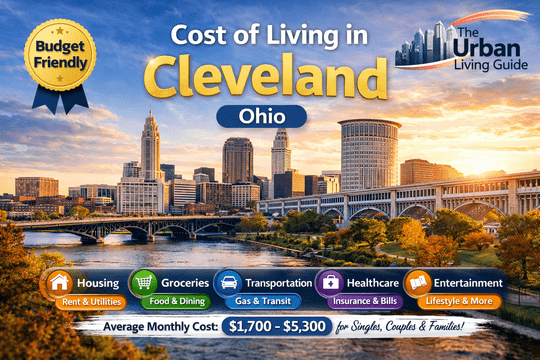
Cost of living in Cleveland, Ohio (2026): A Deep Dive into Lakefront Living, Industrial Roots, and Neighborhood Expenses
Having called Northeast Ohio home for nearly a decade, navigating the financial landscape of Cleveland, Ohio in 2026 means experiencing a resilient Midwestern city where world-class cultural institutions, a stunning Lake Erie coastline, and deeply rooted industrial heritage converge. Whether you are relocating from expensive coastal metros or moving in from nearby rust-belt hubs like Detroit or Pittsburgh, Cleveland offers exceptional purchasing power and an authentic urban lifestyle. Centered around the winding Cuyahoga River and anchored by architectural landmarks like the Terminal Tower, the city brings together diverse neighborhoods from the historic brewpubs of Ohio City to the vibrant artistic community in Tremont and the medical innovation corridor of University Circle.
Overall, living expenses in Cleveland track roughly 7% to 9% below the national average, making it one of the most budget-friendly major metropolitan areas in the United States. However, managing your household budget requires understanding specific regional variables such as property tax assessments, winter heating demands, and varying neighborhood housing markets. For official municipal updates, local community grants, and city services, residents frequently reference the City of Cleveland Official Portal.
Housing Costs, Real Estate & Neighborhood Maintenance in Cleveland, Ohio
Housing represents the most advantageous financial category in Cleveland, where historical real estate valuations remain remarkably accessible compared to national averages. Rental inventory and buying options vary substantially across distinct community grids:
- Studio apartments in downtown towers or near Edgewater Park typically lease between $850 and $1,200 per month.
- 1-bedroom apartments across trendy districts like Ohio City and the Detroit-Shoreway range from $1,100 to $1,500 per month.
- 2-bedroom apartments span $1,400 to $2,100 per month, accommodating roommates and growing families.
- Single-family detached homes and historic Victorians across desirable east-side suburbs like Shaker Heights or west-side neighborhoods like Lakewood command monthly rents or mortgage equivalents from $1,700 to $2,800+.
For prospective home buyers, the median residential listing price hovers near $195,000 within city limits, though suburban properties in Cleveland Heights or Rocky River scale higher. Homeowners must carefully account for local property tax structures, which are notably higher across Cuyahoga County to support public infrastructure and school districts.
Average Monthly Expense Breakdown in Cleveland, Ohio
Evaluating standard monthly household expenditures provides a clear financial picture for single adults, couples, and families establishing roots in Cuyahoga County:
| Household Type | Estimated Monthly Budget | Primary Cost Drivers |
|---|---|---|
| Single Adult | $2,050 – $2,550 | Apartment rent, vehicle insurance, groceries, utilities |
| Couple (No Children) | $3,300 – $4,150 | Multi-room housing, dual vehicle operation, dining out |
| Family of Four | $5,400 – $6,700 | Suburban mortgage, childcare, family healthcare, groceries |
Watch this video to get a closer look at housing and neighborhood pricing in Cleveland, Ohio.
Grocery, Dining & Food Expenses in Cleveland, Ohio
Grocery and everyday food expenses in Cleveland track right at or slightly below national baselines, giving local shoppers plenty of budget-friendly choices without sacrificing quality. From classic neighborhood institutions to modern organic storefronts, food budgeting is straightforward:
- Major regional grocery options include high-end local staples like Heinen’s Grocery Store, alongside value-driven regional chains like Giant Eagle and discount mainstays like Aldi.
- Fresh produce, artisanal meats, and international specialty items are a weekly staple for locals shopping at the historic West Side Market in Ohio City.
- Dining out expenses span a wide range; casual neighborhood diners average $12 to $18 per person, while fine dining in Downtown Cleveland or The Flats East Bank scales from $40 to $85+ per person.
Education and Childcare Expenses in Cleveland, Ohio
Educational planning across the metropolitan area involves weighing public school districts, charter networks, and prestigious private academies:
- Infant daycares and full-time childcare facilities typically range between $900 and $1,500 per month per child across Cuyahoga County.
- Preschool programs average $600 to $1,100 per month, helping young children transition into local kindergarten systems.
- Public education is anchored by the Cleveland Metropolitan School District (CMSD), while suburban families frequently look toward top-rated systems in Solon, Beachwood, and Rocky River.
- Private and college-preparatory institutions such as University School, Hawken School, and St. Ignatius High School command annual tuitions ranging from $28,000 to $42,000+.
Transportation and Commute Costs in Cleveland, Ohio
While Cleveland features a robust multi-modal transit framework, daily commuting patterns heavily influence household transportation budgets:
- Personal vehicle operation requires factoring in regional fuel costs, which fluctuate around $3.00 to $3.50 per gallon, alongside Ohio auto insurance premiums averaging $1,300 to $1,600 annually.
- Public transit is operated by the Greater Cleveland Regional Transit Authority (RTA), offering heavy rail (Rapid Transit Red Line), bus routes, and waterfront lines with monthly passes costing approximately $95.
- Downtown parking involves monthly garage fees or daily rates ranging from $10 to $20, though many neighborhood residents rely on free street parking outside the central business district.
Utilities, Energy & Home Bills in Cleveland, Ohio
Because Northeast Ohio experiences distinct four-season weather patterns—featuring freezing lake-effect winter snows and humid summer heatwaves—utility budgeting requires careful annual planning:
- Electricity is primarily supplied by FirstEnergy (The Illuminating Company), with average monthly bills ranging from $90 to $160 for apartments and higher for detached homes.
- Natural gas for winter heating is serviced by Dominion Energy Ohio, with heating bills peaking between $80 and $180 per month during January and February.
- Water, sewer, and waste services managed by the Northeast Ohio Regional Sewer District (NEORSD) typically add $75 to $120 per month to household ledgers.
- High-speed broadband internet through providers like Spectrum and AT&T Fiber generally runs $55 to $95 per month.
Healthcare & Medical Insurance Costs in Cleveland, Ohio
Cleveland is internationally renowned for its elite medical research and healthcare infrastructure, providing residents with exceptional clinical access:
- World-class medical networks are anchored by the globally recognized Cleveland Clinic, alongside University Hospitals (UH) and MetroHealth.
- Employer-sponsored health insurance premiums typically deduct $120 to $320 per month for individuals and $450 to $850 per month for family tier plans.
- Out-of-pocket routine medical care, specialist visits, and dental care track close to national averages, supported by a vast network of neighborhood clinics.
Entertainment, Culture & Lifestyle Costs in Cleveland, Ohio
Recreational and lifestyle spending in Cleveland reflects a deeply proud cultural identity rooted in arts, music, and expansive park systems:
- Iconic cultural attractions include the Cleveland Museum of Art (with free general admission), the historic Cleveland Orchestra at Severance Hall, and the legendary Rock & Roll Hall of Fame on the downtown lakefront.
- Professional sports entertainment draws massive local crowds for Cleveland Guardians baseball at Progressive Field, Cleveland Cavaliers basketball at Rocket Mortgage FieldHouse, and Cleveland Browns football at Huntington Bank Field.
- Fitness club memberships and specialty yoga studios across Lakewood and Tremont average $35 to $85 per month.
Pet-Related Living Costs in Cleveland, Ohio
For pet owners moving to Cleveland, the city is remarkably accommodating, featuring expansive green spaces and specialized pet amenities:
- Veterinary care and routine wellness visits average between $50 and $80 per standard examination across local animal hospitals.
- Pet insurance premiums for dogs and cats range from $35 to $75 per month depending on coverage level and animal age.
- Dog-friendly outdoor recreation is highlighted by dedicated fenced areas within the Cleveland Metroparks system and neighborhood dog parks in Ohio City.
City-Specific Living Cost Drivers & Seasonal Expenses in Cleveland, Ohio
Living along the shores of Lake Erie introduces specific environmental and seasonal maintenance factors that directly impact annual household budgeting:
- Lake-effect winter snowstorms require budgeting for snow removal services, winter tires, de-icing supplies, and heightened residential heating loads from December through March.
- Spring thaw and heavy rainfall adaptations necessitate proper basement waterproofing, sump pump maintenance, and clean gutter systems to prevent seasonal water accumulation.
- Outdoor property upkeep for suburban homeowners involves professional lawn care, leaf collection across mature neighborhood tree canopies, and exterior surface sealing against freeze-thaw damage.
Local Property Taxes & Municipal Levies in Cleveland, Ohio
Tax obligations in Cleveland combine state income tax with municipal and county assessments that impact take-home earnings:
- Ohio state income tax follows a progressive tax bracket ranging from 2.75% to 3.75% for mid-to-high income earners.
- Cleveland city income tax is assessed at 2.5% for individuals working within city limits, while suburban municipalities levy local earnings taxes between 1% and 2.5%.
- Property tax rates within Cuyahoga County are among the higher assessments in the state, averaging roughly 2.5% to 3.5% of assessed market value annually depending on the specific taxing district.
Is the Cost of living in Cleveland, Ohio Worth It?
Evaluating whether financial investments in Cleveland pay off reveals a compelling balance of urban culture and economic breathing room:
- Exceptional Housing Value: Your monthly housing dollar stretches significantly further here than in nearly any other major U.S. metropolitan center, allowing buyers to secure historic character or modern square footage without drowning in mortgage debt.
- World-Class Amenities on a Budget: Residents enjoy access to elite healthcare networks, free world-class museums, and expansive park reservations without paying tier-one coastal living premiums.
- Career and Educational Anchors: A thriving healthcare, tech, and manufacturing economy provides steady employment opportunities paired with manageable daily commute times.
- Trade-Off Considerations: Higher local property tax assessments and winter energy demands require careful budgeting, but these are easily offset by overall savings on daily consumer goods and rent.
Who May Find Cleveland Expensive — And Who Can Afford It?
Understanding cost positioning requires examining how different financial brackets experience life in the region:
Minimum-wage earners, entry-level service workers, and independent students renting in newly gentrified luxury developments downtown may find certain urban pockets financially tight. When combining local city income taxes, high winter utility bills, and personal vehicle maintenance, modest entry-level paychecks can experience noticeable compression.
Conversely, established healthcare professionals, corporate managers, remote technology workers, and dual-income families find Cleveland exceptionally comfortable. Individuals and households earning annual incomes upward of $70,000 to $95,000+ can effortlessly secure spacious real estate in premier neighborhoods, fund robust savings accounts, and fully enjoy the region’s rich culinary and cultural arts scene without financial anxiety.
Downtown vs. Suburbs Cost of Living Comparison
| Expense Category | Downtown / Urban Core | Established Suburbs (e.g., Lakewood / Shaker Heights) |
|---|---|---|
| Average Monthly Rent (1-2 BHK) | $1,250 – $2,100 | $1,400 – $2,400 |
| Median Home Purchase Price | $210,000 – $360,000 | $280,000 – $520,000+ |
| Property Tax Burden | Moderate (Cleveland city limits) | Higher (Suburban school district millage rates) |
| Transportation & Parking | High transit access; paid garage parking | Car-dependent; free residential driveway parking |
| Dining & Entertainment | Walkable nightlife, theater district & sports arenas | Family-centric bistros, local parks & retail plazas |
Practical Money-Saving Tips for Cleveland Residents
Optimizing your monthly budget while living in Cleveland becomes seamless when applying these localized financial strategies:
- Utilize the Greater Cleveland RTA transit system and monthly pass programs if your daily workspace is located within the downtown commercial loop to cut down on monthly parking garage fees.
- Enroll in budget billing plans with Dominion Energy Ohio and FirstEnergy to smooth out seasonal utility payment spikes during freezing winter months.
- Shop weekly grocery specials at neighborhood staples like Aldi and source fresh produce directly from local vendors at the West Side Market instead of relying entirely on high-end specialty grocers.
- Take advantage of free world-class attractions, including the Cleveland Museum of Art and the expansive Cleveland Metroparks reservation trails for weekend entertainment.
- Explore community energy aggregation programs offered through your specific municipality to secure lower residential electricity and natural gas supply rates.
- Leverage employer commuter benefits or pre-tax transit accounts to reduce federal and state taxable income while paying for public transportation.
- Patronize neighborhood restaurant happy hours and early-week dining specials across Ohio City and Tremont rather than weekend peak hours.
- Participate in local tool-lending libraries and community garden plots operated across Cuyahoga County to minimize home maintenance and landscaping equipment expenses.
Local Resident Realities: What Long-Timers Say About Living Costs
“Moving to Ohio City seven years ago completely transformed my financial outlook. The money I save on rent compared to Chicago allowed me to buy my first home and still enjoy incredible dining right outside my door.” — Derek R., Ohio City resident of 7 years (Feedback sourced from Greater Cleveland community boards & local resident forums)
“Property taxes and winter heating bills are definitely things you have to budget for carefully in Northeast Ohio, but once you set up budget billing and find the right neighborhood, your overall cost of living remains wonderfully manageable.” — Elena M., Tremont homeowner of 11 years (Feedback sourced from Tremont neighborhood association feedback)
Frequently Asked Questions About Living in Cleveland, Ohio
How does the overall cost of living in Cleveland compare to the national average?
The overall cost of living in Cleveland tracks roughly 7% to 9% below the national average. While certain expenses like property taxes and winter energy bills require careful attention, housing and grocery costs remain remarkably affordable across the metropolitan area.
What is the average monthly rent for a 1-bedroom apartment in Cleveland?
A standard 1-bedroom apartment in Cleveland typically leases between $1,100 and $1,500 per month. Rent prices vary depending on whether you choose a high-rise downtown loft or a residential apartment in surrounding neighborhoods like Lakewood or Cleveland Heights.
Are utility bills expensive during the winter months in Cleveland?
Winter heating bills can experience noticeable increases due to sub-freezing temperatures and lake-effect weather patterns. On average, combined household utilities range from $180 to $300 per month, which can be easily stabilized by enrolling in utility budget billing plans.
Is a personal vehicle necessary for commuting around Cleveland?
While the RTA provides reliable rail and bus transit connecting urban neighborhoods and downtown employers, Cleveland is largely a car-centric Midwestern city. Owning a personal vehicle is recommended for convenient travel across the broader Cuyahoga County grid.
What annual salary is required for a single adult to live comfortably in Cleveland?
A single adult earning an annual salary between $50,000 and $60,000 can live very comfortably in Cleveland, comfortably covering rent, vehicle expenses, health insurance, groceries, and recreational outings without severe financial pressure.
How do property taxes impact home buyers in Cuyahoga County?
Property tax assessments in Cuyahoga County average roughly 2.5% to 3.5% of assessed market value annually. Prospective home buyers must factor these local tax rates into their monthly mortgage escrow calculations when purchasing residential real estate.
Want to know more about this city?
At The Urban Living Guide (TULG), we have covered various guides related to Cleveland on living and moving details to help you plan your relocation smoothly. Whether you are researching neighborhood demographics, weighing pros and cons, or evaluating financial trade-offs, check out these helpful resources:
- Living in Cleveland, Ohio
- Pros and Cons of Living in Cleveland, Ohio
- Best Neighborhoods in Cleveland, Ohio
- Moving to Cleveland, Ohio
Follow The Urban Living Guide (TULG) for comprehensive USA city details, neighborhood spotlights, and financial insights across all major metropolitan areas.