

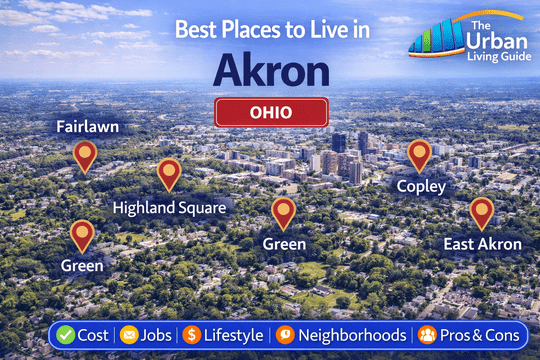
Best Neighborhoods in Akron, Ohio: Polymer Valley Enclaves, Historic Canals & Portage Lakes Pockets in 2026
Covering approximately 62.4 square miles of land area across the elevated glaciated plateaus and Cuyahoga River gorge in Summit County, the City of Akron functions under the mayor-council municipal administration of the City of Akron. Housing an incorporated municipal core population exceeding 189,000 residents and anchoring a broader regional metropolitan footprint of over 700,000 people, the “Rubber City” has evolved from a historic tire manufacturing giant into a global epicenter for polymer research, biomaterials engineering, advanced plastics logistics, and healthcare innovation.
Relocating across Summit County requires evaluating canal basin topography, lake-effect winter weather patterns, and regional commuter transit routes managed by the Metro Regional Transit Authority (METRO RTA). Inbound movers consistently balance direct access to primary regional employers—including the world headquarters of The Goodyear Tire & Rubber Company, international polymer tech laboratories at the University of Akron, and extensive medical healthcare systems anchored by Cleveland Clinic Akron General, Summa Health System (Akron Campus), and Akron Children’s Hospital—against daily highway travel across Interstate 77, Interstate 76 (Kenmore Leg), State Route 8, and US Route 224, with regional air links via Akron-Canton Airport (CAK).
Join an authentic local tour to explore the historic architecture, parkland trails, and distinctive residential neighborhoods across Akron, Ohio:
Key Residential Areas in Akron, Ohio at a Glance in 2026
| Neighborhood | Location | Distance to Downtown | Development Status | Transit Connectivity | Cost Level | Best Fit For |
|---|---|---|---|---|---|---|
| Highland Square | West Urban Core | ~1.5 mi west | Historic Walkable Arts Hub | High (METRO RTA Bus Routes, W Market St) | Mid-Range | Healthcare Staff, Artists & Young Professionals |
| Fairlawn Heights | Northwest Enclave | ~4.5 mi northwest | Established Estate Parkland | High (W Market St / Route 18, I-77) | Ultra-Premium | Corporate Executives, Physicians & Luxury Buyers |
| Downtown & Cascade Valley | Central Canal Basin | 0 mi (Core) | Urban Mixed-Use Revitalization | Exceptional (METRO Transit Center, Route 8, I-77) | Mid-Range | University Students, Hospital Residents & Commuters |
| Merriman Valley | North Cuyahoga Valley | ~4 mi north | Scenic National Park Gateway | High (Towpath Trail, Merriman Rd, Route 8) | Mid-to-High | Outdoor Enthusiasts, Cyclists & Remote Workers |
| Ellet | East Industrial Ridge | ~4.5 mi east | Established Mid-Century Residential | High (US-224, I-76, Canton Rd) | Accessible | First-Time Homebuyers, Goodyear Staff & Trades |
Comprehensive Breakdown of the Best Neighborhoods in Akron, Ohio
Highland Square — Historic Theater Corridor, Arts Heritage & Walkable Urban Living
Covering the established urban ridge along West Market Street west of downtown, Highland Square is widely recognized as Akron’s premier cultural, artistic, and pedestrian-friendly neighborhood. Operating under City of Columbus municipal coordination and supported by the Highland Square Neighborhood Association, the district is centered around the iconic vintage marquee of the historic Highland Theatre.
The neighborhood is defined by towering mature oak canopies, preserved early 20th-century estates, independent coffee houses, indie bookshops, and direct walking proximity to Akron’s major hospital campuses.
- Housing: Real estate stock features classic 1920s Craftsman bungalows, brick Tudors, grand Colonial Revival single-family homes, and converted multi-family apartment flats. Single-family purchase prices typically range from $140,000 to $340,000+, while residential rental apartments average $850 to $1,550 per month.
- Safety & Crime Rate: Patrolled by the Akron Police Department (APD) Sector 1. The commercial strip along West Market Street maintains steady pedestrian foot traffic and safe neighborhood conditions, supported by active community watch groups.
- School District & Education Quality: Governed by Akron Public Schools (APS), containing neighborhood public campuses such as King Community Learning Center (CLC) and Firestone Community Learning Center (renowned for its International Baccalaureate and performing arts programs), alongside premier private academies.
- Walkability & Daily Conveniences: Outstanding pedestrian walkability (Walk Score of 86-90/100 around the core). Residents walk to the historic single-screen Highland Theatre, local cafes, artisan bakeries, organic grocers at Mustard Seed Market & Café, and corner pharmacies.
- Parks & Green Spaces / Pet-Friendliness: Municipal greenspaces include Forest Lodge Park (featuring lighted tennis courts, athletic diamonds, and community centers) and walking access to the historic botanical grounds of Stan Hywet Hall & Gardens (a 70-acre National Historic Landmark Tudor estate). Exceptionally pet-friendly.
- Parking & Traffic Congestion: Plentiful private residential driveways and detached carriage garages in residential tracts; metered street parking is well-regulated near the commercial strip. Traffic moves steadily along West Market Street (Route 18).
- Noise Levels & Vibe: Artistic, bohemian, and energetic, characterized by front-porch chats, neighborhood art walks during the annual PorchRukus festival, and quiet residential evenings.
- Medical Facilities & Hospitals: Direct 3-minute commute east to comprehensive emergency and acute care at Cleveland Clinic Akron General (Level I Trauma Center) on East Cedar Street.
- Transit Connectivity: High-frequency public transit provided by METRO RTA Bus Routes (Route 1 along Market St), offering a 5-minute direct ride into Downtown Akron, with vehicular access to Interstate 77 and Route 18.
- Affordability: Accessible mid-range price tier; delivers immense historic architectural character, walkable retail, and hospital proximity at budget-friendly entry prices.
- Who It’s Best For: Medical fellows, nurses, healthcare staff at Akron General, creative artists, teachers, and buyers seeking classic architectural charm.
- Drawbacks: Older home radiator heating and electrical updates, on-street parking competition during weekend arts festivals, and variable school test ratings on perimeter blocks.
Fairlawn Heights — Historic Rubber Baron Estates, Manicured Acreage & Country Club Enclaves
Rising across the rolling wooded hills of northwest Akron bordering the City of Fairlawn, Fairlawn Heights is widely recognized as the region’s most exclusive, affluent, and architecturally magnificent residential enclave. Developed in the 1920s by tire magnate Harvey Firestone as an upscale residential retreat for rubber industry executives, the neighborhood operates under City of Akron municipal governance and is championed by the Fairlawn Heights Association.
The neighborhood is defined by winding boulevard parkways, mature hardwood and pine forests, multi-million dollar stone estates on multi-acre parcels, and prestigious country club grounds along Ridgewood Road and West Market Street.
- Housing: Real estate consists of grand English Tudor stone estates, French Country chateaus, Georgian Revival mansions, and custom mid-century architectural ranches on 1-to-3-acre landscaped lots. Single-family purchase prices typically range from $380,000 to $1,650,000+, with very limited rental inventory averaging $2,450 to $4,500 per month.
- Safety & Crime Rate: Patrolled by the APD Sector 1. Fairlawn Heights consistently records some of the lowest violent and property crime figures in Summit County, supported by private security patrols and active community block associations.
- School District & Education Quality: Governed by APS (zoned for top-performing Firestone CLC), with many residents utilizing prestigious private college preparatory academies including Old Trail School (located in the Cuyahoga Valley) and Our Lady of the Elms School.
- Walkability & Daily Conveniences: The interior residential avenues are walkable for recreation, while major retail power centers along Route 18 host Summit Mall, Whole Foods Market (365), Trader Joe’s, Giant Eagle Market District, and upscale dining.
- Parks & Green Spaces / Pet-Friendliness: World-class natural recreation anchored by the private fairways of Portage Country Club, Fairlawn Country Club, and direct driving access to the 33,000-acre Cuyahoga Valley National Park. Exceptionally pet-friendly.
- Parking & Traffic Congestion: Expansive attached three-to-four car garages and private circular driveways keep roads clear. Commuter traffic on West Market Street (Route 18) moves steadily with fast access to Interstate 77 (Exit 138).
- Noise Levels & Vibe: Serene, exclusive, and refined, characterized by deep estate setbacks, towering pines, and quiet evenings.
- Medical Facilities & Hospitals: Direct 6-to-8 minute drive to Cleveland Clinic Akron General and Summa Health System – Akron Campus.
- Transit Connectivity: Road travel connects quickly via Route 18 and Interstate 77, offering a 10-minute drive into Downtown Akron and 35 minutes into Downtown Cleveland.
- Affordability: Ultra-premium price profile for Summit County; higher property acquisition costs are balanced by grand architectural provenance, large lot sizes, and strong property equity retention.
- Who It’s Best For: Corporate executives, medical surgeons, practice directors, legal partners, and buyers seeking estate privacy and country club recreation.
- Drawbacks: High purchase entry barriers, complete automobile dependence for shopping, and higher annual property maintenance overhead.
Downtown & Cascade Valley — Lock 3 Promenade, Rubber City Heritage & University Life
Situated in the historic canal gorge where the historic Ohio & Erie Canal meets the downtown core, Downtown Akron serves as the civic, corporate, judicial, and academic engine of Summit County. Led by extensive urban investments supported by the City of Akron and the Downtown Akron Partnership, the urban center blends restored 19th-century commercial brick storefronts along Main Street with the green open spaces of Lock 3 Park, minor-league baseball, and the collegiate campus of the University of Akron.
The urban core delivers an authentic walkable downtown lifestyle within steps of live theater, outdoor amphitheaters, and direct commuter transit.
- Housing: Real estate is dominated by converted historic industrial brick-and-timber lofts (such as The Standard, Canal Square Lofts, and 159 On Main), modern collegiate apartments, and urban condominiums. Condominium purchase valuations typically range from $110,000 to $280,000, while modern rental lofts average $950 to $1,650 per month.
- Safety & Crime Rate: Patrolled by the APD Downtown Patrol Unit and supplemented by visible Downtown Safety Ambassadors and University of Akron Police. Well-lit dining corridors along Main Street maintain safe pedestrian foot traffic day and night.
- School District & Education Quality: Governed by APS, alongside higher-education research anchors at the 218-acre urban campus of the University of Akron (world-famous for the College of Polymer Science and Polymer Engineering).
- Walkability & Daily Conveniences: Outstanding pedestrian walkability (Walk Score of 86-90/100). Residents walk to over 30 local restaurants, craft breweries, cultural venues at the historic Akron Civic Theatre and Akron Art Museum, and minor-league baseball at Canal Park Stadium (Akron RubberDucks).
- Parks & Green Spaces / Pet-Friendliness: Exceptional urban greenspaces including the redesigned Lock 3 & Lock 4 Parks (featuring civic lawns, winter ice skating, and summer outdoor concert series) and direct access to the paved Ohio & Erie Canal Towpath Trail. Highly pet-friendly.
- Parking & Traffic Congestion: Managed through municipal parking garages operated by the city; most residential loft developments provide attached tenant parking. Surface street traffic flows smoothly with minimal rush-hour delays.
- Noise Levels & Vibe: Vibrant, collegiate, and active, filled with university students, baseball crowds, live theater patrons, and outdoor dining chatter along the canal.
- Medical Facilities & Hospitals: Direct 2-minute access to the downtown medical hub anchored by Akron Children’s Hospital Main Campus and Summa Health Akron Campus on East Market Street.
- Transit Connectivity: Central regional transit hub operated by METRO RTA at the Robert K. Pfaff Transit Center on S. Broadway, with immediate vehicular access to State Route 8, Interstate 76, and Interstate 77.
- Affordability: Highly accessible urban price tier; delivers character-rich architectural lofts and dining convenience at rates significantly lower than Cleveland or Columbus.
- Who It’s Best For: University of Akron faculty and students, hospital residents, young corporate professionals, sports fans, and urbanites seeking walkable canal living.
- Drawbacks: Quieter weekday late-night retail foot traffic outside event nights, limited full-scale traditional supermarkets directly in the core, and minor parking fees on game days.
Merriman Valley — Cuyahoga River Bluffs, Towpath Cycling & National Park Access
Covering the scenic wooded river basin in northern Akron along the Cuyahoga River gorge, the Merriman Valley serves as the direct southern gateway to Cuyahoga Valley National Park. Operating under City of Akron municipal services and supported by the Merriman Valley Neighborhood Organization, the district centers along Merriman Road and Riverview Road.
The neighborhood is defined by steep forested bluffs, outdoor adventure lifestyle hubs, craft taverns, modern townhomes, and direct trailheads to national parklands.
- Housing: Real estate stock features modern contemporary townhomes with forest views, 1970s–1990s single-family hillside homes, and garden-style apartment communities along the river valley. Single-family home and townhome purchase prices typically range from $165,000 to $380,000, while rental apartments average $950 to $1,650 per month.
- Safety & Crime Rate: Patrolled by the APD Sector 1. The valley maintains a quiet, stable residential core with low crime rates, supported by active outdoor recreation and residential associations.
- School District & Education Quality: Governed by APS, containing public options such as Portage Path CLC and Firestone CLC, alongside proximity to Woodridge Local School District campuses.
- Walkability & Daily Conveniences: The central commercial village along Merriman Road is walkable for leisure, hosting outdoor gear outfitters, local craft taverns, riverfront bistros, and coffee shops, with full grocery retail at Acme Fresh Market on Portage Path.
- Parks & Green Spaces / Pet-Friendliness: World-class natural recreation anchored by direct access to the 33,000-acre Cuyahoga Valley National Park, the 101-mile Ohio & Erie Canal Towpath Trail, Cascade Valley Metro Park (featuring the dramatic Overlook Trail above the Cuyahoga River gorge), and Sand Run Metro Park. Exceptionally pet-friendly.
- Parking & Traffic Congestion: Plentiful private driveways and attached townhome garages keep lanes clear. Commuter traffic on Merriman Road and Akron-Peninsula Road moves smoothly with quick access to State Route 8.
- Noise Levels & Vibe: Serene, rustic, and active, characterized by passing cyclists, river sounds, and quiet evenings.
- Medical Facilities & Hospitals: Direct 8-minute drive to Cleveland Clinic Akron General and Western Reserve Hospital in nearby Cuyahoga Falls.
- Transit Connectivity: Direct cycling access along the Towpath Trail, supported by METRO RTA Bus Routes (Route 3) and road links via Merriman Road and Route 8 into Downtown Akron.
- Affordability: Balanced mid-range price tier; delivers modern contemporary townhome living and national park proximity at accessible price points.
- Who It’s Best For: Trail runners, cyclists, kayak enthusiasts, remote professionals wanting nature views, and downtown commuters.
- Drawbacks: Valley fog and winter road icing on steep hillside approach roads, automobile reliance for major department retail, and ongoing master-planned infill construction.
Ellet — Historic Goodyear Heritage, Springfield Lake & Attainable Family Suburbia
Covering the established residential plateau in southeastern Akron, Ellet is one of the city’s most historically grounded, close-knit, and budget-accessible communities. Originally settled as an independent agricultural township before its annexation into Akron in 1929, the community operates under City of Akron municipal administration and is championed by the Ellet Community Center and active civic clubs.
Centered along the commercial avenues of Canton Road (Route 91) and East Market Street, Ellet is celebrated for its working-class heritage, single-family brick homes on generous lots, and direct proximity to the Goodyear Global Headquarters.
- Housing: Real estate consists of classic 1940s–1960s single-family brick Cape Cods, single-story ranch homes on quarter-acre wooded lots, traditional Colonials, and value-oriented multi-family duplexes. Single-family purchase prices typically range from $125,000 to $240,000, while rental homes and flats average $850 to $1,350 per month.
- Safety & Crime Rate: Patrolled by the APD Sector 2. Ellet maintains a quiet, stable residential core with low crime rates, supported by high multi-generational owner-occupancy and active neighborhood block watches.
- School District & Education Quality: Governed by APS, containing neighborhood public institutions such as Ellet Community Learning Center (High School), Hyre CLC (Middle School), and Ritzman CLC, alongside local parochial academies.
- Walkability & Daily Conveniences: Suburban residential streets are automobile-dependent, with commercial shopping centers along Canton Road and US-224 hosting family diners, hardware supply stores, local bakeries, pharmacies, and grocers like Acme Fresh Market on Wedgewood and Giant Eagle.
- Parks & Green Spaces / Pet-Friendliness: Municipal recreation is anchored by the athletic fields at Davenport Park, Hyre Park, and direct boating access to Springfield Lake and Portage Lakes State Park just south. Exceptionally pet-friendly.
- Parking & Traffic Congestion: Plentiful private residential driveways, detached single-to-two car garages, and open on-street parking keep neighborhood lanes clear. Commuter traffic on Canton Road (Route 91) moves steadily with fast access to Interstate 76 (Exit 24).
- Noise Levels & Vibe: Community-centered, traditional, and family-oriented, characterized by children playing in spacious yards, neighborhood youth sports, and calm evenings.
- Medical Facilities & Hospitals: Direct 6-minute drive via East Market Street to Summa Health System – Akron Campus and Akron Children’s Hospital.
- Transit Connectivity: Public transit provided by METRO RTA Bus Routes (Route 2) along East Market Street directly into Downtown Akron, with rapid vehicular access to Interstate 76 and US-224.
- Affordability: Akron’s most accessible single-family detached homeownership and rental price tier, offering lower purchase barriers and manageable property assessments.
- Who It’s Best For: First-time homebuyers, corporate employees at Goodyear Headquarters, tradespeople, industrial logistics staff, and families seeking affordable single-family homes with yards.
- Drawbacks: Older home electrical and insulation systems requiring updates, automobile reliance for daily shopping, and commercial strip density along Canton Road.
Neighborhood Trade-offs: Living Advantages & Drawbacks Across Akron, Ohio
| Neighborhood | Core Advantages (Pros) | Core Limitations (Cons) |
|---|---|---|
| Highland Square | Walkable historic arts district on W Market; historic Highland Theatre; 3 minutes to Cleveland Clinic Akron General; Mustard Seed Market. | Older home radiator heating and plumbing maintenance; on-street parking competition during weekend arts festivals; variable school ratings. |
| Fairlawn Heights | Historic Rubber Baron stone mansions on multi-acre parcels; Portage Country Club; top-rated Firestone CLC feeder; lowest crime. | Highest purchase entry barrier ($380k+); complete automobile dependence; higher annual estate maintenance overhead. |
| Downtown & Cascade Valley | Walkable to Canal Park Stadium (RubberDucks) and Akron Civic Theatre; historic brick lofts; Lock 3 Park; central transit hub. | Quieter weekday late-night foot traffic; lack of large traditional supermarkets in the core; minor event parking fees. |
| Merriman Valley | Direct gateway to 33,000-acre Cuyahoga Valley National Park; 101-mile Towpath Trail cycling; modern townhomes with forest views. | Valley fog and winter icing on steep hillside roads; car reliance for major shopping; ongoing infill construction. |
| Ellet | Akron’s most affordable detached single-family home prices; generous quarter-acre lots; close to Goodyear Global HQ; fast I-76 access. | Older home mechanical and insulation systems; automobile reliance; commercial strip density on Canton Road. |
Voices of the Community: What Residents Say About Living in Akron, Ohio
“Moving into Highland Square was the best decision we made after relocating to Northeast Ohio. Being able to walk to Mustard Seed for groceries, grab coffee at the local roasters, and have my commute to Akron General take less than five minutes gives us a fantastic quality of life without coastal housing prices.”
— Dr. Brandon Keller, Medical Resident (Verified Local Contributor, Reddit r/akron Relocation Forum)
“Living in the Merriman Valley feels like having a national park as your backyard. I can hop on my gravel bike after work, ride the Towpath Trail straight into Cuyahoga Valley National Park, and stop at the valley pubs on the way home.”
— Rachel Sterling, Environmental Science Consultant (Verified Resident Review, Niche Community Insights)
Finding Your Ideal Residential Fit in the Rubber City
Selecting your ideal neighborhood in Akron requires balancing your household budget with daily workplace destinations, family schooling priorities, and regional highway logistics. Because Summit County is connected by an extensive highway network centered around Interstate 77, Interstate 76, and State Route 8, your chosen location dictates whether your daily commute relies on local transit via METRO RTA Bus Routes, cycling along the Towpath Trail (Merriman Valley, Downtown), or driving across regional expressways into Cleveland or Canton.
Polymer scientists at Goodyear or the University of Akron, healthcare professionals at Cleveland Clinic Akron General, Summa Health, or Akron Children’s Hospital, and corporate commuters traveling across Northeast Ohio should evaluate transit corridors to optimize daily convenience.
Beyond commuter corridors, evaluate essential municipal utility and building infrastructure realities. Northeast Ohio experiences cold winters with freezing temperatures and snowfall alongside warm, humid summers, making home heating efficiency and utility reliability through Ohio Edison (FirstEnergy) and Dominion Energy Ohio (Enbridge Gas) an important factor.
In addition, prospective homebuyers evaluating historic Tudor estates in Fairlawn Heights or Craftsman bungalows in Highland Square should inspect roofs, boiler systems, and foundations for winter resilience, while buyers in modern condominiums should verify homeowners association (HOA) reserve funds. Before executing a residential lease or property purchase agreement, verify high-speed fiber broadband availability (such as AT&T Fiber or Spectrum Gigabit) and confirm Akron Public Schools assignment boundaries.
Essential Local Insights & FAQs for Akron, Ohio
Which neighborhood in Akron is considered best for families with children?
Fairlawn Heights, Merriman Valley, and surrounding suburbs like Copley and Bath are widely regarded as premier family communities in Greater Akron. Fairlawn Heights offers safe, expansive estate parcels and access to top private preparatory schools like Old Trail School, while Merriman Valley provides direct access to Cuyahoga Valley National Park.
What is the most walkable neighborhood in Akron where you can live without relying heavily on a car?
Highland Square and Downtown Akron offer the highest walkability in the city, both scoring above 86 on Walk Score. Highland Square allows residents to complete daily errands on foot, walk to cafes, Mustard Seed Market, the historic Highland Theatre, and connect directly to METRO RTA bus lines into downtown.
What are the safest residential neighborhoods to live in within Greater Akron?
Fairlawn Heights, Merriman Valley, and outer suburban enclaves in Copley and Fairlawn consistently report the lowest violent and property crime rates in Summit County. Fairlawn Heights benefits from high owner-occupancy, private estate setbacks, and active community block associations.
What are the most affordable neighborhoods for homebuyers and renters in Akron?
Ellet, Goodyear Heights, and Kenmore provide the most budget-friendly housing opportunities in the area. In Ellet, buyers and renters can secure solid single-family brick homes on generous lots at price points significantly lower than regional and state averages.
How bad is traffic congestion when commuting across Akron expressways?
Traffic congestion on major Akron expressways—particularly Interstate 77, Interstate 76, and State Route 8—is generally mild compared to larger metropolitan areas, with minor slowdowns during peak morning and evening rush hours. Commutes to downtown employers typically take under 15 minutes.
Which Akron neighborhood is best for healthcare professionals working at local hospitals?
Highland Square, Downtown Akron, and Fairlawn Heights provide the fastest commutes to major medical campuses. Highland Square is within a 3-minute drive to Cleveland Clinic Akron General, while Downtown is adjacent to Summa Health Akron Campus and Akron Children’s Hospital.
Is Akron an affordable place to live compared to Cleveland and Columbus?
Yes, Akron’s overall cost of living and housing prices are significantly lower than Cleveland and Columbus, offering historic single-family homes, lower rental rates, and large suburban lots at a fraction of regional Midwest real estate costs.
Akron, Ohio Relocation Resources & Living Guides
The Urban Living Guide creates deeply researched, practical, and informative city relocation resources designed to help individuals, working professionals, and families navigate complex urban landscapes. By analyzing municipal infrastructure, hyper-local zoning patterns, commuter realities, and housing markets, our guides provide actionable insights so you can make confident, data-backed decisions when moving to major metropolitan areas.
Explore our regional guides across Akron and Northeast Ohio:
Made your decision to move to the Rubber City? Read our comprehensive relocation roadmap: Moving to Akron, Ohio.
Follow The Urban Living Guide for ongoing regional insights, neighborhood developments, and expert local coverage across Greater Akron and the state of Ohio.