

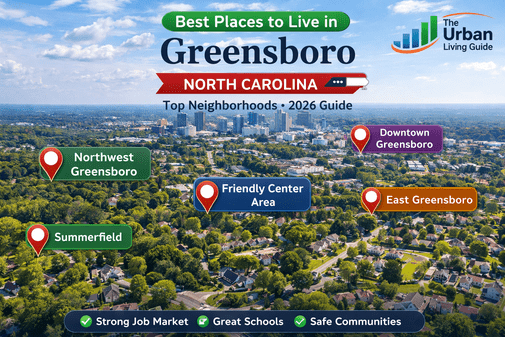
Best Neighborhoods in Greensboro: Piedmont Triad Enclaves, Historic Canopies & Gate City Living in 2026
Covering approximately 129.5 square miles of land area across the gently rolling hills and lush hardwood forests of central Guilford County, the consolidated municipality of Greensboro operates under the council-manager municipal administration of the City of Greensboro. Housing an incorporated municipal core population exceeding 300,000 residents and anchoring the vibrant Piedmont Triad metropolitan region of over 1.7 million people, the “Gate City” stands as an essential national center for aviation aerospace manufacturing, advanced supply-chain logistics, collegiate education, and specialized healthcare.
Relocating across Central North Carolina requires evaluating highway beltway corridors, historic neighborhood preservation overlays, and regional public transit systems managed by the Greensboro Transit Agency (GTA). Inbound movers consistently balance direct access to primary regional employers—including global aerospace campuses at the Piedmont Triad International Airport Aerospace Hub (housing Honda Aircraft Company, Boom Supersonic, and HAECO Americas), corporate headquarters for VF Corporation, Qorvo, Volvo Trucks North America, and extensive healthcare systems anchored by Cone Health (The Moses H. Cone Memorial Hospital)—against daily transit commutes across Interstate 840 (Greensboro Urban Loop), Interstate 40, Interstate 85, US Route 220 (Battleground Avenue), and Wendover Avenue, with regional air links via Piedmont Triad International Airport (PTI).
Take a guided local tour through the historic tree-lined avenues, botanical gardens, and distinctive residential neighborhoods across Greensboro, North Carolina:
Key Residential Districts in Greensboro, North Carolina at a Glance in 2026
| Neighborhood | Location | Distance to Downtown | Development Status | Transit Connectivity | Cost Level | Best Fit For |
|---|---|---|---|---|---|---|
| Fisher Park | North Downtown Edge | ~0.8 mi north | Preserved Historic Urban Parkland | High (GTA Bus Routes, N Elm St) | High-to-Premium | Physicians, Attorneys & Historic Lovers |
| Sunset Hills | West Collegiate Basin | ~2.5 mi west | Historic 1920s Tree-Canopied Residential | High (Spring Garden St, Market St) | Mid-to-High | Professors, Growing Families & Medical Staff |
| Downtown & South End | Central Commercial Core | 0 mi (Core) | High-Density Mixed-Use Arts Core | Exceptional (J. Douglas Galyon Depot, Elm St) | Mid-Range | Young Professionals, Creatives & Commuters |
| Old Irving Park | North Central Country Club | ~3 mi north | Preserved Historic Country Club Enclave | High (Battleground Ave / US-220, I-840) | Ultra-Premium | Corporate Executives, Founders & Luxury Buyers |
| Lindley Park | West Urban Infill | ~3.5 mi west | Historic Craftsman Bungalow District | High (GTA Bus Network, Spring Garden St) | Accessible / Mid-Range | First-Time Homebuyers, Foodies & Renters |
Comprehensive Breakdown of the Best Neighborhoods in Greensboro
Fisher Park — Historic Parkside Mansions, Shaded Willow Oaks & Hospital Proximity
Covering the established residential territory immediately north of the central business district, Fisher Park is celebrated as Greensboro’s oldest and most architecturally distinguished historic suburb. Developed starting in 1901 around a natural parkland donated by Captain Basil J. Fisher, the community operates under city historic district overlay guidelines and is championed by the Fisher Park Neighborhood Association.
The neighborhood is defined by towering willow oak canopies, winding paved walking paths around a central stream, grand early 20th-century estates, and direct walking access to downtown dining and Cone Health’s flagship hospital.
- Housing: Real estate stock features grand stone and brick American Craftsman bungalows, Prairie-style estates, Neoclassical Revival mansions, and converted historic multi-family apartments along North Elm Street and Fisher Park Circle. Single-family purchase prices typically range from $380,000 to $1,250,000+, while residential rental flats average $1,350 to $2,450 per month.
- Safety & Crime Rate: Patrolled by the Greensboro Police Department (GPD) Central Division. Fisher Park consistently maintains a safe, stable residential core with low crime rates, supported by high owner-occupancy and active community watch organizations.
- School District & Education Quality: Governed by Guilford County Schools (GCS), containing neighborhood options such as Joyner Elementary School, Mendenhall Middle School, and Page High School (renowned for strong AP participation and college placement), alongside nearby private institutions.
- Walkability & Daily Conveniences: Outstanding pedestrian walkability (Walk Score of 84-88/100). Residents stroll along shaded sidewalks to local bakeries, craft coffee houses, independent bistros along North Elm Street, and grocers including Deep Roots Market (community-owned co-op) and Harris Teeter on Lawndale.
- Parks & Green Spaces / Pet-Friendliness: Direct access to the 12-acre Fisher Park (a continuous divided greenway featuring stone bridges, stream banks, nature trails, and children’s play structures) and Hendrix Street Park. Exceptionally pet-friendly.
- Parking & Traffic Congestion: Plentiful private residential driveways, detached carriage garages, and open on-street parking keep neighborhood lanes clear. Commuter traffic on North Elm Street and Greene Street moves smoothly.
- Nearby: 2-minute drive into Downtown Greensboro, 15 minutes to Piedmont Triad International Airport (PTI), and 6 minutes to the Greensboro Science Center.
- Noise Levels & Vibe: Historic, peaceful, and cultured, characterized by birdsong, park joggers, and quiet residential evenings.
- Medical Facilities & Hospitals: Direct walking proximity: located adjacent to the main medical campus of The Moses H. Cone Memorial Hospital (Cone Health – Level II Trauma Center) on North Church Street.
- Transit Connectivity: Served by GTA Bus Routes (Routes 3 and 7) along Elm and Church Streets, offering a 3-minute ride into the central depot downtown, with rapid roadway access to US-220 and Wendover Avenue.
- Affordability: High-tier price profile for Guilford County; premium real estate acquisition values are balanced by historic architectural pedigree, park access, and hospital proximity.
- Who It’s Best For: Physicians, surgeons, and medical staff at Moses Cone Hospital, attorneys, corporate executives, and buyers seeking historic estate craftsmanship.
- Drawbacks: Higher initial purchase entry prices, older home radiator heating and plumbing maintenance overhead, and strict historic district exterior renovation guidelines.
Sunset Hills — Tree-Canopied 1920s Brick Tudors, Holiday Traditions & Collegiate Energy
Covering the rolling residential basin west of the University of North Carolina at Greensboro (UNCG), Sunset Hills is widely recognized as one of the city’s most beloved, close-knit, and family-centric communities. Developed in the 1920s and 1930s by developer A.K. Moore, the community operates under City of Greensboro municipal administration and is championed by the Sunset Hills Neighborhood Association.
Centered along the curving tree-shaded avenues of Rolling Road, Madison Avenue, and Ridgeway Drive, the neighborhood is famous for its classic brick architecture, community spirit, and the world-renowned “Running of the Balls” holiday light display.
- Housing: Real estate stock is dominated by classic 1920s–1940s brick English Tudors, stone Craftsman bungalows, Colonial Revival homes, and mid-century Cape Cods on mature landscaped lots. Single-family purchase prices typically range from $320,000 to $750,000+, while residential rentals average $1,350 to $2,350 per month.
- Safety & Crime Rate: Patrolled by the GPD Western Division. Sunset Hills maintains a very safe, family-oriented environment with active neighborhood watch networks and high owner-occupancy.
- School District & Education Quality: Governed by GCS, zoned to public institutions such as Morehead STEM Academy Elementary, Kiser Middle School, and Grimsley High School (historic powerhouse known for its International Baccalaureate and advanced arts programs).
- Walkability & Daily Conveniences: Outstanding village walkability (Walk Score of 82-86/100 around the commercial nodes). Residents walk to neighborhood cafes, artisan bakeries, and corner bistros, with full grocery supermarkets like Harris Teeter on Friendly Center located 3 minutes away.
- Parks & Green Spaces / Pet-Friendliness: Municipal recreation is anchored by Sunset Hills Park, nearby Lindley Park, and walking access to the extensive arboretum grounds of the Greensboro Arboretum and the 7-acre Bog Garden at Benjamin Park. Exceptionally dog-friendly.
- Parking & Traffic Congestion: Plentiful private residential driveways and detached single-to-two car garages keep streets clear. Commuter traffic moves smoothly along Spring Garden Street and West Market Street.
- Nearby: 5-minute drive into Downtown Greensboro, 4 minutes to Friendly Center shopping mall, and 14 minutes to PTI Airport.
- Noise Levels & Vibe: Warm, community-centered, and family-oriented, characterized by children playing in front yards, seasonal festivities, and peaceful residential evenings.
- Medical Facilities & Hospitals: Direct 6-minute drive to Wesley Long Hospital (Cone Health) on North Elam Avenue.
- Transit Connectivity: Served by GTA Bus Routes (Route 2) along Market and Spring Garden Streets, with rapid vehicular access to Wendover Avenue, Holden Road, and I-40.
- Affordability: Balanced mid-to-high price tier; delivers single-family detached homes on mature wooded parcels with top public school feeder patterns.
- Who It’s Best For: Growing families prioritizing Grimsley High School, UNCG faculty, healthcare professionals at Wesley Long, and buyers seeking an active neighborhood community.
- Drawbacks: Older home mechanical systems requiring modernization, competitive bidding for renovated brick Tudors, and heavy visitor traffic during December holiday light events.
Downtown & South End — Urban Arts Renaissance, Tanger Center & Historic Rail Depot
Positioned in the geographic core of Guilford County along Elm Street and Greene Street, Downtown Greensboro (including the vibrant South End district) serves as the civic, corporate, legal, and cultural engine of the Piedmont Triad. Driven by massive public-private urban investments supported by the City of Greensboro and Downtown Greensboro Inc. (DGI), the urban center blends restored 19th-century commercial brick storefronts with contemporary glass mid-rises, performing arts centers, and luxury residential lofts.
The urban core delivers an authentic walkable downtown lifestyle within steps of Broadway theater productions at the Tanger Center, minor-league baseball, craft breweries, and passenger rail transit.
- Housing: Real estate is dominated by converted historic industrial brick-and-timber lofts (such as The Southeastern Building, The Kress Building, and Southside Neighborhood townhomes), modern podium apartments, and upscale condominiums along Elm Street. Condominium purchase valuations typically range from $180,000 to $540,000+, while modern rental lofts average $1,250 to $2,150 per month.
- Safety & Crime Rate: Patrolled by the GPD Central Division and supported by visible uniformed Downtown Safety Ambassadors. Well-lit dining corridors along Elm Street maintain safe foot traffic, though standard city awareness is advised on peripheral commercial streets late at night.
- School District & Education Quality: Governed by GCS, alongside specialized public magnet options such as The Early College at Guilford and Greensboro College campus facilities downtown.
- Walkability & Daily Conveniences: Outstanding pedestrian infrastructure (Walk Score of 88-92/100). Residents walk to over 40 local restaurants, craft cocktail lounges, indie bookstores, the Greensboro Cultural Center, and fresh grocery shopping at Deep Roots Market.
- Parks & Green Spaces / Pet-Friendliness: Municipal greenspaces include the 3.5-acre Center City Park, the 4-acre LeBauer Park (featuring interactive splash fountains, putting greens, dog runs, and food kiosks), and minor-league baseball at First National Bank Field (Greensboro Grasshoppers). Exceptionally pet-friendly.
- Parking & Traffic Congestion: Managed through municipal parking decks operated by the city; most residential loft conversions provide assigned parking. Surface street traffic flows smoothly with minimal rush-hour delays.
- Nearby: 12-minute drive to Piedmont Triad International Airport (PTI), 8 minutes to Four Seasons Town Centre, and 25 minutes to Winston-Salem.
- Noise Levels & Vibe: Vibrant, historic, and creative, filled with Broadway theatergoers at the 3,000-seat Steven Tanger Center for the Performing Arts, baseball crowds, and outdoor patio conversations.
- Medical Facilities & Hospitals: Direct 3-minute drive north to The Moses H. Cone Memorial Hospital on North Church Street.
- Transit Connectivity: Major multi-modal transit hub centered at the historic J. Douglas Galyon Depot (Amtrak Carolinian, Piedmont, and Crescent lines) and GTA Central Bus Hub, with vehicular access to US-29, I-40, and I-85 Business.
- Affordability: Mid-range urban price structure; delivers authentic vintage architectural lofts and dining convenience at rates significantly lower than Charlotte or Raleigh.
- Who It’s Best For: Young professionals, corporate staff, theater lovers, healthcare residents at Moses Cone, and urbanites seeking walkable downtown living.
- Drawbacks: Monthly residential parking garage fees, late-night weekend noise near entertainment corridors, and ongoing infill construction projects.
Old Irving Park — Historic Country Club Fairways, Gilded Age Mansions & Elite Greensboro Prestige
Covering the prestigious elevated parklands north of the city center centered around the fairways of the historic Greensboro Country Club, Old Irving Park represents the pinnacle of historic luxury and architectural prestige in the Piedmont Triad. Developed starting in 1911 by developer A.W. McAlister as a planned golf course suburb, the neighborhood operates under City of Greensboro municipal administration and is championed by the Irving Park Community Association.
The neighborhood is defined by majestic hardwood oak canopies, multi-million dollar stone estates, winding boulevard parkways along Country Club Drive and Carlisle Road, and premier country club amenities.
- Housing: Real estate stock features grand 1920s–1940s Georgian Revival brick mansions, stone English Tudors, French Normandy chateaus, and custom modern estate builds on 1-to-3-acre wooded parcels. Single-family purchase prices typically range from $550,000 to $3,200,000+, with very limited rental properties averaging $2,800 to $5,500 per month.
- Safety & Crime Rate: Patrolled by the GPD Western Division. Old Irving Park consistently records some of the lowest violent and property crime rates in Guilford County, supported by private security patrols and active community block vigilance.
- School District & Education Quality: Governed by GCS, zoned to top-performing public institutions such as Joyner Elementary and Page High School, with many families utilizing elite independent college preparatory academies like Greensboro Day School and Canterbury School.
- Walkability & Daily Conveniences: The interior residential avenues are walkable for recreation, while commercial shopping villages along Battleground Avenue (US-220) host upscale specialty grocers including Fresh Market Flagship on Lawndale, Harris Teeter, fine jewelry boutiques, and gourmet dining.
- Parks & Green Spaces / Pet-Friendliness: World-class natural recreation anchored by the private championship fairways of the historic Greensboro Country Club (Donald Ross Course), Kirkwood Park, and direct driving access to the 250-acre Guilford Courthouse National Military Park. Exceptionally pet-friendly.
- Parking & Traffic Congestion: Expansive attached multi-car garages, detached carriage houses, and private circular motor courts keep roads clear. Surface traffic on Battleground Avenue (US-220) moves efficiently.
- Nearby: 5-minute drive into Downtown Greensboro, 12 minutes to Piedmont Triad International Airport (PTI), and 8 minutes to the Greensboro Science Center.
- Noise Levels & Vibe: Serene, exclusive, and refined, characterized by mature oak canopies, golf course views, and quiet residential evenings.
- Medical Facilities & Hospitals: Direct 5-minute drive via Elm Street to The Moses H. Cone Memorial Hospital.
- Transit Connectivity: Road travel connects quickly via Battleground Avenue (US-220), North Elm Street, and the Interstate 840 Urban Loop, offering non-stop highway travel across the Triad.
- Affordability: Ultra-premium price tier for the Piedmont Triad; represents the most historically prestigious and high-value residential real estate in Greensboro.
- Who It’s Best For: Corporate CEOs, medical practice directors, legal partners, golf enthusiasts, and buyers seeking grand historic estate pedigree.
- Drawbacks: Substantial capital requirements for homeownership, high annual estate maintenance overhead, and limited starter-home inventory.
Lindley Park — Historic 1930s Craftsman Cottages, Corner Eateries & Arboretum Trails
Covering the established residential basin southwest of the UNCG campus along Spring Garden Street and Walker Avenue, Lindley Park is celebrated as one of Greensboro’s most welcoming, artistic, and budget-accessible historic neighborhoods. Developed in the 1920s and 1930s as a streetcar suburb around the historic Lindley Nursery grounds, the community operates under City of Greensboro municipal administration and is championed by the Lindley Park Neighborhood Association.
The neighborhood combines quiet tree-lined residential streets with classic Craftsman bungalows, independent corner bistros at the Walker-Elam intersection, and direct access to the Greensboro Arboretum.
- Housing: Real estate stock features classic 1920s–1940s wood-frame Craftsman bungalows, brick cottages, Cape Cods on generous lots, and value-oriented multi-family duplexes. Single-family purchase prices typically range from $210,000 to $390,000, while rental homes and flats average $950 to $1,650 per month.
- Safety & Crime Rate: Patrolled by the GPD Western Division. Lindley Park maintains a stable residential core with low violent crime rates, supported by high owner-occupancy and active community block programs.
- School District & Education Quality: Governed by GCS, containing neighborhood public institutions such as Lindley Elementary School and Kiser Middle School, alongside proximity to collegiate programs at UNCG.
- Walkability & Daily Conveniences: Outstanding pedestrian walkability around the Walker & Elam commercial hub, hosting neighborhood coffee houses, craft taverns (Sticks & Stones Clay Oven Pizza, Fishers Bar & Grill), bakeries, and the weekly Corner Farmers Market.
- Parks & Green Spaces / Pet-Friendliness: Municipal recreation is anchored by the 17-acre Greensboro Arboretum (featuring formal rose collections and wooded walking loops), Lindley Park Nature Trails, and Geneva Park. Exceptionally pet-friendly.
- Parking & Traffic Congestion: Plentiful private residential driveways, detached single-car garages, and open on-street parking keep neighborhood lanes clear. Commuter traffic on Spring Garden Street moves smoothly.
- Nearby: 6-minute drive into Downtown Greensboro, 5 minutes to Friendly Center, and 12 minutes to PTI Airport.
- Noise Levels & Vibe: Grounded, artistic, and community-centered, characterized by neighbors chatting on front porches, weekend farmers markets, and calm evenings.
- Medical Facilities & Hospitals: Direct 4-minute drive north to Wesley Long Hospital (Cone Health) on Elam Avenue.
- Transit Connectivity: Public bus transit provided by GTA Bus Routes (Route 2) along Spring Garden Street directly into the Downtown Depot, with rapid vehicular access to Wendover Avenue and I-40.
- Affordability: Greensboro’s most accessible historic single-family homeownership price tier in a walkable setting, offering lower mortgage entry barriers and solid rental yields.
- Who It’s Best For: First-time homebuyers, young creative professionals, healthcare staff at Wesley Long, UNCG faculty, and culinary enthusiasts.
- Drawbacks: Older home electrical and insulation systems requiring updates, smaller original bungalow square footages, and street parking competition near the Walker/Elam intersection.
Neighborhood Trade-offs: Living Advantages & Drawbacks Across Greensboro, North Carolina
| Neighborhood | Core Advantages (Pros) | Core Limitations (Cons) |
|---|---|---|
| Fisher Park | Historic 12-acre Fisher Park greenway; shaded willow oaks; walking distance to The Moses H. Cone Hospital and downtown dining. | Higher purchase entry barrier ($380k+); older home radiator heating overhead; strict historic preservation renovation codes. |
| Sunset Hills | Top-rated Grimsley High School feeder; classic 1920s brick Tudors; close to Greensboro Arboretum; active holiday traditions. | Older home plumbing systems; competitive bidding on renovated brick homes; heavy visitor traffic during December light events. |
| Downtown & South End | Walkable to Steven Tanger Center and First National Bank Field; historic lofts on Elm St; 4-acre LeBauer Park; central transit hub. | Monthly residential parking garage fees; late-night weekend noise near entertainment corridors; ongoing infill construction. |
| Old Irving Park | Donald Ross championship golf at Greensboro Country Club; grand historic stone mansions; top safety ratings; close to Fresh Market. | Ultra-premium purchase pricing ($550k-$3.2M+); complete automobile dependence; higher annual estate maintenance costs. |
| Lindley Park | Greensboro’s most affordable historic bungalow prices; walkable corner bistros at Walker & Elam; Greensboro Arboretum. | Older home mechanical systems; smaller original floor plans; on-street parking competition around commercial corners. |
Voices of the Community: What Residents Say About Living in Greensboro, North Carolina
“Moving to Fisher Park gave us the perfect historic home with massive hardwood oak trees and a stream in the park right in front of our house. My commute to Moses Cone Hospital takes literally two minutes, and we can easily walk into downtown for dinner and shows at the Tanger Center.”
— Dr. Julian Bennett, Trauma Surgeon (Verified Local Contributor, Reddit r/gso Relocation Forum)
“Sunset Hills has the best neighborhood spirit in the Triad. Our children safely ride bikes under the canopy trees to elementary school, and the community tradition during the Christmas holiday running of the lighted balls brings everyone out onto the sidewalks.”
— Megan Hollingsworth, Instructional Design Consultant (Verified Resident Review, Niche Community Insights)
How to Navigate Your Greensboro Neighborhood Selection
Selecting your ideal neighborhood in Greensboro requires balancing your household budget with daily workplace destinations, family schooling priorities, and regional highway logistics. Because Guilford County is connected by an extensive beltway system centered around the newly completed Interstate 840 (Greensboro Urban Loop), Interstate 40, and Interstate 85, your chosen location dictates whether your daily commute relies on local transit via GTA Bus Routes, walkable sidewalks into Downtown Greensboro or Fisher Park, or driving across the expressway network into Winston-Salem or High Point.
Aerospace engineers at Honda Aircraft or Boom Supersonic at PTI Airport, healthcare professionals at Moses Cone or Wesley Long, and faculty at UNCG or North Carolina A&T State University should evaluate transit corridors to optimize daily convenience.
Beyond commuter corridors, evaluate essential municipal utility and building infrastructure realities. Central North Carolina experiences mild winter temperatures alongside warm, humid summer conditions, making home cooling and heating efficiency through Duke Energy Carolinas and Piedmont Natural Gas an important consideration.
In addition, prospective homebuyers evaluating historic brick Tudors in Sunset Hills or Craftsman bungalows in Lindley Park should inspect crawl spaces, HVAC systems, and foundations for regional humidity resilience, while buyers in Old Irving Park should verify municipal property tax assessments. Before executing a residential lease or property purchase agreement, verify high-speed fiber broadband availability (such as Lumos Fiber, AT&T Fiber, or Spectrum Gigabit) and confirm Guilford County Schools assignment boundaries.
Essential Local Insights & FAQs for Greensboro, North Carolina
Which neighborhood in Greensboro is considered best for families with children?
Sunset Hills, Old Irving Park, and Fisher Park are widely regarded as premier family communities in Greater Greensboro. Sunset Hills provides access to top-ranked public schools in Guilford County Schools (such as Grimsley High School) alongside safe, tree-lined streets and extensive community parks.
What is the most walkable neighborhood in Greensboro where you can live without relying heavily on a car?
Downtown Greensboro and Fisher Park offer the highest walkability in the city, boasting Walk Scores above 84. Residents can walk to over 40 restaurants, Tanger Center theater, LeBauer Park, Deep Roots Market, and connect directly to the J. Douglas Galyon Depot transit hub.
What are the safest residential neighborhoods to live in within Greensboro proper?
Old Irving Park, Sunset Hills, and Fisher Park consistently report some of the lowest violent and property crime rates in Guilford County. These neighborhoods benefit from high owner-occupancy, private security patrols, and active community block watch associations.
What are the most affordable neighborhoods for homebuyers and renters in Greensboro?
Lindley Park, College Hill, and Westerwood provide budget-friendly housing opportunities in the area. In Lindley Park, buyers and renters can secure historic Craftsman single-family homes and duplex apartments at price points significantly lower than regional state averages.
How bad is traffic congestion when commuting across Greensboro expressways?
Traffic congestion in Greensboro is generally mild compared to Charlotte or Raleigh, with minor slowdowns on Interstate 40 and Wendover Avenue during peak rush hours. The completion of the Interstate 840 Urban Loop allows drivers to navigate around the city in under 20 minutes.
Which Greensboro neighborhood is best for healthcare professionals working at Moses Cone Hospital?
Fisher Park and Downtown Greensboro provide the fastest commutes to The Moses H. Cone Memorial Hospital. Fisher Park allows medical staff to walk or drive to the hospital campus in under 2 minutes, while Sunset Hills is within a 5-minute drive to Wesley Long Hospital.
Is Greensboro an affordable place to live compared to Raleigh and Charlotte?
Yes, Greensboro’s overall cost of living and housing prices are significantly lower than Raleigh and Charlotte, offering historic single-family homes, modern lofts, and spacious wooded yards at a fraction of regional North Carolina real estate costs.
Greensboro, North Carolina Relocation Resources & Living Guides
The Urban Living Guide creates deeply researched, practical, and informative city relocation resources designed to help individuals, working professionals, and families navigate complex urban landscapes. By analyzing municipal infrastructure, hyper-local zoning patterns, commuter realities, and housing markets, our guides provide actionable insights so you can make confident, data-backed decisions when moving to major metropolitan areas.
Explore our regional guides across Greensboro and the Piedmont Triad:
- Living in Greensboro, North Carolina
- Cost of Living in Greensboro, North Carolina
- Pros and Cons of Living in Greensboro, North Carolina
Made your decision to move to the Gate City? Read our comprehensive relocation roadmap: Moving to Greensboro, North Carolina.
Follow The Urban Living Guide for ongoing regional insights, neighborhood developments, and expert local coverage across Greater Greensboro and the state of North Carolina.