

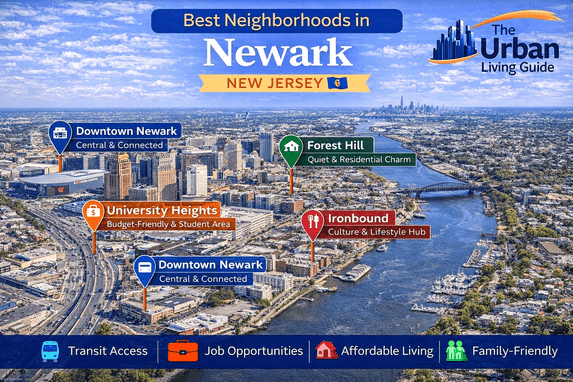
Best Neighborhoods in Newark, New Jersey: Historic Transit Hubs, Ironbound Gastronomy & Brick Mansions in 2026
Covering approximately 24.1 square miles of land area along the Passaic River and Newark Bay in Essex County, the incorporated municipality of Newark operates under the mayor-council governance of the City of Newark. Housing an incorporated municipal core population exceeding 305,000 residents and anchoring New Jersey’s primary economic, cultural, and transportation gateway within the Greater New York metropolitan region (surpassing 20 million people), the “Brick City” stands as an essential global hub for international container shipping logistics, air cargo transit, corporate life insurance, financial technology, higher education, and specialized healthcare.
Relocating across North Jersey requires evaluating distinct five-ward municipal boundaries, historic neighborhood preservation overlays, and multi-modal transit corridors managed by NJ Transit, the Port Authority of New York and New Jersey (PATH), and Amtrak.
Inbound movers consistently balance direct daily access to primary regional employers—including global corporate headquarters for Prudential Financial, PSEG (Public Service Enterprise Group), Panasonic Corporation of North America, Audible (an Amazon Company), the deepwater logistics complex at Port Newark–Elizabeth Marine Terminal, and healthcare systems anchored by University Hospital (Level I Trauma Center) and Newark Beth Israel Medical Center—against daily transit commutes across Interstate 78, Interstate 280, New Jersey Turnpike (I-95), US Route 1/9, McCarter Highway (Route 21), and Broad Street, with international air travel via Newark Liberty International Airport (EWR).
Join an authentic local tour exploring the historic brownstone avenues, famous Ironbound dining corridors, and distinctive residential neighborhoods across Newark, New Jersey:
Key Residential Districts in Newark, New Jersey at a Glance in 2026
| Neighborhood | Location | Distance to Newark Penn Station | Development Status | Transit Connectivity | Cost Level | Best Fit For |
|---|---|---|---|---|---|---|
| The Ironbound (East Ward) | East Riverfront Basin | ~0.4 mi east (Direct Walk) | Vibrant Culinary & High-Density Urban | Exceptional (PATH, NJ Transit, Ferry St, Route 21) | Mid-to-High | NYC Commuters, Foodies & Young Professionals |
| Forest Hill (North Ward) | North Branch Brook Ridge | ~3.2 mi north | Preserved Gilded Age Historic Mansions | High (Newark Light Rail, Route 21, I-280) | High-to-Premium | Physicians, Attorneys & Historic Home Lovers |
| Downtown & Central Business District | Central Commercial Core | 0 mi (Core Hub) | Adaptive High-Rise Mixed-Use & Arts | Exceptional (PATH, Amtrak, Light Rail, Broad St) | Mid-to-High | Corporate Staff, Tech Workers & University Faculty |
| University Heights (Central Ward) | West Collegiate Basin | ~1.2 mi west | Collegiate Research & Modern Infill | Exceptional (Newark Light Rail, Central Ave, I-280) | Accessible / Mid-Range | Medical Residents, NJIT/Rutgers Staff & Students |
| Weequahic (South Ward) | South Parkside Basin | ~3.5 mi south | Historic 1920s Parkside Residential | High (NJ Transit Buses, I-78, US-22, Route 27) | Accessible / Mid-Range | First-Time Homebuyers, Beth Israel Staff & Investors |
Comprehensive Breakdown of Living Options Across Newark
The Ironbound (East Ward) — Portuguese Gastronomy, Ferry Street Energy & Penn Station Walkability
Covering approximately four square miles in Newark’s East Ward bounded by the Passaic River and Amtrak rail corridors, The Ironbound is celebrated as one of the most culturally vibrant, safe, and culinarily distinguished urban districts in the New York metropolitan area. Operating under City of Newark municipal administration and championed by the Ironbound Business Improvement District (IBID), the neighborhood derives its historic name from the network of railroad tracks that encircle its perimeter.
Centered along the bustling commercial storefronts of Ferry Street, Adams Street, and Lafayette Street, the Ironbound seamlessly blends authentic Portuguese, Brazilian, and Spanish churrascarias with modern multi-family construction, artisan bakeries, and immediate walking proximity to Newark Penn Station.
- Housing: Real estate stock features classic two- and three-family semi-detached brick and vinyl homes, contemporary multi-story infill condominiums, and luxury modern mid-rise rental communities (such as Vermella East and Textile Lofts). Multi-family and single-family purchase prices typically range from $380,000 to $850,000+, while modern 1-bedroom rental apartments average $1,750 to $2,850 per month.
- Safety & Crime Rate: Patrolled by the Newark Police Department (NPD) 3rd Precinct. The Ironbound consistently records the lowest violent crime rates in Newark, maintaining active, well-illuminated pedestrian foot traffic day and night supported by close-knit merchant networks.
- School District & Education Quality: Governed by Newark Public Schools (NPS), containing neighborhood public campuses such as Ann Street School (consistently rated among the highest-performing K-8 public schools in Essex County), Oliver Street School, and East Side High School.
- Walkability & Daily Conveniences: Outstanding pedestrian walkability (Walk Score of 94-98/100). Residents walk to over 150 independent restaurants, cafes, pastelerias, wine markets along Ferry Street, and grocers including Seabra Foods Supermarket (Flagship on Lafayette) and Twin City Supermarket.
- Parks & Green Spaces / Pet-Friendliness: Municipal recreation is anchored by the 14-acre Riverfront Park (featuring lighted soccer fields, boardwalks along the Passaic River, and public boat launches), Independence Park (featuring tree-canopied walking paths and sports courts), and Peter Francisco Park. Exceptionally pet-friendly.
- Parking & Traffic Congestion: On-street parking is highly competitive; multi-family homes with private driveways or attached garages command premium valuations. Commuter traffic on Ferry Street and Raymond Boulevard moves steadily.
- Nearby: 5-minute walk to Newark Penn Station, 18-minute PATH train ride to World Trade Center (Manhattan), 20-minute NJ Transit ride to New York Penn Station (Midtown), and 8 minutes to Newark Liberty Airport (EWR).
- Noise Levels & Vibe: Energetic, European, and culinary-centered, filled with outdoor sidewalk dining, families strolling in parks, bustling soccer watch parties, and vibrant weekend street life.
- Medical Facilities & Hospitals: Direct 6-minute drive to Saint Michael’s Medical Center and 8 minutes to University Hospital.
- Transit Connectivity: Unrivaled heavy transit hub centered at Newark Penn Station (PATH Subway, NJ Transit Rail, Amtrak Northeast Corridor, and Newark Light Rail), with rapid vehicular access to US Route 1/9, Route 21, and the NJ Turnpike (I-95 Exit 15E).
- Affordability: Mid-to-high urban price profile for Essex County; elevated property equity reflects the neighborhood’s unmatched 20-minute Manhattan transit access, exceptional safety record, and world-class food scene.
- Who It’s Best For: Manhattan and Jersey City commuters, culinary enthusiasts, young professionals, multi-family real estate investors, and families prioritizing Ann Street School.
- Drawbacks: Competitive street parking during evening restaurant rush hours, higher multi-family real estate prices, and dense urban lot configurations with limited private yard space.
Forest Hill (North Ward) — Gilded Age Victorian Mansions, Branch Brook Park & Cherry Blossoms
Covering the elevated forested ridges of the North Ward bordering the historic 360-acre Branch Brook Park along Ballantine Parkway, Mt. Prospect Avenue, and Delavan Avenue, Forest Hill is celebrated as Newark’s most architecturally distinguished and affluent historic residential neighborhood. Developed in the late 19th and early 20th centuries by wealthy industrial barons, the community operates under municipal historic district guidelines and is championed by the Forest Hill Community Association.
The neighborhood is defined by sprawling custom mansions featuring Queen Anne, Beaux-Arts, Colonial Revival, and Gothic Revival architecture on expansive tree-shaded lots, gaslamp-style streetlighting, and direct border access to the nation’s largest collection of cherry blossom trees in Branch Brook Park.
- Housing: Real estate stock features grand historic single-family stone and brick mansions (often exceeding 4,000 to 7,000 square feet) with slate roofs and carriage houses, well-preserved Craftsman homes, and luxury pre-war cooperative apartments along Mt. Prospect Avenue. Single-family purchase prices typically range from $550,000 to $1,650,000+, while residential rentals average $1,850 to $3,500 per month.
- Safety & Crime Rate: Patrolled by the NPD 2nd Precinct. Forest Hill consistently records low crime rates, supported by high owner-occupancy, private security details, and active community block watch associations.
- School District & Education Quality: Governed by NPS, containing public institutions such as Park Elementary School and Ridge Street School, alongside specialized magnet institutions like Technology High School and prestigious private academies nearby.
- Walkability & Daily Conveniences: The interior residential avenues are walkable for recreation, while commercial retail corridors along Bloomfield Avenue and Broadway host neighborhood cafes, bakeries, pharmacies, and grocers including Super Foodtown and ShopRite of Belleville nearby.
- Parks & Green Spaces / Pet-Friendliness: World-class municipal recreation anchored by direct pedestrian access to the 360-acre Branch Brook Park (designed by the Olmsted Brothers, featuring over 5,300 blooming Japanese cherry blossom trees, lakes, and sports fields) and the historic Cathedral Basilica of the Sacred Heart. Exceptionally pet-friendly.
- Parking & Traffic Congestion: Expansive private residential driveways, detached multi-car carriage houses, and wide streets keep neighborhood roads clear. Commuter traffic moves smoothly along McCarter Highway (Route 21) and I-280.
- Nearby: 8-minute drive to Downtown Newark, 12 minutes to Newark Penn Station, and 15 minutes to Newark Liberty Airport (EWR).
- Noise Levels & Vibe: Serene, historic, and stately, characterized by mature tree canopies, birdsong, park joggers, and quiet residential evenings.
- Medical Facilities & Hospitals: Direct 4-minute drive to Clara Maass Medical Center (RWJBarnabas Health) in Belleville and 8 minutes to University Hospital.
- Transit Connectivity: Direct access to the Newark Light Rail (Davenport Ave & Branch Brook Park Stations) connecting to Newark Broad Street Station and Penn Station in under 10 minutes, with rapid roadway access to Route 21, Route 3, and Garden State Parkway (Exit 148).
- Affordability: Premium historic residential price profile; delivers grand Gilded Age mansion square footage and parkside estate living at price points significantly lower than Montclair or Brooklyn.
- Who It’s Best For: Physicians, corporate attorneys, university deans, architecture preservationists, and families seeking large historic mansions with parkland views.
- Drawbacks: Substantial historic home heating and slate roof restoration overhead, higher annual property taxes on estate parcels, and automobile reliance for regional shopping centers.
Downtown & Central Business District — Prudential Headquarters, NJPAC Performing Arts & Luxury High-Rises
Covering the central commercial grid centered along Broad Street, Market Street, and Halsey Street, Downtown Newark serves as the corporate, judicial, cultural, and entertainment engine of New Jersey. Supported by significant institutional investments championed by the City of Newark and the Newark Downtown District (NDD), the urban center blends restored historic Art Deco department store conversions with gleaming new luxury residential skyscrapers, performing arts halls, and major-league sports arenas.
The urban core delivers an authentic car-optional lifestyle with the Newark Light Rail, NJ Transit trains, and PATH subway connecting residents directly to Midtown Manhattan and the Financial District in under 20 minutes.
- Housing: Real estate is dominated by modern glass high-rise luxury apartment towers (such as One Theater Square, 50 Rector Park, and 777 McCarter), converted historic Art Deco brick lofts (like Hahne & Co. Residences and The National Newark Building), and boutique condominiums along Halsey Street. Condominium purchase prices typically range from $250,000 to $650,000+, while modern rental apartments average $1,850 to $3,200 per month.
- Safety & Crime Rate: Patrolled by the NPD 1st Precinct and heavily supported by uniformed Newark Downtown District (NDD) Safety and Hospitality Ambassadors. The central arts, corporate, and campus corridors maintain safe, well-illuminated pedestrian foot traffic day and night.
- School District & Education Quality: Governed by NPS, containing elite public magnet high schools such as Science Park High School and Arts High School (the first public arts high school in the United States), alongside collegiate anchors at Rutgers University-Newark and Seton Hall Law School.
- Walkability & Daily Conveniences: Outstanding pedestrian infrastructure (Walk Score of 95-98/100). Residents walk to over 80 restaurants, trendy coffee shops along Halsey Street, cultural galleries, and full grocery supermarkets including Whole Foods Market at Hahne & Co. on Broad Street.
- Parks & Green Spaces / Pet-Friendliness: Municipal recreation is anchored by the historic 5-acre Military Park (featuring outdoor reading rooms, yoga lawns, and carousel plazas), Washington Park (Harriet Tubman Square), world-class Broadway touring theater at the New Jersey Performing Arts Center (NJPAC), and NHL hockey and concerts at Prudential Center (New Jersey Devils). Exceptionally pet-friendly.
- Parking & Traffic Congestion: Managed through municipal and private structured parking garages; monthly parking spaces add $150 to $250 per month. Commuter traffic on Broad Street and McCarter Highway (Route 21) builds during arena event evenings.
- Nearby: 2-minute walk to Newark Penn Station or Newark Broad Street Station, 15 minutes to Lower Manhattan, and 8 minutes to Newark Liberty Airport (EWR).
- Noise Levels & Vibe: High-tempo, corporate, and cultural, filled with business executives, university students, hockey fans heading to Prudential Center, and lively outdoor lunchtime park programming.
- Medical Facilities & Hospitals: Direct 5-minute drive west to University Hospital on 12th Avenue and Saint Michael’s Medical Center downtown.
- Transit Connectivity: Unmatched dual-station rail transit served by Newark Penn Station and Newark Broad Street Station (NJ Transit Morris & Essex and Montclair-Boonton lines), connected by the Newark Light Rail, with rapid vehicular access to I-280 and I-78.
- Affordability: Mid-to-high urban price tier; delivers brand-new luxury high-rise amenities and instant Manhattan rail connectivity at rental rates roughly 40-50% lower than Manhattan, Brooklyn, or Jersey City waterfronts.
- Who It’s Best For: Corporate executives at Prudential or Audible, tech workers, healthcare researchers, law students, and Manhattan commuters seeking modern high-rise luxury.
- Drawbacks: Monthly residential parking garage fees, arena crowd congestion on concert and game nights at Prudential Center, and limited detached single-family housing inventory.
University Heights (Central Ward) — Major Higher-Education Hub, NJIT/Rutgers Campuses & Biotech Labs
Covering the central elevated territory immediately west of the downtown core along Central Avenue, Lock Street, and Warren Street, University Heights serves as Newark’s intellectual, bioscience, and collegiate research engine. Housing over 50,000 university students and faculty, the district centers around the expansive contiguous campuses of the New Jersey Institute of Technology (NJIT), Rutgers University-Newark, Essex County College, and Rutgers New Jersey Medical School.
The neighborhood combines state-of-the-art STEM research laboratories and business incubators with student dining avenues, historic brownstones in James Street Commons, and modern transit-oriented mid-rise apartments.
- Housing: Real estate stock features modern student and faculty mid-rise apartment communities (such as 15 Washington and University Center), renovated 19th-century brick brownstones in the James Street Commons Historic District, and newly constructed townhomes. Condominium and townhome purchase prices typically range from $240,000 to $550,000+, while residential rentals average $1,350 to $2,350 per month.
- Safety & Crime Rate: Patrolled by the NPD Central Division and heavily supplemented by dedicated 24/7 patrols from NJIT Campus Police and Rutgers University Police, maintaining a highly secure academic footprint with emergency call-box networks.
- School District & Education Quality: Governed by NPS, containing elite magnet high schools such as Science Park High School, Arts High School, and the Newark Collegiate Academy Charter School, alongside world-class higher-education research facilities.
- Walkability & Daily Conveniences: Outstanding campus walkability (Walk Score of 90-94/100). Residents walk to student coffee lounges, diverse international eateries along Central Avenue, university libraries, and grocers including Whole Foods Market on Broad St and ShopRite of Newark on Springfield Ave.
- Parks & Green Spaces / Pet-Friendliness: Municipal and campus greenspaces include the historic Eberhardt Hall Lawn, Summit Street Greenways, Norman Samuels Plaza, and walking access to the extensive art collections of the Newark Museum of Art. Highly pet-friendly.
- Parking & Traffic Congestion: Managed through university parking decks and metered street spots; private residential garage spaces add value. Commuter traffic on Central Avenue and University Avenue moves steadily.
- Nearby: 4-minute Light Rail ride to Newark Penn Station, 6 minutes to Downtown Financial District, and 12 minutes to Newark Liberty Airport (EWR).
- Noise Levels & Vibe: Collegiate, intellectual, and active, filled with university students, medical researchers walking between hospital pavilions, and lively campus courtyard gatherings.
- Medical Facilities & Hospitals: Direct walking and driving proximity: home to University Hospital (Northern New Jersey’s Flagship Level I Trauma Center) and Rutgers Cancer Institute of New Jersey on Bergen Street.
- Transit Connectivity: Outstanding transit integration centered on the Newark Light Rail (Warren St/NJIT, Washington St, and Norfolk St Stations), providing 5-minute direct connections to Penn Station and Broad Street Station, with rapid road access to Interstate 280.
- Affordability: Accessible-to-mid urban price tier; delivers strong rental yields for investors and budget-friendly housing opportunities for medical residents and academic staff.
- Who It’s Best For: Medical fellows and nursing staff at University Hospital, NJIT and Rutgers faculty, graduate researchers, engineering professionals, and student renters.
- Drawbacks: Student rental density on perimeter blocks, street parking competition near academic buildings, and urban hospital emergency siren traffic along Bergen Street.
Weequahic (South Ward) — Historic 1920s Architecture, 311-Acre Olmsted Park & Beth Israel Proximity
Covering the established residential territory in Newark’s South Ward along Lyons Avenue, Elizabeth Avenue, and Meeker Avenue, Weequahic (celebrated as the setting for Philip Roth’s famous literary novels) is one of the city’s most architecturally charming and historically grounded neighborhoods. Operating under City of Newark municipal administration, the community borders the expansive 311-acre Weequahic Park.
The neighborhood is defined by historic 1920s brick Tudors, Center-Hall Colonials on generous parcels, mature tree-lined sidewalks, the historic Weequahic Park Golf Course, and direct walking proximity to Newark Beth Israel Medical Center.
- Housing: Real estate stock features classic 1920s–1930s single-family brick Colonials, English Tudors, Craftsman homes on generous quarter-acre lots in the Weequahic Historic District, two-family investment properties, and pre-war brick apartment complexes. Single-family purchase prices typically range from $280,000 to $580,000+, while residential rentals average $1,250 to $2,150 per month.
- Safety & Crime Rate: Patrolled by the NPD 5th Precinct and supported by Newark Beth Israel Medical Center Security along medical corridors. The central parkside residential tracts maintain active neighborhood block associations.
- School District & Education Quality: Governed by NPS, containing neighborhood public campuses such as Chancellor Avenue School, Maple Avenue School, and Weequahic High School, alongside popular public charter options like North Star Academy.
- Walkability & Daily Conveniences: The interior residential loops are walkable for recreation, while commercial shopping plazas along Lyons Avenue and Elizabeth Avenue host local diners, bakeries, pharmacies, and grocers including Super Foodtown of Hillside and ShopRite of Hillside nearby.
- Parks & Green Spaces / Pet-Friendliness: World-class natural recreation anchored by the 311-acre Weequahic Park (featuring the 80-acre Weequahic Lake, the historic 18-hole Weequahic Golf Course—the oldest public course in New Jersey—tennis courts, and a rubberized 2.2-mile jogging track). Exceptionally pet-friendly.
- Parking & Traffic Congestion: Plentiful private residential driveways and detached garages keep neighborhood lanes clear. Commuter traffic on Elizabeth Avenue and I-78 moves steadily with fast highway on-ramps.
- Nearby: 5-minute drive to Newark Liberty International Airport (EWR), 8 minutes to Downtown Newark, and 10 minutes to Newark Penn Station.
- Noise Levels & Vibe: Grounded, traditional, and family-centered, characterized by park joggers, golf course vistas, neighbors tending front gardens, and calm evenings.
- Medical Facilities & Hospitals: Direct walking proximity: located adjacent to the major medical campus of Newark Beth Israel Medical Center (RWJBarnabas Health – Children’s Hospital of NJ) on Lyons Avenue.
- Transit Connectivity: Major roadway positioning along Interstate 78 (Exit 56), US Route 22, and Route 27, supported by NJ Transit Bus Routes (Routes 39, 99, and 107) providing express commuter service directly to the Port Authority Bus Terminal in Midtown Manhattan.
- Affordability: Newark’s most accessible historic single-family homeownership price tier, offering large lots, solid brick construction, and high rental demand near the hospital.
- Who It’s Best For: Healthcare practitioners and nurses at Beth Israel, first-time homebuyers, airport logistics personnel, golfers, and buyers seeking historic architectural character at attainable price points.
- Drawbacks: Older home electrical and radiator heating updates, block-by-block transitional variance on outer perimeter edges, and flight approach sound from nearby EWR Airport runways.
Neighborhood Trade-offs: Living Advantages & Drawbacks Across Newark, New Jersey
| Neighborhood | Core Advantages (Pros) | Core Limitations (Cons) |
|---|---|---|
| The Ironbound | Walkable to Newark Penn Station (18 min PATH to NYC); world-class Portuguese/Spanish dining on Ferry St; top-rated Ann Street School; lowest crime. | Competitive on-street parking during dinner hours; higher multi-family purchase prices; dense urban lots with small yards. |
| Forest Hill | Gilded Age historic stone mansions on large lots; direct border to 360-acre Branch Brook Park (Cherry Blossoms); Newark Light Rail access. | Higher purchase entry barrier ($550k+); historic slate roof and heating upkeep; automobile dependence for major retail. |
| Downtown / CBD | Direct rail transit to NYC; luxury high-rises; Prudential Center (Devils) & NJPAC; Whole Foods Market; corporate headquarters hub. | Monthly residential parking garage fees ($150+); arena crowd traffic on event nights; limited detached single-family homes. |
| University Heights | Direct access to NJIT & Rutgers-Newark; walking distance to University Hospital (Level I Trauma); Newark Light Rail. | Student rental density on perimeter blocks; street parking competition near campuses; emergency vehicle sirens on Bergen St. |
| Weequahic | Newark’s most affordable historic brick single-family homes; 311-acre Weequahic Park & Golf Course; walking distance to Beth Israel Hospital. | Older home mechanical updates; block-by-block transitional variance; aircraft approach sounds from nearby EWR Airport. |
Voices of the Community: What Residents Say About Living in Newark, New Jersey
“Moving to the Ironbound gave us the best commute to Manhattan we could have asked for. I walk five minutes to Newark Penn Station, take the PATH train straight into the World Trade Center in eighteen minutes, and have dozens of world-class Portuguese restaurants and bakeries right on Ferry Street.”
— Antonio Silva, Financial Risk Analyst (Verified Local Contributor, Reddit r/newark Relocation Forum)
“Living in Forest Hill feels like owning a piece of architectural history. Our stone mansion sits right next to Branch Brook Park, our kids love seeing the cherry blossoms every spring, and the Newark Light Rail gets me to my medical practice in downtown Newark in under ten minutes.”
— Dr. Elena Rostova, Pediatric Neurologist (Verified Resident Review, Niche Community Insights)
Finding Your Ideal Residential Fit in the Brick City
Selecting your ideal neighborhood in Newark requires balancing your household budget with daily workplace destinations, family schooling priorities, and regional rail logistics. Because Essex County is framed by the Passaic River and interconnected by Newark Penn Station, the Newark Light Rail, and PATH Subways, your chosen location dictates whether your daily commute relies on rapid subway transit into Downtown Manhattan (The Ironbound, Downtown), light rail connectivity into NJIT and Rutgers (University Heights, Forest Hill), or driving across regional expressways like Interstate 78, Interstate 280, and the New Jersey Turnpike (I-95).
Corporate professionals at Prudential Financial or Audible, healthcare staff and medical residents at University Hospital or Newark Beth Israel, faculty at NJIT or Rutgers-Newark, and port logistics personnel should evaluate transit corridors to optimize daily convenience.
Beyond transportation corridors, evaluate essential municipal utility and building infrastructure realities. Northern New Jersey experiences four distinct seasons with cold, freezing winter conditions alongside warm, humid summers, making home heating and cooling efficiency through PSE&G (Public Service Electric and Gas) an essential consideration.
In addition, prospective homebuyers evaluating historic Victorian mansions in Forest Hill or 1920s brick homes in Weequahic should inspect slate roofing, cast-iron boiler heating systems, lead service lines, and clay sewer laterals, while buyers of multi-family properties in the Ironbound should verify local rent control ordinances and certificate of occupancy records. Before executing a residential lease or property purchase agreement, verify high-speed fiber broadband availability (such as Verizon Fios or Altice Optimum Gigabit) and confirm Newark Public Schools assignment boundaries.
Essential Local Insights & FAQs for Newark, New Jersey
Which neighborhood in Newark is considered best for families with school-age children?
The Ironbound (East Ward) and Forest Hill (North Ward) are widely regarded as premier family communities in Newark. The Ironbound provides access to top-ranked public elementary institutions like Ann Street School alongside safe, tight-knit residential streets, while Forest Hill offers large historic homes with spacious yards bordering Branch Brook Park.
What is the most walkable neighborhood in Newark where you can commute easily to New York City?
The Ironbound and Downtown Newark offer the highest walkability in the city, boasting Walk Scores above 94. Both neighborhoods allow residents to walk directly to Newark Penn Station, providing an 18-minute PATH train ride to the World Trade Center (Lower Manhattan) and a 20-minute NJ Transit ride to New York Penn Station (Midtown).
What are the safest residential neighborhoods to live in within Newark proper?
The Ironbound and Forest Hill consistently report some of the lowest violent crime rates in the city. The Ironbound benefits from high owner-occupancy and vibrant merchant networks, while Forest Hill features private security details and active neighborhood associations.
What are the most affordable neighborhoods for homebuyers and renters in Newark?
Weequahic (South Ward), Upper Vailsburg (West Ward), and Upper Clinton Hill provide budget-friendly housing opportunities in the city. In Weequahic and Upper Vailsburg, buyers and renters can secure historic single-family homes and two-family investment properties at price points significantly lower than the Ironbound and North Jersey suburbs.
How bad is traffic congestion when commuting from Newark into New York City?
Traffic congestion across the Holland Tunnel, Lincoln Tunnel, and George Washington Bridge is heavy during morning (6:30 AM to 9:30 AM) and evening (4:00 PM to 7:00 PM) rush hours. Utilizing the PATH subway or NJ Transit rail from Newark Penn Station provides a dependable alternative to bypass tunnel and turnpike gridlock.
Which Newark neighborhood is best for healthcare professionals working at local hospitals?
University Heights and Downtown provide the fastest commutes to University Hospital and Saint Michael’s Medical Center (under 4 to 6 minutes). Weequahic offers immediate walking and driving access to Newark Beth Israel Medical Center on Lyons Avenue.
Is Newark an affordable place to live compared to Jersey City and New York City?
Yes, Newark’s overall cost of living and housing prices remain roughly 40% to 60% lower than Manhattan, Brooklyn, and Downtown Jersey City, offering spacious historic homes, luxury high-rises, and rapid rail access into Manhattan at a fraction of coastal metro real estate costs.
Newark, New Jersey Relocation Resources & Living Guides
The Urban Living Guide creates deeply researched, practical, and informative city relocation resources designed to help individuals, working professionals, and families navigate complex urban landscapes. By analyzing municipal infrastructure, hyper-local zoning patterns, commuter realities, and housing markets, our guides provide actionable insights so you can make confident, data-backed decisions when moving to major metropolitan areas.
Explore our regional guides across Newark and Northern New Jersey:
- Living in Newark, New Jersey
- Cost of Living in Newark, New Jersey
- Pros and Cons of Living in Newark, New Jersey
Made your decision to move to the Brick City? Read our comprehensive relocation roadmap: Moving to Newark, New Jersey.
Follow The Urban Living Guide for ongoing regional insights, neighborhood developments, and expert local coverage across Greater Newark and the state of New Jersey.