

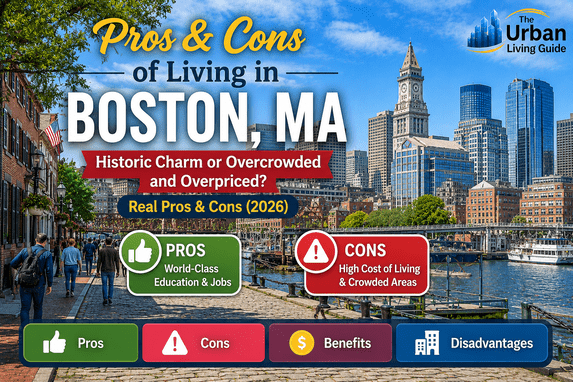
Boston Is One of America’s Most Iconic Cities — But Is It Actually Worth Living In?
Few cities carry as much history, prestige, and personality as Boston. From the Freedom Trail to Fenway Park, from Harvard to the biotech corridor along Kendall Square — this is a city that punches well above its population of 675,000. But the pros and cons of living in Boston, Massachusetts tell a story that goes beyond the postcard version most people know.
If you’re seriously considering a move here, this is the honest breakdown — not the admissions brochure.
Advantages of Living in Boston
1. One of America’s Most Powerful Job Markets
Boston is a global hub for biotech, healthcare, finance, and education. Major employers include Massachusetts General Hospital, Fidelity Investments, Biogen, Moderna, and dozens of research institutions tied to Harvard and MIT. Many residents appreciate that career opportunities here span multiple elite industries simultaneously — a rare combination in any American city.
2. World-Class Universities Create Unmatched Intellectual Energy
Harvard University, MIT, Boston University, Northeastern, and Tufts all sit within the metro area. One thing people often mention is how this concentration of academic institutions creates a city that feels perpetually curious, innovative, and intellectually alive in ways that genuinely affect everyday life.
3. Exceptional Public Transit for a US City
The MBTA — known locally as the T — is one of America’s oldest and most comprehensive public transit systems. Subway, bus, commuter rail, and ferry connections make car-free living genuinely viable in Boston — something very few American cities can honestly claim.
4. Rich History and Cultural Depth
The Freedom Trail, Faneuil Hall, Isabella Stewart Gardner Museum, and Boston Symphony Orchestra represent just the surface of a cultural offering that most cities twice Boston’s size would envy. Many residents appreciate that history here isn’t preserved behind glass — it’s literally the sidewalk under your feet.
5. Four Distinct Seasons Done Right
Boston’s seasons are real and dramatic — genuine summers, spectacular New England autumns, snowy winters, and fresh springs. For movers tired of monotonous weather, the seasonal rhythm here adds a quality-of-life texture that many find genuinely energizing.
6. Neighborhood Diversity and Distinct Character
South End, Beacon Hill, Jamaica Plain, Allston, and Charlestown each have completely distinct personalities, demographics, and price points. Many residents appreciate that Boston feels like a collection of real neighborhoods rather than a single homogeneous urban blob.
📺 Real Boston residents share what daily life here actually looks like — worth watching before you decide.
Challenges of Living in Boston
1. Housing Costs Are Brutally High
This is Boston’s most defining challenge. Median rents consistently rank among the top 5 most expensive in the United States, and home prices in desirable neighborhoods regularly exceed $700,000–$900,000. Some newcomers find it challenging that even a strong salary feels stretched thin once housing costs are factored into the monthly budget.
2. The Winters Are Genuinely Harsh
Boston averages over 48 inches of snow annually, and nor’easters can shut the city down entirely. Some newcomers find it challenging that the winters here — particularly January through March — are longer, colder, and more relentless than anything they’ve experienced before.
3. Traffic and Driving Culture
Boston drivers have a national reputation — and it’s earned. The road layout, largely unchanged since colonial-era cow paths, is notoriously confusing. Storrow Drive, Rotaries, and aggressive local driving culture combine into something that genuinely unsettles newcomers for months.
4. High Overall Cost of Living
Beyond housing, Boston is expensive across the board. Groceries, dining, childcare, and parking all run significantly above national averages. The financial pressure is real and persistent, even for professionals earning competitive salaries.
5. Neighborhood Cliquishness and the “Boston Cold”
Boston has a well-documented reputation for social insularity — sometimes called the “Boston Freeze.” Some newcomers find it challenging that building genuine local friendships takes considerably longer here than in more socially open cities like Denver or Austin.
Who Should Consider Living in Boston?
Boston is an outstanding fit for biotech and healthcare professionals, finance and tech workers, academics and researchers, and students building careers in elite industries. Anyone who values world-class cultural institutions, walkable urban living, and genuine intellectual community will find Boston deeply rewarding.
Who should think twice? Budget-conscious movers, families needing affordable housing, anyone with a strong aversion to harsh winters, and those who prioritize easy social integration should weigh Boston’s trade-offs carefully before committing.
Final Verdict – Is Boston Right for You?
Boston demands a lot — financially, climatically, and socially. But what it gives back is equally significant. The pros and cons of living in Boston, Massachusetts ultimately favor career-driven, intellectually curious movers who can handle the financial weight. For the right person, Boston isn’t just a city — it’s a genuine launchpad.
FAQs
Is Boston, MA safe to live in?
Safety varies significantly by neighborhood. Beacon Hill, Back Bay, South End, and Cambridge are among the safest and most desirable areas. Roxbury, Mattapan, and parts of Dorchester have higher crime rates and require careful neighborhood-level research before committing.
What salary do you need to live comfortably in Boston?
A single professional realistically needs $85,000–$100,000 annually to live comfortably in Boston. Families typically require $140,000–$160,000+ depending on housing choices, childcare costs, and lifestyle expectations.
Is Boston good for families?
Certain neighborhoods and suburbs are excellent for families — West Roxbury, Hyde Park, and nearby suburbs like Newton and Brookline offer strong schools and community feel. Boston proper is expensive for families, pushing many toward the suburbs once children arrive.
How is public transportation in Boston?
The MBTA T is genuinely functional for a US city — subway, bus, commuter rail, and ferry options make car-free living realistic downtown. That said, the system has aging infrastructure and reliability issues that frustrate daily commuters regularly.
Is the job market strong in Boston?
Exceptionally strong — particularly in biotech, healthcare, finance, education, and tech. Boston consistently ranks among America’s top job markets for educated professionals, with unemployment rates running well below national averages.
Is Boston worth the high cost of living?
For career-focused movers in the right industries — generally yes. The earning potential, professional networks, and quality of life justify the cost for many residents. Those in lower-paying fields or on fixed incomes will find the financial pressure genuinely difficult to sustain long-term.
Explore More
- 📍 Living in Boston, Massachusetts — Complete relocation guide covering neighborhoods, culture, and what Boston life really feels like day to day
- 💰 Cost of Living in Boston, Massachusetts — Honest breakdown of rent, groceries, transit costs, and what your salary actually covers in Boston