

Why More Chicago-Area Residents Are Choosing Aurora, Illinois for Affordable Suburban Living
Positioned roughly 40 miles west of downtown Chicago across DuPage, Kane, Kendall, and Will counties, Living in Aurora, Illinois provides an appealing balance of suburban space, relative economic independence, and practical commuter access to the greater metropolitan area. Famously known as the City of Lights for being one of the first in the nation to illuminate its streets with electric arc lights in 1881, Aurora has grown into the second-largest city in Illinois, supporting a diverse population of over 175,000 residents.
Relocating to this sprawling collar city offers significant housing relief for families and first-time homebuyers priced out of Chicago or upscale DuPage enclaves like Naperville. While a vast percentage of the workforce commutes into Chicago or neighboring tech corridors via the Metra BNSF line, Aurora possesses a vibrant local commercial base driven by healthcare networks, logistics centers, and manufacturing plants. However, navigating the city requires understanding its geographic scale, as neighborhoods vary sharply from historic downtown blocks to rapidly expanding western subdivisions. Whether you are a healthcare professional at Rush Copley, a logistics manager, or a family seeking larger square footage for your money, Aurora delivers a grounded, industrious Midwestern lifestyle.
What Makes Aurora So Popular & Unique
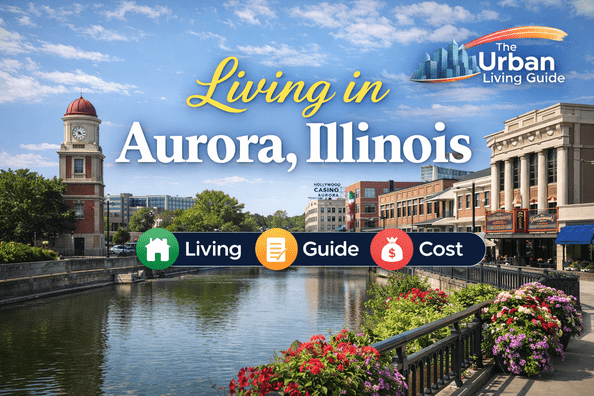
Aurora stands out in the regional real estate market because it combines big-city population scale with genuine suburban affordability, allowing buyers to secure significantly more property value than they would closer to the Chicago loop. The city features a revitalized historic downtown along the Fox River, cultural landmarks like the Paramount Theatre, and massive commercial developments on the far west side near Route 59. For newcomers looking to access municipal services, public library branches, and local utility information, the official City of Aurora portal serves as an essential digital resource.
- The Fox River Corridor: A scenic natural waterway slicing through the heart of the city, featuring riverside parks, pedestrian bridges, and bike paths.
- The Paramount Theatre: A stunningly restored 1930s art deco architectural masterpiece that hosts Broadway-caliber theatrical productions right downtown.
- Exceptional Space-to-Cost Value: Offers substantially lower median home prices and rental rates compared to downtown Chicago and its immediate inner-ring suburbs.
- Multi-County Infrastructure: Spans four distinct counties, giving residents diverse municipal service options and varied local school district boundaries.
Aurora at a Glance: Key Relocation Metrics
Reviewing these baseline statistics can help you set realistic expectations for your relocation to the City of Lights. These figures reflect current northern Illinois suburban market conditions and regional economic benchmarks.
| Metric | Aurora City Data | Regional Context |
|---|---|---|
| City Population | Over 175,000 Residents | Second-largest city in the state of Illinois |
| Median Home Price | $300,000 – $380,000 | Significantly cheaper than neighboring Naperville |
| Average 1BR Rent | $1,200 – $1,600 | Accessible rental entry points across town |
| Average Commute | 60 – 75 Minutes (to Chicago) | Shorter for local healthcare or industrial parks |
| Top Industries | Manufacturing, Healthcare, Logistics | Retail trade and regional public education |
If you’re unfamiliar with the region, the map below helps you visualize the city’s location and surroundings.
Famous Personalities, Sports Teams & Major Brands in Aurora
Aurora’s cultural footprint blends industrial heritage with unexpected pop culture fame, while maintaining strong regional ties to the broader Chicago economic and sports ecosystem. While it operates as an independent collar city rather than a corporate capital, its influence stretches across the western suburbs.
- Pop Culture Fame: The city gained international pop culture recognition as the quirky hometown setting featured in the hit comedy film Wayne’s World, starring Mike Myers and Dana Carvey.
- Sports Loyalties: While Aurora features robust local high school athletic traditions, professional sports fandom aligns entirely with Chicago franchises, including massive community support for the Chicago Bears, Chicago Bulls, and Chicago Cubs.
- Corporate Proximity: Residents benefit from close geographic proximity to major Chicago-area corporate headquarters such as McDonald’s, United Airlines, and Boeing, with many regional employees utilizing Aurora’s affordable housing base.
Job Market & Business Opportunities with Major Employers
Aurora’s employment landscape is uniquely resilient because it draws strength from both local commercial sectors and regional access to the Chicago metro job market. Key local industries include heavy and light manufacturing, advanced healthcare administration, large-scale warehousing and logistics distribution, and public education.
Major local employers providing thousands of stable jobs include Rush Copley Medical Center, regional distribution hubs for national retailers, and multiple large school districts. Official economic reference data from the Illinois Department of Commerce & Economic Opportunity shows that while local salaries span a practical range, many ambitious professionals choose to commute toward Chicago or the I-88 tech corridor for higher corporate earnings.
- Entry-level salaries: Typically range between $45,000 – $60,000 for administrative, retail, and entry-level logistics roles.
- Mid-level professional roles: Generally span $65,000 – $85,000 for healthcare staff, teachers, and manufacturing supervisors.
- Senior technical or management roles: Frequently command $95,000+, supporting comfortable middle-class homeownership.
Housing & Real Estate Overview in Aurora
Housing is unquestionably Aurora’s greatest competitive advantage when compared to downtown Chicago or inner-ring suburbs like Oak Park or Naperville. In 2026, median home prices across the city hover between $300,000 and $380,000, allowing buyers to secure spacious single-family homes with yards. Luxury suburban builds in master-planned communities can exceed $600,000.
The rental market is equally practical, offering reasonable entry points for newcomers. Current average monthly rent projections are:
- Studio Apartment: $1,000 – $1,300
- 1 Bedroom Apartment: $1,200 – $1,600
- 2 Bedroom Apartment: $1,600 – $2,200
- Family Home Rentals: $2,300 – $3,400+
Securing property here provides significantly better space-to-cost value, though buyers should carefully evaluate county tax variations depending on whether the property falls in DuPage, Kane, Kendall, or Will county.
Best Neighborhoods in Aurora: Finding Your Ideal Community
Choosing the right neighborhood in Aurora dramatically alters your school district access, daily commute times, and property appreciation. Neighborhood insights are based on local housing trends, safety reports, and resident surveys. The table below outlines the most prominent residential zones.
| Neighborhood / Category | Location, Pricing & Community Overview |
|---|---|
| Stonebridge (Luxury) | An upscale golf-course community located on the far west side, featuring custom luxury homes, mature landscaping, private club facilities, and exceptionally strong property resale value. |
| White Eagle (Upscale) | A sprawling planned residential area overlapping the Aurora-Naperville border, known for larger executive properties, community pools, tennis courts, and high safety ratings. |
| Far West Aurora (Family) | Extremely popular among families seeking a modern suburban feel, newer single-family construction, neighborhood parks, and access to highly rated western school districts. |
| Oakhurst (Established) | A well-established residential neighborhood featuring mature trees, community clubhouses, neighborhood ponds, and close proximity to local elementary and middle schools. |
| Downtown Aurora (Budget/Urban) | Features historic brick loft apartments and ongoing municipal redevelopment projects, offering lower rental entry points and immediate walking access to the Metra station. |
What It’s Really Like Living in Aurora (Daily Life & Vibe)
Life in Aurora offers a slower, more grounded suburban pace compared to the intense vertical energy of central Chicago. Weekdays typically revolve around local school schedules, neighborhood errands, and commuting either to nearby industrial parks or toward the Chicago loop via the Metra rail line. The atmosphere is practical, industrious, and community-oriented.
Weekends are defined by outdoor recreation at Phillips Park Zoo, walking along the Fox River trail system, attending local farmers markets, or shopping along the Route 59 commercial corridor. While nightlife is more modest than what you would find in downtown Chicago, Aurora provides immense residential stability, park district programming, and quiet neighborhood streets.
Watch a recent video by a popular vlogger to understand daily life and vibes in Aurora:
Cost of Living in Aurora: Monthly Expenses & Salary Needs
Aurora’s cost of living sits well below downtown Chicago, offering a financially forgiving alternative while remaining within the state’s economic orbit. Cost estimates are derived from official statistics and city-level cost databases. To live comfortably, manage housing expenses, and build household savings, a single professional should target a salary of $70,000+, while families typically require $105,000+.
- Average Rent (1BR): ~$1,400 for updated apartments or townhome rentals.
- Monthly Utilities: $150–$220 (Covering electricity, heating, and municipal water).
- Groceries & Household Goods: $350–$450 per month for an individual.
- Transportation: $150–$300 accounting for gas, vehicle maintenance, or Metra commuter fares.
- Property Taxes: Moderate to high compared to national averages, varying significantly based on county boundaries.
Transportation, Highway Bottlenecks & Airport Connectivity
Transportation in Aurora caters to both drivers and rail commuters. The city is connected directly to Chicago via the Metra commuter rail (BNSF Line), with train commutes taking roughly 60 to 75 minutes into Union Station. Car ownership remains common for navigating the sprawling municipal grid.
For drivers, connectivity is anchored by Interstate 88 and Route 30. However, local commuters experience frustrating rush-hour bottlenecks along commercial arterials like Route 59 and Eola Road. For air travel, residents utilize convenient highway access to both O’Hare and Midway international airports.
Weather Patterns, Seasonal Realities & Climate Factors
The city experiences a humid continental climate, characterized by classic northern Illinois weather cycles. Winters bring cold temperatures, biting winds, and seasonal snowfall, requiring proper vehicle winterization and home heating management. Warm, humid summers provide ideal conditions for enjoying local parks and riverfront trails. Climate reference and tracking are regularly provided by the National Weather Service Northern Illinois region.
Education, Schools & Major Universities
Education in Aurora is structured across multiple public school districts, allowing families to evaluate options based on specific neighborhood boundaries:
- East Aurora School District 131 & West Aurora School District 129: Serving the core municipal areas with extensive community programs, magnet options, and diverse student bodies.
- Waubonsee Community College: A premier local institution offering robust two-year degrees, vocational training, and adult continuing education programs.
- Nearby Northern Illinois University (NIU): Located a short drive west in DeKalb, providing regional university access and higher-education partnerships.
Medical Facilities, Hospitals & Healthcare Systems
Residents have access to robust medical care directly within city limits without needing to travel into Chicago for routine or emergency treatment. The local healthcare infrastructure is anchored by prominent facilities:
- Rush Copley Medical Center: A massive, highly rated 210-bed acute care hospital offering advanced emergency services, surgical suites, heart care, and specialized clinics.
- Amita Health / Ascension Saint Joseph – Aurora: Providing comprehensive community hospital services, emergency care, and outpatient clinics on the city’s east side.
- Local Immediate Care Centers: Sprawling urgent care and multi-specialty medical offices located conveniently along major commercial corridors.
Popular Hotels, Cafes, Dining & Culinary Scene
Aurora’s hospitality and dining scene has expanded dramatically, reflecting its growing population and downtown revitalization.
- Popular Hotels: Business travelers and visitors frequently book stays at downtown boutique properties like Two Brothers Roundhouse (housed in a historic limestone stone roundhouse) or modern highway-adjacent business hotels.
- Cafes: Independent coffee roasters and artisan bakeries thrive near downtown and the West Side commercial developments, serving as popular morning gathering spots.
- Restaurants: Downtown Aurora features an eclectic mix of authentic taquerias, historic pubs, and fine dining establishments like Hardware Sustainability Market, drawing food enthusiasts from across the Fox River Valley.
Sightseeing, Cultural Spots & Tourist Attractions
Residents enjoy a rich array of cultural and recreational attractions right within city limits.
- Phillips Park Zoo & Family Aquatic Center: A historic public park featuring a free zoo, sunken gardens, walking trails, and an outdoor water park.
- Paramount Theatre: Hosting spectacular Broadway musical series and live entertainment in a historic downtown venue.
- Aurora Regional Fire Museum: Housed in a historic 1894 central fire station, celebrating local firefighting history and community education.
- Prarie Fest: The city’s massive annual summer community festival featuring live music, carnivals, and local food vendors.
Hostels & Budget Stay Options
Traditional youth hostels do not operate within Aurora. Budget-conscious visitors, contractors, or prospective residents scouting neighborhoods typically rely on alternative lodging formats:
- Extended-Stay Properties: Suite-style hotels offering kitchenette amenities for relocating professionals or temporary workers.
- Highway Business Motels: Accessible, budget-flexible lodging options positioned near major Interstate 88 commercial interchanges.
- Short-Term Corporate Rentals: Furnished rental apartments scattered across commercial corridors for interim housing needs.
Honest Trade-offs: Pros and Cons of Living in Aurora
Every city requires compromise. Here is the unvarnished reality for anyone planning a move to this Fox River Valley hub in 2026:
Pros:
- Substantially more affordable housing and rental rates compared to Chicago and Naperville.
- Direct commuter rail access to downtown Chicago via Metra.
- Family-friendly residential subdivisions and expanding community parks.
- Abundant suburban space and lower housing density.
- A thriving local commercial base and medical infrastructure.
Cons:
- Longer daily train or driving commutes into central Chicago.
- A quieter, more modest local nightlife and entertainment scene.
- Cold, snowy winter weather requiring seasonal home and vehicle upkeep.
- Property taxes that can run high depending on county jurisdictions.
- Fewer high-paying local corporate headquarters compared to inner-ring tech hubs.
Who Is Aurora Ideal For (and Who Should Avoid It?)
Aurora offers suburban stability with metro access. Ideal For:
- First-time homebuyers and families seeking affordable suburban housing.
- Healthcare workers, educators, and logistics professionals working locally.
- Chicago commuters willing to trade a longer train ride for lower mortgage costs.
- Retirees looking for established park districts and manageable municipal services.
Who Should Avoid It:
- Professionals who require a short, effortless daily commute into downtown Chicago.
- Young singles seeking an dense, high-energy urban nightlife and arts core.
- Buyers seeking extremely low property tax rates without county variations.
Real Experiences: Perspectives from Long-Term Residents (5 to 10+ Years)
Data gives you the metrics, but daily life gives you the truth. Here is what veteran locals have to say about living in Aurora:
“We moved out here from the city because we got priced out of everything closer in, and honestly, buying a home near the west side gave us double the space for way less money. The Metra ride is long—about an hour and fifteen minutes—so you use that time to read or sleep, but coming home to a quiet neighborhood makes it worth it.”
[Source: r/auroraillinois Community Discussions]
“Downtown Aurora has changed so much over the last ten years with the Paramount Theatre and local brewpubs opening up. It’s a huge city with distinct pockets, so your experience depends entirely on whether you live downtown or out by Route 59. Taxes can bite, but the space and community feel are solid.”
[Source: Local Neighborhood Survey Threads]
Frequently Asked Questions About Living in Aurora, Illinois
Is Aurora, Illinois expensive to live in?
Aurora is significantly more affordable than Chicago and neighboring Naperville, particularly regarding housing prices and apartment rental rates across most neighborhoods.
What salary do you need to live comfortably in Aurora?
A single individual typically requires around $70,000 annually, while families generally need $105,000+ to manage mortgages, utilities, and daily household expenses.
How long is the Metra train commute from Aurora to Chicago?
The train ride from the Aurora Transportation Center (or Route 59 Metra station) into downtown Chicago’s Union Station takes approximately 60 to 75 minutes each way.
Which county tax jurisdiction is best when buying in Aurora?
Aurora spans DuPage, Kane, Kendall, and Will counties. Buyers often research county lines carefully because property tax rates and school district performance metrics shift noticeably across them.
Is Aurora safe for raising children?
Safety varies by neighborhood; newer subdivisions on the far west side and master-planned areas are generally viewed as very secure and family-oriented.
🔗 Explore More Cities in Illinois
If you’re exploring more options beyond Aurora, The Urban Living Guide has covered several other popular cities in Illinois. You can also check:
- Living in Chicago, Illinois
- Living in Springfield, Illinois
- Living in Naperville, Illinois
- Living in Rockford, Illinois
If you want to know more about living in Aurora, explore these guides:
- Cost of Living in Aurora, Illinois
- Pros and Cons of Living in Aurora, Illinois
- Best Neighborhoods in Aurora, Illinois
For a complete overview, check our full guide: Moving to Aurora, Illinois
These guides give you a complete picture of what it’s like living across different cities, covering everything from cost of living, housing, and job opportunities to neighborhoods, commute, weather, education, popular places, and major employers.
The Urban Living Guide brings together these local insights in one place, helping you compare cities easily and make a confident, well-informed decision based on your lifestyle and goals.