

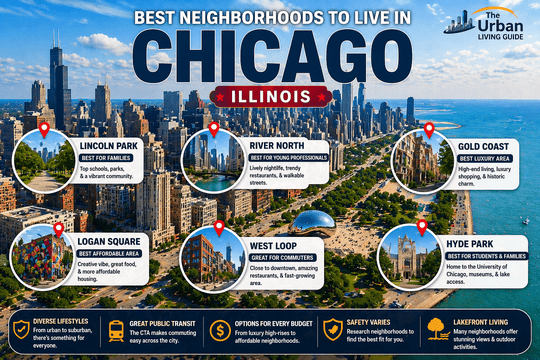
Best Neighborhoods in Chicago, Illinois: Lakefront High-Rises, Historic Boulevards & Urban Quarters in 2026
Covering approximately 227 square miles of land area along the southwestern shores of Lake Michigan in Cook County, the City of Chicago functions under the mayor-council municipal administration of the City of Chicago. Anchoring a municipal core population exceeding 2.66 million residents and a tri-state regional metropolitan footprint of over 9.4 million people, “The Windy City” is the economic, financial, architectural, and transport capital of the American Midwest.
Relocating across Chicago requires evaluating lakefront microclimates, historic neighborhood preservation overlays, winter weather resilience, and extensive heavy rail systems managed by the Chicago Transit Authority. Inbound movers consistently balance direct access to central business hubs—such as the Loop Central Business District, the Fulton Market Tech & Corporate Corridor, the Illinois Medical District, and corporate aviation hubs at O’Hare International Airport (ORD)—against commute times across major expressways like the Kennedy Expressway (I-90/94), Dan Ryan Expressway, Eisenhower Expressway (I-290), and DuSable Lake Shore Drive.
Watch this video to explore different neighborhoods, streetscapes, and residential lifestyles across Chicago:
Best Areas to Live in Chicago at a Glance in 2026
| Neighborhood Name | Location | Distance from Core (The Loop) | Development Status | Transit Connectivity | Cost Level | Best Fit For |
|---|---|---|---|---|---|---|
| Lincoln Park | North Side Lakefront | Approximately 3 miles north | Historic Tree-Canopied Residential | Exceptional (CTA Red/Brown/Purple Lines, Buses) | High-to-Premium | Families, Corporate Executives & Academics |
| River North | Central North River Basin | Approximately 1 mile north | High-Density Commercial & High-Rise Core | Exceptional (CTA Red/Brown Lines, Riverwalk) | High-to-Premium | Young Professionals, Finance Workers & Renters |
| Logan Square | Northwest Boulevard Corridor | Approximately 5.5 miles northwest | Historic Infill & Thriving Arts Sector | High (CTA Blue Line, The 606 Trail) | Mid-Range | Creatives, Tech Commuters & First-Time Buyers |
| Gold Coast | Near North Lakefront | Approximately 1.8 miles north | Preserved Historic Ultra-Luxury | Exceptional (CTA Red Line, Lake Shore Dr) | Ultra-Premium | High-Net-Worth Buyers & Luxury Renters |
| West Loop | Near West Side Basin | Approximately 1.2 miles west | Adaptive Industrial Loft & Corporate Tech Hub | Exceptional (CTA Green/Pink Lines, Metra Rail) | High-to-Premium | Tech Employees, Corporate Execs & Foodies |
| Hyde Park | South Side Lakefront | Approximately 7 miles south | Historic Academic & Cultural Enclave | High (Metra Electric, CTA Express Buses) | Mid-Range | Academics, Medical Staff, Students & Families |
Best Neighborhoods in Chicago Discussed in Detail
Lincoln Park — Premier Lakefront Greenspace, Top Schools & Classic Brownstones
Situated along Lake Michigan directly north of Old Town, Lincoln Park is one of Chicago’s most coveted residential neighborhoods. Named after the sprawling 1,200-acre lakefront park framing its eastern border, the district blends historic brick brownstones and tree-lined residential streets with bustling shopping and dining along Armitage Avenue and Clark Street.
Operating under municipal oversight from the City of Chicago, Lincoln Park offers an ideal combination of urban walkability, top-tier schools, and lakefront recreation for long-term residents.
- Housing: Inventory consists of 19th-century brick and greystone walk-ups, renovated Victorian single-family homes, and luxury high-rise condominiums along Lincoln Park West. Detached single-family purchase prices typically range from $1,200,000 to $4,500,000+, while 2-bedroom rental apartments average $2,450 to $3,900 per month.
- Safety & Crime Rate: Patrolled by the Chicago Police Department (CPD) 18th and 19th Districts. Lincoln Park maintains one of the city’s lowest violent crime rates, supported by high residential foot traffic, active community associations, and campus security patrols near DePaul University.
- School District & Education Quality: Governed by Chicago Public Schools (CPS), featuring top-ranked public schools such as Lincoln Park High School (offering an authorized International Baccalaureate programme) and Lincoln Elementary School, alongside higher-education institutions anchored by DePaul University.
- Walkability & Daily Conveniences: Outstanding pedestrian walkability (Walk Score of 90-95/100). Residents walk to grocery markets including Whole Foods Market on Kingsbury, Trader Joe’s on Diversey, neighborhood bakeries, and boutique retail.
- Parks & Green Spaces / Pet-Friendliness: Direct access to Lincoln Park, the free Lincoln Park Zoo, North Avenue Beach, and the 18-mile paved Chicago Lakefront Trail. Highly dog-friendly with dedicated dog parks at Wiggly Field.
- Parking & Traffic Congestion: Residential zoned street permit parking is enforced; garage parking adds $200 to $350 per month. Rush-hour vehicle traffic slows along Fullerton Avenue and DuSable Lake Shore Drive.
- Noise Levels & Vibe: Refined, active, and family-oriented, shifting from quiet residential side streets to lively student and dining hubs near Lincoln Avenue.
- Medical Facilities & Hospitals: Direct 8-minute transit access to comprehensive pediatric and adult care at Ann & Robert H. Lurie Children’s Hospital and Northwestern Memorial Hospital in Streeterville.
- Transit Connectivity: Direct public transit service provided by the CTA Red, Brown, and Purple Lines (Fullerton, Armitage, and Diversey stations), connecting to the Loop in 12 minutes, complemented by Lake Shore Drive express buses.
- Affordability: High-to-premium pricing tier; elevated property values and rental rates are offset by strong long-term appreciation, safety, and school quality.
- Who It’s Best For: Families seeking top-tier CPS schools, corporate executives, DePaul faculty, and buyers prioritizing lakefront parkland.
- Drawbacks: High real estate entry costs, tight street parking on residential blocks, and heavy summer festival foot traffic near the lakefront.
River North — High-Density High-Rises, Art Gallery District & Nightlife Hub
Positioned immediately north of the Chicago River across from the Loop, River North is the central dining, arts, and nightlife hub of downtown Chicago. Once an industrial warehouse sector, the neighborhood now features luxury glass skyscraper towers, world-class design showrooms at The Mart (Merchandise Mart), and dense commercial entertainment along Hubbard Street.
Guided by transit-oriented development frameworks, River North provides fast-paced vertical urban living within walking distance of the central business district.
- Housing: Real estate stock is dominated by contemporary high-rise condominium towers (such as The Sterling and Grand Plaza), converted industrial brick lofts, and luxury rental towers. Condominium purchase valuations typically range from $320,000 to $1,800,000+, while 1-bedroom apartment rentals average $2,200 to $3,400 per month.
- Safety & Crime Rate: Patrolled by the CPD 18th District (Near North). The district maintains visible police patrols and well-illuminated commercial avenues, though non-violent property theft and nightlife-related incidents occur around late-night entertainment corridors.
- School District & Education Quality: Governed by CPS, containing public options like Ogden International School of Chicago (authorized IB curriculum), alongside private academies and higher-education extensions.
- Walkability & Daily Conveniences: Outstanding walkability (Walk Score of 96-98/100). Residents walk to flagship grocers like Jewel-Osco, Whole Foods Market, hundreds of acclaimed restaurants, and the iconic retail along the Magnificent Mile (Michigan Avenue).
- Parks & Green Spaces / Pet-Friendliness: Public recreation includes the scenic Chicago Riverwalk, Ward (A. Montgomery) Park along the river (featuring an active dog park), and Ohio Street Beach nearby. Most high-rise buildings offer private indoor dog runs and grooming stations.
- Parking & Traffic Congestion: Deeded or leased garage parking in residential buildings adds $250 to $400 per month per space. Street traffic is heavy along Ontario Street and Ohio Street due to on-ramps connecting to the Kennedy Expressway (I-90/94).
- Noise Levels & Vibe: Vibrant, cosmopolitan, and high-energy, characterized by bustling restaurant patios, sirens, and active evening entertainment crowds.
- Medical Facilities & Hospitals: Direct 5-minute access to world-class academic medicine at Northwestern Memorial Hospital and the Shirley Ryan AbilityLab.
- Transit Connectivity: Unmatched transit access with CTA Red Line subway stations at Grand and Chicago, CTA Brown and Purple Line elevated stations at Merchandise Mart and Chicago, and easy walking access into the Loop.
- Affordability: Mid-to-high urban pricing; competitive prices per square foot on high-rise condos are balanced by higher monthly HOA assessments.
- Who It’s Best For: Finance professionals, tech workers, attorneys, corporate transferees, and urbanites seeking a car-free downtown lifestyle.
- Drawbacks: High monthly parking fees, elevated weekend nightlife noise, and highway approach congestion on Ontario and Ohio Streets.
Logan Square — Historic Boulevards, Thriving Culinary Scene & Creative Energy
Covering a wide boulevard system in northwest Chicago, Logan Square is celebrated for its historic greystone architecture, wide grassy parkways, and thriving creative community. Centered around the iconic Illinois Centennial Monument at the Logan Square roundabout, the neighborhood blends preserved 19th-century architecture with independent craft cocktail lounges, indie coffee houses, and music venues along Milwaukee Avenue.
The neighborhood is popular among artists, young families, and tech professionals commuting along the Blue Line corridor to downtown or O’Hare.
- Housing: Real estate spans classic two-flats and three-flats, historic greystone single-family homes, converted vintage courtyard apartments, and modern transit-oriented infill developments. Property purchase prices typically range from $450,000 to $1,150,000, while rental apartments average $1,650 to $2,650 per month.
- Safety & Crime Rate: Patrolled by the CPD 14th District (Shakespeare). Residential streets along the boulevards are active and community-focused, though opportunistic car break-ins and property crimes occur near busy commercial strips.
- School District & Education Quality: Governed by CPS, containing neighborhood institutions such as Darwin Elementary School and Brentano Math & Science Academy.
- Walkability & Daily Conveniences: High walkability (Walk Score of 88-92/100). Residents walk to boutique grocers, farmer-direct markets at the weekly Logan Square Farmers Market, independent bookshops, and diverse dining options.
- Parks & Green Spaces / Pet-Friendliness: Outstanding public greenspace anchored by the historic Logan Square Boulevards, Palmer Square Park, and direct elevated trail access to The 606 (Bloomingdale Trail). Extremely dog-friendly.
- Parking & Traffic Congestion: Street parking is manageable on residential side streets with city parking permits. Vehicular traffic slows along Milwaukee Avenue and Fullerton Avenue during peak commute hours.
- Noise Levels & Vibe: Creative, community-centric, and energetic, characterized by bicyclists, outdoor patio dining, live music, and front-porch gatherings.
- Medical Facilities & Hospitals: Direct 8-to-10 minute drive to comprehensive medical care at AMITA Health Saint Mary and Elizabeth Medical Center and Advocate Illinois Masonic Medical Center.
- Transit Connectivity: Outstanding heavy rail access via the CTA Blue Line (Logan Square and California subway stations), providing a 15-minute ride to the Loop and 25 minutes to O’Hare International Airport.
- Affordability: Accessible mid-range price structure; delivers authentic vintage architectural charm and generous multi-bedroom floor plans at rates lower than Lincoln Park or West Loop.
- Who It’s Best For: Creatives, remote tech workers, foodies, first-time homebuyers, and commuters seeking direct Blue Line transit.
- Drawbacks: Rising housing prices due to demand, older home infrastructure requiring winter heating upgrades, and limited expressway access compared to near-downtown areas.
Gold Coast — Historic Mansions, Lake Michigan Views & Upscale Living
Perched along the lakefront immediately north of Streeterville and River North, the Gold Coast is one of the most prestigious and historic residential enclaves in the country. Developed in the late 19th century following the Great Chicago Fire, the neighborhood features historic brownstone mansions along the Astor Street Historic District and luxury high-rises lining Lake Shore Drive.
The community operates with strict historic preservation guidelines overseen by the City of Chicago, maintaining architectural elegance and immediate proximity to downtown luxury retail.
- Housing: Real estate consists of multi-million dollar historic brick and limestone mansions, vintage pre-war cooperative apartments, and full-amenity luxury high-rise condominiums along East Lake Shore Drive. Condominium sales typically range from $380,000 to $4,500,000+, while luxury residential leases average $2,600 to $6,500 per month.
- Safety & Crime Rate: Patrolled by the CPD 18th District and supported by private residential doormen and security details, the Gold Coast maintains one of the lowest violent crime rates in the metropolitan core.
- School District & Education Quality: Governed by CPS, containing top options like Ogden International School, while being minutes from elite independent preparatory institutions including The Latin School of Chicago and Catherine Cook School.
- Walkability & Daily Conveniences: Walk Score exceeds 95/100. Residents walk to designer luxury boutiques along Oak Street, upscale grocers like Potash Markets and Plum Market, and fine steakhouses in the historic Viagra Triangle (Mariano Park).
- Parks & Green Spaces / Pet-Friendliness: Direct access to Oak Street Beach, the green pathways of southern Lincoln Park, and the Lakefront Trail. Highly pet-friendly with tree-lined sidewalk corridors.
- Parking & Traffic Congestion: Street parking is limited and heavily permitted; high-rise valets and deeded garage parking spaces are standard. Traffic moves slowly along North State Street and Division Street on weekends.
- Noise Levels & Vibe: Refined, quiet, and exclusive along residential side streets, with lively upscale dining and shopping along State and Rush Streets.
- Medical Facilities & Hospitals: Direct 3-minute medical access to the world-renowned campus of Northwestern Memorial Hospital on Fairbanks Court.
- Transit Connectivity: Served directly by the CTA Red Line Subway (Clark/Division Station), express CTA bus lines (151, 156) along Lake Shore Drive and Michigan Avenue, and quick access to DuSable Lake Shore Drive.
- Affordability: Ultra-premium price tier across real estate acquisitions, building assessments, property taxes, and neighborhood retail.
- Who It’s Best For: High-net-worth buyers, corporate executives, medical leaders, and residents seeking classic architectural pedigree and lakefront views.
- Drawbacks: High HOA dues on vintage cooperatives, steep housing acquisition prices, and scarce on-street guest parking.
West Loop — Former Meatpacking Hub, Tech Epicenter & Restaurant Row
Covering the Near West Side directly across the expressway from the Loop, the West Loop has undergone one of the most significant urban transformations in North America. Formerly an industrial meatpacking and warehouse district, the neighborhood is now Chicago’s primary tech and culinary center, hosting corporate headquarters for Google and McDonald’s alongside celebrated dining along Randolph Street (Restaurant Row) and Fulton Market.
The neighborhood combines industrial timber lofts with modern glass residential towers, attracting tech professionals and corporate executives seeking walkable proximity to downtown.
- Housing: Real estate is composed of converted authentic brick-and-timber lofts, modern podium mid-rises, and luxury high-rise apartment towers along Halsted Street and Fulton Market. Condominium purchase valuations typically range from $380,000 to $1,650,000+, while modern apartment rentals average $2,350 to $3,800 per month.
- Safety & Crime Rate: Patrolled by the CPD 12th District (Near West). The core Fulton Market and Randolph Street dining strips are well-patrolled and active day and night, with below-average violent crime metrics.
- School District & Education Quality: Governed by CPS, zoned to high-performing public schools such as Skinner West Elementary School (nationally recognized for academic excellence) and Whitney M. Young Magnet High School.
- Walkability & Daily Conveniences: Outstanding walkability (Walk Score of 94-97/100). Residents walk to premier grocers including Whole Foods Market on Halsted, Mariano’s, boutique fitness gyms, and Michelin-starred dining.
- Parks & Green Spaces / Pet-Friendliness: Municipal recreation includes the community gathering lawn at Mary Bartelme Park (featuring a sunken dog park, children’s play areas, and misting towers) and Union Park nearby. Exceptionally pet-friendly.
- Parking & Traffic Congestion: Residential garage parking spaces add $225 to $350 per month. Heavy vehicular gridlock concentrates near Randolph Street, Halsted Street, and on-ramps to the Kennedy (I-90/94) and Eisenhower (I-290) Expressways.
- Noise Levels & Vibe: High-energy, trendsetting, and commercial, filled with tech workers, culinary enthusiasts, and active outdoor restaurant patios.
- Medical Facilities & Hospitals: Direct 5-minute commute to the massive Illinois Medical District (IMD), anchored by Rush University Medical Center and UI Health.
- Transit Connectivity: Unmatched regional transit access via CTA Green and Pink Lines at Morgan Station and Clinton Station, alongside walking access to commuter trains at Ogilvie Transportation Center and Chicago Union Station (Metra and Amtrak).
- Affordability: High-to-premium urban pricing; rapid commercial development has elevated both rental and condo sale prices per square foot.
- Who It’s Best For: Tech professionals, corporate executives, culinary workers, and commuters utilizing Metra suburban trains.
- Drawbacks: High rental and condominium price points, ongoing high-rise construction activity, and heavy weekend restaurant traffic.
Hyde Park — University Heritage, Lakefront Culture & Historic Tree-Lined Avenues
Situated on the South Side lakefront approximately 7 miles south of downtown, Hyde Park is a culturally rich, historic, and academically oriented community. World-famous as the home of the University of Chicago, the Museum of Science and Industry, and the site of the 1893 World’s Columbian Exposition, Hyde Park delivers an intellectual atmosphere surrounded by parks and lakefront beaches.
Operating with municipal oversight from the City of Chicago and university planning, Hyde Park features architectural landmarks designed by Frank Lloyd Wright alongside bustling commercial streets along 53rd Street.
- Housing: Real estate stock features historic Gothic Revival townhomes, mid-century modern single-family properties, vintage courtyard cooperatives, and modern rental mid-rises along 53rd Street. Single-family home prices typically range from $380,000 to $1,450,000, while apartment rentals average $1,550 to $2,500 per month.
- Safety & Crime Rate: Patrolled by the CPD 2nd District (Wentworth) and heavily supplemented by the visible, 24/7 University of Chicago Police Department (UCPD) across the neighborhood, maintaining safe campus and residential corridors.
- School District & Education Quality: Governed by CPS, containing top-tier public options such as Kenwood Academy High School, Ray Elementary, and premier independent academies like the University of Chicago Laboratory Schools.
- Walkability & Daily Conveniences: High walkability (Walk Score of 86-90/100). Residents walk to local independent bookshops, international dining along 53rd and 57th Streets, grocers like Trader Joe’s, and the Hyde Park Farmers Market.
- Parks & Green Spaces / Pet-Friendliness: Exceptional natural acreage anchored by the 500-acre Jackson Park (home to the Japanese Garden on Wooded Island and future Obama Presidential Center), Washington Park, Promontory Point, and 57th Street Beach. Highly pet-friendly.
- Parking & Traffic Congestion: Manageable on-street permit parking and residential lot parking compared to near-north downtown districts. Traffic flows smoothly along DuSable Lake Shore Drive into downtown.
- Noise Levels & Vibe: Scholarly, serene, and culturally diverse, characterized by tree-shaded sidewalks, students carrying books, and quiet residential evenings.
- Medical Facilities & Hospitals: Direct emergency medical coverage provided within the district by the world-renowned academic medical center at UChicago Medicine (University of Chicago Medical Center) on Maryland Avenue.
- Transit Connectivity: Commuter rail access is centered along the Metra Electric District Line (stations at 51st/53rd, 55th-56th-57th, and 59th), delivering a 15-minute express train ride to Millennium Station in the Loop, alongside CTA express bus lines (2, 6, 28).
- Affordability: Accessible mid-range price tier; offers generous square footage and vintage historic architectural details at pricing significantly lower than north side lakefront enclaves.
- Who It’s Best For: University professors, medical researchers, students, intellectuals, and families seeking strong private and public academic environments.
- Drawbacks: Greater distance to North Side entertainment hubs, lack of CTA ‘L’ subway train stops directly in the core (reliant on Metra rail and buses), and colder lakefront winter winds.
Comprehensive Neighborhood Pros and Cons Comparison
| Neighborhood | Core Advantages (Pros) | Core Limitations (Cons) |
|---|---|---|
| Lincoln Park | Direct access to 1,200-acre Lincoln Park and free zoo; top-performing Lincoln Elementary; CTA Red/Brown lines; low crime rates. | High real estate purchase prices; competitive residential street parking; heavy summer park visitor crowds. |
| River North | Walkable commute to the Loop; direct access to the Chicago Riverwalk; world-class dining and art galleries; luxury high-rise amenities. | Elevated monthly parking fees ($300+); weekend nightlife street noise; expressway approach traffic on Ontario/Ohio. |
| Logan Square | Historic greystone architecture; direct CTA Blue Line to Loop and O’Hare; The 606 trail; thriving indie arts and dining scene. | Rising home acquisition costs; older housing infrastructure requiring maintenance; limited direct expressway access. |
| Gold Coast | Historic mansions on Astor Street; luxury retail along Oak Street; Oak Street Beach access; minutes to Northwestern Hospital. | Ultra-premium home prices; high monthly cooperative HOA dues; limited street parking for guests. |
| West Loop | Major tech hub (Google, McDonald’s); Michelin dining on Restaurant Row; top-ranked Skinner West school; Metra train access. | High rental rates; ongoing construction activity; heavy evening and weekend dining traffic. |
| Hyde Park | Prestigious University of Chicago campus; Metra Electric express rail to Loop; expansive Jackson Park; accessible pricing. | 7 miles south of downtown; lack of CTA ‘L’ subway stops in central core; colder lakefront winter winds. |
How You Decide Which Neighborhood Is Best For You
Selecting your ideal neighborhood in Chicago requires balancing your housing budget with daily commute methods, lifestyle density, and school system assignments. Because Chicago is interconnected by the heavy rail network of the Chicago Transit Authority (CTA ‘L’) and commuter lines of Metra Rail, your location dictates whether your daily commute relies on the Red Line (Lincoln Park, River North, Gold Coast), the Blue Line (Logan Square, O’Hare corridor), the Green/Pink Lines (West Loop), or the Metra Electric Line (Hyde Park).
Finance workers in the Loop, tech employees in Fulton Market, and healthcare professionals in Streeterville or the Illinois Medical District should evaluate transit routes to optimize daily convenience.
Beyond transit routes, evaluate essential municipal utility and building infrastructure realities. Northern Illinois experiences sub-freezing winter weather with heavy snowfall, making heating efficiency and utility reliability through Commonwealth Edison (ComEd) and Peoples Gas an important factor.
In addition, prospective buyers evaluating vintage brownstones and greystones should inspect radiators, insulation, and plumbing, while condominium buyers should review homeowners association (HOA) reserve funds and winter maintenance budgets. Before executing a lease or closing on a home, verify high-speed broadband availability (such as AT&T Fiber or Astound Broadband) and confirm Chicago Public Schools enrollment tier boundaries.
Frequently Asked Questions About Chicago Neighborhoods
Which neighborhood in Chicago is considered best for families with children?
Lincoln Park and Hyde Park are widely regarded as premier family communities in Chicago. Lincoln Park offers top-rated public elementary schools like Lincoln Elementary, quiet tree-lined streets, and direct access to Lincoln Park Zoo and parkland. Hyde Park provides prestigious academic institutions such as the University of Chicago Laboratory Schools and Ray Elementary, along with expansive greenspaces in Jackson Park.
What is the most walkable neighborhood in Chicago where you can live without a car?
River North, West Loop, and the Gold Coast offer the highest walkability in Chicago, all scoring above 94 on Walk Score. Residents in these areas can complete all daily errands on foot, walk to multiple major grocery stores like Whole Foods and Jewel-Osco, dine at hundreds of restaurants, and connect to several CTA ‘L’ train lines.
What are the safest residential neighborhoods to live in within Chicago?
Lincoln Park, Gold Coast, and the central corridors of River North and West Loop consistently report the lowest violent crime rates in the city. These neighborhoods benefit from high pedestrian activity, active neighborhood watch organizations, and dedicated Chicago Police Department patrols.
What are the most affordable neighborhoods for homebuyers and renters in Chicago?
Logan Square, Hyde Park, and surrounding Northwest and South Side neighborhoods provide better affordability compared to downtown and near-north lakefront enclaves. In Logan Square and Hyde Park, buyers and renters can secure spacious multi-bedroom apartments and vintage homes at accessible price points.
How bad is traffic congestion when commuting across Chicago?
Traffic congestion on major Chicago expressways—particularly the Kennedy Expressway (I-90/94), Eisenhower Expressway (I-290), and DuSable Lake Shore Drive—is significant during morning and evening rush hours. Utilizing the CTA ‘L’ rapid transit train system or Metra commuter rail provides a dependable alternative to bypass highway delays.
Which Chicago neighborhood is best for tech professionals working in Fulton Market?
West Loop and River North provide the fastest and most convenient commutes to the Fulton Market tech corridor, allowing employees at Google, McDonald’s, and local startups to walk, bike, or take a short CTA bus or Green Line ride to work within 5 to 15 minutes.
How does winter weather impact living in Chicago lakefront neighborhoods?
Lakefront neighborhoods like the Gold Coast, Lincoln Park, and Hyde Park experience strong lake-effect winds (“the lake effect”) and cooler temperatures during winter months. However, the city efficiently manages snow clearing along major corridors and DuSable Lake Shore Drive, keeping transit networks operational.
Know More About the City
The Urban Living Guide creates deeply researched, practical, and informative city relocation resources designed to help individuals, working professionals, and families navigate complex urban landscapes. By analyzing municipal infrastructure, hyper-local zoning patterns, commuter realities, and housing markets, our guides provide actionable insights so you can make confident, data-backed decisions when moving to major metropolitan areas.
Explore our comprehensive guides to the Chicago metropolitan region:
- Living in Chicago, Illinois
- Cost of Living in Chicago, Illinois
- Pros and Cons of Living in Chicago, Illinois
- Moving to Chicago, Illinois
Follow The Urban Living Guide for ongoing regional insights, neighborhood developments, and expert local coverage across Greater Chicago and the state of Illinois.