

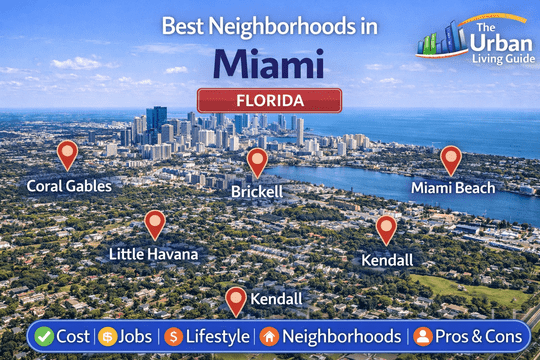
Best Neighborhoods in Miami, Florida: Coastal Enclaves, Brickell High-Rises & Suburban Pockets in 2026
Covering approximately 36 square miles of land area across the Biscayne Bay coastal plain of Southeast Florida, the City of Miami functions under the commission-manager municipal administration of the City of Miami while serving as the central urban economic anchor of Miami-Dade County. Housing a core municipal population of approximately 455,000 residents and anchoring a massive South Florida metropolitan footprint exceeding 6.15 million people, the Magic City has emerged as a premier global gateway for international finance, wealth management, maritime logistics, technology, and luxury hospitality. Moving to Miami requires understanding localized elevation variations, Biscayne Bay stormwater drainage basins, tropical marine weather patterns, and multi-layered transportation corridors managed by the Florida Department of Transportation.
Residential life across Greater Miami presents dramatic lifestyle contrasts, separating dense financial waterfront skyscrapers and barrier island resort strips from historic Mediterranean-canopied suburban cities and culturally rich mainland residential basins. Inbound movers consistently balance direct daily access to primary corporate employment epicenters—such as the Brickell Financial District, Downtown Miami Central Business District, Health District (Civic Center), and aviation hubs surrounding Miami International Airport—against peak-hour causeway and highway commute times.
Selecting the right neighborhood defines your daily route across major transportation arteries, including Interstate 95, State Road 836 (Dolphin Expressway), State Road 826 (Palmetto Expressway), US Route 1 (South Dixie Highway), and the Rickenbacker and MacArthur Causeways, while shaping your access to county parks, private and public educational institutions, and regional healthcare networks.
Watch this video to explore different neighborhoods, coastal corridors, and residential communities across Miami:
Best Areas to Live in Miami at a Glance in 2026
| Neighborhood Name | Location | Distance from Core (Downtown) | Development Status | Transit Connectivity | Cost Level | Best Fit For |
|---|---|---|---|---|---|---|
| Coral Gables | Southwest Metro (Independent City) | Approximately 6 miles southwest | Historic Mediterranean Master-Planned | Moderate (Coral Gables Trolley, Metrorail, US-1) | High-to-Premium | Families, Corporate Executives & Academics |
| Brickell | Central Bayfront Core | Approximately 0.8 miles south | High-Density Financial High-Rise Core | Exceptional (Metromover, Metrorail, I-95) | High-to-Premium | Finance Professionals, Tech Founders & Urbanites |
| Miami Beach (South Beach to Mid-Beach) | Barrier Island (Independent City) | Approximately 5 miles east | Established Coastal Resort Urban | Moderate (Miami Beach Trolley, Express Buses, I-195/I-395) | Ultra-Premium | Luxury Homebuyers, Beach Lovers & Investors |
| Kendall | Southwest Mainland Suburbs | Approximately 14 miles southwest | Established Suburban / Master-Planned | Moderate (Dadeland South Metrorail, SR-874, SR-878) | Mid-Range | Suburban Families, Medical Staff & Commuters |
| Little Havana | West Central Urban Basin | Approximately 2 miles west | Historic Cultural Infill | High (Metrobus Routes, SR-836, I-95) | Accessible / Budget-Friendly | First-Time Renters, Creatives & Value Seekers |
Best Neighborhoods in Miami Discussed in Detail
Coral Gables — Historic Mediterranean Elegance & Banyan-Shaded Sanctuary
Positioned immediately southwest of the central urban core, the incorporated municipality of Coral Gables (known as “The City Beautiful”) is one of South Florida’s most prestigious and architecturally cohesive master-planned enclaves. Founded in the 1920s by developer George Merrick, the city operates under its own municipal charter via the City of Coral Gables Official Portal. Characterized by strict Mediterranean Revival zoning codes, grand stone entrance gates, winding residential banyan tree canopies, and historic waterways, Coral Gables seamlessly blends corporate regional headquarters along Ponce de Leon Boulevard with tranquil residential luxury.
- Housing: Architectural inventory features historic 1920s Spanish Mediterranean villas, coral stone estates, mid-century modern single-story homes, and upscale boutique condominiums near downtown. Single-family purchase prices typically range around $1,350,000 to $6,800,000+, while luxury condominium and apartment rentals average $2,800 to $4,900 per month.
- Safety & Crime Rate: Patrolled by the dedicated Coral Gables Police Department, the city consistently reports some of the lowest violent and property crime figures in Miami-Dade County, backed by an independent emergency dispatch system and active community patrol divisions.
- School District & Education Quality: Governed by Miami-Dade County Public Schools (M-DCPS), hosting top-performing public institutions such as Coral Gables Senior High School (offering an authorized International Baccalaureate Diploma Programme) and George Washington Carver Middle School, alongside premier private academies like Gulliver Preparatory School and higher education anchored by the private research campus of the University of Miami (UM).
- Walkability & Daily Conveniences: The central pedestrian strip along Miracle Mile and Giralda Plaza is exceptionally walkable, featuring sidewalk cafes, designer boutiques, bridal shops, and open-air fine dining, complemented by upscale retail at Shops at Merrick Park.
- Parks & Green Spaces / Pet-Friendliness: Renowned outdoor amenities include the historic spring-fed Venetian Pool, the expansive tropical plant collections at Fairchild Tropical Botanic Garden along Old Cutler Road, and Matheson Hammock Park, featuring a natural saltwater atoll pool and marina.
- Parking & Traffic Congestion: Residential driveways and private garages keep neighborhood streets clear. Commuter traffic builds along US Route 1 (South Dixie Highway), LeJeune Road (SW 42nd Avenue), and Bird Road (SW 40th Street) during morning and evening rush hours.
- Noise Levels & Vibe: Refined, quiet, and family-oriented, characterized by shaded, picturesque residential streets with strictly enforced municipal noise regulations.
- Medical Facilities & Hospitals: Direct emergency medical coverage provided within municipal borders by Doctors Hospital (Baptist Health South Florida) on University Drive and nearby pediatric specialty care at Nicklaus Children’s Hospital.
- Transit Connectivity: Served by the free Coral Gables Trolley connecting downtown commercial corridors directly to the Miami Metrorail (Douglas Road and University Stations), with highway access via US-1 and SR-836.
- Affordability: High-to-premium pricing; substantial municipal property taxes and historic preservation standards are offset by pristine public landscaping and exceptional municipal services.
- Who It’s Best For: Families seeking premier public and private schools, university faculty, corporate attorneys, multinational executives, and buyers prioritizing historic architectural beauty.
- Drawbacks: Stringent Board of Architects exterior renovation approvals, high purchase price barriers, and heavy commuter traffic on surrounding perimeter thoroughfares.
Brickell — Wall Street of the South & High-Density Urban Financial Core
Situated directly south of the Miami River overlooking Biscayne Bay, Brickell represents the dense financial, technological, and luxury high-rise center of South Florida. Widely referred to as the “Wall Street of the South,” Brickell hosts the largest concentration of international banks and foreign consulates in the United States outside New York. Governed under the City of Miami and guided by urban development plans overseen by the Miami Downtown Development Authority (DDA), Brickell offers true vertical coastal urbanism lined with modern glass residential towers.
- Housing: Dominated by luxury glass residential skyscraper towers (such as Panorama Tower, Brickell Flatiron, and Echo Brickell) and luxury waterfront condominiums along Brickell Avenue and Brickell Key. Condominium purchase valuations typically range around $520,000 to $2,800,000+, while modern 1-bedroom apartment rentals average $2,650 to $4,100 per month.
- Safety & Crime Rate: Patrolled by the City of Miami Police Department Central District and supplemented by private security details in residential towers, Brickell maintains a well-monitored street environment, though non-violent opportunistic theft and bicycle larceny occur in crowded nightlife corridors.
- School District & Education Quality: Governed by M-DCPS, containing choice elementary options such as Southside Preparatory Academy and Mater Academy Brickell, alongside private preparatory programs.
- Walkability & Daily Conveniences: Outstanding walkability (Walk Score of 92-96/100). Residents walk to premier lifestyle retail at Brickell City Centre, grocery markets including Whole Foods Market and Publix at Mary Brickell Village, rooftop lounges, and financial offices.
- Parks & Green Spaces / Pet-Friendliness: Urban green spaces include Simpson Park Hammock (an 8-acre old-growth tropical hardwood preserve), Brickell Point Park, and bayfront jogging loops around Brickell Key. The district is exceptionally dog-friendly, featuring dedicated private building dog runs and pet relief areas.
- Parking & Traffic Congestion: Assigned garage parking spaces typically add $175 to $350 per month for tenants. Street traffic along Brickell Avenue and South Miami Avenue slows significantly during peak commuter windows and when the Miami River drawbridge opens for boat traffic.
- Noise Levels & Vibe: Fast-paced, high-energy, and cosmopolitan, filled with luxury sports cars, international dining patrons, light rail bells, and active nightlife chatter.
- Medical Facilities & Hospitals: Direct 10-minute transit access to the extensive hospital networks within the Miami Health District, including UHealth – University of Miami Health System and Jackson Memorial Hospital.
- Transit Connectivity: Exceptional public transit integration via the free elevated Metromover loop (stations at Financial District, Brickell City Centre, and Eighth Street) and the Miami Metrorail (Brickell Station), connecting directly to the airport and northern medical hubs. Regional passenger rail is accessible via Brightline MiamiCentral Station located 1 mile north, with vehicle access to I-95.
- Affordability: Premium urban cost structure; high monthly condo association (HOA) fees and parking costs reflect the neighborhood’s central location and high-end building amenities.
- Who It’s Best For: Finance professionals, corporate attorneys, tech founders, foreign investors, and young executives seeking a walkable, car-optional lifestyle.
- Drawbacks: Severe rush-hour vehicular gridlock on access bridges, localized street flooding during seasonal “King Tide” events, and high monthly rental and HOA expenses.
Miami Beach — Iconic Barrier Island, Art Deco Splendor & Oceanfront Living
Stretching between Biscayne Bay and the Atlantic Ocean east of mainland Miami, the independent barrier island municipality of Miami Beach is globally celebrated for its turquoise coastal waters, white-sand beaches, and preserved 1930s architectural treasures. Governed independently via the City of Miami Beach Official Website, the city spans diverse coastal sub-neighborhoods, including the historic Art Deco District of South Beach (SoBe), the residential high-rises along Millionaire’s Row in Mid-Beach, and the quiet family enclaves of North Beach.
- Housing: Real estate stock spans ultra-luxury oceanfront condominium towers along Collins Avenue, preserved 1930s Art Deco walk-up apartments, and gated multi-million dollar waterfront single-family estates on private islands (such as Star Island, Palm Island, and Venetian Islands). Condominium sale prices typically range around $380,000 to $4,500,000+, while luxury residential leases average $2,900 to $7,500 per month.
- Safety & Crime Rate: Patrolled by the dedicated Miami Beach Police Department (MBPD). Residential island enclaves maintain private gate guards and low crime rates, while high-density entertainment strips on Ocean Drive and Washington Avenue experience elevated rates of property crime and nightlife-related incidents.
- School District & Education Quality: Governed by M-DCPS, featuring neighborhood institutions such as North Beach Elementary School, Nautilus Middle School, and Miami Beach Senior High School.
- Walkability & Daily Conveniences: Outstanding walkability (Walk Score of 88-92/100) in South Beach and North Beach. Residents comfortably walk to beach access points, local markets like Trader Joe’s on West Avenue and Lincoln Road Farmers Market, and open-air shopping along the world-famous Lincoln Road Mall.
- Parks & Green Spaces / Pet-Friendliness: Exceptional coastal recreational infrastructure anchored by the 7-mile paved Miami Beach Beachwalk, South Pointe Park (featuring panoramic cruise ship channel views, splash pads, and dog play areas), Flamingo Park, and Lummus Park.
- Parking & Traffic Congestion: Street parking is strictly managed through municipal resident permits and high-rate meters; private garage parking is essential. Major causeway traffic bottlenecks occur along the MacArthur Causeway (I-395) and Julia Tuttle Causeway (I-195) during weekend afternoons and special events like Art Basel.
- Noise Levels & Vibe: Energetic, glamorous, and resort-centric in South Beach, transitioning to tranquil, breeze-cooled coastal serenity in Mid-Beach and residential island neighborhoods.
- Medical Facilities & Hospitals: Direct emergency medical and specialty trauma care anchored within city borders by Mount Sinai Medical Center on Alton Road, overlooking Biscayne Bay.
- Transit Connectivity: Public transit is supported by the free Miami Beach Trolley network and express Metrobus routes connecting across causeways to mainland Miami, alongside boating transit through local marinas.
- Affordability: Ultra-premium price tier across property purchases, windstorm and flood insurance premiums, and dining, offset by immediate Atlantic Ocean access.
- Who It’s Best For: Luxury homebuyers, outdoor aquatic enthusiasts, hospitality entrepreneurs, international remote executives, and buyers seeking direct oceanfront living.
- Drawbacks: Heavy seasonal tourist density, high building HOA and special assessment costs for coastal concrete restoration, and vulnerability to coastal storm surge and sea-level rise.
Kendall — Established Suburban Anchor, Family Stability & Accessible Comfort
Situated in the southwestern quadrant of Miami-Dade County, Kendall is a sprawling, established unincorporated suburban community that serves as a cornerstone for family living in South Florida. Governed directly by the Miami-Dade County Government, Kendall is characterized by expansive single-family residential subdivisions, lakefront communities, and major regional commercial hubs centered along Kendall Drive (SW 88th Street) and North Kendall Drive.
- Housing: Real estate consists of single-story 1970s and 1980s CBS (concrete block and stucco) ranch-style single-family homes with private pools, gated lakefront townhome communities, and garden-style apartment developments. Single-family purchase prices typically range around $490,000 to $880,000, while rental apartments average $1,850 to $2,750 per month.
- Safety & Crime Rate: Patrolled by the Miami-Dade Police Department (MDPD) Kendall District. The community consistently reports below-average violent crime rates, maintaining stable, family-centered residential subdivisions.
- School District & Education Quality: Governed by M-DCPS, containing highly regarded campuses such as Miami Killian Senior High School, Kendall Christian School, and the massive suburban campus of Miami Dade College Kendall Campus.
- Walkability & Daily Conveniences: Suburban residential tracts are car-dependent, but commercial hubs like Dadeland Mall, The Palms at Town & Country, and Kendall Village Center offer retail shopping at Macy’s, Target, Publix Super Markets, and extensive casual dining.
- Parks & Green Spaces / Pet-Friendliness: Exceptional family recreation options, including the 750-acre Zoo Miami (one of the largest free-range zoos in the nation), Kendall Indian Hammocks Park (featuring disc golf and skate parks), and Continental Park, which hosts active tennis programs and a community dog park.
- Parking & Traffic Congestion: Plentiful private two-car garages and spacious residential driveways. Commuter traffic slows significantly along Kendall Drive (SW 88th St) and the Don Shula Expressway (SR-874) during peak morning rush hours heading toward the Palmetto Expressway and Downtown.
- Noise Levels & Vibe: Serene, friendly, and family-focused, dominated by school athletic leagues, weekend backyard barbecues, and quiet residential evenings.
- Medical Facilities & Hospitals: Direct medical infrastructure supported by the large flagship medical campus of Baptist Hospital of Miami located on North Kendall Drive.
- Transit Connectivity: Commuter rail access is anchored at the Dadeland North and Dadeland South Metrorail Stations, providing direct rapid rail transit into Brickell, Downtown Miami, and the Jackson Health District, supported by tollway access via SR-874 and SR-826.
- Affordability: Competitive mid-range pricing; delivers substantially larger square footage, private yards, and attached garages per dollar compared to inner-loop or coastal Miami neighborhoods.
- Who It’s Best For: Growing families prioritizing school quality and yard space, healthcare workers at Baptist Hospital, and commuters utilizing Metrorail park-and-ride facilities.
- Drawbacks: Heavy rush-hour expressway bottlenecks along Kendall Drive, total automobile dependence for daily errands, and distance from Atlantic coastal beaches.
Little Havana — Vibrant Cultural Epicenter, Calle Ocho Living & Accessible Infill
Positioned directly west of Downtown Miami and Brickell, Little Havana is the historic and cultural heart of Miami’s Cuban-American diaspora. Centered along the famous commercial spine of Calle Ocho (SW 8th Street), the district is celebrated for its historic 1920s wood-frame bungalows, mid-century courtyard apartments, traditional cigar factories, open-air fruit markets, and famous coffee walk-up windows (ventanitas). Governed under City of Miami council oversight, Little Havana provides an authentic, high-energy cultural lifestyle supported by community initiatives through the City of Miami Neighborhood Services.
- Housing: Real estate stock is composed of classic 1920s Craftsman and Mediterranean bungalows, mid-century multi-family apartment buildings, and newer contemporary infill apartment complexes. Single-family purchase prices typically range around $380,000 to $650,000, while rental apartments average $1,450 to $2,250 per month.
- Safety & Crime Rate: Patrolled by the City of Miami Police Department Little Havana Neighborhood Team. While property crimes and opportunistic automotive break-ins occur in high-traffic commercial blocks, interior residential streets maintain tight-knit, multi-generational community ties.
- School District & Education Quality: Governed by M-DCPS, hosting local facilities such as Riverside Christian School, Mater Academy, and Miami Senior High School (Florida’s oldest high school, established in 1903).
- Walkability & Daily Conveniences: Outstanding pedestrian accessibility along SW 8th Street between 12th Avenue and 27th Avenue, home to traditional supermarkets like Sedano’s Supermarkets, bakeries, indie art galleries, live music venues at Ball & Chain, and the famous Máximo Gómez Park (Domino Park).
- Parks & Green Spaces / Pet-Friendliness: Municipal open spaces include Jose Marti Park along the Miami River (featuring sports fields, indoor gymnasiums, and a public riverwalk), Sewall Park, and Shenandoah Park.
- Parking & Traffic Congestion: Street parking can be competitive on residential blocks and along Calle Ocho, though private driveways are common on single-family lots. Rapid highway on-ramps provide quick access to State Road 836 (Dolphin Expressway) and Interstate 95.
- Noise Levels & Vibe: Energetic, culturally expressive, and lively, with ambient sounds of Latin music, espresso machines, domino games, and neighborhood street life.
- Medical Facilities & Hospitals: Direct emergency medical coverage supported by Coral Gables Hospital on Douglas Road and nearby access to the Jackson Memorial Medical Center complex.
- Transit Connectivity: High-frequency public transit provided by the City of Miami Little Havana Trolley and Metrobus Routes (such as Route 8 along Calle Ocho), offering 10-minute transit rides into Brickell and Downtown, with direct vehicle access to SR-836. Long-distance air travel is accessible via Miami International Airport (MIA) located just 4 miles northwest.
- Affordability: Miami’s most accessible central homeownership and rental price tier, offering character-rich living within minutes of the urban core at competitive rates.
- Who It’s Best For: Young professionals, first-time homebuyers, cultural enthusiasts, culinary workers, and commuters seeking close proximity to Brickell and Downtown without luxury high-rise price tags.
- Drawbacks: Street parking deficits for multi-vehicle households, older housing inventory requiring ongoing maintenance, and elevated daytime street traffic on major arterials.
Comprehensive Neighborhood Pros and Cons Comparison
| Neighborhood | Core Advantages (Pros) | Core Limitations (Cons) |
|---|---|---|
| Coral Gables | Historic Mediterranean architecture; top-performing M-DCPS schools and University of Miami; dedicated CGPD public safety; lush botanical landscapes at Fairchild Garden. | High purchase price entry barrier; strict architectural review board regulations; peak-hour traffic delays along US-1. |
| Brickell | Direct Metromover and Metrorail transit; high walkability to Brickell City Centre and financial offices; luxury waterfront high-rise amenities. | Expensive monthly building HOA and parking fees; severe rush-hour traffic gridlock; localized street flooding during King Tide events. |
| Miami Beach | Direct Atlantic Ocean and beach access; historic Art Deco architecture; walkable lifestyle on Lincoln Road; scenic promenades at South Pointe Park. | Ultra-premium real estate valuations; high condo HOA special assessments; heavy seasonal tourist density and causeway traffic. |
| Kendall | Spacious single-family homes with private pools; strong public schools; direct Metrorail commuter access at Dadeland; access to Zoo Miami. | Heavy peak-hour commuter congestion along Kendall Drive; complete automobile dependence for daily errands; 14-mile distance to Downtown. |
| Little Havana | Miami’s most accessible central housing prices; rich cultural identity and dining along Calle Ocho; close proximity to Brickell and Downtown. | Pockets of property crime; limited street parking for multi-car households; older housing stock requiring maintenance. |
How You Decide Which Neighborhood Is Best For You
Selecting your ideal neighborhood in Greater Miami requires balancing your household finances with daily workplace destinations, lifestyle preferences, and coastal climate resilience. Because the Miami metropolitan area is compartmentalized by Biscayne Bay, urban river waterways, and extensive expressway grids, your location dictates whether your daily commute relies on causeway bridges like the MacArthur (I-395) and Julia Tuttle (I-195) or on direct rapid transit connections via the Miami Metrorail and Metromover systems. Corporate executives and finance analysts working in Brickell or Downtown should prioritize high-rise living within the urban core or close-in transit-connected suburbs like Coral Gables to bypass severe expressway gridlock.
Beyond daily transportation logistics, evaluate critical municipal utility and environmental realities. South Florida experiences intense tropical heat and humidity alongside seasonal Atlantic hurricane risks, making structural resilience, windstorm insurance premiums, and electricity reliability through Florida Power & Light (FPL) essential considerations. In addition, when evaluating multi-family condominium buildings—especially in coastal areas like Miami Beach or Brickell—it is critical to review structural integrity reserve studies, recent milestone inspections, and building HOA monthly fees. Before executing a residential lease or property closing, verify high-speed fiber broadband availability (such as AT&T Fiber or Xfinity Gigabit), check FEMA flood zone maps, and confirm local school district assignment boundaries.
Frequently Asked Questions About Miami Neighborhoods
Which neighborhood in the Miami area is considered best for families with school-age children?
Coral Gables and Kendall are widely regarded as the premier family communities in Greater Miami. Coral Gables offers exceptional public and private schools (including Coral Gables Senior High and Gulliver Prep), secure tree-lined streets, and historic community parks like Venetian Pool. Kendall provides spacious single-family homes with large yards, strong public school options, and extensive youth recreational amenities.
What is the most walkable neighborhood in Miami where you can live without a car?
Brickell and South Beach (Miami Beach) offer the highest walkability in South Florida, both scoring above 90 on Walk Score. Brickell allows residents to walk to grocery stores like Whole Foods and Publix, hundreds of dining venues, and financial offices while utilizing the free elevated Metromover and Metrorail systems. South Beach provides dense pedestrian access to retail, dining, and beaches.
What are the safest residential neighborhoods to live in within Greater Miami?
Coral Gables and the gated residential island communities of Miami Beach consistently report the lowest violent and property crime rates in Miami-Dade County. Coral Gables maintains an independent municipal police force with rapid emergency response times, while island communities feature 24/7 guarded security checkpoints.
What are the most affordable neighborhoods for homebuyers and renters near central Miami?
Little Havana and parts of neighboring Shenandoah provide the most budget-friendly housing opportunities near the urban center. In Little Havana, renters and buyers can secure historic bungalows and apartments at price points significantly lower than Brickell, Downtown, or Coral Gables.
How bad is traffic congestion when commuting from the suburbs into Downtown Miami or Brickell?
Commuting from outer suburbs like Kendall or western Miami into central Miami during peak morning rush hours typically takes between 40 and 65 minutes along State Road 836 or US-1. Utilizing the Miami Metrorail from park-and-ride stations like Dadeland North provides a dependable 25-minute rail alternative to highway driving.
How do HOA fees and building milestone inspections impact condominium buying in Miami?
Florida condominium regulations require mandatory structural reserve studies and milestone safety inspections for buildings over 30 years old (or 25 years within three miles of the coast). Prospective buyers in high-density areas like Brickell and Miami Beach must review association financials, pending special assessments, and monthly HOA fees before purchasing.
Which Miami neighborhood is best for healthcare professionals working in the Health District?
Brickell, Downtown Miami, and Little Havana provide the fastest commutes to the Miami Health District (Jackson Memorial Hospital, University of Miami Hospital, and VA Medical Center), offering direct 5-to-10 minute transit commutes via the Metrorail or short surface street drives.
Know More About the City
The Urban Living Guide creates deeply researched, practical, and informative city relocation resources designed to help individuals, working professionals, and families navigate complex urban landscapes. By analyzing municipal infrastructure, hyper-local zoning patterns, commuter realities, and housing markets, our guides provide actionable insights so you can make confident, data-backed decisions when moving to major metropolitan areas.
Explore our comprehensive guides to the Miami metropolitan region:
- Living in Miami, Florida
- Cost of Living in Miami, Florida
- Pros and Cons of Living in Miami, Florida
- Moving to Miami, Florida
Follow The Urban Living Guide for ongoing regional insights, neighborhood developments, and expert local coverage across Greater Miami and South Florida.