

Best Neighborhoods in San Diego, California: Complete Relocation & Livability Guide in 2026
Covering an expansive 326 square miles of land area along Southern California’s southwestern coastline, the City of San Diego functions under the municipal governance of the City of San Diego within the broader bounds of San Diego County. Serving an incorporated city population of approximately 1.4 million residents and anchoring a regional metropolitan footprint exceeding 3.3 million people, the city is geographically compartmentalized into distinct mesa tops, coastal bluffs, deep canyons, and coastal plains. Relocating across America’s Finest City requires navigating unique localized planning districts, localized marine layer microclimates, and regional transit corridors overseen by the San Diego Association of Governments.
Residential life across San Diego reveals sharp contrasts between coastal lifestyle enclaves, dynamic urban business districts, planned suburban master developments, and sunny inland valleys. Inbound movers continuously evaluate connectivity to core employment centers such as the Torrey Pines Biotech Mesa, Kearny Mesa Tech Corridor, Downtown Financial District, and active naval installations including Naval Base San Diego and MCAS Miramar. Deciding on a neighborhood establishes your daily commute patterns across essential freeway arteries like Interstate 5 (John J. Montgomery Freeway), Interstate 805 (Jacob Dekema Freeway), Interstate 15, and California State Route 56, while determining your local access to municipal parks, regional healthcare centers, and top-tier public school systems.
| Metric / Attribute | Municipal Data & Operational Statistics |
|---|---|
| Municipal Land Area | Approximately 325.9 square miles (Incorporated City) |
| Core City Population | Approximately 1,385,000 to 1,410,000 residents |
| County Population | Approximately 3,290,000 to 3,320,000 residents |
| Primary Public Transit Authority | San Diego Metropolitan Transit System (MTS) & NCTD |
| Primary School District | San Diego Unified School District (SDUSD) |
| Median Home Price Benchmark | Typically ranges around $880,000 to $1,150,000 citywide |
| Average 1-Bedroom Rental Cost | Typically ranges around $2,150 to $3,200 per month depending on submarket |
Watch this video to explore popular neighborhoods, coastal corridors, and residential communities across San Diego:
Best Areas to Live in San Diego at a Glance in 2026
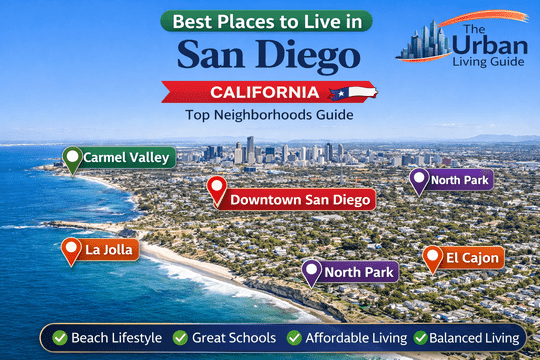
| Neighborhood Name | Location | Distance from Core (Downtown) | Development Status | Transit Connectivity | Cost Level | Best Fit For |
|---|---|---|---|---|---|---|
| Carmel Valley | North County Coastal / Mesa | Approximately 18 miles north | Master-Planned Suburban | Moderate (Buses, I-5, SR-56) | High-to-Premium | Families & Biotech Professionals |
| Downtown San Diego | Central Bayfront | 0 miles (Urban Core) | High-Density Urban Center | Exceptional (MTS Trolley Hub, Santa Fe Depot) | Mid-to-High Range | Young Professionals & Urbanites |
| La Jolla | Coastal Peninsula | Approximately 13 miles northwest | Established Luxury Coastal | Moderate (MTS Buses, UC San Diego Blue Line) | Ultra-Premium | Executives, Academics & Retirees |
| North Park | Uptown / Urban Core Edge | Approximately 3.5 miles northeast | Historic Walkable Urban | High (Frequent MTS Bus Corridors, I-805) | Mid-Range | Creatives, Foodies & Remote Workers |
| El Cajon | East County Valley | Approximately 16 miles east | Inland Suburban / Commercial | High (MTS Trolley Orange/Green Lines, I-8) | Accessible / Budget-Friendly | Budget Conscious Movers & Commuters |
Best Neighborhoods in San Diego Discussed in Detail
Carmel Valley — Master-Planned Suburban Haven & Educational Epicenter
Nestled along the northwestern corridor of San Diego just east of the coast, Carmel Valley represents one of Southern California’s premier master-planned communities. Governed under the City of San Diego’s first district council oversight, the area features wide paved thoroughfares, manicured landscaped medians, and planned commercial centers such as Del Mar Highlands Town Center and One Paseo. Designed with family living and corporate proximity in mind, Carmel Valley borders the northern biotech clusters while preserving expansive natural canyon preserves.
- Housing: Real estate stock is dominated by contemporary two-story Spanish Mediterranean and Craftsman single-family homes in subdivisions, alongside luxury mid-rise townhomes and gated condominiums. Single-family purchase prices typically range around $1,650,000 to $3,200,000, while rental apartments average $3,100 to $4,800 per month.
- Safety & Crime Rate: Patrolled by the San Diego Police Department Northwestern Division, Carmel Valley consistently ranks among the safest residential submarkets in the county, with negligible violent crime rates and proactive community surveillance.
- School District & Education Quality: Exceptionally rated dual-district coverage: elementary education is served by the Del Mar Union School District (DMUSD) and Solana Beach School District, feeding into high-performing secondary schools in the San Dieguito Union High School District (SDUHSD) such as Torrey Pines High School and Canyon Crest Academy.
- Walkability & Daily Conveniences: While interior residential tracts are car-dependent, the central mixed-use retail hub along El Camino Real and Del Mar Heights Road provides walkable open-air shopping, gourmet grocers like Whole Foods, and artisan coffee houses.
- Parks & Green Spaces / Pet-Friendliness: Exceptional access to open park spaces, including the Carmel Valley Recreation Center, Ocean Air Community Park, and hiking trailheads connecting into the Los Peñasquitos Canyon Preserve and Torrey Hills Park.
- Parking & Traffic Congestion: Ample two-car private garages and generous residential street parking are standard. Commuter congestion concentrates around the I-5 and SR-56 freeway interchange during morning and evening rush hours.
- Noise Levels & Vibe: Quiet, serene, and suburban, characterized by peaceful residential cul-de-sacs with low ambient background noise.
- Medical Facilities & Hospitals: Served directly by multi-specialty outpatient clinics from Scripps Health and Sharp Rees-Stealy, with comprehensive acute care hospital campuses located just 10 minutes south at Scripps Memorial Hospital La Jolla.
- Transit Connectivity: Direct freeway access via California State Route 56 and Interstate 5, supported by MTS Bus Route 830 commuter services.
- Affordability: High-tier pricing across property ownership, local homeowners association (HOA) fees, and Mello-Roos infrastructure assessments.
- Who It’s Best For: Families seeking premier public schools, biotech researchers working in Torrey Pines or Sorrento Valley, and professionals wanting upscale suburban refinement near coastal beaches.
- Drawbacks: Elevated real estate buy-in costs, presence of special tax assessments (Mello-Roos) in certain subdivisions, and car dependence for daily errands outside commercial village centers.
Downtown San Diego — Waterfront Urban Core & Vibrant Entertainment District
Positioned along the pristine waters of San Diego Bay, Downtown San Diego serves as the urban economic, cultural, and judicial headquarters of the region. Composed of distinct micro-neighborhoods including the historic Gaslamp Quarter, the bayside high-rises of the Marina District, the residential core of Little Italy, and the bustling sports corridor of East Village surrounding Petco Park, Downtown offers true vertical coastal urbanism administered by the City of San Diego.
- Housing: Dominated by high-rise luxury condominium towers, converted brick lofts, and contemporary mid-rise apartments along Broadway and Pacific Highway. Condominium sales typically range around $550,000 to $1,600,000+, while 1-bedroom apartment rentals average $2,350 to $3,700 per month.
- Safety & Crime Rate: Patrolled by the SDPD Central Division. Safety levels vary noticeably by micro-district: Little Italy and the Marina maintain strong neighborhood oversight, while parts of East Village along Imperial Avenue experience visible street vagrancy and property-related incidents.
- School District & Education Quality: Governed by San Diego Unified School District (SDUSD), featuring downtown charter options such as e3 Civic High (located inside the Central Library) and Urban Discovery Academy.
- Walkability & Daily Conveniences: Exceptionally walkable with scores routinely reaching 95/100; residents easily stroll to Piazza della Famiglia in Little Italy, full-service grocery stores like Ralphs on 1st Ave, and waterfront walkways along Embarcadero Marina Park.
- Parks & Green Spaces / Pet-Friendliness: Waterfront public spaces include Waterfront Park on Pacific Highway and Fault Line Park in East Village, complemented by dedicated community dog runs.
- Parking & Traffic Congestion: Assigned garage parking is critical, as monthly space rentals range from $150 to $300 per month. Street parking is strictly metered, with traffic surges occurring during San Diego Padres home games at Petco Park.
- Noise Levels & Vibe: Energetic, bustling, and fast-paced, with noticeable ambient sounds from trolley bells, weekend nightlife crowds, and flight paths arriving at San Diego International Airport (SAN).
- Medical Facilities & Hospitals: Proximate to downtown medical clinics and situated 10 minutes south of major hospital complexes including UC San Diego Health – Hillcrest and Scripps Mercy Hospital.
- Transit Connectivity: Unmatched regional connectivity through the San Diego Trolley (Blue, Orange, Green, and Silver Lines) operated by MTS, alongside commuter rail access via COASTER and Amtrak Pacific Surfliner trains at the historic Santa Fe Depot.
- Affordability: Mid-to-high living costs with steep monthly condominium HOA dues covering building security, pools, and concierge services.
- Who It’s Best For: Corporate professionals, legal practitioners, remote tech specialists, and urban nightlife lovers desiring a walkable coastal city core.
- Drawbacks: Elevated building HOA fees, visible urban homelessness in certain eastern blocks, and airplane noise beneath the Lindbergh Field flight descent path.
La Jolla — Iconic Coastal Jewel & World-Class Research Corridor
Known affectionately as “The Jewel” of Southern California, La Jolla is an affluent seaside enclave occupying 7 miles of dramatic Pacific coastline surrounded by ocean bluffs and marine reserves. Operating as a distinct community within the City of San Diego, La Jolla hosts prestigious research institutions such as the University of California San Diego (UCSD), the Salk Institute, and Scripps Institution of Oceanography, creating an unparalleled mix of academic prestige and luxury coastal living.
- Housing: Real estate ranges from multi-million dollar oceanfront mansions along Camino de la Costa, Spanish Revival hillside estates on Mount Soledad, to luxury boutique condominiums in La Jolla Village. Detached home prices typically range around $2,200,000 to $15,000,000+, while residential rentals average $3,400 to $7,500 per month.
- Safety & Crime Rate: Patrolled by the SDPD Northern Division, La Jolla maintains low crime statistics, supported by strong residential vigilance and active private community patrols.
- School District & Education Quality: Governed by SDUSD, containing high-performing public schools such as La Jolla Elementary, Torrey Pines Elementary, and La Jolla High School, alongside world-renowned private institutions like The Bishop’s School.
- Walkability & Daily Conveniences: The central La Jolla Village area along Girard Avenue and Prospect Street is highly walkable, featuring upscale boutiques, art galleries, and fine coastal dining overlooking La Jolla Cove.
- Parks & Green Spaces / Pet-Friendliness: World-renowned coastal open spaces including Ellen Browning Scripps Park, La Jolla Shores Beach, Torrey Pines State Natural Reserve, and Kellogg Park.
- Parking & Traffic Congestion: Parking in the Village and near the Cove is competitive on weekends. Primary traffic bottlenecks occur along Torrey Pines Road and La Jolla Parkway during daily commuter peaks.
- Noise Levels & Vibe: Serene, refined, and relaxed, punctuated by ocean waves and sea breeze, with daytime tourist activity focused around the Cove and Village.
- Medical Facilities & Hospitals: World-class healthcare hub anchored by Scripps Memorial Hospital La Jolla and the comprehensive UC San Diego Health – Jacobs Medical Center campus.
- Transit Connectivity: Road access via La Jolla Parkway to State Route 52 and Interstate 5. The MTS UC San Diego Blue Line Trolley serves the eastern university district, connecting directly to Downtown.
- Affordability: Ultra-premium price structure across property acquisitions, local dining, insurance, and retail services.
- Who It’s Best For: High-net-worth families, biotech executives, university researchers, and retirees seeking premier coastal beauty and top-ranked medical systems.
- Drawbacks: High housing entry costs, dense tourist foot traffic during peak summer periods, and extended commute delays exiting the peninsula via Torrey Pines Road.
North Park — Historic Urban Enclave & Creative Cultural Epicenter
Perched directly northeast of Balboa Park, North Park is one of San Diego’s most culturally vibrant and walkable historic urban neighborhoods. Defined by classic 1920s Craftsman bungalows, Spanish Colonial revival homes, and modern infill apartment buildings, North Park centers around the energetic intersection of University Avenue and 30th Street. Governed under the City of San Diego’s third district, it is widely celebrated for its independent coffee shops, nationally renowned craft breweries, and live music venues.
- Housing: Real estate consists of restored historic single-family Craftsman bungalows, California duplexes, and newly developed mid-rise residential apartments. Detached bungalow purchase prices typically range around $950,000 to $1,750,000, while 1-bedroom rental apartments average $2,100 to $3,100 per month.
- Safety & Crime Rate: Patrolled by the SDPD Mid-City Division. The area experiences moderate urban property crimes, such as vehicle break-ins and bicycle theft, while residential side streets maintain strong community engagement.
- School District & Education Quality: Governed by SDUSD, containing neighborhood schools such as McKinley Elementary School (an authorized International Baccalaureate World School) and Jefferson Elementary.
- Walkability & Daily Conveniences: Outstanding walkability (Walk Score of 88-92/100). Residents comfortably walk to organic markets, local hardware stores, vintage boutiques, and hundreds of independent eateries.
- Parks & Green Spaces / Pet-Friendliness: Immediate pedestrian proximity to the northern trails of Balboa Park, Bird Park, and Montclair Park. North Park is exceptionally dog-friendly, featuring numerous pet-welcoming restaurant patios.
- Parking & Traffic Congestion: Street parking is notoriously competitive on weekends along 30th Street and University Avenue. Accessing the North Park Parking Garage on 29th Street alleviates some pressure, while residential driveways are highly prized.
- Noise Levels & Vibe: Trendy, social, and lively with energetic weekend foot traffic, craft taproom activity, and steady neighborhood energy.
- Medical Facilities & Hospitals: Convenient 5-minute access to major medical facilities in neighboring Hillcrest, including Scripps Mercy Hospital San Diego and UC San Diego Medical Center.
- Transit Connectivity: Excellent bus connectivity via MTS Rapid Bus Line 215 providing 12-minute transit connections straight into Downtown San Diego, supported by direct vehicular access to Interstate 805 and State Route 15.
- Affordability: Mid-range urban pricing; while detached single-family home prices have escalated, rental apartments and condominiums remain accessible compared to coastal zones.
- Who It’s Best For: Young professionals, remote creative workers, culinary enthusiasts, and buyers who value historic architectural charm with walkable urban amenities.
- Drawbacks: Tight residential street parking, smaller historic home square footage with compact lot sizes, and persistent weekend nightlife street noise along commercial corridors.
El Cajon — Accessible East County Valley & Practical Commuter Base
Situated in the scenic valley basin of San Diego’s East County, the incorporated municipality of El Cajon (known locally as “The Box”) delivers functional, budget-conscious housing options surrounded by picturesque mountain ridges. Governed independently via the City of El Cajon Official Portal, the city offers expansive retail power centers such as Parkway Plaza, an active civic core at Downtown El Cajon’s Main Street, and direct arterial connectivity into central San Diego.
- Housing: Real estate features mid-century ranch-style single-family homes on spacious lots, multi-family apartment communities, and manufactured home parks. Single-family purchase prices typically range around $650,000 to $950,000, while rental apartments average $1,650 to $2,450 per month.
- Safety & Crime Rate: Protected by the independent El Cajon Police Department (ECPD). Property crime rates are moderate in major commercial retail zones, while residential foothills such as Fletcher Hills and Granite Hills offer quiet and secure environments.
- School District & Education Quality: Primary education is administered by the Cajon Valley Union School District (CVUSD), feeding into high schools in the Grossmont Union High School District (GUHSD) like Grossmont High School and Valhalla High School.
- Walkability & Daily Conveniences: The city is predominantly automobile-dependent, though Downtown Main Street and the area surrounding Parkway Plaza offer walkable dining, civic centers, and retail shopping.
- Parks & Green Spaces / Pet-Friendliness: Municipal parks include Kennedy Park, Wells Park (which features a popular off-leash dog park), and immediate driving proximity to outdoor adventures at Mission Trails Regional Park and Mount Helix Park.
- Parking & Traffic Congestion: Abundant and accessible parking across residential properties and shopping plazas. Morning commuter slowdowns occur primarily on westbound Interstate 8 and State Route 52 heading toward coastal employment corridors.
- Noise Levels & Vibe: Practical, relaxed suburban valley atmosphere with quiet evening residential hours, transitioning to bustling traffic along Broadway and Fletcher Parkway.
- Medical Facilities & Hospitals: Anchored by the extensive trauma center campus at Sharp Grossmont Hospital in neighboring La Mesa and the El Cajon Family Health Center.
- Transit Connectivity: Excellent regional light rail transit via the MTS Trolley Orange Line and Green Line at the El Cajon Transit Center, alongside direct highway access via Interstate 8, Route 67, and Route 125.
- Affordability: One of the most affordable housing and rental markets in Greater San Diego County, offering significantly more interior square footage and land area per dollar.
- Who It’s Best For: Budget-conscious homebuyers, multi-vehicle families needing larger yards, and commuters working in East County or central San Diego.
- Drawbacks: Significantly warmer summer temperatures (often 10 to 18 degrees Fahrenheit hotter than coastal zones), longer daily commute distances to coastal employment hubs, and lower walkability outside the urban core.
Comprehensive Neighborhood Pros and Cons Comparison
| Neighborhood | Core Advantages (Pros) | Core Limitations (Cons) |
|---|---|---|
| Carmel Valley | Nationally recognized public school districts; exceptionally safe suburban streets; rapid access to One Paseo and Torrey Pines biotech offices. | High entry purchase pricing; recurring Mello-Roos infrastructure taxes; significant rush-hour congestion on SR-56. |
| Downtown San Diego | High walkability to dining in Little Italy and games at Petco Park; direct multi-line MTS Trolley network; coastal bayfront views. | Steep monthly building HOA fees; street parking deficits; street-level social challenges in eastern sectors; airport flight-path noise. |
| La Jolla | Pristine coastline and iconic beaches; world-class healthcare and medical research institutions; highly rated public schools. | Among the highest real estate costs in California; summer tourist congestion around the Cove; bottlenecked peninsula access. |
| North Park | Pedestrian-friendly urban core; direct access to Balboa Park nature trails; celebrated culinary and craft brewery scene; historic architecture. | Scarce guest street parking; compact historic lot footprints; elevated weekend evening noise levels along commercial boulevards. |
| El Cajon | Significantly lower purchase and rental pricing; generous single-family yard sizes; dual light rail trolley access at transit center. | Elevated summer heat requiring high air conditioning usage; longer commutes to coastal job epicenters; car dependence. |
How You Decide Which Neighborhood Is Best For You
Selecting the right neighborhood in San Diego requires balancing your overall household finances with daily commuting requirements, microclimate preferences, and utility infrastructure reliability. Because San Diego County encompasses diverse geographic zones separated by mesas and valleys, your chosen location dictates whether your daily routine involves breeze-cooled coastal drives or congested highway transit along I-5, I-805, and SR-56. Individuals working on-site at major biotech facilities in Torrey Pines or corporate campuses in Sorrento Mesa should calculate peak rush-hour transit times rather than relying on standard map distances.
Furthermore, consider critical livability elements including electrical grid stability, cooling expenses, and digital connectivity. Inland communities like El Cajon face substantially higher summer energy usage through San Diego Gas & Electric (SDG&E) due to peak seasonal heat, while coastal pockets like La Jolla enjoy mild marine layers year-round. Before executing a lease or purchase contract, verify high-speed fiber internet coverage (such as AT&T Fiber or Cox Communications Gigablast), review municipal water quality, and confirm that multi-family residences provide deeded, off-street garage parking.
Frequently Asked Questions About San Diego Neighborhoods
Which neighborhood in San Diego is considered the best for families?
Carmel Valley is widely considered the top choice for families due to its master-planned layout, modern community parks, and top-performing public schools within the Del Mar Union and San Dieguito Union High School Districts. For families seeking a historic coastal enclave with outstanding public education and coastal recreation, La Jolla also provides premier schools like La Jolla Elementary and La Jolla High.
What is the most walkable neighborhood to live in San Diego without a car?
Downtown San Diego (particularly the Little Italy and Marina districts) and North Park offer the highest walkability. Downtown allows residents to walk to grocers, dining, and offices while connecting to the San Diego Trolley network. North Park features dense pedestrian commercial corridors along University Avenue and 30th Street with immediate access to Balboa Park trails.
What are the safest residential neighborhoods in San Diego?
Suburban master-planned communities like Carmel Valley and coastal enclaves like La Jolla consistently report the lowest violent and property crime rates in San Diego County. Both areas benefit from dedicated police division patrols and active residential community watches.
What are the most affordable areas to live in San Diego County?
El Cajon and neighboring East County communities provide some of the most affordable home purchase and rental prices in the metropolitan area. Renters and buyers can secure larger single-family homes and multi-bedroom apartments at a fraction of the cost found in coastal or central urban neighborhoods.
How much warmer is it living inland versus on the San Diego coast?
San Diego experiences significant microclimate variation. Inland valley neighborhoods like El Cajon routinely experience summer afternoon temperatures between 88 and 98 degrees Fahrenheit, whereas coastal neighborhoods like La Jolla stay tempered by ocean breezes and marine fog layers with averages between 72 and 78 degrees Fahrenheit.
Is street parking difficult in popular San Diego neighborhoods?
Street parking is notoriously difficult in dense urban neighborhoods like North Park and Downtown San Diego, where street sweeping, meters, and high nightlife density limit availability. Suburban areas like Carmel Valley and El Cajon offer abundant private driveways, garages, and unrestricted residential street parking.
Which San Diego neighborhood is best for biotech and healthcare professionals?
Carmel Valley and La Jolla provide the most convenient residential positioning for biotech and healthcare workers, offering direct 5-to-15 minute commutes to the Torrey Pines Mesa, University Towne Center (UTC) life science hubs, and major hospital campuses like Scripps Memorial and UC San Diego Health.
Know More About the City
The Urban Living Guide develops deeply researched, objective, and practical city relocation resources designed to help individuals, working professionals, and families understand local urban landscapes. By analyzing municipal governance, zoning structures, commuter infrastructure, and housing markets, our guides deliver actionable insights to help you make confident, data-backed decisions when relocating across major metropolitan areas.
Explore our comprehensive guides to the San Diego metropolitan region:
- Living in San Diego, California
- Cost of Living in San Diego, California
- Pros and Cons of Living in San Diego, California
- Moving to San Diego, California
Follow The Urban Living Guide for ongoing regional insights, neighborhood developments, and expert local coverage across Southern California.