

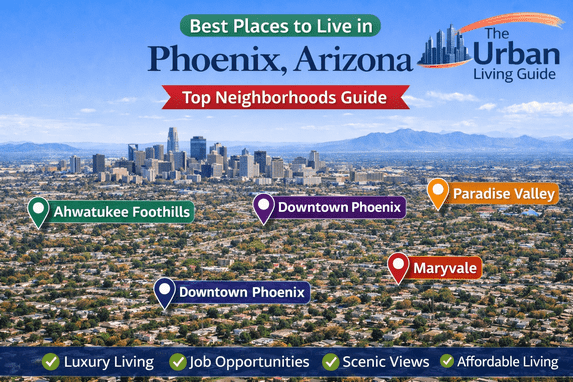
Best Neighborhoods in Phoenix, Arizona: Desert Mountain Preserves, Light Rail Hubs & Valley of the Sun Living in 2026
Covering approximately 517.9 square miles of land area across the vast desert basin of the Salt River Valley in Maricopa County, the incorporated municipality of Phoenix operates under the council-manager governance of the City of Phoenix. Housing an incorporated municipal core population exceeding 1.6 million residents and anchoring a rapidly expanding Valley of the Sun metropolitan region of over 4.9 million people, the nation’s fifth-largest city stands as an essential global powerhouse for semiconductor manufacturing, aerospace defense, financial technology, healthcare innovation, and solar engineering.
Relocating across the Sonoran Desert requires navigating distinct mountain preserve boundaries, intense summer climate realities, and multi-modal transit networks operated by Valley Metro.
Inbound movers consistently balance direct access to primary regional employers—including global semiconductor fabrication complexes for Taiwan Semiconductor Manufacturing Company (TSMC) and Intel Corporation, Fortune 500 corporate hubs like Avnet, Freeport-McMoRan, and Honeywell Aerospace, and extensive medical systems anchored by Banner – University Medical Center Phoenix, Mayo Clinic Hospital (Phoenix Campus), and St. Joseph’s Hospital and Medical Center—against daily transit commutes across Interstate 10 (Papago Freeway), Interstate 17 (Black Canyon Freeway), Loop 101 (Agua Fria / Pima Freeway), Loop 202 (Red Mountain / South Mountain Freeway), and State Route 51 (Piestewa Freeway), with global air travel via Phoenix Sky Harbor International Airport (PHX).
Explore Phoenix’s premier desert mountain communities, urban arts corridors, and distinctive residential neighborhoods with this curated local guide:
Key Residential Districts in Phoenix, Arizona at a Glance in 2026
| Neighborhood | Location | Distance to Downtown (Washington St) | Development Status | Transit Connectivity | Cost Level | Best Fit For |
|---|---|---|---|---|---|---|
| Downtown & Roosevelt Row (RoRo) | Central Urban Core | 0 mi (Core) | High-Density Arts & Tech Hub | Exceptional (Valley Metro Rail, Central Ave, I-10) | High-to-Premium | Young Professionals, Tech Workers & Creatives |
| Arcadia | East Camelback Foothills | ~8 mi northeast | Historic Citrus Grove Luxury Estates | High (Camelback Rd, Indian School Rd) | Ultra-Premium | Corporate Executives, Physicians & Luxury Buyers |
| Desert Ridge | North Sonoran Basin | ~18 mi north | Master-Planned Resort & Tech Suburb | High (Loop 101, SR-51, Tatum Blvd) | High-to-Premium | TSMC/Tech Engineers, Families & Golfers |
| Biltmore (Camelback Corridor) | Uptown Financial Core | ~6 mi north | Upscale Resort & Financial District | High (SR-51 Piestewa Fwy, 24th St) | High-to-Premium | Attorneys, Finance Leaders & Downsizers |
| Ahwatukee Foothills | South Mountain Enclave | ~14 mi south | Master-Planned Mountain Foothills | High (I-10, Loop 202 South Mountain Fwy) | Mid-to-High | Hikers, Suburban Families & Intel Commuters |
Comprehensive Breakdown of Living Options Across Phoenix
Downtown & Roosevelt Row (RoRo) — High-Rise Living, Arts Districts & Light Rail Transit
Covering the vibrant urban center centered along Central Avenue, Washington Street, and Roosevelt Street, Downtown Phoenix (anchored by the world-famous Roosevelt Row Arts District) is the civic, financial, bioscience, and entertainment core of Arizona. Led by aggressive urban regeneration championed by the City of Phoenix and Downtown Phoenix Inc. (DPI), the district blends colorful street murals and restored Craftsman bungalows with sleek high-rise residential towers, craft breweries, and the 30-acre Phoenix Bioscience Core.
The urban core delivers an authentic car-optional lifestyle within steps of NBA and MLB sports stadiums, live Broadway theater, university campuses, and light rail transit.
- Housing: Real estate is dominated by modern glass luxury high-rise towers (such as Adeline Luxury Living, X Phoenix, and The Ryan), contemporary mid-rises, converted warehouse lofts, and historic brick bungalows in adjacent Evans Churchill. Condominium purchase valuations typically range from $310,000 to $1,150,000+, while 1-bedroom rental apartments average $1,650 to $2,850 per month.
- Safety & Crime Rate: Patrolled by the Phoenix Police Department (PPD) Central City Precinct and supported by visible Downtown Phoenix Ambassadors (DTPHX D-Towners). The core entertainment and campus corridors maintain safe, well-illuminated pedestrian traffic, though standard city awareness is advised on peripheral avenues late at night.
- School District & Education Quality: Governed by Phoenix Union High School District (PUHSD) and Phoenix Elementary School District, containing prestigious magnet institutions like Bioscience High School and Metropolitan Arts Institute, alongside higher-education campuses for Arizona State University (ASU Downtown Campus) and University of Arizona College of Medicine – Phoenix.
- Walkability & Daily Conveniences: Outstanding pedestrian walkability (Walk Score of 91-95/100). Residents walk to over 100 locally owned restaurants, craft taprooms, indie coffee houses, music venues, and full grocery supermarkets including Fry’s Food and Drug (Downtown Urban Format) on 1st Street and Safeway.
- Parks & Green Spaces / Pet-Friendliness: Municipal greenspaces include the 3.5-acre Civic Space Park (featuring the iconic 145-foot “Her Secret Is Patience” sculpture), Margaret T. Hance Park (a 32-acre urban park deck spanning the I-10 tunnel, home to the Japanese Friendship Garden), and major-league sports venues at Chase Field (Arizona Diamondbacks) and Footprint Center (Phoenix Suns). Exceptionally pet-friendly.
- Parking & Traffic Congestion: Structured parking garage spaces add $125 to $225 per month; metered on-street parking is regulated by the city. Surface traffic flows smoothly with occasional delays during major stadium concerts or game nights.
- Nearby: 8-minute drive to Phoenix Sky Harbor International Airport (PHX), 12 minutes to Old Town Scottsdale, and 15 minutes to Tempe / ASU Main Campus.
- Noise Levels & Vibe: High-energy, artistic, and cosmopolitan, filled with First Friday art walk crowds, sports fans, tech entrepreneurs, and lively patio dining.
- Medical Facilities & Hospitals: Direct 4-minute drive to Banner – University Medical Center Phoenix (Level I Trauma Center) and St. Joseph’s Hospital and Medical Center (Barrow Neurological Institute).
- Transit Connectivity: Unmatched light rail integration centered on the Valley Metro Rail (Central Station and Roosevelt/Central Stations), providing direct rail transit to Tempe, Mesa, and the airport PHX Sky Train, with rapid vehicular access to Interstate 10 and I-17.
- Affordability: High-tier urban price structure; premium price-per-square-foot metrics reflect the neighborhood’s walkability, bioscience employment density, and transit convenience.
- Who It’s Best For: Young tech workers, bioscience researchers, medical residents at Banner, law associates, art enthusiasts, and urbanites seeking car-free transit.
- Drawbacks: Monthly residential parking garage fees, summer urban heat island temperatures, and game-day traffic congestion near sports arenas.
Arcadia — Historic Citrus Groves, Camelback Mountain Views & Custom Ranch Estates
Nestled along the southern base of iconic Camelback Mountain spanning eastern Phoenix and western Scottsdale, Arcadia is widely celebrated as one of the most prestigious, scenic, and desirable residential enclaves in the American Southwest. Originally planted with commercial orange, lemon, and grapefruit groves in the early 20th century, the community operates under City of Phoenix municipal governance and is championed by the Arcadia Residents, Inc. (ARI).
Centered along the lush, mature tree canopies of Camelback Road, Exeter Boulevard, and Lafayette Boulevard, Arcadia blends historic mid-century ranch estates with sweeping mountain vistas, boutique dining, and flood-irrigated green acreage.
- Housing: Real estate stock features grand custom modern farmhouses, restored 1950s Mid-Century Modern ranch estates on half-to-one-acre irrigated parcels, Spanish Colonial Revival mansions, and luxury townhomes. Single-family purchase prices typically range from $1,250,000 to $6,500,000+, while residential rentals average $2,850 to $6,500 per month.
- Safety & Crime Rate: Patrolled by the PPD Mountain View Precinct. Arcadia consistently records some of the lowest violent and property crime rates in the Valley of the Sun, supported by high owner-occupancy and active community vigilance.
- School District & Education Quality: Governed primarily by the top-rated Scottsdale Unified School District (SUSD) (including Hopkins Elementary, Ingleside Middle School, and Arcadia High School), alongside elite private academies nearby like Phoenix Country Day School.
- Walkability & Daily Conveniences: The commercial corridors along 40th Street & Campbell and 44th Street & Camelback are highly walkable, hosting chef-driven bistros (LGO – La Grande Orange, Postino Central), boutique bakeries, upscale coffee roasters, and grocers like AJ’s Fine Foods, Fry’s Signature, and Trader Joe’s.
- Parks & Green Spaces / Pet-Friendliness: World-class natural recreation anchored by immediate hiking trailhead access to Camelback Mountain (Echo Canyon & Cholla Trails), the paved running and cycling paths along the Arizona Canal Trail, and Arcadia Park. Exceptionally pet-friendly.
- Parking & Traffic Congestion: Generous attached three-to-four car garages and private circular motor courts keep neighborhood roads clear. Surface traffic on Camelback Road and Indian School Road moves smoothly with minor rush-hour slowdowns.
- Nearby: 5-minute drive into Old Town Scottsdale, 10 minutes to Phoenix Sky Harbor Airport (PHX), and 12 minutes to Downtown Phoenix.
- Noise Levels & Vibe: Serene, refined, and upscale, characterized by rustling palm trees, mountain views, neighborhood joggers along the canal, and quiet evenings.
- Medical Facilities & Hospitals: Direct 8-minute drive to HonorHealth Scottsdale Osborn Medical Center and 12 minutes to Banner – University Medical Center Phoenix.
- Transit Connectivity: Roadway travel connects quickly via Camelback Road, 44th Street, and State Route 51 (Piestewa Freeway), providing rapid vehicular access to Loop 202 and I-10.
- Affordability: Ultra-premium price tier for Arizona; high acquisition costs are balanced by Camelback Mountain views, large irrigated lots, and top-tier property equity stability.
- Who It’s Best For: Corporate CEOs, medical surgeons, practice directors, luxury home buyers, and families seeking estate lots in a top public school district.
- Drawbacks: Substantial capital entry requirements, high summer landscape irrigation utility bills, and lack of streetlights on select historic residential blocks.
Desert Ridge — Master-Planned Resort Suburbia, Mayo Clinic & TSMC Silicon Corridor
Covering approximately 5,700 acres in the high Sonoran Desert of north Phoenix, Desert Ridge is widely recognized as one of the most successful master-planned communities in the American Southwest. Developed starting in the late 1990s, the community operates under City of Phoenix municipal administration and is guided by the Desert Ridge Community Association.
Centering around Tatum Boulevard, Loop 101, and Desert Ridge Marketplace, the district combines major biomedical research hospitals with championship golf resorts, pristine desert greenways, and direct highway access to TSMC’s massive semiconductor fabrication hub.
- Housing: Real estate stock features modern 2000s–2020s two-story single-family executive homes on desert-landscaped lots in gated subdivisions (like Aviano, Fireside at Desert Ridge, and Wildcat Ridge), luxury townhomes, and modern apartment complexes. Single-family purchase prices typically range from $550,000 to $1,650,000+, while residential rentals average $1,850 to $3,400 per month.
- Safety & Crime Rate: Patrolled by the PPD Black Mountain Precinct. Desert Ridge consistently records one of the lowest violent and property crime rates in Maricopa County, supported by master-planned gated enclaves and active community security.
- School District & Education Quality: Governed by the highly regarded Paradise Valley Unified School District (PVUSD), containing top-performing institutions such as Pinnacle High School, Explorer Middle School, and Desert Trails Elementary School.
- Walkability & Daily Conveniences: Outstanding pedestrian walkability within the 1.2-million-square-foot open-air Desert Ridge Marketplace and High Street, featuring over 100 retailers, boutique cinemas, splash pads, and grocers including Target, Sprouts Farmers Market, and Whole Foods Market (nearby on Mayo Blvd).
- Parks & Green Spaces / Pet-Friendliness: World-class recreational amenities anchored by the championship fairways of Wildfire Golf Club (JW Marriott Desert Ridge Resort), Reach 11 Sports Complex (a 1,500-acre park with 18 soccer fields), and direct hiking access to the Phoenix Sonoran Desert Preserve. Exceptionally pet-friendly.
- Parking & Traffic Congestion: Plentiful private attached two-to-three car garages and wide driveways keep neighborhood lanes clear. Commuter traffic moves efficiently along Tatum Boulevard and Loop 101.
- Nearby: 15-minute highway drive to TSMC Semiconductor Plant in north Phoenix, 12 minutes to Scottsdale Airpark, and 22 minutes to PHX Sky Harbor Airport.
- Noise Levels & Vibe: Polished, active, and family-centered, characterized by manicured desert xeriscaping, community clubhouses, and quiet evenings.
- Medical Facilities & Hospitals: Direct 3-minute access to the world-renowned specialty and acute care campus at Mayo Clinic Hospital (Phoenix Campus) on Mayo Boulevard.
- Transit Connectivity: Major highway positioning at the convergence of Loop 101 (Pima Freeway) and State Route 51 (Piestewa Freeway), offering non-stop freeway access across the entire metropolitan area.
- Affordability: High-tier suburban price profile; higher acquisition costs are balanced by nationally recognized Pinnacle High School zoning, pristine safety, and Mayo Clinic proximity.
- Who It’s Best For: Semiconductor engineers at TSMC, Mayo Clinic physicians and researchers, corporate executives, avid golfers, and families seeking master-planned amenities.
- Drawbacks: Distance from Downtown Phoenix (18 miles), automobile dependence outside the Desert Ridge core, and monthly master HOA assessments.
Biltmore (Camelback Corridor) — Iconic Arizona Biltmore Resort, Financial District & Luxury Condominiums
Covering the central corporate and resort corridor along East Camelback Road between 24th Street and 32nd Street, the Biltmore Area (Camelback Corridor) is widely recognized as Phoenix’s premier upscale financial and retail district. Developed around the legendary 1929 Frank Lloyd Wright-influenced Arizona Biltmore Resort (the “Jewel of the Desert”), the community operates under City of Phoenix municipal governance and is championed by the Camelback East Primary Core Association.
The neighborhood combines Fortune 500 corporate financial glass towers with championship golf fairways, luxury open-air shopping, fine steakhouses, and guard-gated estate communities.
- Housing: Real estate stock features luxury high-rise and mid-rise condominiums (such as Optima Biltmore Towers, Biltmore Promenade, and Two Biltmore Way), guard-gated golf villas in Biltmore Estates, and custom single-family homes in Biltmore Greens. Single-family home and condominium purchase prices typically range from $380,000 to $3,500,000+, while luxury rental apartments average $1,850 to $3,800 per month.
- Safety & Crime Rate: Patrolled by the PPD Mountain View Precinct and supplemented by 24/7 private security patrols throughout the Biltmore resort and commercial sector. The district maintains very low crime rates and high property security.
- School District & Education Quality: Governed by Creighton Elementary School District and Phoenix Union High School District (Camelback High School), with many families utilizing elite private preparatory academies like Brophy College Preparatory (all-boys Jesuit prep) and Xavier College Preparatory nearby.
- Walkability & Daily Conveniences: Outstanding commercial walkability (Walk Score of 86-90/100 around 24th and Camelback). Residents walk to premier retailers at Biltmore Fashion Park (open-air luxury center featuring Saks Fifth Avenue), artisan cafes, gourmet steakhouses, and grocers like Whole Foods Market on Camelback and Trader Joe’s at Town & Country.
- Parks & Green Spaces / Pet-Friendliness: Municipal recreation is anchored by the championship fairways of Arizona Biltmore Golf Club (Adobe & Links Courses), Piestewa Peak Trailhead at Phoenix Mountains Preserve (featuring dramatic mountain summit hiking), and the Arizona Canal Trail. Exceptionally pet-friendly.
- Parking & Traffic Congestion: Plentiful underground structured parking garages in condominium towers and attached private garages in gated enclaves. Commuter traffic builds along East Camelback Road and 24th Street during peak morning rush hours.
- Nearby: 10-minute drive to Phoenix Sky Harbor Airport (PHX), 8 minutes to Downtown Phoenix, and 8 minutes to Old Town Scottsdale.
- Noise Levels & Vibe: Sophisticated, corporate, and relaxed, filled with finance executives, resort vacationers, golfers on fairways, and quiet gated residential evenings.
- Medical Facilities & Hospitals: Direct 6-minute drive to St. Joseph’s Hospital and Medical Center and 8 minutes to Banner – University Medical Center Phoenix.
- Transit Connectivity: Unrivaled freeway positioning along State Route 51 (Piestewa Freeway – Exit 4) and Camelback Road, providing direct 10-minute travel to downtown and the airport.
- Affordability: High-tier price tier; delivers maintenance-free luxury condominium living, resort golf amenities, and central Midtown location.
- Who It’s Best For: Corporate attorneys, financial executives working along the Camelback Corridor, downsizers seeking lock-and-leave luxury condos, and golf enthusiasts.
- Drawbacks: Higher condominium HOA assessments, rush-hour traffic along Camelback Road, and limited entry-level single-family housing inventory.
Ahwatukee Foothills — South Mountain Preserve Living, Top Kyrene Schools & Intel Silicon Valley Proximity
Positioned along the scenic southern ridge of South Mountain Park and Preserve, Ahwatukee Foothills is celebrated as Phoenix’s unique “island” enclave. Geographically separated from the rest of the city by South Mountain, the master-planned community operates under City of Phoenix municipal administration and is championed by the Ahwatukee Foothills Village Planning Committee.
Centered along Chandler Boulevard, Desert Foothills Parkway, and Ray Road, Ahwatukee combines Spanish tile-roof single-family homes with mountain trail access, award-winning Kyrene public schools, and direct highway access to Intel’s semiconductor campuses in Chandler.
- Housing: Real estate consists of modern 1980s–2010s single-family Spanish-style stucco homes with tile roofs in master subdivisions (like Mountain Park Ranch, Club West, and Caballero Foothills), contemporary townhomes, and luxury custom hillside view estates. Single-family purchase prices typically range from $420,000 to $1,450,000+, while residential rentals average $1,650 to $2,950 per month.
- Safety & Crime Rate: Patrolled by the PPD South Mountain Precinct. Ahwatukee Foothills consistently records some of the lowest violent and property crime rates in Phoenix, supported by natural mountain boundaries and active community block watches.
- School District & Education Quality: Governed by the nationally acclaimed Kyrene Elementary School District and Tempe Union High School District, containing top-performing institutions such as Desert Vista High School (regularly ranked among Arizona’s top public high schools), Altadeña Middle School, and Kyrene de la Sierra Elementary.
- Walkability & Daily Conveniences: Suburban residential streets are automobile-dependent, but commercial shopping centers along Ray Road and 48th Street host family diners, specialty bakeries, and grocers including Sprouts Farmers Market, Fry’s Marketplace, Safeway, and Trader Joe’s.
- Parks & Green Spaces / Pet-Friendliness: World-class natural recreation anchored by immediate hiking and mountain biking trailheads into the 16,000-acre South Mountain Park and Preserve (the largest municipal park in the nation, featuring over 50 miles of trails), Desert Foothills Park, and Pecos Park (featuring lighted skate parks and dog parks). Exceptionally pet-friendly.
- Parking & Traffic Congestion: Plentiful private attached two-to-three car garages and wide driveways keep neighborhood lanes clear. Commuter traffic on Interstate 10 moves smoothly following the opening of the Loop 202 South Mountain Freeway bypass.
- Nearby: 12-minute drive to Intel Ocotillo Semiconductor Campus in Chandler, 15 minutes to Phoenix Sky Harbor Airport (PHX), and 18 minutes to ASU Main Campus in Tempe.
- Noise Levels & Vibe: Peaceful, rustic, and family-centered, characterized by desert wildlife, mountain hiking groups, and quiet residential evenings.
- Medical Facilities & Hospitals: Direct 8-minute drive east to Banner Desert Medical Center and 12 minutes to Chandler Regional Medical Center.
- Transit Connectivity: Major highway positioning at the junction of Interstate 10 and the Loop 202 (South Mountain Freeway), providing rapid travel to the West Valley and East Valley tech hubs, supported by Valley Metro Express Bus (Route 514) to downtown.
- Affordability: Balanced mid-to-high price tier; delivers single-family detached homeownership, mountain views, and top-rated Kyrene public schools at competitive price points.
- Who It’s Best For: Outdoor hikers, mountain bikers, semiconductor engineers at Intel Chandler, families prioritizing Desert Vista High School, and relocators seeking quiet foothills living.
- Drawbacks: Distance from Downtown Phoenix (14 miles), automobile reliance for daily shopping, and summer desert wildlife (coyotes, javelinas) on hillside borders.
Neighborhood Trade-offs: Living Advantages & Drawbacks Across Phoenix, Arizona
| Neighborhood | Core Advantages (Pros) | Core Limitations (Cons) |
|---|---|---|
| Downtown & Roosevelt Row | Direct Valley Metro Rail transit; walkable arts and dining on Roosevelt Row; Chase Field & Footprint Center; bioscience hub. | Higher rent and condo purchase prices; monthly garage parking fees ($125+); summer urban heat island intensity. |
| Arcadia | Historic citrus groves under Camelback Mountain; top-rated Arcadia High (SUSD); walkable dining at 40th & Campbell; large acre lots. | Ultra-premium purchase pricing ($1.25M-$6.5M+); high summer landscape irrigation utility bills; limited entry-level stock. |
| Desert Ridge | Top-rated Pinnacle High School; open-air shopping at Desert Ridge Marketplace; 3 minutes to Mayo Clinic Hospital; TSMC corridor. | 18-mile commute to Downtown Phoenix; complete automobile dependence; monthly master-planned HOA assessments. |
| Biltmore (Camelback Corridor) | Luxury shopping at Biltmore Fashion Park; Frank Lloyd Wright-inspired resort living; Piestewa Peak trails; 10 minutes to airport. | Higher condominium HOA dues; rush-hour traffic along Camelback Road; limited entry-level single-family housing. |
| Ahwatukee Foothills | Direct trail access to 16,000-acre South Mountain Preserve; top-rated Kyrene / Desert Vista High schools; 12 minutes to Intel Chandler. | Automobile reliance for daily shopping; distance from Downtown Phoenix (14 miles); summer desert wildlife on borders. |
Voices of the Community: What Residents Say About Living in Phoenix, Arizona
“Moving to Roosevelt Row in Downtown Phoenix gave us an incredible urban lifestyle that rivals any major coastal city. We take the light rail to work, walk to Diamondbacks games and First Friday art walks, and have dozens of craft coffee shops and bistros right downstairs without dealing with freeway gridlock.”
— Nathan Morales, Bioscience Research Fellow (Verified Local Contributor, Reddit r/phoenix Relocation Forum)
“Living in Ahwatukee Foothills feels like having a pristine mountain sanctuary in your backyard. I can hike South Mountain trails at sunrise, our kids attend top-rated Kyrene schools, and my commute to the semiconductor engineering campuses in the East Valley takes barely twelve minutes on the Loop 202.”
— Vanessa Lindqvist, Semiconductor Process Engineer (Verified Resident Review, Niche Community Insights)
Finding Your Ideal Residential Fit in the Valley of the Sun
Selecting your ideal neighborhood in Phoenix requires balancing your household budget with daily workplace destinations, family schooling priorities, and desert climate realities. Because Maricopa County is interconnected by an extensive modern freeway loop network centered around Loop 101, Loop 202, State Route 51, and Interstate 10, your chosen location dictates whether your daily commute relies on light rail transit via Valley Metro Rail (Downtown Phoenix), cycling along the Arizona Canal Trail (Arcadia, Biltmore), or driving across regional expressways into semiconductor and tech corridors.
Semiconductor engineers at TSMC in North Phoenix or Intel in Chandler, healthcare researchers at Banner or Mayo Clinic, corporate executives along the Camelback Corridor, and aviation personnel at Sky Harbor Airport should evaluate transit corridors to optimize daily convenience.
Beyond transportation corridors, evaluate essential municipal utility and building infrastructure realities. The Sonoran Desert experiences extreme summer heat with temperatures regularly exceeding 100°F (38°C) alongside mild winter conditions, making air conditioning efficiency and utility reliability through Arizona Public Service (APS) / Salt River Project (SRP) and Southwest Gas a paramount consideration.
In addition, prospective homebuyers evaluating historic ranch homes in Arcadia or single-family properties in Ahwatukee should inspect swimming pool equipment, dual-pane window insulation, roof underlayment, and HVAC seer ratings, while buyers in master-planned communities like Desert Ridge should verify homeowners association (HOA) reserve funds. Before executing a residential lease or property purchase agreement, verify high-speed fiber broadband availability (such as Quantum Fiber / CenturyLink, Cox Gigabit, or Google Fiber) and confirm county school district assignment boundaries.
Essential Local Insights & FAQs for Phoenix, Arizona
Which neighborhood in Phoenix is considered best for families with children?
Desert Ridge, Arcadia, and Ahwatukee Foothills are widely regarded as premier family communities in Greater Phoenix. Desert Ridge and Ahwatukee provide access to top-ranked public schools (such as Pinnacle High and Desert Vista High) alongside safe, master-planned parks, while Arcadia offers large irrigated lots and zoning for Scottsdale Unified schools.
What is the most walkable neighborhood in Phoenix where you can live without relying heavily on a car?
Downtown Phoenix (including the Roosevelt Row Arts District) offers the highest walkability in the city, boasting Walk Scores above 91. Residents can walk to over 100 restaurants, Chase Field, Footprint Center, grocery stores like Fry’s Urban Market, and connect directly to the Valley Metro Light Rail.
What are the safest residential neighborhoods to live in within Phoenix proper?
Desert Ridge, Ahwatukee Foothills, and Arcadia consistently report some of the lowest violent and property crime rates in Maricopa County. These neighborhoods benefit from high owner-occupancy, private gated security, and active community watch associations.
What are the most affordable neighborhoods for homebuyers and renters in Phoenix?
Maryvale, South Phoenix, and North Mountain provide budget-friendly housing opportunities in the city. In these areas, buyers and renters can secure single-family homes and contemporary apartments at price points significantly lower than luxury foothills and resort enclaves.
How bad is traffic congestion when commuting across Phoenix freeways?
Traffic congestion on Interstate 10, Interstate 17, and the Loop 101 is heavy during morning (7:00 AM to 9:00 AM) and evening (4:30 PM to 6:30 PM) rush hours. Utilizing the Loop 202 South Mountain Freeway or Valley Metro Rail can provide dependable alternatives to bypass bottleneck corridors.
Which Phoenix neighborhood is best for healthcare professionals working at local hospitals?
Downtown Phoenix and Biltmore provide the fastest commutes to Banner – University Medical Center Phoenix and St. Joseph’s Hospital (under 6 minutes). Desert Ridge offers immediate 3-minute access to Mayo Clinic Hospital on Mayo Boulevard.
Is Phoenix an affordable place to live compared to major West Coast metros?
Yes, Phoenix’s overall cost of living and housing prices remain significantly lower than Los Angeles, San Diego, San Francisco, and Seattle, offering spacious single-family homes with pools, luxury apartments, and scenic mountain views at a fraction of coastal real estate costs.
Phoenix, Arizona Relocation Resources & Living Guides
The Urban Living Guide creates deeply researched, practical, and informative city relocation resources designed to help individuals, working professionals, and families navigate complex urban landscapes. By analyzing municipal infrastructure, hyper-local zoning patterns, commuter realities, and housing markets, our guides provide actionable insights so you can make confident, data-backed decisions when moving to major metropolitan areas.
Explore our regional guides across Phoenix and the Valley of the Sun:
- Living in Phoenix, Arizona
- Cost of Living in Phoenix, Arizona
- Pros and Cons of Living in Phoenix, Arizona
Made your decision to move to the Valley of the Sun? Read our comprehensive relocation roadmap: Moving to Phoenix, Arizona.
Follow The Urban Living Guide for ongoing regional insights, neighborhood developments, and expert local coverage across Greater Phoenix and the state of Arizona.