

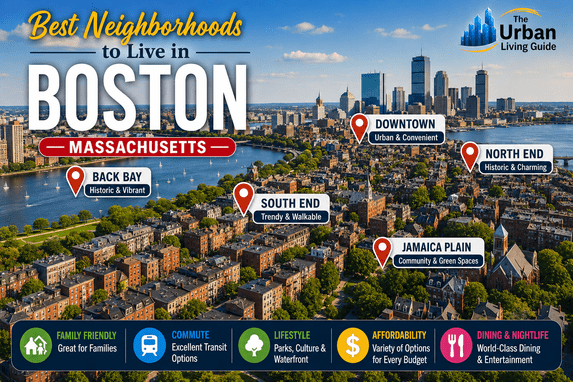
Best Neighborhoods in Boston, Massachusetts: Historic Triple-Deckers, Outer Belt Single-Families & Hub City Living in 2026
Covering approximately 48.4 square miles of land area across the Shawmut Peninsula and coastal embayments of Massachusetts Bay in Suffolk County, the incorporated municipality of Boston operates under the mayor-council municipal administration of the City of Boston. Housing an incorporated municipal core population exceeding 650,000 residents and anchoring New England’s primary economic, technological, and cultural metropolis of over 4.9 million people, the historic “Hub of the Universe” stands as an essential global center for biomedical research, higher education, financial services, and innovation.
Relocating across the Greater Boston area requires evaluating distinct municipal transit systems managed by the Massachusetts Bay Transportation Authority (MBTA) subway and commuter rail networks, historic preservation guidelines, and multi-modal highway arteries overseen by the Massachusetts Department of Transportation (MassDOT). Inbound movers consistently balance direct access to primary regional employers—including world-class medical institutions anchored by Mass General Brigham, Beth Israel Deaconess Medical Center, and Boston Children’s Hospital, major higher-education pillars such as Harvard University and MIT, and corporate financial headquarters—against daily travel across Interstate 93, Interstate 90 (Mass Pike), Storrow Drive, and Route 128, with international air travel via Boston Logan International Airport (BOS).
Take a virtual walking tour through the historic tree-lined residential corridors, triple-decker condo hubs, and distinctive neighborhoods of Boston, Massachusetts:
Key Residential Districts in Boston at a Glance in 2026
| Neighborhood | Location | Distance to Downtown Boston | Development Status | Transit Connectivity | Cost Level | Best Fit For |
|---|---|---|---|---|---|---|
| Jamaica Plain (Southwest Urban Core) | Emerald Necklace Corridor | ~4 mi southwest | Triple-Decker Condos & Parkside Living | Exceptional (MBTA Orange Line, Centre St) | High | First-Time Buyers, Young Professionals & Park Lovers |
| West Roxbury (Outer Southwest Belt) | Suburban City Edge | ~8 mi southwest | Single-Family Homes & Private Yards | High (Commuter Rail, Centre St) | High-to-Premium | Families, Single-Family Seekers & Competitors |
| Hyde Park (Quiet Outer South) | Southern City Boundary | ~9 mi south | Undervalued Single-Family & Rail Access | High (Fairmount Commuter Rail Line) | Mid-to-High | Value-Conscious Buyers & Smart Real Estate Investors |
| East Boston (Waterfront & Value Pockets) | Boston Harbor Eastern Peninsula | ~2 mi northeast (Across Harbor) | Waterfront High-Rises & Softened Condos | Exceptional (MBTA Blue Line, Airport Access) | Mid-Range | Negotiation Seekers, Commuters & Harbor View Fans |
| Dorchester (Diverse Central Corridor) | South-Central Urban Core | ~3 to 5 mi south | Historic Triple-Deckers & Deep Market Demand | Exceptional (MBTA Red Line, I-93) | Mid-to-High | First-Time Homebuyers & High-Liquidity Buyers |
Comprehensive Breakdown of the Best Neighborhoods in Boston
Jamaica Plain — Emerald Necklace Parks, Triple-Decker Condos & Vibrant Centre Street
Covering the expansive parkside residential territory situated southwest of downtown along the historic Emerald Necklace park system and Centre Street, Jamaica Plain (affectionately known as JP) is widely celebrated as one of Boston’s most dynamic, diverse, and high-liquidity urban neighborhoods. Operating under City of Boston municipal governance and supported by neighborhood business associations, the community blends historic green spaces with independent cafes.
The neighborhood is defined by grand Victorian homes, active triple-decker condo conversions, sparkling ponds at Jamaica Pond and Arnold Arboretum, and direct Orange Line transit access, delivering an exceptional walkable lifestyle for first-time buyers and professionals.
- Housing: Real estate inventory is anchored by highly active triple-decker condominium conversions priced between $500,000 and $800,000, alongside larger executive condos and historic homes ranging from $800,000 to $1,200,000+, closing with strong competitive demand.
- Safety & Crime Rate: Patrolled by the Boston Police Department District E-13 Command, maintaining reliable urban safety, community policing initiatives, and secure residential side streets.
- School District & Education Quality: Governed by Boston Public Schools (BPS), offering local neighborhood elementary options alongside access to competitive city-wide exam schools and private institutions.
- Walkability & Daily Conveniences: Outstanding pedestrian walkability (Walk Score exceeding 85/100 along Centre Street). Residents easily stroll to artisanal bakeries, craft breweries, local grocers, bookstores, and neighborhood health clinics.
- Parks & Green Spaces / Pet-Friendliness: Direct access to the world-renowned Arnold Arboretum, Jamaica Pond walking paths, and the linear greenways of the Emerald Necklace. Exceptionally pet-friendly for dog owners.
- Parking & Traffic Congestion: On-street residential parking permit restrictions apply; triple-decker properties frequently feature dedicated driveway or garage parking spaces. Centre Street experiences steady urban transit flow.
- Noise Levels & Vibe: Vibrant, progressive, and energetic, characterized by park joggers, outdoor patio diners, local artists, and academic professionals.
- Medical Facilities & Hospitals: Direct access via the Orange Line or short drives to the Longwood Medical Area, hosting world-class institutions like Brigham and Women’s Hospital and Boston Children’s Hospital.
- Transit Connectivity: Unrivaled public transit via multiple MBTA Orange Line stations (including Green Street and Forest Hills) and frequent local bus routes, offering a 15-minute ride straight into Downtown Boston.
- Affordability: Mid-to-high urban price tier; represents one of Boston’s deepest and most liquid buyer demand zones with strong future resale value.
- Who It’s Best For: First-time condo buyers, medical professionals, young couples, and park enthusiasts seeking deep market liquidity.
- Drawbacks: Highly competitive bidding conditions with properties frequently closing above asking price, and dense urban parking competition.
West Roxbury — Outer Suburban Belt, Single-Family Yards & Family Competition
Situated across the southwestern outer edge of the city limits along Centre Street and the Bellevue commuter rail corridor, West Roxbury represents Boston’s quintessential single-family suburban haven within city boundaries. Supported by municipal neighborhood services and active civic associations, the area provides a traditional residential atmosphere.
The neighborhood features detached single-family homes with private backyards, tree-lined streets, local commercial squares, and commuter rail convenience into South Station.
- Housing: Real estate stock is dominated by detached single-family colonial, cape, and ranch homes with private driveyards and yards. Purchase prices typically range from $800,000 to $1,200,000, ranking among the most competitive single-family zones in Boston proper.
- Safety & Crime Rate: Patrolled by the Boston Police Department District E-5 Command, consistently reporting some of the lowest crime statistics within the City of Boston proper.
- School District & Education Quality: Governed by Boston Public Schools, featuring local neighborhood elementary and middle schools alongside strong community engagement.
- Walkability & Daily Conveniences: Suburban residential design with pedestrian commercial pockets along Centre Street hosting local pharmacies, banks, family restaurants, and grocers.
- Parks & Green Spaces / Pet-Friendliness: Recreation is anchored by the massive Millennium Park (featuring walking trails, athletic fields, and panoramic hilltop views) and the West Roxbury Parkway greenbelts. Highly pet-friendly.
- Parking & Traffic Congestion: Plentiful private driveways, attached garages, and accessible street parking. Centre Street and Route 1 meet steady morning commuter volume heading toward the parkways.
- Noise Levels & Vibe: Quiet, peaceful, and family-oriented, characterized by children playing in backyards, neighborhood little leagues, and relaxed residential evenings.
- Medical Facilities & Hospitals: Convenient 10-minute drive to Faulkner Hospital and rapid access to the Longwood Medical Area via parkway arteries.
- Transit Connectivity: Excellent commuter rail integration via multiple MBTA Commuter Rail stations (West Roxbury and Bellevue) providing direct 20-minute train service into Back Bay and South Station.
- Affordability: High-tier urban-suburban pricing; commands significant buyer competition due to true single-family home scarcity within city borders.
- Who It’s Best For: Families needing actual backyards, single-family home buyers, medical professionals, and commuters wanting city services with suburban feel.
- Drawbacks: High bidding competition with homes frequently closing significantly over asking price, and distance from central nightlife.
Hyde Park — Quiet Outer South, Undervalued Homes & Smart Buyer Upside
Covering the southernmost residential valley of the city along the Fairmount commuter rail line and Cleary Square, Hyde Park is celebrated as Greater Boston’s smartest under-the-radar buying opportunity. Supported by City of Boston neighborhood revitalization initiatives, the area preserves classic New England character.
The neighborhood offers attainable single-family homes, actual private yards, municipal services, and rapid commuter rail access into downtown without the full price premium of its northern neighbors.
- Housing: Real estate stock features detached single-family homes, two-family properties, and classic New England colonials. Purchase prices sit at the more accessible end of the outer single-family belt, offering superior square footage per dollar.
- Safety & Crime Rate: Patrolled by the Boston Police Department District E-18 Command, maintaining stable community safety and active neighborhood watch involvement.
- School District & Education Quality: Governed by Boston Public Schools, offering local neighborhood educational options and community enrichment programs.
- Walkability & Daily Conveniences: Historic commercial town centers at Cleary Square and Logan Square host local diners, hardware stores, community banks, and essential retail outlets.
- Parks & Green Spaces / Pet-Friendliness: Recreation is anchored by the Neponset River Reservation, Stony Brook Reservation, and local athletic fields. Exceptionally pet-friendly.
- Parking & Traffic Congestion: Generous private driveways, multi-car garages, and easier street parking compared to inner-core Boston neighborhoods.
- Noise Levels & Vibe: Quiet, unpretentious, and community-focused, characterized by long-term residents, family parks, and peaceful residential streets.
- Medical Facilities & Hospitals: Fast access to local regional medical clinics and 15-minute drives to major Boston teaching hospitals.
- Transit Connectivity: Outstanding commuter rail access via the MBTA Fairmount Line, providing direct, reliable train service into downtown Boston stations.
- Affordability: Mid-to-high outer tier; provides relative value and price insulation compared to overheated adjacent enclaves like West Roxbury.
- Who It’s Best For: Value-conscious homebuyers, smart real estate investors, families wanting yards, and commuters seeking transit leverage.
- Drawbacks: Fewer high-end retail options and ongoing commercial corridor redevelopment phases.
East Boston — Harbor Waterfront Views, Softened Condos & Blue Line Access
Situated across Boston Harbor on the eastern peninsula easily viewed from downtown, East Boston (affectionately called Eastie) is celebrated as the city’s premier waterfront neighborhood for value-seeking buyers. Supported by the City of Boston and waterfront redevelopment planning, the district blends historic maritime roots with modern luxury harbor-view high-rises.
The neighborhood offers stunning panoramic skyline vistas from Piers Park, softened condominium pricing with negotiating leverage, and rapid Blue Line transit into the Financial District.
- Housing: Real estate stock spans luxury waterfront high-rise condominiums, converted industrial loft buildings, and multi-family triple-deckers. Sub-$800,000 condominiums have experienced market softening, giving active buyers meaningful negotiating leverage.
- Safety & Crime Rate: Patrolled by the Boston Police Department District A-7 Command, ensuring active community safety across waterfront and commercial residential blocks.
- School District & Education Quality: Governed by Boston Public Schools, providing neighborhood public options and community family centers.
- Walkability & Daily Conveniences: Exceptional urban walkability along Maverick Square and Meridian Street, hosting authentic international dining, coffee shops, and local markets.
- Parks & Green Spaces / Pet-Friendliness: World-class recreation anchored by Piers Park (offering unmatched harbor sailing views and green lawns) and the East Boston Greenway. Highly pet-friendly.
- Parking & Traffic Congestion: Street parking requires resident parking permits; modern waterfront developments provide secure structured garage parking. Tunnel access to downtown can experience rush-hour volume.
- Noise Levels & Vibe: Maritime, cosmopolitan, and fast-paced, characterized by international culinary culture, young professionals, and stunning harbor vistas.
- Medical Facilities & Hospitals: Direct access to local community health centers and fast MBTA Blue Line connection to Massachusetts General Hospital downtown.
- Transit Connectivity: Unrivaled public transit via multiple MBTA Blue Line stations (Maverick, Airport, Wood Island) delivering a 6-minute ride straight into downtown Boston.
- Affordability: Mid-range urban tier; stands out as one of the few Boston sectors where buyers retain negotiating leverage and lower asking-price ratios.
- Who It’s Best For: Negotiation-focused buyers, young professionals, harbor view enthusiasts, and airport-frequent flyers.
- Drawbacks: Aircraft overhead noise from Logan International Airport and tunnel traffic bottlenecks during peak commuting hours.
Dorchester — Historic Triple-Deckers, Red Line Access & Deep Market Demand
Covering the expansive south-central urban corridor of the city along the MBTA Red Line and Interstate 93, Dorchester (Boston’s largest neighborhood) is celebrated for its rich historical heritage, diverse cultural communities, and deep real estate market liquidity. Supported by municipal neighborhood services, the district offers vibrant urban living.
The neighborhood features iconic Victorian triple-decker architecture, bustling commercial squares, beautiful historic parks, and fast rapid-transit commuting into downtown and Cambridge.
- Housing: Real estate inventory is anchored by highly active triple-decker condo conversions priced between $500,000 and $800,000, alongside single-family homes and Victorian properties. This segment represents the single most active, liquid entry point in Boston proper.
- Safety & Crime Rate: Patrolled by the Boston Police Department District C-11 and B-3 Commands, maintaining active community policing and targeted neighborhood security programs.
- School District & Education Quality: Governed by Boston Public Schools, offering numerous neighborhood elementary and secondary educational facilities.
- Walkability & Daily Conveniences: Urban pedestrian infrastructure connecting residents to commercial plazas along Avenue Victor Hugo, Dot Ave, and local shopping hubs.
- Parks & Green Spaces / Pet-Friendliness: Recreation is anchored by the historic Franklin Park (designed by Frederick Law Olmsted), Savin Hill Park, and waterfront beaches at Malibu Beach. Exceptionally pet-friendly.
- Parking & Traffic Congestion: On-street parking permits apply; triple-decker properties often include driveway or off-street parking pads. Interstate 93 provides direct north-south highway access.
- Noise Levels & Vibe: Dynamic, culturally diverse, and energetic, characterized by community festivals, local neighborhood restaurants, and fast-paced urban activity.
- Medical Facilities & Hospitals: Convenient access via Red Line or short drives to major medical centers including Boston Medical Center and downtown teaching hospitals.
- Transit Connectivity: Outstanding rapid transit via multiple MBTA Red Line stations (Savin Hill, JFK/UMass, Fields Corner, Ashmont) providing direct commutes into downtown and MIT/Harvard in Cambridge.
- Affordability: Mid-to-high urban pricing tier; offers deep market liquidity ensuring exceptional resale demand when property disposition occurs.
- Who It’s Best For: First-time homebuyers, high-liquidity investors, young professionals, and buyers wanting direct Red Line transit access.
- Drawbacks: Highly competitive bidding environments for entry-level triple-deckers and variable pocket-by-pocket block conditions.
Neighborhood Evaluation: Weighing Living Merits and Shortfalls Across Boston
| Neighborhood | Core Advantages (Pros) | Core Limitations (Cons) |
|---|---|---|
| Jamaica Plain | Arnold Arboretum parks; active triple-decker condo market; Orange Line access. | Fierce bidding wars closing above asking; tight parking. |
| West Roxbury | True single-family homes with yards; commuter rail; low crime statistics. | Intense buyer competition; premium price tags ($800k+). |
| Hyde Park | Relative single-family affordability; Fairmount commuter rail line; smart buyer upside. | Fewer high-end retail corridors; transitional commercial pockets. |
| East Boston | Stunning Piers Park harbor views; Blue Line rapid transit; negotiating leverage on condos. | Logan Airport aircraft noise overhead; tunnel traffic bottlenecks. |
| Dorchester | Highest market liquidity; MBTA Red Line access; historic triple-decker charm. | Competitive entry-level pricing; variable block-by-block dynamics. |
Local Perspectives: What Area Residents Reveal About Living in Boston, Massachusetts
“Buying a triple-decker condo in Jamaica Plain gave us the ultimate Boston entry point. We can walk to the Arboretum every weekend and take the Orange Line straight to our jobs downtown.”
— Marcus Vance, Biomedical Researcher (Verified Local Contributor, Boston Community Forum)
“Moving to East Boston gave us incredible harbor views at Piers Park and a 6-minute Blue Line commute into the Financial District, plus actual room to negotiate on our condo price.”
— Sarah Jenkins, Financial Analyst (Verified Resident Review, Greater Boston Living Insights)
Matching Your Personal Lifestyle with the Right Hub City Community
Selecting your ideal community in Boston requires balancing your household budget with daily workplace destinations, school enrollment choices, and regional transportation logistics. Because Suffolk County is strictly framed by historic peninsulas and connected by MBTA transit corridors and major highways like Interstate 93 and the Mass Pike, your chosen location dictates whether your daily commute prioritizes triple-decker condos in Jamaica Plain, single-family yards in West Roxbury, smart buying upside in Hyde Park, harbor views in East Boston, or Red Line connectivity in Dorchester.
Medical professionals at Longwood Medical Area, biotech researchers, financial executives, and university scholars should evaluate regional transit routes to optimize daily convenience.
Beyond transportation corridors, evaluate essential municipal utility and building infrastructure realities. New England experiences harsh winter nor’easters and freezing temperatures alongside humid summers, making home heating efficiency and utility reliability through Eversource Energy and National Grid an essential consideration.
In addition, prospective homebuyers evaluating historic triple-deckers or older single-family homes should inspect roof integrity, knob-and-tube electrical wiring, and plumbing stacks. Before executing a residential lease or property purchase agreement, verify high-speed fiber broadband availability (such as Verizon Fios or Xfinity Gigabit) and confirm Boston Public Schools assignment tiers.
Essential Local Insights & FAQs for Boston, Massachusetts
Which neighborhood in Boston is considered best for first-time buyers looking for triple-decker condos?
Jamaica Plain and Dorchester are widely regarded as the most liquid and active entry points for triple-decker condominium ownership, offering vibrant community life and strong resale demand.
What is the top outer belt neighborhood for single-family homes with private yards?
West Roxbury provides traditional detached single-family colonial and cape homes with private yards and commuter rail access, ranking among the most competitive single-family zones in Boston proper.
Are there undervalued neighborhoods offering smart buying upside within city limits?
Yes, Hyde Park sits in the outer single-family belt, offering attainable home prices, actual yards, and commuter rail access without the full price premium of its neighbors.
What are the best waterfront neighborhoods offering negotiating leverage on condominiums?
East Boston features luxury harbor-view high-rises and softened sub-$800,000 condominium inventory, giving buyers meaningful negotiating leverage alongside rapid Blue Line transit.
How manageable is the daily commute into downtown Boston from the outer residential belts?
Commuting into downtown is highly efficient via the MBTA Orange, Red, and Blue subway lines, commuter rail corridors, and express buses, cutting transit times down to 15 to 25 minutes.
Which central corridor offers exceptional Red Line rapid transit connectivity?
Dorchester features multiple MBTA Red Line stations connecting residents directly to downtown Boston and Cambridge university hubs.
Is Boston an affordable place to live compared to national averages and suburban towns?
No, Boston’s overall cost of living and housing purchase prices are among the highest in the nation, significantly exceeding national averages, but justified by world-class medical centers, elite universities, and robust job markets.
Boston, Massachusetts Relocation Resources & Living Guides
Boston, Massachusetts Relocation Resources & Living Guides
Relocating to a historic economic and academic hub requires reliable local data on municipal transit, neighborhood safety, and housing markets. The Urban Living Guide provides comprehensive, data-backed community resources to help working professionals, families, and property investors make informed decisions when moving to major metropolitan areas.
Discover our in-depth guides for Boston and Suffolk County:
- Living in Boston, Massachusetts
- Cost of Living in Boston, Massachusetts
- Pros and Cons of Living in Boston, Massachusetts
Planning your upcoming move to the Hub of the Universe? Read our complete step-by-step moving strategy: Moving to Boston, Massachusetts.
Stay connected with The Urban Living Guide for continuous neighborhood spotlights, regional transit updates, and expert real estate analysis across Greater Boston and the commonwealth of Massachusetts.