

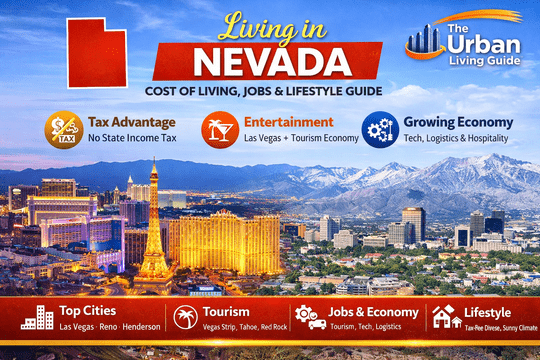
Living in Nevada: Tax Advantages, Desert Innovation & The Great Basin Lifestyle in 2026
Making your home in Nevada in 2026 means settling into a state defined by rapid transformation, geographic extremity, and a unique fiscal framework that has turned the “Silver State” into a magnet for professionals fleeing high-tax coastal regions. Spanning over 110,577 square miles, Nevada is a landscape of stark beauty, bounded by the jagged Sierra Nevada Mountains to the west and the arid, expansive Great Basin to the east.
As a long-term resident will tell you, the reality of living here is far more nuanced than the bright neon lights of Las Vegas might suggest. While southern Nevada offers a high-octane, sun-drenched urban life, the northern corridors near Reno and Lake Tahoe provide a tech-forward, high-altitude experience that is increasingly drawing engineers, researchers, and remote workers. Everyday life in the state is characterized by low tax burdens, a booming logistics and gaming economy, and a lifestyle that places a premium on outdoor autonomy and desert adaptability.
For official administrative guidelines, state tax filings, and civic resources, residents frequently consult the Official State of Nevada Portal.
| Quick Facts Snapshot: Nevada (2026) | |
|---|---|
| Time Zone | Pacific Time (PT / UTC-8, Daylight Saving UTC-7) |
| State Population | Approx. 3.2 Million (Major growth centered in Clark County) |
| State Income Tax | 0% (No state personal income tax) |
| Median Home Price | $380,000 – $550,000+ (Extreme variance between Las Vegas suburbs and rural northern basins) |
| Average Rent Range | $1,300 – $2,300+ per month (Dependent on strip proximity vs. outer suburbia) |
| Sales Tax Baseline | 6.85% state base, with local municipal additions pushing totals to 8.375% in major metros |
What It Is Really Like to Live Here (The Macro Reality & Cultural Identity)
Living in Nevada requires mastering a lifestyle governed by the desert environment, where efficient, climate-controlled urban design meets the absolute, silent power of the high desert. Locals quickly understand that day-to-day existence depends entirely on your ability to handle extremes—heat management during summer and the necessary preparation for high-desert winters in the north. The state’s culture is fundamentally built on a foundation of independence, a lack of intrusive state taxation, and a “24-hour city” mindset that permeates even the quietest residential neighborhoods.
Whether you are living in the master-planned suburbs of Henderson or the revitalized tech-district of downtown Reno, the cultural vibe is one of constant reinvention. Long-term residents value the personal freedom and financial retention that the zero-income-tax policy provides, even while acknowledging that local infrastructure and city services are managed under a system designed for high-density, tourism-heavy traffic. Explore regional recreation, heritage, and tourism guides via the Travel Nevada office.
- Cultural Vibe: A unique melting pot driven by the hospitality and gaming industry, a rugged Western frontier independence, and a rapidly expanding tech and data-center workforce that is diversifying the state’s traditional economy.
- Pace of Life: Varies significantly—ranging from the high-octane, neon-lit energy of the Las Vegas Strip and its surrounding commuter hubs, to the slow-paced, mountain-focused rhythm of Northern Nevada and Lake Tahoe.
- The Resident Trade-Off: Residents accept the lack of diverse, lush, forested landscapes in exchange for the financial benefit of keeping more of their paycheck, access to world-class entertainment, and proximity to diverse, massive-scale outdoor landscapes like Red Rock Canyon.
Regional Diversity, Geography & Economic Zones
Because Nevada sits at the heart of the Great Basin, its geography dictates everything from how houses are built to how the local economy functions.
Southern Nevada: The Urban & Tourism Engine
- Las Vegas & Henderson: The economic powerhouse, hosting the world’s highest density of hospitality and gaming venues, alongside an increasingly significant logistics and warehousing infrastructure that supports the entire Southwest.
- The Desert Basin: Characterized by the Mojave Desert ecosystem, requiring water-conscious xeriscaping and efficient cooling systems in every residential neighborhood.
Northern Nevada: The Tech & Mountain Hub
- Reno & Sparks: A distinct economic zone that has transitioned from a gaming-reliant city to a massive data-center and technology-manufacturing hub, leveraging its proximity to Silicon Valley without the prohibitive costs.
- The High Sierras: Areas bordering Lake Tahoe offer a distinct alpine climate, attracting affluent residents, outdoor athletes, and those seeking mountain-town living over desert heat.
Infrastructure, Power Grids, Water Systems & Transport Networks
Sustaining a booming population in the driest state in the nation requires sophisticated water rights management and a massive energy-production network.
Water Resources & Watersheds
- Colorado River Management: Nevada’s water security is tied to the Colorado River and Lake Mead. Residents are highly incentivized to utilize water-efficient landscaping through state programs. Learn more via the Nevada Division of Water Resources.
Power Generation & Energy Frameworks
- Grid Resiliency: Supplied by NV Energy, the state grid is aggressively integrating massive solar installations from the desert basins to meet the extreme power demands of residential air conditioning and data-center cooling.
Statewide Transit, Rail, Air & Port Connectivity
- Global Aviation: International travel is anchored by Harry Reid International Airport (LAS) in Las Vegas, one of the busiest in the country, alongside Reno-Tahoe International Airport (RNO).
- Transit Grid: RTC (Regional Transportation Commission) provides bus-based transit for Las Vegas, while inter-city movement relies on the critical North-South corridor of Interstate 15 (I-15).
Statewide Economy, Job Markets & Major Industries
Nevada has effectively moved beyond its “tourist-only” stigma, evolving into a center for technical manufacturing, advanced logistics, and large-scale data storage.
- Economic Footprint: Leveraging its geography to become a critical distribution node for the entire West Coast, with massive warehouse density in the Henderson and North Las Vegas areas.
- Dominant Sectors: Hospitality and entertainment, logistics/supply chain, advanced manufacturing (Tesla/Panasonic/Switch), and mining.
- Corporate Presence: Operational HQs for major entities like MGM Resorts, Caesars Entertainment, and massive investments from Tesla and Google (data centers). Track economic initiatives via the Nevada Governor’s Office of Economic Development.
Salary Realities Across Economic Corridors
- Metropolitan Potential: Technical roles in data centers, logistics management, and specialized engineering in the Reno-Sparks corridor often command salaries ranging from $85,000 to $135,000+.
- Regional Wage Variance: Traditional service and gaming wages remain the backbone of the Southern Nevada economy, providing reliable entry-level income, though they are subject to industry-specific market cycles.
Cost of Living Realities & Housing Market Variance
Living in Nevada offers an immediate fiscal advantage through the absence of state income tax, though rising housing demand in the metro cores has narrowed the margin of “extreme affordability” seen a decade ago.
| Expense Category | Cost Range / Index Reality |
|---|---|
| Housing (Urban vs. Suburban) | $1,600–$2,600+ monthly in Vegas/Henderson; $1,100–$1,600 in outlying rural hubs |
| Utilities | High peak summer costs due to consistent air conditioning usage |
| Transportation | Moderate; high reliance on personal vehicle ownership and fuel |
| Groceries & Goods | Standard national medians, influenced by desert logistics |
State Tax Climate, Business Environment & Government Policies
Nevada’s business-friendly policy is anchored by its “zero income tax” status, which provides residents with significantly higher take-home pay. Review compliance via the Nevada Department of Taxation.
- Fiscal Model: The state relies on sales and gaming taxes, creating a very transparent fiscal structure for individual earners.
- Property Taxes: Generally considered moderate to low compared to the Northeast or West Coast, though this can vary by county assessments.
Legal & Lifestyle Governance Quirks
- Vehicle Titling: Residents must transfer out-of-state driver’s licenses and register vehicles through the Nevada Department of Motor Vehicles (DMV) within 30 days of establishing residency.
- Public Records: The state maintains robust open-records laws ensuring transparency regarding agency documentation.
Climate, Weather Extremes & Natural Geography
Nevada features a dramatic, high-altitude desert climate that brings distinct seasonal shifts despite the arid baseline.
- Seasonal Variations: Southern deserts face extremely hot, dry summers and mild winters, while the northern mountains experience cold winters with significant snow.
- Environmental Realities: The “Dry Heat” is tempered by consistent low humidity, but wildfire mitigation is a necessary component of property and landscape management.
- Natural Landmarks: The towering red rock cliffs of Red Rock Canyon and the alpine glacial beauty of Lake Tahoe.
Insurance Cost Realities (Disaster & Weather Risks)
- Wildfire Preparedness: Homeowners insurance policies increasingly incorporate wildfire mitigation guidelines; residents in forested areas should prioritize “Fire-Smart” landscaping.
- Extreme Temperature Protection: Residential hardware (cooling systems/roofing) requires specific maintenance cycles to handle 110°F+ temperatures.
Education Systems & Major Healthcare Networks
Education and healthcare are rapidly expanding to match the state’s population growth. Explore public health data via the Nevada Department of Health and Human Services.
- Higher Education: Home to institutions like the University of Nevada, Las Vegas (UNLV) and University of Nevada, Reno (UNR).
- Advanced Healthcare: Elite networks like Sunrise Health System and the Renown Health system provide clinical care in the state’s primary metros.
Culture, Outdoor Recreation & Lifestyle Shifts
Daily life balances neon-lit entertainment with some of the best outdoor access in the West. Explore recreation via Nevada State Parks.
- Outdoor Living: Hiking in Red Rock Canyon, boating on Lake Mead, and enjoying the world-class alpine resorts near Lake Tahoe.
- Arts & Entertainment: Global dining, the Smith Center in Las Vegas, and a vibrant local art and event scene.
Relocation & State Residency Essentials
- DMV Licensing: New residents have 30 days to obtain a Nevada driver’s license.
- Voter Registration: Online registration is available via the Nevada Secretary of State office.
Major Counties and Rural Living Realities in Nevada
- Clark County: The massive, vibrant heart of the state’s economy and population.
- Washoe County: The Northern tech, data-center, and mountain-adjacent hub.
- Carson City: The historic capital offering stable administrative living.
Major Regional Hubs and Cities to Explore
Major Urban Hubs at a Glance
| City / Hub | Economic Driver | Vibe & Lifestyle Profile |
|---|---|---|
| Las Vegas | Tourism, Gaming | Fast-paced, vibrant, world-famous |
| Reno | Tech, Manufacturing | Resilient, outdoor-accessible, tech-focused |
| Henderson | Corporate, Suburban | Family-oriented, high-end, manicured |
| North Las Vegas | Logistics | Affordable, fast-growing, logistic-hub |
| Carson City | Gov | Historic, stable, community-driven |
Detailed Breakdown of Key Regional Hubs
Las Vegas — The Global Entertainment Epicenter
As the ultimate urban center of the Southwest, Las Vegas is defined by its scale, cultural diversity, and relentless 24-hour economy. It offers a unique residential experience with incredible access to high-end amenities and sports culture.
Reno — The “Biggest Little City” Tech Hub
Reno has successfully transitioned into a key technology and logistics hub. It offers a more balanced, outdoor-adjacent lifestyle than Las Vegas, with immediate access to Lake Tahoe and the Sierra Nevada mountains.
Henderson — The Suburban Lifestyle Choice
Henderson is the premier suburban choice for families, offering master-planned communities, high-quality public services, and close proximity to the Las Vegas entertainment corridor.
North Las Vegas — The Distribution Gateway
A rapidly developing hub for logistics and warehouse management, North Las Vegas provides affordability for families and young professionals seeking proximity to major employment nodes.
Carson City — The Historic Administrative Anchor
Sitting in the shadows of the Sierras, Carson City provides a quiet, historic, and stable environment, serving as the administrative and political heart of Nevada.
Pros and Cons of Making Nevada Your Home
| Advantages (Pros) | Systemic Drawbacks (Cons) |
|---|---|
| Zero state personal income tax | Extremely hot desert summers |
| Lower housing costs than West Coast neighbors | Heavy reliance on car transportation |
| Access to world-class entertainment and arts | Tourism-based economy can be cyclical |
| Year-round sunshine and low humidity | Long-term desert water scarcity risks |
| Business-friendly tax environment | Limited urban transit infrastructure |
Frequently Asked Questions About Living in Nevada
Is Nevada a good state to live in?
Yes, especially if you prioritize high disposable income due to the lack of state income tax, access to desert and mountain recreation, and the cultural amenities of a major tourist hub.
What is the actual cost of living in Nevada?
It is moderate by national standards. While housing prices have escalated in Las Vegas and Reno, the overall tax structure provides significant relief compared to states like California.
Which region or city is best to settle down in?
It depends on your career path: Las Vegas for the hospitality/entertainment industry, Reno for tech and mountain access, and Henderson for family-oriented suburban living.
Does Nevada have high taxes?
Nevada has a highly competitive tax environment with zero state personal income tax, though municipal sales taxes vary by region.
How safe is everyday life across the state?
Safety is high in master-planned communities and smaller regional hubs; as with any major metro state, urban zones require standard metropolitan awareness.
What industries dominate Nevada’s job market?
Tourism and gaming are foundations, but there is explosive growth in logistics, data center technology, healthcare diagnostics, and aerospace manufacturing.
What is the weather like?
The climate is predominantly arid. Southern Nevada experiences very high summer temperatures and mild winters, while the northern part of the state features a four-season climate with colder winters.
Explore Detailed City Guides Across Nevada
At The Urban Living Guide (TULG), our core mission is to provide deeply researched regional insights and city-level navigation tools to help you evaluate your relocation options with total confidence. To discover what daily life, housing patterns, and local economies look like across our featured municipal centers throughout the Silver State, explore our comprehensive resident hub guides below:
- Living in Las Vegas, Nevada
- Living in Reno, Nevada
- Living in Henderson, Nevada
- Living in Carson City, Nevada
- Living in North Las Vegas, Nevada
Whether you are comparing career prospects in the global entertainment sector or evaluating lifestyle shifts in the high-desert mountains, our editorial team remains dedicated to delivering research-backed, data-driven frameworks to support your relocation and residency decisions with complete clarity.